This site is supported by our readers. We may earn a commission, at no cost to you, if you purchase through links.
Most men blaming genetics for a patchy beard are looking in the wrong place. Research consistently shows that nutritional deficiencies affecting beard growth are among the most correctable—and most overlooked—factors in follicle performance.
Your hair follicles are metabolically active structures demanding a steady supply of protein, micronutrients, and hormonal raw materials. Starve them of zinc, iron, or vitamin D, and the follicle cycle stalls before it ever reaches its potential.
The good news: what nutrition depletes, nutrition can restore. Understanding exactly which deficiencies matter—and how to correct them—puts the outcome back in your hands.
Table Of Contents
- Key Takeaways
- How Nutrition Influences Beard Growth
- Key Nutritional Deficiencies Impairing Beard Growth
- Vital Vitamins and Minerals for Beard Health
- Signs, Symptoms, and Diagnosis of Deficiencies
- Addressing Deficiencies for Optimal Beard Growth
- Frequently Asked Questions (FAQs)
- What foods are bad for beard growth?
- What vitamins help beard growth?
- Does vitamin deficiency affect beard growth?
- Can stress permanently damage beard growth potential?
- Does beard growth slow with age naturally?
- How does sleep quality affect facial hair?
- Can genetics override good nutritional habits?
- Do topical products help nutrient-deficient beards?
- Conclusion
Key Takeaways
- Most patchy beard growth traces back to correctable nutritional gaps—zinc, iron, vitamin D, and protein—not genetics, and targeted dietary changes can restore follicle function within months.
- Low ferritin triggers beard shedding well before clinical anemia appears, making early blood testing a smarter move than waiting for obvious symptoms.
- Vitamins D and B-complex, alongside trace minerals like selenium and copper, each operate through distinct biological pathways, so broad-spectrum deficiency correction outperforms single-nutrient supplementation.
- Even a precise nutrition protocol fails without consistent sleep, stress management, and regular exercise, since cortisol elevation and poor hormonal rhythms directly suppress follicle activity.
How Nutrition Influences Beard Growth
Your beard doesn’t grow in a vacuum — it’s built from what you eat, absorbed through pathways your body runs on daily. Nutrition shapes everything from follicle strength to hair density, and the gaps in your diet show up on your face.
Protein is especially critical — your follicles literally can’t build hair without it, so it’s worth understanding how protein intake directly drives beard development.
Here’s how it all works.
The Science Behind Hair Follicle Function
Your beard starts deep in the dermis, where each hair follicle operates as a self-contained production unit. At its center sits the dermal papilla — a cluster of cells that controls hair growth by directing matrix keratinocytes to divide, harden, and form the shaft.
This follicle cycle repeats throughout your life, and nutritional deficiencies can interrupt it at any stage, stalling beard development entirely.
Nutritional Pathways Affecting Beard Development
Once the follicle is primed, what you eat determines whether it thrives or stalls.
Three pathways drive beard growth: Androgen Support from saturated fats, zinc, and selenium; IGF-1 Signaling from balanced protein and carbohydrate intake; and Sebum Regulation via omega-3 fats.
Nutritional deficiencies disrupt hormonal balance and nutrient absorption at the hair follicle level, quietly shutting down growth before you notice.
Dietary Impact on Beard Thickness and Density
What you eat directly controls keratin production, oxygen delivery to follicles, and follicle inflammation — three factors that determine whether your beard grows thick or patchy.
Low protein, iron, or essential fats don’t just slow beard growth; they shrink hair shaft diameter over time.
Nutrient synergy matters: no single food fixes everything. Consistent, varied nutrition is what separates a full beard from a frustrating one.
Key Nutritional Deficiencies Impairing Beard Growth

Your beard doesn’t grow in a vacuum — it runs on raw materials your body either has or doesn’t. Several specific deficiencies are known to stall follicle activity, reduce density, and compromise overall beard quality. Here’s where most men fall short.
Protein Deficiency and Follicle Health
Your hair follicles are protein factories — and keratin structure depends entirely on a steady amino acid supply. Cut protein intake, and follicle matrix cells slow their division rate, producing finer, weaker strands that snap before reaching length.
Foods like eggs and liver give your follicles the biotin they need — check out these home remedies for hair growth to see how small dietary shifts can make a real difference.
Three consequences you can’t ignore:
- Reduced keratin synthesis thins beard density noticeably
- Follicles shift into resting phase, increasing shedding
- Nutrient absorption gaps worsen outcomes on low-protein diets
Iron and Ferritin Levels
Oxygen is the unsung engine of beard growth. When iron intake drops, your red blood cells can’t deliver enough oxygen to follicles, slowing hair growth at the cellular level. Critically, low ferritin — your iron storage marker — triggers shedding before full anemia sets in. Don’t wait for a diagnosis; ferritin testing catches the problem early.
Low ferritin triggers beard shedding long before anemia sets in — test early
| Iron Source | Type | Bioavailability |
|---|---|---|
| Red meat | Heme | High |
| Fatty fish | Heme | High |
| Lentils | Non-heme | Low |
| Spinach | Non-heme | Low |
| Fortified cereals | Non-heme | Low |
Addressing these nutrient deficiencies directly fosters stronger, denser beard growth.
Zinc and Magnesium Roles
Zinc and magnesium are the unsung architects of beard growth. Zinc absorption directly promotes testosterone production — and without adequate levels, that hormonal regulation falters, slowing growth and weakening hair structure.
Phytate-rich diets can sabotage mineral balance by blocking zinc uptake. Magnesium benefits extend to stress response and sleep quality, both critical for follicle repair. Don’t underestimate these nutrient interactions — deficiencies here quietly dismantle your beard’s potential.
Essential Fatty Acids and Beard Quality
Fatty acid balance is the foundation your beard’s skin environment depends on. When omega-3 fatty acids drop too low — think an omega-3 index below 8 percent — your healthy skin barrier breaks down, triggering inflammation that suppresses follicle activity.
Omega-3 benefits extend to pigmentation too; deficiency can dull and shed beard hair prematurely. Fatty acid deficiency also makes strands brittle. Fatty fish, seeds, and quality beard oil supplements close that gap fast.
Vital Vitamins and Minerals for Beard Health
Getting enough protein, iron, and zinc matters — but specific vitamins and minerals do the heavy lifting in terms of actual follicle function and beard quality. Each one works through a distinct biological pathway, and knowing which does what puts you in control of the process. Here’s what your beard actually needs.
Biotin and B-Vitamins

Biotin is the backbone of keratin production — without it, your beard hairs grow brittle and break before they reach their potential. Your B Complex vitamins, particularly Vitamin B12 and folate supplements, drive red blood cell formation that delivers oxygen directly to each follicle.
Deficiency shows up fast:
- Thin, snapping strands despite normal testosterone
- Patchy growth from starved follicle clusters
- Dull texture signaling weakened keratin structure
Most supplementation protocols target 2,500–5,000 mcg of biotin daily alongside full-spectrum vitamin B nutrients from eggs, liver, and legumes.
Vitamin D and Hormonal Regulation

Few nutrients shape beard density as directly as vitamin D. Low vitamin D levels push follicles into extended rest, disrupting regrowth patterns and leaving coverage thin. This vitamin also promotes hormone balance, influencing testosterone and DHT pathways that drive follicle stimulation.
Target 2,000–5,000 IU daily, confirmed by 25-hydroxy testing.
| Vitamin D Level | Follicle Impact | Recommended Action |
|---|---|---|
| Below 20 ng/mL | Resting phase dominates | Supplement immediately |
| 20–40 ng/mL | Moderate hormonal balance | Enhance through diet |
| Above 40 ng/mL | Active follicle stimulation | Maintain current intake |
Vitamin E and Antioxidant Protection
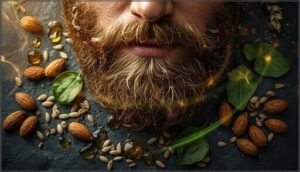
Oxidative stress is silently degrading your beard follicles right now. Free radical damage weakens cell membranes, disrupting hair growth at the structural level. Vitamin E‘s antioxidant properties intercept that damage directly.
Three Vitamin E benefits driving Beard Health Optimization:
- Shields follicle membranes from oxidative stress
- Improves local circulation when applied topically
- Reinforces collagen integrity around the follicle base
Nutrition-first always — nuts, seeds, and leafy greens deliver it consistently.
Selenium, Copper, and Trace Elements
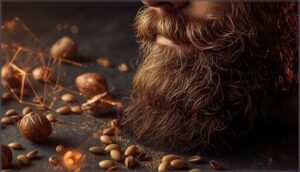
Beyond vitamin E, mineral balance becomes the next layer of beard defense. Selenium — your follicle’s antioxidant role partner — works alongside vitamin E to neutralize oxidative damage, but stay near 55 micrograms daily; excess selenium actually triggers loss. Copper intake facilitates collagen cross-linking, anchoring each strand firmly. These trace element nutrients are non-negotiable dietary connections — small gaps, visible consequences.
Signs, Symptoms, and Diagnosis of Deficiencies

Your body doesn’t stay quiet when something’s off — it sends signals, and your beard is often the first to broadcast them. Knowing what to look for puts you in control before the problem compounds. Here’s what a nutritional deficiency actually looks like in practice.
Recognizing Poor Beard Growth Patterns
Recognizing the early warning signs of nutritional deficiencies in your beard growth stages can save you months of frustration. Patchy beard development — particularly thinner cheek coverage while the chin and mustache fill in normally — is a classic signal that your follicles aren’t getting what they need.
Facial hair loss and beard shedding that leaves a once-dense beard noticeably sparse over three to six months often points to iron, protein, or zinc gaps. Poor hair regrowth patterns, where hair follicle health declines and terminal hairs miniaturize into fine, wispy strands, confirm that nutrient deficiencies are actively compromising your beard growth.
Associated Skin and Hair Changes
Your beard doesn’t suffer alone — your skin and scalp send distress signals right alongside it. Nutritional deficiencies that compromise follicle health and keratin production often surface as a cluster of symptoms:
- Skin irritation, flaking, or dermatitis along the jawline and beard zone — classic signs of zinc or biotin shortfalls
- Rough, straw-like hair texture from weakened hair structure due to protein or zinc gaps
- Increased beard shedding alongside scalp issues like diffuse thinning
- Brittle nails and cracked mouth corners confirming systemic deficiency, not just localized hair follicle health decline
Addressing Deficiencies for Optimal Beard Growth
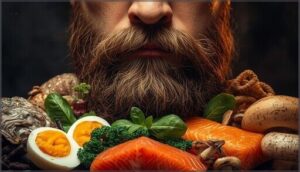
Knowing you have a deficiency is only half the battle — what you do next is what actually moves the needle.
The good news is that correcting these gaps follows a clear, actionable path. Here’s exactly what to focus on.
Diet Strategies for Correction
Your diet is the first lever to pull. Target 0.8 grams of protein per kilogram of bodyweight daily — spread across meals, not front-loaded at dinner.
Pair iron-rich foods like spinach or beans with vitamin C to sharpen absorption. Add fatty fish twice weekly and use olive oil as your default cooking fat.
Sound nutrition alone corrects most deficiencies.
Supplementation Best Practices
When food alone isn’t enough, strategic supplements fill the gap — but only strategically. Start with a quality multivitamin as your foundation, then layer in targeted additions: 15 to 30 mg zinc, 1,000 to 2,000 IU vitamin D, and 1 to 3 mg copper to maintain healthy mineral ratios.
Always take zinc with food. Lab work first, supplements second.
Monitoring Progress and Beard Improvement
Tracking real beard growth after correcting nutritional deficiencies requires a system, not guesswork. Photograph your beard every two to four weeks using consistent lighting and angles, then build monthly side-by-side comparisons to spot genuine density gains.
Measure length at fixed points, note hair texture shifts, and log nutrition changes in a dated journal — so you connect supplementation adjustments directly to visible improvement.
Lifestyle Factors Supporting Nutritional Gains
Even the most precise nutrition protocol will fall short if your lifestyle works against it.
Sleep patterns matter more than most men realize — consistent, quality sleep triggers growth hormone release and enhances testosterone rhythms that drive hair growth. Pair that with stress management, regular exercise, and a balanced diet, and you create conditions where healthy habits and sound dietary habits finally let your follicles perform.
Frequently Asked Questions (FAQs)
What foods are bad for beard growth?
Sugary drinks, refined grains, fried snacks, and processed foods are the biggest offenders.
Excess sugar, unhealthy fats, and alcohol consumption all disrupt hormones and inflame follicles — key foods that hinder beard growth.
What vitamins help beard growth?
Biotin, vitamin D, vitamin C, and B vitamins are your core vitamins for facial hair health. They support keratin production, follicle regulation, collagen synthesis, and the hair growth cycle from root to tip.
Does vitamin deficiency affect beard growth?
Yes, vitamin deficiency affects beard growth. Low vitamin D, biotin, and other nutrients push follicles into resting phases, weakening shaft diameter and density.
Correcting nutritional deficiencies restores healthier growth cycles over months.
Can stress permanently damage beard growth potential?
As the old saying goes, stress kills — and your beard isn’t immune. Chronic cortisol elevation triggers telogen effluvium, oxidative stress, and follicle damage.
But permanent beard growth loss is rare if stress is managed early.
Does beard growth slow with age naturally?
Beard growth does slow naturally with aging.
Hormone Decline, Follicle Miniaturization, and Reduced Circulation all contribute — testosterone drops roughly 1% yearly after 30, gradually weakening follicle output, though genetics determine how dramatically this affects you.
How does sleep quality affect facial hair?
Skipping sleep isn’t just tiring — it quietly strangles beard density. Poor sleep spikes cortisol, disrupts hormonal fluctuations, and stalls facial hair growth by pushing follicles into rest phases overnight.
Can genetics override good nutritional habits?
Genetic limits set the ceiling. No matter how clean your diet is, follicle sensitivity — shaped by inherited patterns and ethnic variations — determines how your beard ultimately reacts to hormone balance.
Do topical products help nutrient-deficient beards?
Topical products can stimulate follicles and improve beard growth, but they can’t fix nutrient deficiencies from within. Minoxidil effects boost density; skin penetration limits mean real repair requires internal supplementation.
Conclusion
Think of your follicles like a construction crew with no materials—motivated, ready, but completely stalled. The nutritional deficiencies affecting beard growth work exactly that way: the biological machinery exists, but without adequate zinc, iron, vitamin D, and protein, nothing gets built.
You now know what’s missing and how to fix it. Test your levels, correct the gaps, and give your follicles what they’ve been waiting for. The crew’s ready—stock the supply line.
- https://capilarhaircenter.com/blog/does-lack-of-protein-cause-hair-loss-hair-health-advice/
- https://pmc.ncbi.nlm.nih.gov/articles/PMC8759975/
- https://driphydration.com/blog/8-vitamins-for-beard-growth/
- https://livebearded.com/blogs/do-better/the-important-vitamins-that-fuel-beard-growth
- https://www.treasuringtresses.com/blog/unlocking-the-secrets-to-hair-growth-how-dht-iron-and-vitamin-d-imbalances-cause-hair-lossand-how-to-fix-them