This site is supported by our readers. We may earn a commission, at no cost to you, if you purchase through links. This content is for general informational and educational purposes only and is not a substitute for professional medical, dermatological, or nutritional advice.
Walk down any beauty aisle and you’ll find castor oil and coconut oil sitting side by side, each promising thicker, longer, healthier hair. One’s thick as molasses, the other pours like water—and that difference alone tells you they work in completely different ways.
A systematic review of 22 studies found coconut oil reduced hair breakage by nearly 42%, while separate trials showed castor oil users saw roughly 48% faster growth after 90 days. Two oils, two distinct mechanisms, two different problems they solve best.
Knowing which one your hair actually needs can be the difference between real results and a greasy disappointment.
Table Of Contents
- Key Takeaways
- Castor Oil Vs. Coconut Oil
- Coconut Oil Better Prevents Breakage
- Castor Oil May Support Scalp Health
- Best Oil for Your Hair Type
- How to Use Both Oils
- Frequently Asked Questions (FAQs)
- Which is better castor oil or coconut oil?
- Does castor oil promote hair growth?
- Does coconut oil promote hair growth?
- What are the benefits of castor oil & coconut oil?
- How to mix castor oil with coconut oil?
- What’s the best oil for hair growth?
- Does castor oil really regrow hair?
- Will my hair grow faster with castor oil?
- What oil is best for hair growth?
- Which oil is better than castor oil for hair?
- Conclusion
Key Takeaways
- Coconut oil penetrates the hair shaft and binds to keratin, cutting breakage by over 40% — making it the stronger pick if your main concern is keeping the hair you already have.
- Castor oil’s ricinoleic acid works on the scalp by boosting circulation and sealing in moisture, which is why it suits dry, curly, or coily hair better than fine or oily types.
- Neither oil regrows hair where follicles have stopped working — what looks like "faster growth" is really just less breakage and better length retention over time.
- Your hair type is the deciding factor: reach for coconut oil on fine or straight hair, castor oil on thick or textured hair, and blend both if you want to cover conditioning and scalp health at once.
Castor Oil Vs. Coconut Oil
Both oils have real benefits, but they work in very different ways. Understanding what sets them apart will help you choose the right one for your hair. Here’s what you need to know before deciding.
A closer look at argan oil vs. jojoba oil for hair breaks down exactly how each one behaves on different hair types.
Key Fatty Acid Differences
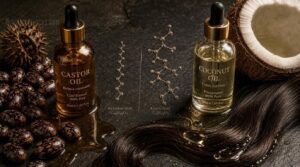
These two oils work differently because their key fatty acids are built differently.
Coconut oil runs on lauric acid — a 12-carbon saturated fat with no double bonds and no extra groups attached. That straight, uniform shape is part of what makes it so effective internally.
Castor oil is dominated by ricinoleic acid, an 18-carbon chain with both a double bond and a hydroxyl group. That hydroxyl changes everything — it increases polarity, alters how the oil sits on your hair surface, and gives castor oil its distinctly different behavior compared to coconut oil’s largely saturated, medium-chain fatty acid profile.
Understanding the difference between saturated vs unsaturated fats helps explain why their textures and effects vary.
| Property | Coconut Oil | Castor Oil |
|---|---|---|
| Main Fatty Acid | Lauric acid | Ricinoleic acid |
| Chain Length | 12-carbon (medium) | 18-carbon (long) |
| Saturation | Saturated | Monounsaturated + hydroxyl |
Texture and Absorption
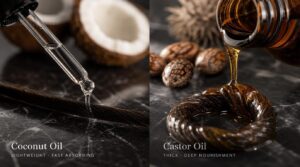
Knowing what’s in each oil is one thing — feeling the difference in your hands is another.
Coconut oil absorbs quickly. Its lightweight lauric acid chain slips into the hair shaft with ease, reaching the cortex where it binds to keratin. That’s why it feels clean rather than greasy after application.
Castor oil behaves the opposite way. Its thick, syrupy texture forms a viscous oil layer that sits on the surface. It doesn’t penetrate deep — instead, it coats each strand, locking in moisture and adding slip.
| Feature | Coconut Oil | Castor Oil |
|---|---|---|
| Consistency | Light, fluid | Thick, syrupy |
| Oil Film Thickness | Thin, even | Heavy, surface-level |
| Cuticle Openness needed | Low | Higher porosity helps |
| Moisture Retention style | Internal binding | External sealing |
| Scalp Lubrication feel | Absorbs quickly | Slow, coating feel |
Neither texture is better outright. Your hair type determines which one actually works for you.
Best Hair Types
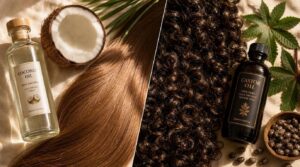
Your texture tells you which oil to reach for.
Coconut oil suits fine, straight, or wavy hair best. Its lightweight consistency won’t weigh strands down, and it penetrates the shaft to reduce breakage without leaving residue.
Castor oil works better for curly, coily, or thick hair — textures that need a heavier coating to seal moisture and soften dense, tightly coiled strands.
| Hair Type | Best Oil |
|---|---|
| Fine / Straight / Wavy | Coconut oil |
| Curly / Coily / Thick | Castor oil |
Growth Versus Conditioning
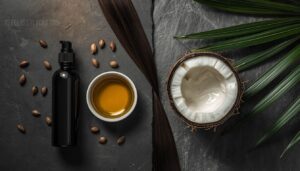
Choosing the right oil comes down to what you actually want from it. Growth vs conditioning is the real distinction here.
Coconut oil excels at conditioning benefits — it penetrates the shaft, binds to keratin, and cuts breakage. Castor oil’s ricinoleic acid stimulates hair follicles, offering modest growth potential. Neither replaces follicle biology, but both protect what you already have.
Castor oil’s thick consistency also locks in moisture at the cuticle level, making it especially valuable for retaining hydration in 4C hair.
| Goal | Best Oil | Key Benefit |
|---|---|---|
| Reduce breakage | Coconut oil | Keratin binding |
| Scalp stimulation | Castor oil | Ricinoleic acid |
| Moisture retention | Castor oil | Humectant effect |
Quick Comparison Table
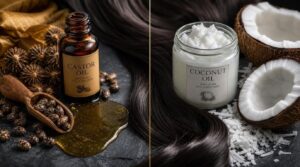
Here’s a quick side-by-side to help you decide.
| Feature | Castor Oil | Coconut Oil |
|---|---|---|
| Fatty acids | Ricinoleic acid (~90%) | Lauric acid (~45–53%) |
| Texture | Thick, slow-spreading film | Light; solid below 76°F |
| Best for | Dry scalps, strand coating | Conditioning, breakage prevention |
Both oils carry real hair benefits — just different ones.
Coconut Oil Better Prevents Breakage
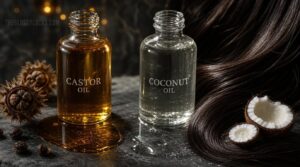
Regarding actually keeping your hair on your head, coconut oil has the stronger track record. The science points to some real, measurable benefits — and they go beyond just making your strands look shiny. Here’s what the research shows.
Stronger Evidence for Hair Health
When considering clinical evidence, coconut oil pulls ahead. A systematic review covering 22 studies found that coconut oil trials — involving 370 participants — showed a 41.8% reduction in hair breakage.
That’s not a small number.
Castor oil studies, by comparison, reported modest luster improvements, but no statistically significant hair health gains. The research simply favors coconut oil here.
Reduces Protein Loss
Coconut oil’s Oil Penetration Depth is what sets it apart. Its lightweight lauric acid chain slips through the cuticle and binds directly to keratin fibers — that’s Keratin Binding Action working from the inside out.
This internal bond reduces protein loss during washing, limits swelling damage, and promotes real hair strengthening.
Castor oil stays on the surface; coconut oil actually gets in.
Helps Dry, Brittle Hair
Dry, brittle hair is fundamentally thirsty hair — and coconut oil speaks its language. Its cuticle smoothing action flattens the raised outer layer, while its moisture locking film slows dehydration between washes.
- Deep conditioning from within reduces that straw-like stiffness
- Friction reduction makes detangling gentler on fragile strands
- Elasticity boost helps hair bend without snapping
Supports Length Retention
Length retention is really just breakage prevention in disguise. Every strand that doesn’t snap is a strand that keeps growing.
Coconut oil’s keratin-binding action reduces protein loss during washing, meaning your hair stays structurally stronger over time. Better detangling slip means fewer breaks during brushing — and fewer breaks mean you actually hold onto the length you’ve worked to grow.
Not a Baldness Cure
Here’s the truth that no oil brand wants to print on the label: coconut oil can’t cure baldness, and neither can castor oil. Both oils work on the hair shaft, not the follicle.
No oil can cure baldness — coconut and castor both work on the shaft, not the follicle
Androgenetic alopecia involves follicle miniaturization that topical oils simply can’t reverse. Retaining more strands through less breakage isn’t regrowth — it just looks that way.
Castor Oil May Support Scalp Health
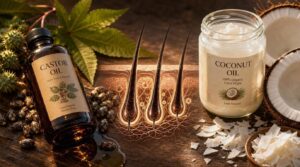
Castor oil’s real strength isn’t just what it does to your hair strands — it’s what it does for your scalp. The ricinoleic acid in it works in some surprisingly practical ways that go beyond simple moisture. Here’s a closer look at what castor oil actually brings to the table.
Ricinoleic Acid Benefits
What makes castor oil stand out is its ricinoleic acid content — nearly 90% of its fatty acid profile.
This rare compound activates prostaglandin E2 receptors in your scalp, widening blood vessels and improving nutrient delivery to hair follicles.
It’s also a humectant, drawing moisture directly to scalp tissue, while its anti-inflammatory and antimicrobial properties help keep irritation and scalp infections in check.
Thick Moisture Barrier
Castor oil’s thick consistency does more than sit on the surface — it forms an occlusive layer that slows moisture escaping from your hair shaft. Think of it as a slow-release seal.
That barrier persistence means strands stay hydrated longer between washes, especially when you dilute it with a lighter carrier oil to improve even surface coverage.
Scalp Massage Benefits
Applying castor oil becomes even more effective when you pair it with a proper scalp massage. The act itself isn’t just relaxing — it delivers real, measurable benefits:
- Better nutrient delivery to follicles through increased blood flow
- Lower stress levels linked to reduced cortisol
- Improved hair density after consistent weekly sessions
- Relaxed scalp tissue that absorbs castor oil more readily
Building a regular massage habit alongside your oil routine promotes scalp health from the inside out.
Luster and Softness
When you massage castor oil into your scalp, it doesn’t stop working at the roots. It coats each strand with a thick surface film that smooths the cuticle and reflects light more evenly — giving hair a noticeable hair luster boost.
That coating also reduces friction between strands, which is where the softness enhancement really comes from.
Growth Claims Explained
So, does castor oil actually grow hair — or just make it look better?
Here’s what clinical studies actually show:
- A 90-day trial found hair growth acceleration of ~48% with castor oil, but sample sizes were small
- No study confirms it regenerates follicles lost to androgenetic alopecia
- Benefits are largely linked to scalp circulation impact via ricinoleic acid
- Most gains reflect retention, not faster follicle cycling
Best Oil for Your Hair Type
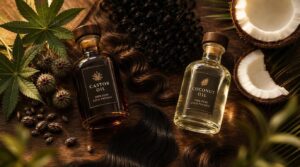
Not every oil works the same way for every hair type, and that matters more than most people realize. What helps curly hair thrive might weigh fine hair down or make an oily scalp worse. Here’s how to figure out which oil actually fits yours.
Dry or Damaged Hair
If your hair feels rough, snaps easily, or looks dull no matter what you do, both oils can help — but in different ways.
Coconut oil penetrates the shaft and binds to keratin, which directly reduces protein loss and improves hair elasticity. That makes it the stronger pick for hair breakage and split end treatment.
Dry hair benefits most from coconut oil’s ability to limit moisture loss from within, while castor oil works as a thick moisture barrier on the surface — useful for environmental damage protection on already-fragile strands.
| Hair Concern | Best Oil |
|---|---|
| Protein loss & breakage | Coconut oil |
| Scalp dryness | Castor oil |
| Split ends | Coconut oil |
| Surface moisture barrier | Castor oil |
A simple hair mask — equal parts both oils — covers both needs at once.
Curly or Textured Hair
Curly and textured hair is often the thirstiest hair type — and both oils earn their place in your routine.
Here’s why it matters:
- Curls lose moisture faster because sebum can’t travel easily down a spiraled shaft.
- Dry curls snap during detangling, quietly undoing weeks of growth.
- Frizz and breakage together are the biggest enemies of length retention.
Coconut oil penetrates the cuticle and binds to keratin, reducing protein loss and keeping curls flexible — especially important for high-porosity textures that absorb and release moisture quickly. It also enhances curl definition by strengthening strands from within.
Castor oil seals the surface, locking in that moisture coconut oil delivers. Its thick barrier limits frizz by reducing how much humidity your strands absorb. For tight coils or coarse textures, it adds softness and visible shine.
Used together, they cover every layer — inside and out.
Fine or Oily Hair
Fine hair is the one type where less is more with oils. Both castor and coconut oil can weigh it down fast, leaving roots looking greasy before midday.
If your scalp runs oily, skip castor oil entirely — its thickness builds up quickly. A tiny amount of coconut oil on mid-lengths only, avoiding roots, gives lightweight conditioning without flattening your strands.
Dandruff-prone Scalp
Dandruff is tricky — it’s not just dryness; it’s often driven by scalp yeast overgrowth. Castor oil’s antifungal and anti-inflammatory properties help control Malassezia and calm irritation.
Coconut oil’s lauric acid also fights yeast, but it can backfire on seborrheic dermatitis‑prone scalps by feeding the problem. Stick with castor oil here for itch relief and flake reduction.
Sensitive Skin Concerns
Sensitive skin doesn’t follow rules — what works for everyone else may sting, redden, or inflame your scalp. Castor oil is generally the safer pick here, but always do a patch test first since ricinoleic acid can trigger allergic reactions in some people.
Coconut oil is usually well-tolerated, though fragranced formulas can irritate barrier-compromised skin.
Keep it simple and unrefined.
How to Use Both Oils
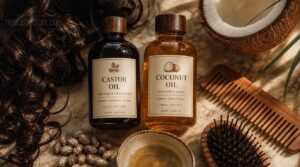
Getting the most out of these oils comes down to how you use them, not just which one you pick. A few simple techniques can make a real difference in your results. Here’s what to know before you start.
Castor-coconut Oil Blend
Combining castor and coconut oil gives you the best of both worlds. Equal parts of each, warmed together until fluid, creates a blend that’s easier to spread than castor oil alone.
- Improves slip during detangling
- Improves scalp circulation through massage
- Reduces mechanical breakage
- Helps retain protein between washes
- Controls buildup with occasional clarifying shampoo
DIY Deep-conditioning Mask
That blend sets you up perfectly for a full DIY deep-conditioning mask.
Mix 1 tablespoon each of castor oil and coconut oil with 1 tablespoon of honey, then warm the blend until fluid.
Apply to damp, clean hair from mid-length to ends, cover with a shower cap, and rinse thoroughly after 30 minutes.
Patch Test First
Before you apply either oil, do a patch test first. Dab a small amount on your inner wrist or behind your ear, then wait 48 to 96 hours. Castor oil can trigger allergic contact reactions in some people. If you notice redness, itching, or swelling, don’t use it on your scalp.
Application Frequency
Once your patch test clears, how often should you actually oil your hair? It depends on the oil.
Castor oil: once a week at most — its thickness builds up fast.
Coconut oil: two to three times weekly works well for most hair types.
Keep castor oil on your scalp; save coconut oil for mid-lengths and ends.
Rinsing and Buildup Prevention
Getting the oil out matters just as much as putting it in. Start with lukewarm water — it loosens both castor and coconut oil without stripping your scalp dry. Apply shampoo directly to dry roots first, letting shampoo emulsification break down the oil before water even touches it.
Follow these five steps for a clean rinse every time:
- Section your hair so water reaches your roots, not just the surface.
- Aim water pressure at the scalp and let it run for a full minute.
- Massage with fingertips while rinsing to lift film clinging near the roots.
- Double shampoo after castor oil — its thick consistency needs two passes.
- Blot dry with a microfiber towel instead of rubbing to avoid spreading residue.
If your hair still feels coated after drying, that’s incomplete rinsing — not oil absorption. Coconut oil’s lighter texture usually rinses clean in one wash, while castor oil’s density almost always needs that second shampoo pass.
Frequently Asked Questions (FAQs)
Which is better castor oil or coconut oil?
It depends on your goal. Coconut oil wins for breakage prevention, while castor oil targets scalp hydration. Neither guarantees hair growth, but both support overall hair health.
Does castor oil promote hair growth?
Castor oil has been touted since ancient times as a hair remedy. Yet clinical study results are modest — ricinoleic acid effects may support scalp circulation, but no trial confirms meaningful hair follicle stimulation or faster regrowth.
Does coconut oil promote hair growth?
Coconut oil doesn’t directly stimulate new hair growth. What it does well is reduce breakage, so your hair retains more length over time. That’s the real win — protection, not production.
What are the benefits of castor oil & coconut oil?
Both oils bring something real to the table. Castor oil promotes scalp hydration and moisture barrier protection, while coconut oil delivers protein protection and breakage reduction — nourishing hair from the inside out.
How to mix castor oil with coconut oil?
Melt solid coconut oil gently, then stir in pure castor oil using a 1:2 ratio. Store the blend in a sealed glass jar, away from sunlight. Use within 3–6 months.
What’s the best oil for hair growth?
Neither oil guarantees new growth. Coconut oil excels at reducing breakage, while pure castor oil may boost scalp circulation. Together, they support healthier, longer-retaining hair over time.
Does castor oil really regrow hair?
Not quite. Castor oil may support scalp health and reduce shedding, but no clinical evidence confirms it regrows hair where follicles have stopped working.
Will my hair grow faster with castor oil?
Probably not faster. Castor oil doesn’t speed up follicles. What it does is reduce breakage, so your hair retains more length over time. That retention is what looks like faster growth.
What oil is best for hair growth?
No single oil guarantees faster hair growth. What oils actually do is reduce breakage, keeping the length you already have. That’s the real win — and it’s backed by clinical evidence.
Which oil is better than castor oil for hair?
Coconut oil edges ahead. Its lauric acid penetrates the hair shaft, binds keratin, and cuts breakage by over 40%. That means stronger, longer strands — without the heavy residue castor oil leaves behind.
Conclusion
Like Goldilocks searching for what’s just right, the answer to which is better—castor oil or coconut oil for hair growth—lives in your mirror, not a single bottle.
Coconut oil quietly repairs what’s already breaking. Castor oil works on the scalp, building conditions for what comes next.
Your hair doesn’t need the trendier option. It needs the right one. Study your strands, pick your oil, and let consistency do what no single application ever can.