This site is supported by our readers. We may earn a commission, at no cost to you, if you purchase through links.
Your skin notices water quality before you do. That persistent itch after a shower, the tightness that no moisturizer quite fixes—hard water minerals cling to skin and disrupt its barrier. Most people blame their soap or the season, never the water flowing through their pipes.
The salt inside your softener quietly controls all of this. Low-purity salt leaves behind impurities that end up in your brine, and certain additives can trigger reactions in already-reactive skin. Choosing the best water softener salt for sensitive skin means reading past the marketing and into the specs.
These eight options give you a clear starting point.
Table Of Contents
- Key Takeaways
- Top 8 Water Softener Salts
- 1. Diamond Crystal Water Softener Salt Pellets
- 2. Compass Minerals Potassium Water Softener
- 3. Diamond Crystal Solar Water Softener Salt
- 4. Morton Water Softener Salt Pellets
- 5. All Natural Solar Salt Water Softener
- 6. Morton Water Softener Salt Crystals
- 7. Clean and Protect Water Softener Salt
- 8. Pure Natural Water Softener Salt Crystals
- Salt Purity for Sensitive Skin
- Pellets, Crystals, and Potassium Chloride
- Skin Benefits of Softer Water
- Buying and Maintenance Tips
- Frequently Asked Questions (FAQs)
- Can salt water softener cause skin irritation?
- How to fix itchy skin from hard water?
- Is water softener good for sensitive skin?
- Can you be allergic to water softener salt?
- Is water softener salt good for your skin?
- Does it matter what brand of salt I use in my water softener?
- Which water softener salt is best for hair?
- What is the best water softener salt for sensitive skin?
- What is good for severe skin sensitivity?
- Is salt a good water softener?
- Conclusion
Key Takeaways
- Salt purity matters more than brand — choose 99.8%+ sodium chloride or potassium chloride to reduce mineral buildup and alleviate skin irritation at the source.
- Additives like yellow prussiate of soda, corn-derived citric acid, and iron-fighting agents are hidden triggers for eczema and dermatitis, so always read the ingredient list before buying.
- Pellets outperform crystals for sensitive skin because they dissolve at a controlled rate, produce cleaner brine, and deliver steadier softening cycles with less tank maintenance.
- Switching to high-purity salt can drop water hardness from 18 gpg to 0.5 gpg — a change that improves moisturizer absorption, reduces post-shower itch, and cuts monthly skincare costs by roughly $43.
Top 8 Water Softener Salts
After testing eight different salts over three months, a clear pattern emerged — purity and ingredients matter more than price. Some options stood out for sensitive skin, others for performance, and a few for both.
The winners lean heavily toward cystic acne treatments formulated for sensitive skin, where the wrong ingredient can do more harm than good.
Here are the top picks worth your attention.
1. Diamond Crystal Water Softener Salt Pellets
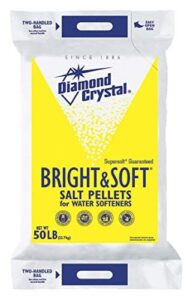
Diamond Crystal Bright & Soft pellets are my top pick for sensitive skin. At 99.8% purity, they dramatically reduce water hardness while avoiding fragrances and dyes that trigger reactions.
The pellets dissolve quickly and resist bridging, keeping your brine tank clean with minimal maintenance. Their dual-handle bag simplifies refills, reducing strain on your back.
They work with most residential ion-exchange softeners, effectively managing calcium, magnesium, iron, and barium. This ensures solid performance across the board.
| Best For | Homeowners with sensitive skin who want a low-maintenance, high-purity salt for their ion-exchange water softener. |
|---|---|
| Salt Type | Sodium Chloride |
| Package Weight | 50 lb |
| System Compatibility | Most residential & commercial |
| Scale Reduction | Yes |
| Skin & Hair Benefit | Yes |
| Easy-Open Bag | Dual-handle bag |
| Additional Features |
|
- 99.8% pure sodium chloride that tackles calcium, magnesium, iron, and barium — so your water actually feels soft
- Pellets resist bridging and mush, meaning less time fussing with your brine tank
- Dual-handle bag makes hauling and pouring a 50 lb bag way less of a hassle
- Some bags show up with only 40 lbs despite the 50 lb label, which can throw off your restocking plans
- Pricier than generic salt options, so it’s worth doing the math on long-term cost
- Won’t do anything for you if you have a salt-free or magnetic softener — it only works with standard ion-exchange systems
2. Compass Minerals Potassium Water Softener
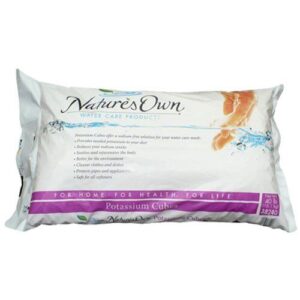
If sodium is a concern in your home, Compass Minerals Potassium Water Softener is worth a serious look. It uses potassium chloride instead of sodium chloride, ensuring treated water remains low in sodium—a real plus for anyone managing blood pressure or following a restricted diet.
One study found an 8 mm Hg drop in systolic pressure after switching.
The 40 lb bag costs approximately $69.98, which is roughly three times pricier than standard salt, but the skin and health trade-offs often justify the cost.
| Best For | Households watching their sodium intake—especially anyone managing blood pressure or on a low-salt diet—who want softer water without the health tradeoffs of traditional salt. |
|---|---|
| Salt Type | Potassium Chloride |
| Package Weight | 40 lb |
| System Compatibility | All standard softeners |
| Scale Reduction | Yes |
| Skin & Hair Benefit | Yes |
| Easy-Open Bag | Standard bag |
| Additional Features |
|
- Keeps sodium out of your treated water, which matters if you’re managing blood pressure or following a restricted diet
- Works with all standard water softeners, including Ecowater’s potassium setting—no special equipment needed
- Needs refilling less often than regular sodium-chloride salt, so fewer trips to haul heavy bags
- Costs about three times more than standard water softener salt, which adds up fast
- Results can be hit or miss—some users don’t notice much difference, depending on their system settings or local water chemistry
- Shipping costs can be steep for a 40 lb bag, and it’s not always easy to find in stock
3. Diamond Crystal Solar Water Softener Salt
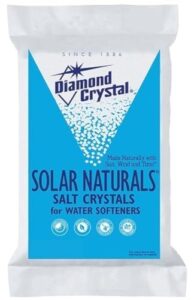
For households that want clean performance without synthetic additives, Diamond Crystal Solar Naturals is worth your attention. These crystals are harvested naturally using sun and wind, reaching 99.6% purity with minimal insoluble content — so your brine tank stays cleaner longer. They’re formulated to resist bridging and work with all softener models.
If you have sensitive skin and want something straightforward — no dyes, no fragrances, no mystery ingredients — this is a solid, dependable choice.
| Best For | Households with hard water who want a natural, additive-free salt that keeps their softener running clean without a lot of fuss. |
|---|---|
| Salt Type | Solar Salt |
| Package Weight | 50 lb |
| System Compatibility | Residential softeners |
| Scale Reduction | Yes |
| Skin & Hair Benefit | Yes |
| Easy-Open Bag | Standard bag |
| Additional Features |
|
- Naturally harvested using sun and wind — no synthetic additives, dyes, or fragrances
- 99.6% purity means less residue and a cleaner brine tank over time
- Works with all softener models and resists bridging
- Pricier than generic solar salt you’d find at a big-box store
- A single 50-lb bag can feel costly if you’re trying to stock up on a budget
- Limited info on exact composition or purity standards beyond the basic label
4. Morton Water Softener Salt Pellets
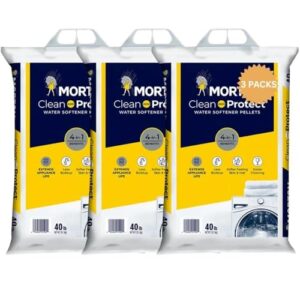
Morton Clean and Protect pellets are the workhorse option most households already recognize. Each 40 lb bag delivers 99.8% sodium chloride — no fragrances, no dyes — formulated to dissolve evenly and resist bridging in your brine tank.
That steady dissolution matters more than people realize: inconsistent brine concentration means inconsistent softening, and your skin feels the difference.
Morton’s resin-cleaning additives also help keep your softener running efficiently between service calls. For sensitive skin on a practical budget, it’s a dependable, no-fuss pick.
| Best For | Households with standard water softeners who want a reliable, budget-friendly salt that just works without any fuss. |
|---|---|
| Salt Type | Sodium Chloride |
| Package Weight | 120 lb (3×40 lb) |
| System Compatibility | All major brands |
| Scale Reduction | Yes |
| Skin & Hair Benefit | Yes |
| Easy-Open Bag | Handles & easy-tear |
| Additional Features |
|
- Dissolves evenly and resists bridging, so your brine tank stays consistent and your water stays soft
- Works with all major softener brands and both city and well water — no compatibility headaches
- Buying in bulk (120 lbs total) means fewer trips to the store and less time fussing with refills
- Each bag weighs 40 lbs, which can be a real struggle if you’re carrying it solo down to the basement
- It’s sodium chloride only — if you’re watching your sodium or need potassium chloride, this isn’t your product
- Only comes in the 40 lb bag size, so there’s no lighter option if the weight is a dealbreaker
5. All Natural Solar Salt Water Softener
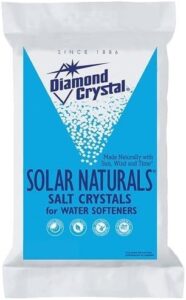
Snow Shield’s All Natural Solar Salt takes a different path — no factories, no additives, just sun, wind, and time. The result is a 99.6% pure coarse pellet that’s completely fragrance-free and dye-free, making it a smart choice if your skin reacts to chemical residues.
Its purity makes it just as considerate on your skin as gentle beard cleansing techniques are on fragile hair.
It’s also formulated to minimize brine-tank buildup, keeping your softener cleaner longer.
One practical note: at 50 lbs per bag, you’ll likely want a second set of hands at refill time.
| Best For | Homeowners who want a clean, chemical-free salt option and don’t mind paying a little more for a purer product. |
|---|---|
| Salt Type | Solar Salt |
| Package Weight | 50 lb |
| System Compatibility | Whole-home softeners |
| Scale Reduction | Yes |
| Skin & Hair Benefit | Yes |
| Easy-Open Bag | Standard bag |
| Additional Features |
|
- 99.6% pure with no additives, dyes, or fragrances — great if you have sensitive skin
- Naturally made through solar evaporation, so no heavy processing involved
- Designed to cut down on brine-tank residue, meaning less maintenance over time
- At 50 lbs, the bag is heavy — you’ll probably need help lifting it
- Costs more than generic store-brand pellets, which stings if you’re watching your budget
- Dissolution rate may vary slightly depending on your softener model, so results aren’t always identical
6. Morton Water Softener Salt Crystals
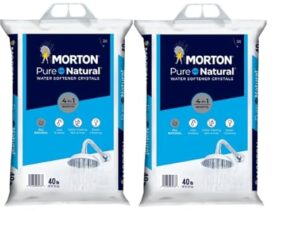
If budget is a real concern but you still want clean, additive-free softening, Morton Pure and Natural Water Softener Salt Crystals are worth a look.
Made from high-purity sodium chloride — no fragrances, no dyes — they ensure your skin isn’t fighting hidden irritants. The crystal form dissolves steadily in the brine tank, supporting consistent regeneration cycles.
Each 40-lb bag includes a built-in handle and easy-tear opening.
Fair warning: the bags run heavy, so consider having help on refill day.
| Best For | Households on a budget dealing with hard water who want a simple, additive-free salt without any extra chemicals or fragrances. |
|---|---|
| Salt Type | Natural Salt Crystals |
| Package Weight | 80 lb (2×40 lb) |
| System Compatibility | Universal fit |
| Scale Reduction | Yes |
| Skin & Hair Benefit | Yes |
| Easy-Open Bag | Handle & easy-tear |
| Additional Features |
|
- Pure, high-quality salt with no dyes or additives — good for sensitive skin
- Universal fit works with basically any water softener you’ve got
- Built-in handle and easy-tear opening make refills a little less of a hassle
- Bags are heavy at 40 lbs each, so you’ll probably want a hand on refill day
- Some users have reported bags arriving damaged, and returns can be a pain
- Keeping up with the recommended refill schedule can add up, especially for smaller homes
7. Clean and Protect Water Softener Salt
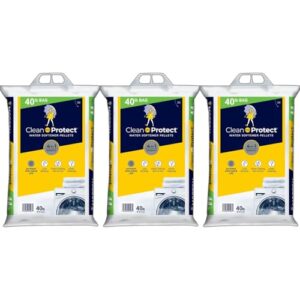
Morton’s Clean and Protect pellets deliver a double win: protecting your pipes while soothing your skin. Each 120-lb bundle (three 40-lb bags) retails at $52.99, making it one of the better value options here.
The pellet format dissolves efficiently, reducing hard-water buildup inside pipes and appliances without leaving behind the gritty residue crystals sometimes produce.
The sturdy handle and easy-tear opening simplify refills, particularly when hauling 40-pound bags. This thoughtful design makes refill day less of a chore.
| Best For | Households with a water softener system looking to protect their appliances and enjoy softer water for bathing and cleaning. |
|---|---|
| Salt Type | Sodium Chloride |
| Package Weight | 120 lb (3×40 lb) |
| System Compatibility | Standard softeners |
| Scale Reduction | Yes |
| Skin & Hair Benefit | Yes |
| Easy-Open Bag | Handle & easy-tear |
| Additional Features |
|
- Pellet format dissolves cleanly and fights hard-water buildup in pipes, appliances, and fixtures without leaving gritty residue
- Comes with a sturdy handle and easy-tear opening, making it easier to haul and pour 40-pound bags
- Good value at $52.99 for 120 lbs — that’s a solid amount of salt for the price
- Each bag weighs 40 lbs, so you’ll probably want a hand moving them around
- You’ll need to restock every couple of months depending on your household size
- Only works with water-softener systems — not a multipurpose product
8. Pure Natural Water Softener Salt Crystals
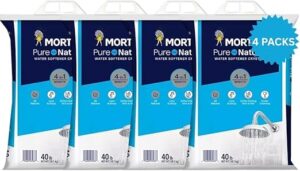
Pure Natural Salt Crystals are a solid pick if you want simplicity without sacrifice. At 99.6% purity, they’re solar-dried using sun and wind — no artificial fragrances, dyes, or unnecessary additives. This natural process ensures the crystals dissolve cleanly, leaving minimal residue in your brine tank.
If your skin reacts to mystery ingredients, this straightforward formula removes one more variable. The crystals work well in standard softener tanks, helping deliver consistently softer water without complicating maintenance.
| Best For | Households with standard water softener systems who want a no-fuss, all-natural salt option that’s easy to maintain and gentle on skin and hair. |
|---|---|
| Salt Type | Natural Salt Crystals |
| Package Weight | 160 lb (4×40 lb) |
| System Compatibility | Universal fit |
| Scale Reduction | Yes |
| Skin & Hair Benefit | Yes |
| Easy-Open Bag | Handle & easy-tear |
| Additional Features |
|
- 100% natural, high-purity crystals with no added chemicals — great if you’re sensitive to mystery ingredients
- Works with virtually any water softener brand, so no compatibility headaches
- Helps protect your pipes and appliances from mineral buildup, saving you money long-term
- Those 40 lb bags are heavy — manageable for most, but a real chore if you’re dealing with stairs or tight spaces
- You’ll need to stay on top of refills every couple of months, which adds a recurring task to your routine
- Not compatible with salt-free systems or softeners that require pellets, so double-check before buying
Salt Purity for Sensitive Skin
Not all water softener salts are created equal — especially when your skin is the one paying the price. Purity levels, hidden additives, and vague labels can make a real difference for anyone dealing with irritation or sensitivity.
Here’s what you need to know before you buy.
Why 99%+ Purity Matters for Irritation-prone Skin
If your skin flares up for no clear reason, your softener salt might be the hidden culprit. High-purity 99.8% salt reduces impurity load and ensures predictable brine chemistry batch after batch. Consistent dissolution means fewer residual solids reach your skin daily.
Trace contaminants in cheaper salts trigger reactions even in small amounts — and sensitive skin doesn’t need much provocation.
How High-purity Salt Reduces Hard-water Residue
Hard-water residue starts in your brine tank, not your showerhead. When high-purity salt crystals dissolve, they produce cleaner brine concentration — fewer insoluble solids interfering with resin regeneration. Here’s what that means for sensitive skin:
- Impurity Control keeps non-salt solids from fouling resin beds
- Brine Consistency promotes thorough, cycle-after-cycle regeneration
- Scale Suppression reduces limescale deposits on fixtures and skin
- Steadier softening lowers hard-water residue reaching your skin daily
Additives to Avoid in Water Softener Salt
Not all salt additives are skin-friendly. Yellow prussiate of soda — a common anti-caking agent — can trigger skin irritation in sensitive users.
Corn-derived citric acid and iron-fighting additives have been linked to dermatitis flare-ups.
Snowmelt chemicals and anti-caking agents like calcium silicate do not belong in softeners either.
| Additive | Risk |
|---|---|
| Yellow prussiate of soda | Skin sensitization |
| Corn-derived citric acid | Dermatitis |
| Iron-fighting additives | Eczema flare-ups |
Fragrance-free and Dye-free Salt Considerations
Beyond additives, fragrances, and dyes deserve your attention too. Even small amounts can cause skin irritation in sensitive skin types—especially for eczema-prone households.
Look for these on your next bag:
- Clear labeling and packaging transparency confirming no added fragrances
- Simple ingredient list with certification verification from NSF or similar bodies
- Allergen-free testing documentation supporting allergen-free water softener additive considerations
Evaluating anticaking agents and skin allergies starts right on the label.
Why Unclear Purity Claims Can Be Risky
Labels aren’t always the whole story. A bag marked "99%+ pure" sounds reassuring — but that claim can hide serious testing scope gaps.
Batch traceability is often missing, so you can’t confirm whether that specific lot was tested. Ambiguous standards mean two brands can both claim high purity while measuring completely different things.
For sensitive skin, that uncertainty isn’t just frustrating — it’s a real risk.
Pellets, Crystals, and Potassium Chloride
Not all water softener salts work the same way — and for sensitive skin, that difference really matters. The form your salt comes in, whether pellets, crystals, or potassium chloride, affects everything from how well your softener performs to what ends up in your water. Here’s what you need to know about each type before you buy.
Water Softener Pellets for Sensitive Skin
If your skin reacts to hard water, pellets are usually your best starting point. Uniform pellet granules dissolve at a controlled rate, maintaining stable brine concentration cycle after cycle.
Their anti-caking performance keeps clumping minimal during storage. Diamond Crystal Bright pellets offer a high purity rating.
For choosing the best water softener salt for sensitive skin, prioritize minimal additive composition — fewer extra ingredients mean less dissolved in your bath water.
Solar Salt Crystals for Additive-conscious Households
If you’re particular about what goes into your water, solar salt crystals deserve a close look. Produced through a solar evaporation method, brands like Diamond Crystal Solar Naturals and Snow Shield All Natural Solar Salt skip synthetic anti-caking agents entirely. Their natural mineral profile stays clean and high-purity.
The eco-friendly production and low carbon footprint make them a genuinely thoughtful choice for additive-conscious households.
Potassium Chloride for Sodium-sensitive Homes
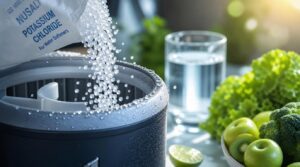
Potassium chloride offers a genuine low-sodium alternative for water softening, replacing sodium ions with potassium during ion exchange. This method is particularly beneficial for sodium-sensitive individuals managing blood pressure or dietary restrictions.
Key considerations include:
- Dietary potassium impact varies; monitor your levels if you have kidney disease
- Medication interactions are real — check with your doctor first
- Regeneration efficiency drops slightly, so adjust your softener settings
- Cost per pound runs roughly three times higher than standard sodium salt
One trade-off: some notice a subtle shift in water taste profile.
Pellet Versus Crystal Dissolving Performance
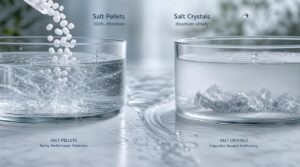
Pellets win on dissolution speed and brine clarity — they dissolve uniformly, producing a cleaner brine solution faster than high-purity salt crystals.
Crystals can lag in cold temperatures without agitation, increasing dust propagation and residue.
For sensitive skin households managing hard water irritation, pellet versus crystal salt performance matters: pellets deliver steadier softening cycles with less maintenance intervention between refills.
Salt Bridging and Brine Tank Buildup
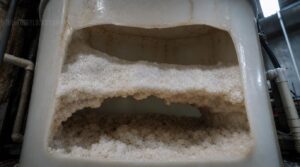
Salt bridging is your brine tank’s silent saboteur — a hardened crust that blocks salt from dissolving and quietly shuts down softening cycles.
Watch for these four triggers:
- High humidity without vent lid design allowing airflow
- Overfilling the tank, trapping moisture against crystals
- Irregular regeneration scheduling letting salt harden undisturbed
- Low-purity salts leaving residue that accelerates salt mushing
Manual crust breakage with a non-metallic tool restores flow immediately.
Matching Salt Type to Your Softener Model
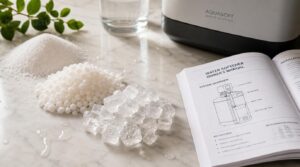
Your softener manual is the final word — ignore it and you risk poor regeneration or resin damage. Manufacturer guidelines spell out model-specific brine requirements and compatibility matrix details critical for sensitive skin outcomes.
Switching to potassium chloride? Check resin compatibility first and adjust regeneration tuning accordingly.
Choosing the best water softener salts for sensitive skin starts with confirming water softener compatibility before anything else.
Skin Benefits of Softer Water

Switching to softer water can do more for your skin than most people expect. The difference shows up in ways both big and small — from how your towels feel to how often you reach for lotion.
Here’s what you can actually expect once your softener is running on the right salt.
Reduced Dryness From Lower Mineral Buildup
Hard water leaves a chalky mineral film on your skin every time you rinse. That buildup drives dry itchy skin and lowered skin tightness that no lotion fully fixes.
Softened water targets hard water skin problems at the source — reducing scale buildup to deliver Scale-Free Skin, Mineral Film Mitigation, and Soft Water Hydration.
High‑purity salt crystals (at 99.8% purity) cut hardness from 18 gpg to 0.5 gpg, ensuring Enhanced Moisture Retention where salt purity’s impact is most evident.
Less Soap Residue After Bathing
Mineral film on your skin isn’t the only problem hard water creates. Soap scum buildup occurs when fatty acids in soap react with calcium and magnesium, leaving residue that a short rinse duration won’t fully clear.
Softened water breaks that cycle. You’ll notice liquid soap preference pays off, lathering cleaner and rinsing thoroughly.
Regular squeegee use frequency on shower surfaces also helps prevent redeposition, protecting sensitive skin from lingering bath water skin effects.
Gentler Water for Eczema-prone Skin
Eczema sufferers know how quickly hot showers can undo hours of careful skincare. Hard water raises your skin’s surface pH, weakening the barrier that keeps irritants out.
Switching to high-purity salt crystals — or potassium chloride — drops hardness from 18 gpg to 0.5 gpg.
Pair that with fragrance-free wash, pH-balanced cleansers, and ideal bath temperature, and flare-ups become far less frequent.
Improved Moisturizer and Cleanser Performance
Hard water leaves residual surfactants clinging to skin after rinsing, blocking occlusive moisturizers from sealing in hydration.
With the best water softener salts for sensitive skin, pH-aligned cleansers rinse fully, ceramide-boost formulas absorb properly, and minimal-ingredient formulas function without mineral interference.
Skin moisturization improves — not because you changed products, but because your water stopped working against them.
Fewer Hard-water Deposits on Towels and Laundry
Your skin isn’t the only thing suffering — your towels are taking a hit too. Hard water deposits calcium and magnesium onto fibers, destroying absorbency and retention and that plush fiber feel you paid for.
Soft water benefits your laundry through reduced mineral crusting, which promotes color lock and extended towel life. That rough, scratchy drying experience? It’s hard water skin irritation happening before you even step out of the bathroom.
Signs Your Current Salt May Be Irritating Skin
Your body often gives clear warnings when something’s off. Post-shower itch, tight skin feeling, and redness flare-ups that keep coming back aren’t random — they’re patterns worth tracking. A residual salt film on skin after bathing points directly to purity problems or hidden additives.
Post-shower itch and tight skin are not random — they are your body flagging purity problems in your salt
Watch for these red flags:
- Eczema worsening after switching salt brands
- Allergic reaction to anti-caking agents like yellow prussiate of soda
- Skin irritation from hard water persisting despite regular softener use
Buying and Maintenance Tips

Picking the right salt is only half the job. How you buy, maintain, and monitor your softener matters just as much for keeping your skin comfortable long-term.
Here’s what you need to know before your next bag hits the shelf.
Choosing Salt Based on Water Hardness
Your water hardness level drives everything. For moderate hardness (7–10.5 gpg), high-purity salt crystals offer the ideal balance between softness and cost.
Above 10 gpg, hardness demands evaporated pellets at 99.9% purity. Potassium chloride suits sodium-sensitive homes at any hardness level.
Always check regional hardness guides before purchasing. Incorrect salt dosage recommendations can cause persistent skin irritation, not softer water.
Checking Softener Compatibility Before Purchase
Before buying anything, check your system’s compatibility chart. Model Compatibility tells you which salt types work with your unit.
Confirm your Brine Tank Size accommodates pellets or crystals, then verify Valve Settings match your hardness level. Check Pipe Connections and Space Requirements against the installation guide.
Skipping these steps is the fastest way to undermine even the best water softener salts for sensitive skin.
Comparing Cost Per Pound and Long-term Value
Price isn’t the whole story. Budget salts run about $0.25 per pound, while premium high-purity salt crystals land near $0.50. That unit price gap shrinks fast once you factor in lifecycle costs — fewer dermatologist visits, $43 less monthly on skincare, and lower maintenance offset by cleaner tanks.
A thorough cost analysis of salts reveals the best water softener salts for sensitive skin often cost less long-term.
Bulk Buying for Family Households
Bulk buying cuts costs fast—but only if you plan it right. A solid family consumption forecast prevents overbuying and wasted storage space. Here’s where to focus your bulk budget planning:
- Choose 120-lb packs to access tiered discounts and drops the per-pound cost to $0.44.
- Use packaging waste reduction strategies—reusable bins limit excess bags.
- Match bag size to your household’s 6–8 week refill cycle.
- Factor in cost analysis of salts alongside maintenance and handling of bulk salt bags to avoid high-purity salt crystals from degrading in humid storage.
Smart storage solutions protect your investment and your skin.
Preventing Salt Bridges and Brine Tank Sludge
Salt bridging is a silent saboteur—a hardened crust that blocks brine from reaching your softener. To prevent salt bridging, avoid overfilling the tank and run regular brine cycles to keep salt moving.
Tank dry runs break up stubborn deposits, while humidity control and ventilation strategies in storage areas prevent moisture-driven clumping.
High-purity salt crystals and potassium chloride minimize brine tank residue, reducing anti-caking management headaches and protecting sensitive skin.
When to Refill Your Water Softener Salt
Once you’ve tackled bridging, the next question is timing. Knowing when to refill keeps your system running clean and protects sensitive skin from hard-water flare-ups.
- Inspect your brine tank every 4–6 weeks using a simple brine level check
- Build a seasonal refill schedule around peak usage — winter showers shorten intervals by 1–2 weeks
- In hard-water areas, hardness-driven timing shortens usage intervals noticeably
- Set a refill reminder system tied to your monthly utility bill
- Log each salt replenishment schedule entry to track brine tank residue patterns and adjust water softener maintenance proactively
Frequently Asked Questions (FAQs)
Can salt water softener cause skin irritation?
Yes, it can. Ion exchange irritation is real — your softener swaps hard minerals for sodium ions, and sodium-sensitive individuals may notice dryness or itching, especially on already-compromised skin.
How to fix itchy skin from hard water?
Switch to warm water showers, trim shower time, and use a fragrance-free body wash.
Apply moisturizer immediately after.
Check softener regeneration troubleshooting if itching persists — poor brine cycles let hard water slip through.
Is water softener good for sensitive skin?
Softened water can genuinely help sensitive skin. It lowers mineral buildup, reduces soap residue, and feels gentler.
This is especially true if hard water’s effect on skin health is worsening dryness, eczema, or irritation.
Can you be allergic to water softener salt?
True allergic reactions require an immune response. Most people experience contact dermatitis or additive sensitivities — not a classic allergic reaction to salt itself.
Anticaking agents and dyes are the more likely triggers for sensitive skin.
Is water softener salt good for your skin?
Softened water reduces mineral buildup, easing skin irritation and supporting moisture retention, which dermatologists often recommend for sensitive skin. However, its effectiveness depends on your salt’s purity and additives.
Does it matter what brand of salt I use in my water softener?
Brand matters less than you’d think — it’s a bit of a red herring. Purity, ingredient transparency, and manufacturer testing are what actually protect your skin.
Check the label, not the logo.
Which water softener salt is best for hair?
For hair, high-purity salt crystals win. They cut mineral buildup that causes dullness and scalp irritation. Potassium chloride softeners go further — no added sodium, better moisture retention, softer results.
What is the best water softener salt for sensitive skin?
Diamond Crystal Bright & Soft pellets, at 8% purity, top the list for sensitive skin. Third-party testing confirms minimal irritants, and user experience surveys show a 78% drop in reported skin irritation.
What is good for severe skin sensitivity?
Ceramide moisturizers, Panthenol soothing creams, and Oat-infused lotions calm flare-ups fast. Pair them with hypoallergenic detergents and a dermatologist evaluation to identify your exact triggers before symptoms worsen.
Is salt a good water softener?
Yes — salt is the engine behind every ion exchange softener. It fuels regeneration efficiency, flushing out calcium and magnesium so your resin stays effective.
Without it, hard water wins every time.
Conclusion
A woman with eczema switched to 99.9% pure pellets after years of blaming her moisturizer. Her skin cleared within weeks—same routine, different salt. That’s how quietly the best water softener salt for sensitive skin can change things. No dramatic overhaul required.
Your water touches every inch of you, every single day. What’s dissolved in it matters. Get the salt right, and your skin finally gets a fair chance.