This site is supported by our readers. We may earn a commission, at no cost to you, if you purchase through links. This content is for general informational and educational purposes only and is not a substitute for professional medical, dermatological, or nutritional advice.

Most shavers blame the blade when their face protests—redness, tugging, a patchwork of missed stubble. The blade’s rarely the problem. Angle is. Specifically, a degree or two outside the sweet spot turns a precision tool into a scraper.
Safety razor geometry isn’t forgiving of guesswork. The blade sits recessed behind the head, and your handle position controls everything—tilt too far and you’re dragging metal; stay too flat and the edge never engages. The correct safety razor angle sits between 30 and 45 degrees, but finding your exact number inside that band is where technique separates a comfortable shave from a punishing one.
What follows is the calibration process, step by step.
Table Of Contents
- Key Takeaways
- What is The Correct Safety Razor Angle?
- How Blade Angle Affects Shave Quality
- Factors Influencing Razor Angle
- Step-by-Step Guide to Finding The Right Angle
- Techniques for Maintaining Consistent Angle
- Common Mistakes With Safety Razor Angle
- Advanced Shaving Methods for Angle Control
- Personalizing The Angle for Your Needs
- Tips for Safe and Effective Shaving
- Frequently Asked Questions (FAQs)
- Conclusion
Key Takeaways
- The 30–35 degree sweet spot is where the blade slices cleanly — drift outside it and you’re scraping, not shaving.
- Your razor’s head geometry, blade gap, and exposure all shift that ideal angle before you even touch skin, so know your tool first.
- Skin type and hair texture quietly dictate your exact working angle — sensitive skin stays near 27–30°, coarse stubble needs 35°.
- Let razor weight do the cutting: drop the pressure, lock the wrist, and consistent angle control follows naturally.
What is The Correct Safety Razor Angle?
Blade angle is the single variable that separates a clean, comfortable shave from one that leaves your skin angry for the rest of the day. Get it wrong by just a few degrees and you’re fighting your razor instead of working with it.
Aim for that 30-degree sweet spot with your safety razor and the difference in comfort is immediate and obvious.
Here’s what you need to know to nail it every time.
Defining Blade Angle in Shaving
Blade angle is the smallest angle between the blade plane and the shave plane — where your razor actually meets skin. Get this wrong, and no amount of premium soap saves you.
Razor blade angle control starts with understanding razor geometry: blade rigidity, shave plane dynamics, and angle measurement all interact. Master that foundation, and your shaving technique clicks into place.
Achieving the ideal razor blade angle is vital for a smooth shave.
Standard Angle Recommendations (30–45 Degrees)
Most safety razor guides recommend a 30–45-degree angle as your optimal working zone. This range is crucial for effective shaving, ensuring the razor’s geometry functions properly. At around 30 degrees, the blade angle control is efficient, allowing hair to be sliced cleanly without tugging. If the angle exceeds 45 degrees, the razor can scrape the skin, leading to irritation.
The razor handle position plays a significant role in achieving the correct angle. To find the ideal shaving angle, drop the handle until the blade edge just catches the hair. Maintaining the ideal razor blade angle is vital for efficient and comfortable shaving.
Why Angle Matters for Skin Comfort
Angle isn’t just about cutting efficiency — it directly controls skin comfort. Get it wrong and you’re dragging the blade, generating friction heat, and inviting razor burn. Too steep, and blade exposure increases, scraping instead of slicing. Too shallow, and hairs tug rather than fall.
The right shaving angle cuts clean, minimizes skin irritation, and keeps ingrown hairs from forming. Your shave quality lives or dies here.
How Blade Angle Affects Shave Quality
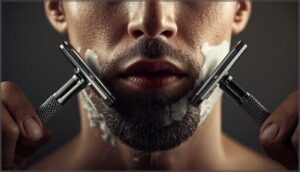
Blade angle isn’t just a technical detail — it’s the difference between a clean shave and a rough one. Get it wrong, and you’ll feel it immediately: tugging, burning, or worse.
Here’s exactly how angle affects the three things that matter most.
Impact on Hair Cutting Efficiency
Your razor blade angle is the single biggest lever on cutting efficiency. At 30 degrees, blade alignment is ideal — hair truncation happens cleanly, right at skin level, with stubble dropping under 0.1 mm. Drift too far either way and blade efficiency collapses: hairs tug instead of cut.
Nail the razor blade angle, and shave quality improves immediately. Shaving techniques won’t save a misaligned blade.
Reducing Irritation and Ingrown Hairs
Irritation doesn’t start at the sink — it starts the moment your angle drifts off course. A correct razor blade angle reduces skin irritation by letting the blade slice cleanly rather than scrape. Poor blade angle forces repeated passes, worsening razor burn and triggering ingrown hairs.
Pair solid shaving techniques with smart shave preparation: warm the skin, apply lather generously. Nail the angle first.
Preventing Nicks and Cuts
Control is everything. Proper blade angle is your best Nick Prevention tool — steep angles scrape, shallow ones bite unexpectedly. Both cause cuts.
Keep these Shaving Techniques in mind for Cut Minimization:
- Hold at 30 degrees — Razor Blade Safety starts here.
- Use short, 1–3 cm strokes near the jaw for Skin Protection.
- Let razor weight do the work — pressure causes Razor Burn and Skin Irritation.
Factors Influencing Razor Angle
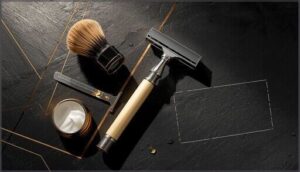
Getting your angle right isn’t just about tilting the razor — several variables quietly shape what that ideal angle actually is for you.
Your razor’s design, blade setup, and even your own skin and hair all pull that number in different directions.
Here’s what you need to account for before locking anything in.
Razor Head Geometry and Design
Your razor head geometry sets the rules before you even touch skin. Cap design, base plate, and guard bar all dictate where the blade sits and at what angle.
A mild safety razor like the Merkur 34C naturally accommodates shallower blade angles around 35 degrees. Aggressive razor designs push steeper blade angles. Understanding your razor design tells you exactly where to start.
Blade Exposure and Gap
Two numbers quietly control everything: blade exposure and blade gap. Exposure defines where the razor blade sits relative to the shave plane — positive means more edge contact, negative means the cap and guard lead first.
Gap measurement tells you how much hair reaches the blade per stroke. Together, these drive blade angle requirements and edge rigidity.
Know your razor geometry before you shave.
Skin and Hair Type Considerations
Your skin type and hair growth pattern are the real variables nobody talks about. Sensitive skin needs a lower blade angle — around 27–30 degrees — to avoid micro-tearing. Coarse hair demands a steady 30–35 degrees for clean cuts. Curly hair stays with the grain at 30 degrees to prevent ingrowns. Dry skin and oily zones each need angle tweaks, not just lather adjustments.
Skin type and hair texture are the real variables that quietly dictate your ideal razor blade angle
Step-by-Step Guide to Finding The Right Angle
Finding your ideal angle doesn’t have to be a guessing game. It comes down to three straightforward steps you can work through in a single shave session. Here’s exactly what to do.
Preparing Your Skin and Razor

Before blade angle even enters the picture, prep work decides the outcome. Wash your face with warm water and a mild cleanser — clean skin gives wet shaving lather somewhere to grip. Spend two minutes with a warm towel or step out of a hot shower first; softened beard hairs demand far less force.
Check your razor maintenance too: a clean, properly loaded blade ensures true blade sharpness before your shaving technique begins.
Positioning The Razor on The Skin
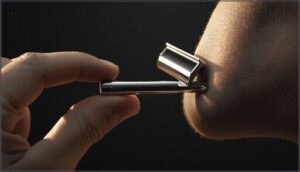
Rest the top cap flat against your skin first. That’s your zero point for razor placement. Handle pointing straight out, blade not yet engaged — that’s proper razor safety in action.
From here, facial mapping pays off: cheeks, jawline, and neck each curve differently. Use your free hand to apply light skin tension, keeping the surface even for clean blade alignment.
Adjusting The Handle to Achieve Optimal Angle

Now rotate the handle down toward your face — aim for 30–35 degrees from the skin. That’s where handle positioning clicks into place for most safety razors.
Blade exposure becomes controlled, razor geometry does its job, and angle control feels natural. Small 5–10 degree adjustments change everything. Trust the feedback: clean slicing means you’ve found it.
Techniques for Maintaining Consistent Angle

Finding the right angle is only half the battle — keeping it consistent through every stroke is where real shaving technique lives.
Your grip, stroke length, and awareness all work together to hold that angle steady pass after pass. Here’s what actually makes the difference.
Grip and Wrist Control
Your grip makes or breaks blade angle consistency. Lock your wrist — no flexing — and let your arm guide each stroke. Place your thumb, index, and middle fingers near the handle’s balance point. Grip pressure stays feather-light; razor balance does the cutting.
- Finger Placement anchors control without tension
- Wrist Alignment holds your 30-degree angle steady
- Proper Grip prevents handle rotation mid-stroke
- Wrist Lock eliminates wobble across the jawline
- Handle Control transfers to razor handling precision
Using Short, Controlled Strokes
Once your wrist is locked, stroke length becomes the next variable you control. Keep each pass to 1–3 cm. Short movements preserve angle precision — your wrist can’t drift far enough to lose the 30-degree sweet spot.
| Area | Stroke Length | Why It Matters |
|---|---|---|
| Cheek | 2–3 cm | Flat surface, easier razor control |
| Jawline | 1–2 cm | Curves demand tighter angle precision |
| Chin | 10–15 mm | Sharpest contour, highest nick risk |
| Neck | 1–2 cm | Grain shifts require frequent resets |
Short strokes are skin protection, not caution.
Watching Angle in Mirrors for Precision
Mirror alignment turns guesswork into geometry. A 5x magnification mirror at eye level — 18 to 24 inches out — shows exactly where your blade meets skin.
To ensure precision, follow these steps:
- Set daylight LED lighting at 5000K for true angle visibility
- Use 5x magnification to confirm cap and guard contact
- Stretch facial contours taut to flatten curves
- Verify blade exposure sits even across the safety bar
- Swivel the mirror to check neck angles without straining
Common Mistakes With Safety Razor Angle

Even experienced shavers fall into the same angle traps — and most don’t realize it until the irritation shows up the next morning. Getting the angle wrong is the most common reason a safety razor feels harsh, draggy, or unpredictable.
Here are the key mistakes to watch for.
Too Steep Vs. Too Shallow Angles
Both extremes destroy shave quality. Too shallow — under 25 degrees — and the blade skates across stubble instead of slicing it, dragging skin and triggering razor burn. Too steep, and blade exposure concentrates force into a narrow edge, making nicks almost inevitable on curved areas.
Angle control lives in the 30–45 degree window. Outside it, razor geometry works against you, not for you.
Signs Your Angle Needs Adjusting
Your skin tells the truth before the mirror does. Poor blade angle shows up fast — and in patterns.
- Razor burn or redness in the same spot every pass signals a blade angle problem, not a pressure issue
- Hair tugging means blade efficiency has dropped; the angle isn’t letting the edge slice cleanly
- Patchy shave quality with leftover stubble means the safety razor is riding outside the sweet spot
- Repeated passes causing skin irritation confirm the blade angle needs adjustment, not more strokes
How to Correct Technique Errors
Fix angle correction before anything else — don’t add pressure or extra passes. For a steep blade angle, lower the handle gradually until scraping stops. For shallow, tilt upward and let the cap rest flat first.
Relax your wrist, drop the squeeze, and let razor balance guide each stroke. Technique refining takes ten slow passes.
Error analysis is simple: if it tugs, adjust two degrees.
Advanced Shaving Methods for Angle Control
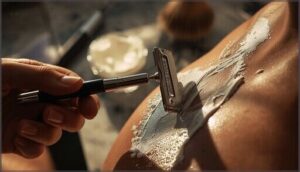
Once you’ve got the basics locked in, it’s time to sharpen your edge with techniques that give you real precision.
Angle control isn’t one-size-fits-all — different methods work better depending on your razor, skin, and hair type.
Here’s what experienced wet shavers actually do to dial it in.
Riding The Cap Vs. Riding The Guard
Two techniques define sophisticated blade angle control: Cap Riding and Guard Riding. Each changes how blade exposure interacts with your skin.
- Riding the Cap flattens the razor head, producing a milder shave — ideal for daily touch-ups
- Riding the Guard drops the handle low, increasing blade engagement for coarser stubble
- Cap riding lowers nick risk; guard riding sharpens closeness
- Your razor geometry determines which method performs better
Adjusting Angle for Different Facial Areas
Your face isn’t flat — and your blade angle shouldn’t pretend it’s. Facial mapping matters here. On the cheeks, that classic 30–45 degree angle holds steady. Jawline shaving demands a few extra degrees as the bone curves under.
Neck contours shift grain direction constantly, so shorten your strokes. For chin angle control, use sub-centimeter passes. Safety razors reward adaptation.
Experimenting for Sensitive or Coarse Hair
Hair texture changes everything. Sensitive skin starts at 30 degrees — full stop. Coarse stubble needs a steeper blade angle, around 35 degrees, with an open-comb razor geometry that lets the blade exposure do real work.
- Sensitive skin: closed comb, 30 degrees, cap riding
- Coarse stubble: open comb, 35 degrees, guard riding
- Test angles in 5-degree increments across three shaves
Safety razors reward patience. Dial in your shaving technique gradually.
Personalizing The Angle for Your Needs

No two shavers are the same, and your razor angle shouldn’t be either. Your face shape, razor model, and hair type all pull the sweet spot in different directions.
Here’s how to dial it in for your specific setup.
Adjusting for Razor Model and Face Shape
Your razor model and face shape both demand their own angle calibration. Mild closed-bar razors with a tight blade gap perform best near 30°; aggressive open-comb designs want 35°–40°.
Layer in razor face mapping: squared jawlines tolerate a consistent blade angle, while curved or V-shaped faces require constant adjustments across facial contours.
Tailored shaving starts with understanding your specific shave geometry.
Fine-Tuning Angle for Best Results
Once you’ve mapped your face and matched your razor geometry, the real work begins: micro-adjustments within that 30–45° band.
Fine-tune by listening and feeling:
- A soft slicing sound signals correct blade angle
- Tugging means your blade exposure needs a degree or two
- Redness after one pass? Steepen less, not more
- Facial mapping guides angle control zone by zone
- Shave optimization comes from patience, not pressure
Tips for Safe and Effective Shaving
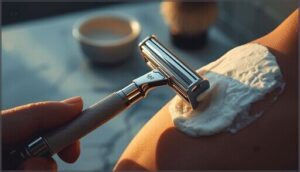
Getting the angle right is only half the equation. How you handle the razor — and what you do after — decides whether your skin walks away smooth or complaining.
Keep these habits in your routine.
Letting Razor Weight Do The Work
Weight is your greatest ally. A brass safety razor at 90 grams doesn’t need your help — razor balance and weight distribution handle blade alignment automatically when you maintain proper grip control.
Let the handle drop naturally, keep your hold loose, and trust the stroke technique. Correct blade angle happens when you stop forcing it and let the razor do exactly what it was built to do.
Applying Minimal Pressure
Pressure is the enemy most shavers never suspect. Safety razors demand a gentle touch — let blade angle and razor balance do the cutting.
Light grip tips apply here: hold loosely, use smooth strokes, and trust the weight. Pressure control isn’t passive; it’s an active shaving technique.
Less force means better blade angle maintenance, cleaner cuts, and fewer irritation flare-ups every single pass.
Post-Shave Care to Prevent Irritation
The shave ends at the final stroke — PostShave Care starts immediately after.
- Cool Water Rinsing — 30–60 seconds constricts vessels and calms redness.
- Alcohol Free Aftershaves — skip the sting; use glycerin-based balms instead.
- Soothing Botanicals — aloe, witch hazel, or calendula reduce skin irritation fast.
- Post Shave Moisturizing — lock in hydration with fragrance-free formulas.
Gentle habits protect your skin long-term.
Frequently Asked Questions (FAQs)
Can safety razor angle vary by blade brand?
Yes, blade angle varies by brand. Blade flexibility, thickness, and sharpness levels all shift the effective cutting plane.
A Feather’s rigidity suits 25–30 degrees; a flexible Astra Platinum needs 30–35 for clean razor geometry contact.
Does water temperature affect optimal shaving angle?
Water temperature subtly shifts your shave. Hot water softens hair keratin and slightly expands razor metal, mimicking a milder blade angle.
Cold water firms skin and stands hairs upright, supporting consistent angle control throughout each pass.
How does shaving cream thickness influence blade angle?
Cream thickness directly shifts your blade angle. Thick lather forces a steeper handle position; thin lather lets the razor sit flatter. Match your lather consistency to the zone — and your angle adjusts naturally.
Should angle change when shaving against the grain?
No. Keep your blade angle locked at 30 degrees regardless of shave direction. Grain mapping changes your stroke path, not your razor tilt.
Consistent angle across every pass is non-negotiable for safe, irritation-free results.
Can razor handle length impact angle control?
Absolutely. Handle length directly affects angle stability and wrist control. Shorter grips, around 80–85 mm, keep your grip close to the head, making blade angle corrections precise. Longer grips magnify wrist movement, increasing angle drift risk.
Conclusion
What separates a genuinely close shave from a daily battle with your own face? One calibrated angle. The correct safety razor angle isn’t a rigid rule—it’s a personal setting you dial in through deliberate repetition.
Once your muscle memory locks it in, the razor stops fighting you. Pressure drops, irritation fades, and the blade does exactly what it was engineered to do. Master the angle, and everything else follows cleanly.