This site is supported by our readers. We may earn a commission, at no cost to you, if you purchase through links. This content is for general informational and educational purposes only and is not a substitute for professional medical, dermatological, or nutritional advice.

Aloe vera has been sitting in people’s kitchens and windowsills for centuries, yet most of us reach for it only after a sunburn. That’s a missed opportunity—because the same gel that calms irritated skin also does something impressive inside the hair shaft.
Its polysaccharides, natural water-binding molecules, pull moisture into each strand and hold it there, which is why hair treated with aloe feels noticeably softer without feeling heavy or coated.
An aloe vera hair mask recipe won’t just add surface shine; it works at the structural level to reduce breakage, calm a flaky scalp, and smooth frizz from the inside out.
Table Of Contents
- Key Takeaways
- Why Aloe Vera Works for Hair
- Gather Your Mask Ingredients
- Pure Aloe Vera Hair Mask
- Best Aloe Vera Mask Variations
- Use It Safely and Store It
- Frequently Asked Questions (FAQs)
- Can you make a hair mask with Aloe vera gel?
- Do homemade aloe vera masks work?
- How long do you leave aloe vera mask on?
- Do I apply aloe vera on wet or dry hair?
- Can aloe vera masks replace a conditioner entirely?
- Does aloe vera work on color-treated hair?
- Can you mix aloe vera with castor oil?
- Is store-bought aloe gel as effective as fresh?
- How long until you see hair growth results?
- Conclusion
Key Takeaways
- Aloe vera’s polysaccharides act like tiny sponges inside each hair strand, pulling in moisture and holding it there to reduce breakage and frizz.
- Pairing aloe with one complementary ingredient — coconut oil for sealing, yogurt for softness, egg for protein, or apple cider vinegar for shine — targets your specific hair concern far more effectively than plain aloe alone.
- How often you apply matters as much as what you apply: fine or oily hair needs a mask every 10–14 days, while curly or dandruff-prone hair benefits from weekly use.
- Fresh aloe gel stays potent for up to 10 days refrigerated or 6 months frozen in ice cube trays, making it easy to prep in batches without losing effectiveness.
Why Aloe Vera Works for Hair
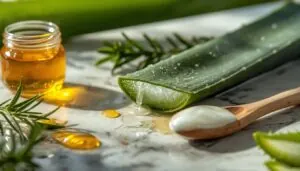
Aloe vera isn’t just a trendy ingredient — it genuinely does something useful for your hair, and the science behind its pretty straightforward. The gel is packed with compounds that work at different levels, from your scalp down to each individual strand.
It’s one of those rare plants where the traditional wisdom and the lab results actually line up — dig into the full science of aloe vera for hair and you’ll see exactly why.
Here’s why it’s worth paying attention to.
Moisturizes Dry, Brittle Strands
Aloe vera’s moisturizing properties work from the inside out. Its gel acts as a humectant, binding moisture directly to dry, brittle strands — think of it like a sponge drawing water in and holding it there. This elasticity boost helps hair bend instead of snapping. Regular use promotes long-term hair moisture retention and scalp hydration.
Aloe vera acts like a sponge for your hair, drawing in moisture and holding it there to prevent breakage
- Delivers direct hair hydration to parched, rough strands
- Humectant binding pulls moisture into the hair shaft
- Improves elasticity, so hair flexes instead of breaking
- Facilitates cuticle sealing for a smoother, softer feel
- Maintains moisture retention between wash days
Incorporating Omega‑9 fatty acids can further strengthen the hair’s protective layer.
Soothes Itchy, Irritated Scalp
Beyond hydration, that same gel does something equally useful: it calms an angry, itchy scalp. Its anti-inflammatory properties help reduce scalp irritation fast — you’ll notice a cooling sensation almost immediately.
Anti-yeast ingredients naturally present in aloe make it a solid antidandruff remedy too.
Stick to fragrance-free formulas, use a gentle rinsing technique, and this soothing aloe vera scalp mask for itchiness promotes real barrier repair over time.
Helps Reduce Frizz and Breakage
Frizz and breakage often come down to friction and moisture loss. Aloe vera’s natural glucomannan — a water-binding compound — delivers a real moisturizing effect that keeps strands flexible, not brittle.
Pair that with smart habits and you’ve got a solid routine:
- Wrap hair in a microfiber drying towel to cut friction
- Apply aloe as a conditioner slip layer before detangling
- Use an oil barrier coating like jojoba to seal moisture in
- Add a keratin reinforcement product to smooth rough cuticle edges
- Practice heat limiting by air-drying when possible
This aloe vera hair mask approach helps hair conditioning from the inside out, visibly reducing frizz and hair split ends over time.
Supports Dandruff-prone Scalps
Dandruff usually comes down to two things: an irritated scalp and an imbalanced environment.
Aloe vera’s antifungal action and anti-inflammatory properties work together to calm that cycle. Its natural pH balancing effect helps your scalp microbiome, while sebum regulation keeps excess oil from feeding flare-ups.
Used consistently as an aloe vera hair mask or leave-in moisturizer, it’s gentle, effective natural hair care for long-term scalp health.
Gather Your Mask Ingredients
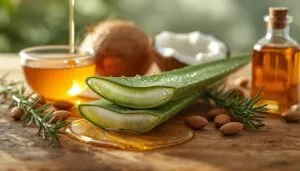
Before you mix anything, it helps to know what you’re actually working with. Each ingredient below does something specific for your hair, so choosing the right ones makes a real difference.
If you want a deeper dive into how these ingredients actually work together, home remedies for hair growth using natural oils and gels breaks it down really well.
Here’s what to grab before you get started.
Fresh Aloe Vera Gel
Fresh aloe vera gel is the star of any DIY aloe vera hair mask recipe — and for good reason. It’s roughly 99% water, so its water content alone gives your strands instant hydration. Its polysaccharide profile, including acemannan, coats each strand gently. Its pH compatibility with hair keeps things balanced.
Here’s what to look for:
- Choose inner-leaf gel — it’s free of the bitter yellow latex
- Check viscosity — fresh gel should feel slippery, not watery
- Use clean extraction techniques — rinse the leaf, slice lengthwise, scoop carefully
- Store correctly — refrigerate in a sealed container for up to one week
Coconut Oil for Deep Conditioning
Coconut oil pulls double duty in a coconut oil and aloe vera hair mask. Its penetrative fatty acids — especially lauric acid — don’t just coat your strands, they absorb into the shaft for real deep conditioning and hair repair.
| Benefit | How It Works | What You’ll Notice |
|---|---|---|
| Cuticle Sealing | Lipid barrier locks in moisture | Softer, smoother feel |
| Hair Slip Enhancement | Reduces friction between strands | Easier detangling |
| Scalp Antimicrobial | Capric and caprylic acids soothe scalp | Less dryness and tightness |
| Oil Absorption Balance | Medium-chain fats absorb without heaviness | No greasy residue |
| Hair Moisturization | Limits swelling from water uptake | Less frizz, less breakage |
Use 2 tablespoons alongside your aloe gel.
Yogurt for Softness and Slip
Plain yogurt does more than you might expect in a yogurt and aloe vera hair mask. Its lactic acid smoothing action gently conditions the cuticle, while the protein coating effect helps each strand feel softer and more manageable.
Yogurt viscosity benefits mean it glides through hair easily, delivering real moisture retention without dripping.
Use 1 tablespoon per mask.
Egg for Strength and Protein
Think of eggs as a repair kit for tired, brittle hair. Egg protein benefits your strands by coating the shaft with amino acids, making hair feel noticeably stronger after rinsing. The yolk delivers fat-soluble nutrients, while egg white concentration offers a higher protein punch.
For your egg and aloe vera hair mask, use one whole egg — it’s the easiest egg mask application you’ll try.
Apple Cider Vinegar for Shine
Apple cider vinegar might be the most underrated ingredient in natural hair care. Its acidity — around pH 3 — makes it a powerhouse for pH Balancing, Cuticle Smoothing, and Buildup Removal all at once. Added to your aloe vera hair mask, it delivers real hair shine improvement, fast.
Here’s what it does for your strands:
- pH Balancing restores your hair’s natural acidity after shampooing, which often leaves it slightly alkaline.
- Cuticle Smoothing flattens the outer hair layer, boosting Light Reflection so strands look glossier.
- Buildup Removal lifts residue from styling products, hard water, and sebum that weigh hair down.
- Dilution Guidelines matter — mix 1–2 tablespoons into 250–500 ml of water before adding to your mask.
- Hair moisturization techniques work better on a clean, balanced scalp, making ACV a smart prep step.
Pure Aloe Vera Hair Mask
Sometimes the simplest recipe is the most effective one. A pure aloe vera mask strips things back to basics, giving your scalp and strands exactly what they need without any extras getting in the way.
Here’s how to make and use it properly.
Simple Aloe-only Recipe
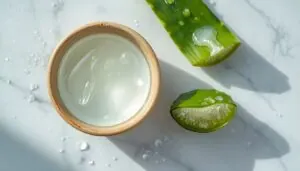
Sometimes the simplest formula is the most effective one. For a pure aloe vera hair mask, you only need 3–4 tablespoons of fresh aloe vera gel — nothing else.
The gel consistency matters here: blend it briefly for smooth, even coverage.
Preparation time is under two minutes, and no extra ingredients mean fewer variables, fewer reactions, and a cleaner result.
Step-by-step Mixing Method
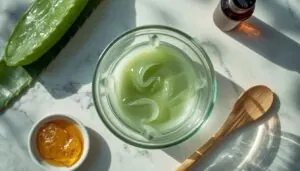
Once your gel is blended smoothly, the rest moves quickly. Follow these three steps for a consistent result every time:
- Gel Consistency Check — Rub a small amount between your fingers. It should feel silky, not stringy or lumpy.
- Temperature Control Tips — Use room-temperature gel so everything mixes without clumping.
- Vinegar Dilution Balance — Stir any add-ins slowly and evenly.
How to Apply Evenly
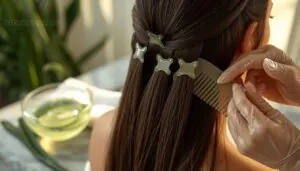
With your mask blended, even application makes all the difference. Start with the Sectioning Method — part your hair into four sections and clip each one. Use the Root-to-End Flow procedure, massaging from scalp outward. Clean Tools and a wide-tooth comb for Comb Distribution prevent patchy spots. Apply the right Mask Quantity — enough for a uniform sheen.
| Step | Action | Tips |
|---|---|---|
| Section Hair | Divide into 4 parts | Work back to front |
| Apply Mask | Roots to ends | Lift hair at parts |
| Comb Through | Wide-tooth comb | Slow, steady strokes |
| Cover | Use a shower cap | Keeps moisture locked in |
Rinsing and Cleansing Tips

Once the timer’s up, step into the shower and rinse with lukewarm water — hot water strips natural oils and leaves hair feeling rough. Focus on Scalp Massage Rinsing, working fingertips in small circles for 30 to 60 seconds.
Follow with a Cool Water Finish to smooth the cuticle. If oiliness lingers, a mild shampoo keeps roots fresh.
For extra nourishment between washes, mixing yogurt into your henna treatment can boost moisture while keeping your color vibrant and intact.
Best Aloe Vera Mask Variations
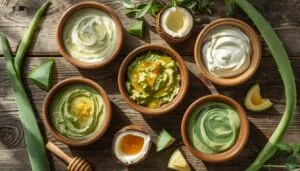
Plain aloe is great on its own, but pairing it with the right ingredient can make a real difference for your specific hair concerns. Each of these combinations targets something a little different — from deep conditioning to frizz control to scalp balance.
Here are five variations worth trying.
Aloe Vera and Coconut Oil
Mix 2 tablespoons of aloe vera gel with 2 tablespoons of coconut oil for a DIY aloe vera hair mask that delivers a real oil-gel emulsion — the aloe drives moisture in while the oil seals it there.
This combination gives you a penetration boost, scalp pH balance, hair elasticity boost, and split end prevention using simple natural hair care ingredients.
Aloe Vera and Yogurt
If your hair feels rough and your scalp runs dry, the aloe vera and yogurt mask is your go-to.
Combine 2 tablespoons of aloe vera gel with 1 tablespoon of Greek yogurt.
Yogurt’s lactic acid benefits loosen surface buildup while its proteins deliver protein enrichment straight to the shaft.
Together, they offer slip enhancement, cooling sensation, and pH balance — one of the simplest DIY aloe vera hair mask recipes around.
Aloe Vera and Egg
When your strands feel both dry and fragile, the egg-and-aloe combo targets Protein Moisture Balance beautifully. Egg yolk deposits a conditioning film — Film Formation Dynamics in action — while aloe keeps it spreadable and light.
For this DIY aloe vera hair mask, you’ll need:
- 5 tbsp aloe vera gel
- 1 whole egg
- Clean bowl and brush
- Cool water for rinsing
- Mild shampoo
Application Timing Tips: leave it on for roughly 20 minutes — no longer, or the egg dries stiff. Allergy Precautions matter here: Scalp Sensitivity Management starts with a patch test. This is one of the most effective hair mask recipes using simple aloe vera hair mask ingredients and preparation steps.
Aloe Vera and Apple Cider Vinegar
Want shinier, smoother strands without a complicated routine? This DIY aloe vera hair mask pairs 2 tablespoons of aloe vera gel with 1 tablespoon of apple cider vinegar — one of the simplest hair mask recipes you’ll find.
Apple cider vinegar manages pH Balancing through Scalp Acidification and Cuticle Smoothing, while aloe softens the mix.
Always prioritize Dilution Ratios and Irritation Prevention: never skip patch testing first.
Aloe Vera and Jojoba Oil
This aloe vera hair mask might be your scalp’s new best friend. Blend 2 tablespoons of aloe vera gel with 1 tablespoon of jojoba oil for lightweight conditioning that won’t weigh your hair down. Their ingredient synergy promotes Scalp pH Balance and slip enhancement naturally.
- Smooths rough, dry strands without greasiness
- Boosts moisture through the full hair length
- Gentle enough for sensitive scalps
- Easy DIY aloe vera hair mask with minimal ingredients
Apply for 20–30 minutes, then rinse.
Use It Safely and Store It
Getting the most from your aloe mask isn’t just about the recipe — it’s also about using it the right way. A few simple habits can protect your scalp, keep your mixture fresh, and help you avoid any unwanted reactions.
Here’s what you need to know before you start.
Patch Test Before First Use
Before you coat your hair in any new mask, do a quick patch test — it’s a simple step that can save you a lot of grief.
Clean a small area on your inner forearm or behind your ear (your Patch Test Site), apply a pea-sized amount, and wait. Here’s what to watch for:
| What to Check | Details |
|---|---|
| Testing Duration | Leave on 24–48 hours without rinsing |
| Skin Preparation | Clean, unbroken skin only |
| Reaction Signs | Redness, itching, swelling, or burning |
| Result Interpretation | No reaction? You’re good to go |
If anything feels off mid-test, rinse immediately. Safety and patch testing for aloe vera matter — especially if you’re sensitive to plants. When in doubt, consult a dermatologist for hair issues before proceeding.
Best Application Frequency by Hair Type
How often you use an aloe vera hair mask depends entirely on your hair type. More isn’t always better — overuse can lead to buildup or a heavy feel.
- Fine Oily Schedule: Every 10–14 days, applied after washing, kept off the roots
- Wavy Hair Timing / Dry Ends Schedule: Weekly to every 10 days, focused on mid-lengths
- Curly Hair Frequency / Dandruff Scalp Interval: Weekly for curls; twice weekly max for dandruff-prone scalps
How to Store Fresh Aloe Gel
Fresh aloe vera gel doesn’t last long at room temperature, so storage matters as much as prep. Keep it in Airtight Glass Jars with Minimal Headspace Packing to reduce air contact, and refrigerate between 4–8°C for up to 10 days. For longer use, freeze in ice cube trays — each cube thaws perfectly for one mask session.
| Storage Method | How Long It Lasts |
|---|---|
| Room temperature | A few hours only |
| Refrigeration (4–8°C) | 7–10 days |
| Freezing (ice cubes) | Up to 6 months |
| Improper sealing | Degrades quickly |
Practice Light‑Free Cool Storage — away from sunlight and heat sources. Check for color changes or off smells before using.
When to Avoid Aloe Masks
Knowing when to skip the mask is just as important as knowing how to make one. Aloe suits most people, but not everyone.
- Stop use immediately if you notice scalp irritation, burning, or a severe allergic reaction.
- Avoid aloe if you have an active scalp infection or a compromised skin barrier.
- Always do a patch test before use if you’re new to aloe.
- Check pregnancy contraindications and child safety concerns with your doctor first.
- Consult a dermatologist for hair issues that persist despite regular masking.
Frequently Asked Questions (FAQs)
Can you make a hair mask with Aloe vera gel?
Yes, you absolutely can. Aloe vera gel works as a complete hair mask on its own — just apply it straight to damp strands, wait 20 minutes, and rinse.
Do homemade aloe vera masks work?
Homemade aloe vera masks do work — but results are temporary. Each wash resets the benefits, so consistency matters more than any single application.
How long do you leave aloe vera mask on?
Leave your aloe vera mask on for 5 to 20 minutes. That’s your ideal contact time — long enough to moisturize, short enough to avoid dryness risk timing or scalp irritation threshold issues.
Do I apply aloe vera on wet or dry hair?
Damp hair wins every time. Your hair and scalp absorb aloe vera more evenly when there’s a little moisture already present — think towel-dried, not dripping.
Can aloe vera masks replace a conditioner entirely?
Aloe vera masks excel at moisture lock and scalp pH balance, but they can’t fully replace conditioner.
For slip and detangling, you’ll still need conditioning agents that Aloe simply doesn’t provide.
Does aloe vera work on color-treated hair?
Yes, aloe vera works well on color-treated hair.
Its water-based moisture helps prevent fading, scalp pH balance, and hair cuticle repair — keeping chemically treated hair softer, shinier, and less prone to breakage.
Can you mix aloe vera with castor oil?
Absolutely — castor oil and aloe vera gel mix well together. Since aloe is water-based and castor oil is oil-based, expect some separation.
Just stir before applying, and you’re good to go.
Is store-bought aloe gel as effective as fresh?
Both can work. Fresh gel is more potent but spoils quickly. Store-bought offers safer Microbial Safety and longer Shelf Life — just check that it’s free of alcohol and fragrances.
How long until you see hair growth results?
Real hair growth takes time. Most people notice softer strands within days, reduced shedding around 4 weeks, and visible length gains after 2 to 3 months of consistent care.
Conclusion
Think of aloe vera as a reset button for your hair—one that’s been hiding in plain sight. Your strands don’t need a complicated routine to feel stronger, softer, and calmer at the scalp.
A simple, well-made aloe vera hair mask recipe, used consistently, does the quiet work that expensive products often promise but rarely deliver. Start with what you have, patch test first, and let the plant do what it’s always done best.