This site is supported by our readers. We may earn a commission, at no cost to you, if you purchase through links. This content is for general informational and educational purposes only and is not a substitute for professional medical, dermatological, or nutritional advice.
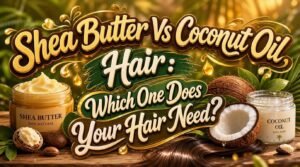
Both shea butter and coconut oil sit in millions of bathroom cabinets, often used interchangeably—but they work in completely opposite ways. Coconut oil penetrates the hair shaft, binding to proteins from the inside out, while shea butter remains on the surface, sealing moisture behind a protective film.
Using the wrong one for your hair type doesn’t just waste product; it can leave strands weighed down, dry, or blocked from absorbing moisture altogether.
Knowing which one your hair actually needs—and when— makes the difference between a routine that works and one that merely feels effective.
Table Of Contents
- Key Takeaways
- Shea Butter Vs Coconut Oil: Key Differences Explained
- How Hair Type and Porosity Affect Your Choice
- Shea Butter Vs Coconut Oil: Benefits and Drawbacks
- Top 10 Shea Butter and Coconut Oil Hair Products
- 1. TheSoapery Organic Raw Shea Butter
- 2. Maui Moisture Shea Butter Hair Mask
- 3. Garnier Banana Hair Food Mask
- 4. SheaMoisture Coconut Oil Hydrating Moisturizer
- 5. Eos Shea Better Coconut Lotion
- 6. Tree Hut Coco Colada Body Butter
- 7. SoShea Black Coconut Whipped Shea Butter
- 8. Petal Fresh Coconut Argan Body Butter
- 9. Palmer’s Raw African Shea Body Balm
- 10. SheaMoisture Illuminating Coconut Hibiscus Body Butter
- How to Use Shea Butter and Coconut Oil Effectively
- Frequently Asked Questions (FAQs)
- Conclusion
Key Takeaways
- Coconut oil penetrates your hair shaft to protect proteins from the inside, while shea butter stays on the surface to lock in moisture—so using the wrong one for your hair type can leave strands dry, weighed down, or blocked from absorbing anything at all.
- Your hair’s porosity is the deciding factor: low-porosity and fine hair does better with coconut oil’s lighter weight, while thick, curly, or high-porosity hair benefits most from layering coconut oil first, then sealing with shea butter on top.
- Both oils build up over time, so clarifying every two to four weeks isn’t optional—it’s what keeps your routine actually working instead of just feeling like it does.
- Neither oil directly stimulates hair growth, but reducing breakage with the right one makes growth more visible, which is where most of the real benefit lies.
Shea Butter Vs Coconut Oil: Key Differences Explained
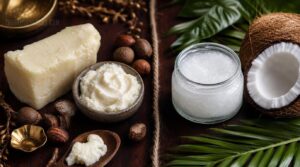
These two ingredients work very differently — and that difference matters more than most people realize. Before you choose one (or both), it helps to understand what’s actually in them and how they interact with your hair.
Knowing the key differences between a hair mask and deep conditioner can save you from layering products that work against each other.
Here’s what sets them apart.
Nutrient and Fatty Acid Profiles Compared
Both oils share a medium-chain fatty acids versus long-chain saturated fat composition, but their internal structures tell distinct stories. Coconut oil relies on lauric acid (C12:0), while shea butter is built on stearic acid (C18:0). This fundamental difference shapes their downstream properties.
| Feature | Coconut Oil | Shea Butter |
|---|---|---|
| Key fatty acid | Lauric (C12:0) | Stearic (C18:0) |
| Saturated/unsaturated balance | Highly saturated | More balanced |
| Unsaponifiable bioactives | Minimal | Rich (vitamins A, E, F) |
Shea butter also contains minor lipid fractions and antioxidant compounds absent in coconut oil. These differences in vitamin content between shea butter and coconut oil significantly impact long-term follicle health. Both oils provide essential fatty acids, which the body cannot synthesize and must obtain from dietary sources.
How Each Ingredient Penetrates or Coats Hair
Molecular size explains everything here. Coconut oil’s small lauric acid molecules penetrate past the cuticle and reach the cortex, acting as a true penetrative hair treatment. In contrast, shea butter’s larger stearic compounds remain on the surface, relying on cuticle adhesion and film durability to coat the strand like a protective seal.
| Property | Coconut Oil | Shea Butter |
|---|---|---|
| Penetration depth | Deep (cortex) | Surface only |
| Heat activation | Low heat needed | Requires warming |
Moisture Sealing Vs Internal Protein Protection
Penetration depth comparison reveals distinct roles for each ingredient. Coconut oil ensures internal protein retention — its lauric acid binds to hair proteins, significantly reducing protein loss. Shea butter prioritizes moisture retention balance through occlusive film dynamics, sealing the cuticle for external protection.
| Factor | Coconut Oil | Shea Butter |
|---|---|---|
| Primary role | Sealant vs penetrative hair treatments: penetrative | Occlusive sealant |
| Protein loss metrics | High reduction | Moderate |
| Cuticle stability impact | Internal strengthening | Surface sealing |
Together, they deliver complete care.
Texture, Scent, and Processing Considerations
Beyond what they do inside your hair, how each feels and smells matters day-to-day. Raw shea butter is heavier in texture with noticeable aroma persistence—that earthy scent lingers. Refined shea butter loses some nutrients through refinement filtration but spreads more evenly.
If that nutty, earthy scent feels overpowering at first, this guide on why shea butter smells the way it does explains what causes it and how to tone it down.
Coconut oil is lighter in texture, with viscosity modulation through heat and a familiar coconutty smell.
| Factor | Shea Butter | Coconut Oil |
|---|---|---|
| Consistency | Whipped Consistency, waxy | Fluid, fast-spreading |
| Melt Temperature | Gradual, holds shape | Abrupt, can drip |
| Scent | Nutty, slow-releasing | Light, immediate |
How Hair Type and Porosity Affect Your Choice
Not every oil works for every head of hair — and that gap comes down to your hair type and porosity. The right choice depends on how well your strands absorb and hold onto moisture.
Here’s how each option stacks up for different hair needs.
For Fine or Low-Porosity Hair
Fine or low-porosity hair is fundamentally a closed door — moisture struggles to get in, and heavy products just pile up outside. That’s why lightweight moisturizers work best here, not thick butters or oils.
- Skip heavy oil usage on low porosity or fine hair — shea butter, heavier in texture, can block water absorption entirely.
- Coconut oil, lighter in texture, works better but still needs heat-activated absorption to penetrate effectively.
- Buildup control matters — clarifying regularly keeps strands fresh.
Volume-boosting tips start with gentle sealing, not smothering.
For Thick, Curly, or High-Porosity Hair
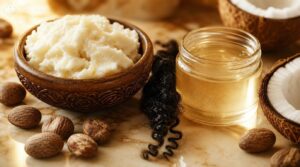
Thick, curly, or high porosity hair loses moisture almost as fast as it absorbs it — so hydration retention isn’t optional, it’s everything. Shea butter versus coconut oil for hair like yours isn’t really a competition; it’s a partnership.
For high-porosity hair, shea butter and coconut oil aren’t rivals — they’re partners in keeping moisture where it belongs
Use coconut oil first for deep slip enhancement and protein support, then layer shea butter to seal. This moisture-layering approach ensures optimal hydration.
The method improves curl clumping, controls frizz, and keeps buildup manageable with regular cleansing.
For Damaged or Brittle Hair
When hair feels brittle and snaps with the lightest touch, natural moisturizers have a role. Coconut oil works internally—binding to proteins for breakage prevention and an elasticity boost. Shea butter manages hydration lock and split-end treatment externally.
For curly hair especially, pairing these treatments with a lightweight mousse for frizz-free curl definition can restore bounce without sacrificing the moisture you’ve worked to lock in.
Together, they make a deep conditioning duo. For hair brittleness, use coconut oil first, then seal with shea butter.
Scalp Health and Sensitivity Considerations
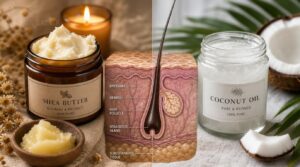
Your scalp matters as much as your strands. Shea butter’s anti-inflammatory properties soothe dry, irritated skin, while coconut oil’s antifungal properties help keep dandruff in check. However, both ingredients are occlusive—overuse risks buildup that traps heat and sweat, weakening the barrier integrity.
For scalp nourishment without reactivity:
- Always patch test first, especially if you have fragrance sensitivity
- Avoid applying either directly to an already-inflamed scalp
- Clarify monthly to prevent occlusive buildup
Shea Butter Vs Coconut Oil: Benefits and Drawbacks
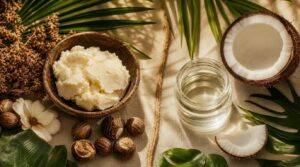
Both shea butter and coconut oil bring real benefits to your hair — but they don’t work the same way, and knowing the difference helps you use them smarter.
Each one has its strengths, and yes, a few drawbacks worth knowing before you reach for the jar. Here’s a closer look at what each one actually does.
Frizz Control in Humid Vs Dry Climates
Your climate determines which product wins the frizz battle. Humidity Swelling raises the Dew Point effect on high-porosity strands, breaking down your moisture barrier quickly. Coconut Oil’s Water-Resistant Coating blocks humid air more effectively, while Shea butter dominates in dry climates by preventing static and sealing against moisture loss—stopping the Heat-Styling Loop before it starts.
In humid conditions, Coconut Oil’s lightweight, water-resistant coating resists moisture uptake, making it the optimal choice. For dry or cold climates, Shea Butter’s thick moisture barrier prevents static and dehydration. In mixed climates, layering both products—Coconut Oil to penetrate and Shea Butter to seal—maximizes frizz control.
| Climate | Best Choice | Why It Works |
|---|---|---|
| Humid | Coconut Oil | Lightweight Water‑Resistant Coating resists moisture uptake |
| Dry/Cold | Shea Butter | Thick moisture barrier prevents static and dehydration |
| Mixed | Both layered | Coconut Oil penetrates; Shea butter seals frizz out |
UV Protection and Antioxidant Benefits
Neither oil is a sunscreen — but both offer something worth knowing about.
Shea butter’s cinnamic acid provides a natural SPF of 7–10, acting as a modest physical UV shield. Coconut oil contributes mainly through lipid oxidation prevention via its saturated fat coating.
Their antioxidant properties support scavenging against UV-driven free radicals, though phenolic variability between batches affects potency.
Together, they offer synergistic sun protection as a light, supplementary photoprotection layer — not a replacement for real sun protection.
| Feature | Shea Butter vs Coconut Oil |
|---|---|
| Natural SPF Properties | Shea ~7–10 via cinnamic acid; Coconut Oil minimal |
| Physical UV Shield | Shea butter’s occlusive layer; Coconut Oil’s hydrophobic film |
| Antioxidant Scavenging | Shea stronger due to vitamins A & E |
| Lipid Oxidation Prevention | Both coat cuticle; Coconut Oil slightly more effective |
| Phenolic Variability | Higher in raw, unrefined versions of both |
Antifungal and Anti-Inflammatory Properties
Beyond UV defense, both oils offer real microbial and inflammatory benefits.
Coconut oil’s lauric acid antifungal action disrupts fungal membranes, helping manage dandruff and yeast infections. Shea butter works differently — its unsaponifiable sterol protection and occlusive barrier effect calm irritation and support scalp microbiome balance through hydration‑driven anti‑inflammation.
| Property | Shea Butter vs Coconut Oil |
|---|---|
| Antifungal action | Coconut oil via lauric acid |
| Anti-inflammatory effect | Shea butter’s sterols and fatty acids |
| Occlusive barrier | Shea butter rates higher |
| Antimicrobial properties | Coconut oil stronger |
| Scalp microbiome balance | Both support, different mechanisms |
Risks of Overuse and Product Buildup
Both oils work best when you use restraint. Heavy application creates Coating Blockage — an occlusive film that stops moisture and conditioners from reaching the shaft. Over time, Buildup-Induced Dullness and Hair Weight Gain flatten your strands, while Greasy Slip replaces true softness. Frequent Clarifying Needed becomes your reality.
| Issue | Shea Butter | Coconut Oil |
|---|---|---|
| Product buildup | Thick, waxy residue | Hardens, feels gummy |
| Heavy oils on fine hair | Weighs strands flat | Causes greasy hair |
| Product buildup removal | Needs clarifying shampoo | Emulsify before rinsing |
Using clarifying shampoo monthly to prevent product buildup keeps both oils performing effectively.
Top 10 Shea Butter and Coconut Oil Hair Products
Finding the right product can feel like half the battle. Whether you’re Team Shea Butter, Team Coconut Oil, or somewhere in between, there are some standout options worth knowing about. Here are ten products that deliver real results.
1. TheSoapery Organic Raw Shea Butter
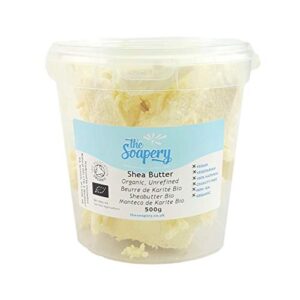
TheSoapery Organic Raw Shea Butter is a solid starting point for those seeking a clean and uncomplicated product. It’s 100% pure, unrefined, and certified organic — with no fillers or synthetic additives.
This purity matters because processing strips nutrients, and this formulation preserves vitamins A and E intact.
The shea butter delivers a full fatty acid profile, including oleic and stearic acids, which soften strands and seal moisture effectively.
At 500g, it’s practical for regular use. Simply warm it between your palms before application for optimal results.
| Best For | Anyone who wants a pure, no-fuss moisturizer for skin, hair, or lips — especially if you’re into clean, natural ingredients with zero synthetic additives. |
|---|---|
| Key Ingredient | Pure Shea Butter |
| Primary Use | Skin & Hair |
| Vegan Friendly | Yes |
| Paraben Free | Yes |
| Price (USD) | Not Listed |
| Net Weight | 500g |
| Additional Features |
|
- 100% pure and certified organic — no fillers, no surprises
- Great for deep moisture on skin, hair, and lips all in one product
- 500g gives you plenty to work with for regular use
- Solid at room temp, so you’ll need to warm it up before applying
- May not work for anyone with nut or tree-oil sensitivities
- Not for internal use, so it’s strictly a topical product
2. Maui Moisture Shea Butter Hair Mask
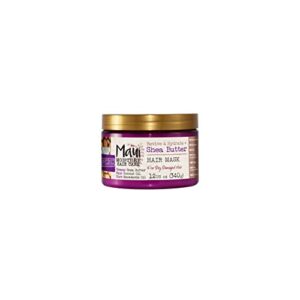
Maui Moisture Heal and Hydrate Shea Butter Hair Mask earns its place for adaptability. At $15.75 for 340g, it combines shea butter with coconut oil, macadamia oil, and aloe vera juice—a blend that works from the inside out. The silicone-free formula is thick enough to coat every strand without dripping.
Use it weekly as a rinse-off mask or leave a small amount in after washing. Fine hair types should go easy on the amount.
| Best For | Anyone with dry, damaged, or chemically treated hair—especially curly, afro, or thick hair types that need deep moisture without silicone buildup. |
|---|---|
| Key Ingredient | Shea Butter & Coconut Oil |
| Primary Use | Hair Treatment |
| Vegan Friendly | Yes |
| Paraben Free | Not Stated |
| Price (USD) | $15.75 |
| Net Weight | 340g |
| Additional Features |
|
- Shea butter, coconut oil, and macadamia oil work together to soften and strengthen hair noticeably after just a couple of uses
- Super versatile—rinse it out like a regular mask or leave a little in for extra hydration
- Vegan-certified and silicone-free, so it won’t weigh your hair down or cause product buildup over time
- Can feel wet and greasy at first, and the scent runs strong—might be a lot if you’re sensitive to fragrance
- Works best with consistent weekly use; don’t expect a single application to be a game-changer
- A few users found it caused frizz or temporary shedding when layered with other products, so results can vary
3. Garnier Banana Hair Food Mask
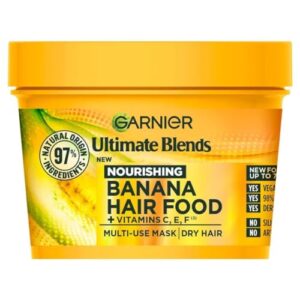
Garnier’s Banana Hair Food Mask pulls double duty as a conditioner, rinse-out mask, and leave-in — all in one 390 ml jar for under $16.
The formula pairs banana extract with shea butter, aloe vera, and coconut to deliver moisture without the heavy feel you’d expect from a mask. It’s vegan, 98% natural origin, and silicone-free.
Best suited for dry or medium-thickness hair. If your hair runs fine or low-porosity, use a light hand — too much can weigh strands down.
For thicker, coarser textures that struggle most with humidity, these anti-frizz serums for African American hair are formulated to tame flyaways and lock in lasting smoothness.
| Best For | Anyone with dry or medium-thickness hair who wants deep moisture without the weight of a heavy mask. |
|---|---|
| Key Ingredient | Shea Butter & Banana |
| Primary Use | Hair Conditioning |
| Vegan Friendly | Yes |
| Paraben Free | Not Stated |
| Price (USD) | $15.87 |
| Net Weight | 390ml |
| Additional Features |
|
- Three products in one — works as a conditioner, rinse-out mask, or leave-in, so it’s easy to get more mileage out of a single bottle.
- Packed with natural ingredients like banana extract, shea butter, and aloe vera — and it’s vegan with 98% natural-origin ingredients.
- Claims to cut breakage up to 4x when used as a rinse-out mask, which is a solid win for fragile or damaged hair.
- Can feel too heavy for fine or low-porosity hair — a little goes a long way, and too much will weigh strands down.
- Some users have reported skin irritation, so a patch test is worth it before going all in. If puffiness is your main concern, these under-eye creams for puffiness are gentle enough to test on that delicate area first. Since many AI skincare tools lack published validation, it helps to compare them against broader personalized skincare routine trends before trusting any single recommendation.
- The breakage-reduction claim only applies to the mask mode — don’t expect the same results if you’re using it as a leave-in or conditioner.
4. SheaMoisture Coconut Oil Hydrating Moisturizer
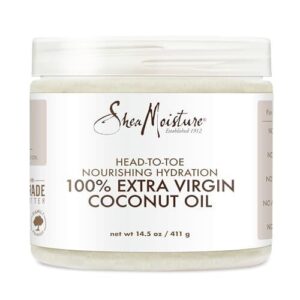
SheaMoisture’s Coconut Oil Hydrating Moisturizer brings the best of both worlds into one bottle — 100% virgin coconut oil paired with shea butter for layered, lasting moisture.
At 16 fl oz and widely available, it’s a practical everyday option. The formula absorbs quickly without leaving a greasy film, making it suitable for dry to combination hair types.
Free from parabens and mineral oil, it delivers straightforward, plant-based nourishment that nourishes hair without unnecessary additives.
| Best For | Anyone looking for a simple, clean, all-in-one moisturizer they can use head to toe — especially people with dry skin or hair who want something natural and no-fuss. |
|---|---|
| Key Ingredient | Coconut Oil |
| Primary Use | Hair & Skin |
| Vegan Friendly | Not Stated |
| Paraben Free | Yes |
| Price (USD) | $13.42 |
| Net Weight | 415g |
| Additional Features |
|
- 100% pure, unrefined coconut oil with no parabens, sulfates, or mineral oil — what you see is what you get.
- Truly multi-purpose: works on hair, skin, cuticles, lips, and even oil pulling, so one jar does a lot.
- Absorbs without a heavy greasy feel, leaving skin soft rather than slick.
- Melts in warm environments, so storage matters — a hot bathroom or summer shipping can turn it into a liquid mess.
- Can leave oil stains on pillowcases or clothes if you don’t give it time to fully sink in.
- Those with oily skin may find it too rich, and removing makeup with it might need a follow-up cleanse.
5. Eos Shea Better Coconut Lotion
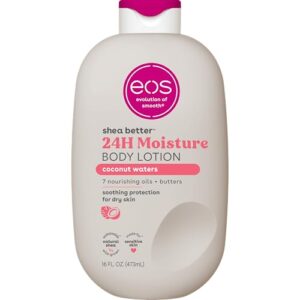
EOS Shea Better Coconut Lotion keeps things simple — and that’s exactly its strength. At $8.98 for 16 fl oz, it combines shea butter and shea oil for 24-hour hydration without the greasy aftermath that heavier formulas leave behind.
The fast-absorbing, vegan-friendly formula suits daily use, offering lightweight moisture ideal for all skin types.
Its coconut-hibiscus scent is pleasant without being overpowering, ensuring freshness without sensory overload.
One minor drawback: the pump can deliver inconsistent amounts, requiring a few extra presses to achieve desired coverage.
| Best For | Anyone who wants an affordable, everyday moisturizer that absorbs quickly and skips the greasy feel — especially great for dry or sensitive skin types who prefer plant-based products. |
|---|---|
| Key Ingredient | Shea Oil & Shea Butter |
| Primary Use | Body Moisturizer |
| Vegan Friendly | Yes |
| Paraben Free | Not Stated |
| Price (USD) | $8.98 |
| Net Weight | 473ml |
| Additional Features |
|
- 24-hour hydration at a budget-friendly $8.98 for a generous 16 fl oz
- Lightweight, fast-absorbing formula that won’t leave your skin feeling sticky or heavy
- Vegan and cruelty-free with natural shea and coconut ingredients
- The coconut scent leans sweet, so it might not be everyone’s cup of tea
- The pump can be finicky, sometimes spitting out air before it delivers actual lotion
- Can feel a bit thick on oily skin, especially in hot or humid weather
6. Tree Hut Coco Colada Body Butter
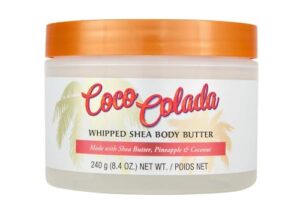
Tree Hut Coco Colada Body Butter isn’t marketed as a hair product, but its shea butter and coconut oil base makes it worth a second look for dry ends and scalp care.
At $8.94 for 8.4 oz, it’s an affordable option that delivers solid emollient support. The whipped, non-greasy texture absorbs without heavy residue, and the coconut-pineapple scent is genuinely pleasant.
Just keep it away from fine hair — the richness can weigh strands down fast.
| Best For | Anyone with dry skin who wants a lightweight, affordable daily moisturizer with a fun tropical scent. |
|---|---|
| Key Ingredient | Shea Butter & Coconut Oil |
| Primary Use | Body Butter |
| Vegan Friendly | Yes |
| Paraben Free | Yes |
| Price (USD) | $8.94 |
| Net Weight | 237ml |
| Additional Features |
|
- Whipped texture absorbs quickly without feeling greasy or heavy on the skin
- Shea butter and coconut oil combo delivers real, lasting hydration
- Clean formula — no parabens, sulfates, or animal-derived ingredients
- The scent won’t work for everyone, and it may fade faster than expected
- Not a good fit for fine hair — the rich oils can weigh strands down
- Only comes in one size, so no bulk option if you go through it fast
7. SoShea Black Coconut Whipped Shea Butter
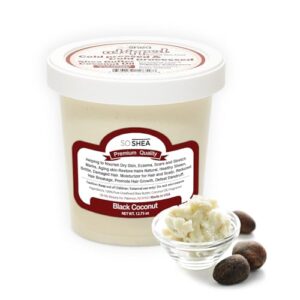
SoShea Black Coconut Whipped Shea Butter effectively pulls double duty, serving as both a skincare and haircare solution. It combines 100% raw African shea butter—sourced from Ghana and whipped at low temperatures—with a coconut oil infusion. This formulation hydrates without added water, ensuring a concentrated, nourishing base.
The product’s airy texture spreads easily and absorbs quickly, leaving minimal residue. This lightweight finish makes it ideal for use as a daily sealant or frizz smoother, particularly for curly or textured hair.
Priced at $15.99 for 11.5 oz, the product is cold-processed and free of parabens and mineral oil, aligning with clean beauty standards. Its practical, no-fuss design caters to those seeking hydration and manageability without compromising on purity.
| Best For | Anyone with dry skin, curly or textured hair, or sensitive skin who wants a clean, multipurpose moisturizer that works from head to toe. |
|---|---|
| Key Ingredient | African Shea Butter |
| Primary Use | Skin & Hair |
| Vegan Friendly | Yes |
| Paraben Free | Yes |
| Price (USD) | $15.99 |
| Net Weight | 326g |
| Additional Features |
|
- Deeply hydrating without feeling heavy or greasy — absorbs fast and leaves minimal residue
- Clean formula with no parabens, mineral oil, or synthetic dyes, so it’s safe for sensitive and eczema-prone skin
- Pulls double duty as both a skin moisturizer and a hair conditioner, making it a solid two-in-one buy
- The initial scent can be strong — some people may find the earthy smell or lavender aroma a bit much before it settles
- Natural batch variation means your jar might look, feel, or smell slightly different from someone else’s
- A few users have noticed a faint added fragrance despite the product being marketed as unscented, which could be a concern for fragrance-sensitive folks
8. Petal Fresh Coconut Argan Body Butter
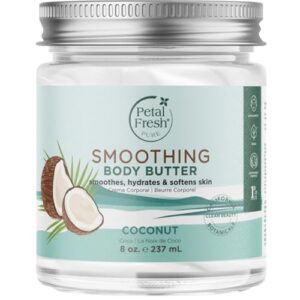
Petal Fresh Coconut Argan Body Butter isn’t marketed as a hair product, but don’t overlook it for dry ends. Its formula combines coconut oil, argan oil, and shea butter into a rich blend that absorbs without leaving residue.
This trio delivers moisture sealing, vitamin E support, and fatty acids to nourish hair. At $9.00 for 8 oz, it offers an affordable option for targeted hydration.
Use a small amount sparingly on ends only—avoid scalp application, as it may cause buildup with heavy use.
| Best For | Anyone looking for an affordable, multi-use moisturizer that can double as a dry-ends treatment for hair. |
|---|---|
| Key Ingredient | Coconut Oil & Shea Butter |
| Primary Use | Body Moisturizer |
| Vegan Friendly | Yes |
| Paraben Free | Yes |
| Price (USD) | $9.00 |
| Net Weight | 227g |
| Additional Features |
|
- Coconut oil, argan oil, and shea butter work together to deliver real, lasting hydration
- Absorbs without a greasy finish, so it’s easy to use daily or right after a shower
- At $9 for 8 oz, it’s a budget-friendly pick that pulls double duty for skin and hair
- Very dry skin may need reapplication within a day—it doesn’t have the longest staying power
- Sensitive skin types should patch test first, since a few users reported irritation or burning
- The initial application can feel a bit heavy, so you’ll want to start with a small amount and work up
9. Palmer’s Raw African Shea Body Balm
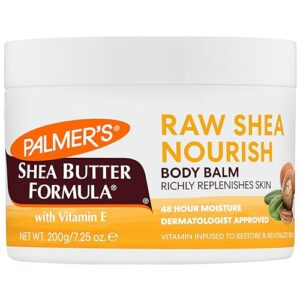
If you want something straightforward and effective, Palmer’s Raw African Shea Body Balm delivers. At $7.68 for 7.41 oz, it’s built around ethically sourced African shea butter and backed by vitamin E, coconut oil, and cocoa butter — a solid lineup for sealing moisture on dry ends.
It melts on contact, so warming it between your palms first makes spreading easier. Keep it off your scalp to avoid buildup, and focus application on mid-lengths and ends where dryness hits hardest.
| Best For | Anyone with extremely dry skin — especially elbows, heels, and feet — who wants a no-fuss, budget-friendly moisturizer that actually delivers. |
|---|---|
| Key Ingredient | Raw Shea Butter |
| Primary Use | Skin Moisturizer |
| Vegan Friendly | Yes |
| Paraben Free | Yes |
| Price (USD) | $7.68 |
| Net Weight | 210g |
| Additional Features |
|
- Deep, long-lasting hydration — users report soft, glowing skin for up to 48 hours after one application.
- Clean, plant-based formula with shea butter, cocoa butter, coconut oil, and vitamin E — no synthetic fillers.
- Incredibly affordable at $7.68 for over 7 oz, and easy to customize by mixing with your favorite lotion or fragrance oil.
- The solid texture means you have to warm it up first — it won’t glide on straight out of the container.
- Absorption takes a while (10–15 minutes), so it’s not great if you’re in a hurry.
- Can feel heavy in hot or humid weather, and the formula has reportedly gotten harder over time, so you might end up using more product per application.
10. SheaMoisture Illuminating Coconut Hibiscus Body Butter
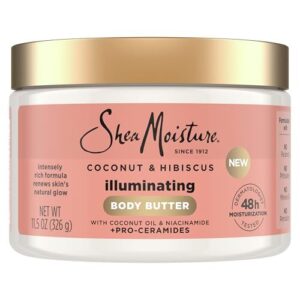
For something with a bit more finesse, the SheaMoisture Illuminating Coconut Hibiscus Body Butter earns its spot. At $11.15 for 11.5 oz, it pairs Fair-Trade shea butter with coconut oil, niacinamide, and Pro-Ceramides — a combination that moisturizes and strengthens your skin barrier for up to 48 hours. It’s dermatologist-tested and formulated specifically for melanin-rich skin.
The texture absorbs cleanly without a heavy residue.
Note that the coconut-hibiscus fragrance runs strong, and it’s not ideal for acne-prone skin.
| Best For | Anyone with melanin-rich or dry skin who wants a budget-friendly body butter that hydrates deeply and adds a subtle glow. |
|---|---|
| Key Ingredient | Shea Butter & Coconut Oil |
| Primary Use | Body Butter |
| Vegan Friendly | Not Stated |
| Paraben Free | Yes |
| Price (USD) | $11.15 |
| Net Weight | 326g |
| Additional Features |
|
- Packs niacinamide, Pro-Ceramides, and Fair-Trade shea butter into one formula — solid barrier support for under $12
- 48-hour hydration claim holds up well for rough spots like elbows, knees, and heels
- Fast-absorbing and free of parabens, phthalates, petrolatum, and mineral oil
- Coconut-hibiscus scent is strong — not great if you’re sensitive to fragrance
- Can feel a little thick or sticky before it fully soaks in
- Not the best pick for acne-prone skin since coconut oil can clog pores
How to Use Shea Butter and Coconut Oil Effectively
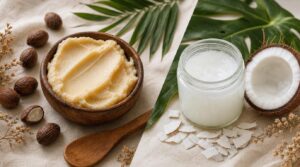
Knowing which ingredient works for your hair is only half the battle — how you use it makes all the difference. Both shea butter and coconut oil have specific application methods that help you get the most out of them without the buildup or greasiness.
Here’s what you need to know to use each one the right way.
Pre-Shampoo and LOC Method Application Tips
Before layering anything, start with a prewash treatment for that Detangling Slip Boost — coconut oil applied 15–30 minutes pre-shampoo protects strands while you work through knots. After your Pre-Poo Rinse timing, build your LOC method:
- Liquid Layer Refresh damp hair first
- Apply a Thin Oil Seal over each section
- Use Sectioned Cream Application with Shea butter last
- Match oil absorption in hair to your hair porosity
- Adjust based on your comparison of Shea butter and coconut oil for hair care needs
Recommended Usage Frequency for Each Ingredient
Once your LOC layers are set, frequency becomes the next variable to manage. Use coconut oil as a prewash treatment once weekly. Reduce to a biweekly rotation if your hair feels stiff.
Apply shea butter as a leave-in or deep conditioner two to three times weekly.
Make seasonal adjustments for drier months, and watch for buildup detection signals like limpness or coating, especially with porosity-specific timing for low-porosity hair.
Using a Clarifying Shampoo to Prevent Buildup
Even with a solid routine, shea butter and coconut oil build up over time. A clarifying shampoo delivers a true scalp reset, lifting residue that regular shampoos miss.
- Clarify every 2–4 weeks for standard use
- Every 1–2 weeks if you swim or use heavy products
- More often if you live in a hard water area
Always follow with post-cleanse moisturizing to restore balance.
Storage Tips for Maximum Freshness and Potency
How you store these ingredients matters more than most people realize. Both are temperature sensitive and degrade fast with light, air, or moisture.
| Storage Factor | Shea Butter & Coconut Oil |
|---|---|
| Airtight sealing | Use glass jars with tight lids |
| Cool dark storage | Cabinet or drawer away from heat |
| Moisture prevention | Always use dry, clean tools |
| Clean handling | Never double-dip with wet fingers |
| Odor monitoring | Discard if sour or off-smelling |
Raw shea butter belongs in a cool space, even the fridge. Keep coconut oil in dark, dry places at room temperature.
Frequently Asked Questions (FAQs)
Which is better for your hair, shea butter or coconut oil?
Neither wins outright. The better choice depends on your hair type, porosity, and goals. Coconut oil penetrates the strand; shea butter seals the surface. Your hair’s needs decide the winner.
Can shea butter clear keloid?
"Hope isn’t a strategy."
Shea butter may help flatten keloids over time, thanks to its anti-inflammatory and antioxidant properties, but it’s not a guaranteed cure. Medical treatment alternatives remain the most reliable option.
Does coconut oil help with cortisol?
Some animal studies suggest coconut oil may support cortisol balance through its antioxidant and anti-inflammatory properties, but human data gaps remain. Don’t rely on it as a hormone treatment.
Can you mix shea butter and coconut oil together?
Yes, you can. Both are fat-based, so they blend smoothly when warmed.
Adjust the ratio to suit your hair’s needs — more shea for sealing, more coconut oil for lighter hold.
Which is better for hair growth stimulation?
Honestly, both are limited here. Hair growth stimulation depends on follicle health, hormones, and scalp circulation — not oils alone.
That said, a good scalp massage routine can boost circulation and give your follicles a gentle nudge in the right direction.
They reduce breakage, which can make growth more visible, but neither directly stimulates follicles.
Are these oils safe during pregnancy or chemotherapy?
Both oils are generally safe topically, but patch testing matters. During pregnancy or chemotherapy, prioritize product purity and medical clearance, as contact dermatitis risk rises with added fragrances or preservatives.
Conclusion
The right tool for the right job—that’s not just workshop wisdom, it applies to your hair care shelf too. In the shea butter vs coconut oil debate, there’s no universal winner.
Coconut oil works from the inside out; shea butter protects from the outside in. Your hair’s porosity, texture, and condition determine which one actually benefits you.
Choose based on what your hair needs, not what works for someone else’s.
- https://pantrybeautyandwellness.com.au/coconut-oil-vs-shea-butter-whats-best-for-your-hair-type/
- https://www.rkthaircare.com/blogs/ingredients/best-coconut-oil-and-shea-butter-for-hair?srsltid=AfmBOoomJ2ENs7-9xBCsDYWqdmS9oh63plDaa8DcNSSv2WoTKl7QF_iZ
- https://www.hairlineillusions.com/post/decoding-hair-oils-unveiling-the-high-penetration-soakers-and-surface-coaters-in-hair-products?srsltid=AfmBOorVsiBrfrLj76QuP_h61m62ryMPlyUae6b4KcMS-g4ks4Zk1XXN