This site is supported by our readers. We may earn a commission, at no cost to you, if you purchase through links. This content is for general informational and educational purposes only and is not a substitute for professional medical, dermatological, or nutritional advice.

That orange bottle on your bathroom shelf isn’t magic, it’s chemistry with a job to do. At a pH between 2.5 and 3.5, L-ascorbic acid slips past the skin’s outer barrier and gets to work neutralizing free radicals before they wreck collagen or trigger dark spots.
Here’s the catch: most people apply it wrong, store it wrong, or buy formulas too unstable to survive the trip home from the store.
Understanding how vitamin C serum works, from tyrosinase inhibition to collagen synthesis, changes how you shop, apply, and actually see results in the mirror.
Table Of Contents
- Key Takeaways
- What is Vitamin C Serum?
- Vitamin C Protects, Brightens, and Builds Collagen
- How Antioxidant Protection Prevents Skin Damage
- How Vitamin C Supports Collagen Production
- How Vitamin C Fades Hyperpigmentation
- Why Vitamin C Strengthens Sunscreen Protection
- What Makes Vitamin C Serum Effective
- How to Use Vitamin C Safely
- Frequently Asked Questions (FAQs)
- Conclusion
Key Takeaways
- Vitamin C serum only works if it’s formulated at a low pH (2.5–3.5) with 10–20% L-ascorbic acid, so checking the label matters more than chasing the highest percentage.
- Applying your serum to slightly damp skin right after cleansing, then following with SPF 30+ every morning, gives you the best absorption and protection combo.
- Give it time: most people see brightening within a few weeks, but real collagen and firmness gains take 8–12 weeks of consistent use.
- Store your serum in a dark, airtight bottle away from heat and light, and toss it if it turns amber or smells sour, since oxidized vitamin C stops working.
What is Vitamin C Serum?

You’ve probably seen vitamin C serum on every skincare shelf, but what’s actually in that little bottle? It’s not just one simple ingredient doing all the work. Let’s break down what makes it tick, from the science behind it to how it actually gets into your skin.
If you’re shopping for a younger complexion, this guide to choosing vitamin C serums for teen skin breaks down which formulas are gentle enough to start with.
Topical Vitamin C Explained
A tiny bottle, a few drops, a lot of chemistry. Topical vitamin C works right at the skin’s surface through transdermal absorption, penetrating the stratum corneum to fuel:
- Antioxidant protection against oxidative stress
- Collagen synthesis support
- Pigmentation reduction over time
Its mechanism of action depends on a stable vitamin C formulation and correct pH, not just the label’s percentage. Of note, topical application of ascorbic acid raises cutaneous vitamin C levels more effectively than oral intake alone, which is part of why serums are formulated for direct skin delivery.
Serum Versus Dietary Vitamin C
So why not just eat an orange? Oral vitamin C raises your whole-body levels, but it doesn’t control what reaches your skin’s surface.
Serum offers targeted skin action through transdermal absorption, delivering bioavailability right where wrinkles and dark spots form.
Systemic support matters, but localized results depend on formulation stability, the real reason serums earn their spot on your shelf.
Common Vitamin C Forms
Formulation stability starts with picking the right form. L-ascorbic acid is the standard, pure and potent, but acidic enough to sting sensitive skin.
That’s why chemists developed gentler alternatives: Vitamin C derivatives like Sodium Ascorbyl Phosphate, 3-O-Ethyl Ascorbic Acid, and esterified forms. Liposomal delivery wraps ascorbic acid for smoother release, while pH stability determines how well each version actually works once bottled.
How Serums Penetrate Skin
Getting the right form matters little if it can’t reach living skin. Active vitamin C molecules stay small enough to cross the molecular weight barrier, but only when pH runs very low, around 2.5 to 3.5, keeping ascorbic acid uncharged for real dermal penetration.
Damp skin absorbs serum roughly tenfold better than dry, so apply it right after cleansing, before that moisture evaporates.
Vitamin C Protects, Brightens, and Builds Collagen

Vitamin C isn’t just one trick; it works on your skin in five distinct ways at once. Think of it as a small but mighty multitasker, quietly handling damage control, brightness, and firmness all in one bottle. Here’s what’s actually happening beneath the surface every time you apply it.
Neutralizes Damaging Free Radicals
Picture free radicals as tiny troublemakers stealing electrons wherever they go. Vitamin C stops them cold through electron donation, offering up its own electrons before your cells get raided.
- Neutralizes reactive oxygen species from UV and pollution
- Interrupts oxidative chain reactions before damage spreads
- Provides steady antioxidant protection in watery skin layers
That’s basic free radical scavenging, and it’s working every single day.
Supports Collagen-Building Enzymes
Behind the scenes, vitamin C moonlights as an enzyme helper. It’s a required cofactor for prolyl hydroxylase and lysyl hydroxylase, enzymes that hydroxylate collagen’s proline and lysine building blocks.
That hydroxylation step lets collagen fold into stable triple helices and crosslink properly. Skip it, and dermal collagen synthesis stalls, leaving fibers weaker and skin less firm over time.
Slows Excess Melanin Production
Since dark spots trace back to one stubborn enzyme, vitamin C goes straight for it. It slows tyrosinase activity, the rate-limiting step in melanin synthesis, easing pigment formation at the source.
- Calms overactive melanocyte signaling
- Reduces new melanin production
- Fades post-inflammatory hyperpigmentation gradually
- Shifts the melanosome environment
- Helps even out skin tone gently
Results build slowly, not overnight, but that’s how real hyperpigmentation treatment works.
Regenerates Vitamin E Antioxidants
Here’s a neat trick: vitamin C doesn’t just work alone, it recharges vitamin E after it’s used up fighting radicals. This is vitamin C recycling, a redox regeneration process converting spent, oxidized vitamin E back to active form.
Since this recycling process helps your skin barrier stay resilient, sealing in that antioxidant boost with proper moisturizer application techniques can make your morning routine even more effective.
Since vitamin E is fat-soluble and vitamin C is water-soluble, they cover different territory. That’s lipid-water cooperation, the antioxidant teamwork cycle behind why serums pair vitamin C with vitamin E and ferulic acid.
Helps Limit Collagen Breakdown
Ever wonder why collagen fades faster in sun-damaged skin? Free radicals trigger enzymes that chew through collagen, and vitamin C interrupts that chain.
- Lowers oxidative stress driving enzyme activation
- Calms matrix metalloproteinase signals
- Protects the extracellular matrix around collagen fibers
- Preserves skin elasticity over time
Less breakdown pressure means your skin keeps more of the collagen it already made.
How Antioxidant Protection Prevents Skin Damage
Your skin faces invisible attacks every single day, from sunlight to city air. Vitamin C steps in as your skin’s bodyguard, working at the molecular level to stop damage before it starts. Here’s exactly how that protection plays out, piece by piece.
UV-Generated Free Radicals

Sunlight feels harmless, but UV rays quietly trigger free radicals in your skin within minutes. Studies show ascorbate radical signals rise fast after UVB exposure, even forming near mitochondria.
These unstable molecules, like superoxide and hydroxyl radicals, damage cells before you notice sun exposure happened. That’s oxidative stress in action, and it’s exactly what antioxidant defenses are built to counter.
Pollution and Oxidative Stress

UV rays aren’t your only daily attacker. Fine particulate matter, especially PM2.5, generates reactive oxygen species and carries pollutants that trigger oxidative stress.
- Traffic exhaust particles
- Industrial soot
- Wildfire smoke
- Airborne metals catalyzing radicals
- Ozone exposure
This redox imbalance overwhelms your skin’s natural antioxidant defense systems, disrupting barrier repair before you even notice damage forming.
Electron Donation Explained Simply

So what’s actually happening at the molecular level? Free radicals are missing an electron, and they’ll steal one from your skin cells to feel "whole" again. Vitamin C offers itself up first.
Free radicals steal electrons to feel whole again, but vitamin C offers up its own first
This is electron transfer in action: ascorbic acid donates electrons, becomes oxidized, and neutralizes the radical before it damages collagen or DNA. Simple donor-acceptor chemistry, protecting your skin one reaction at a time.
Reducing Inflammation After Exposure

Neutralizing radicals is only half the story. Vitamin C also blocks NF-κB, a switch that triggers inflammatory cytokines like TNF-α and IL-6 after UV or pollution exposure. Less cytokine activity means less redness and swelling, often within hours.
It also curbs COX-2 and iNOS, calming vasodilation, supporting barrier recovery, and helping prevent the dark spots that inflammation leaves behind.
Preventing Premature Photoaging

Calm skin heals faster, and that’s the real payoff here. By quieting inflammation, vitamin C serum protects collagen preservation and keeps your antioxidant barrier strong against daily UV exposure and pollution.
This is photoaging prevention in action: fewer radicals, less inflammation, steadier repair. Pair it with SPF for true UV defense teamwork, and you’re building a daily repair cycle that fights antiaging battles before they start.
How Vitamin C Supports Collagen Production

Collagen doesn’t just appear out of thin air, it takes real cellular teamwork to build. Vitamin C plays several distinct roles in that process, from powering up enzymes to keeping breakdown in check. Here’s exactly how it earns its reputation as a collagen booster.
Prolyl and Lysyl Hydroxylase
Think of vitamin C as a backstage assistant for two key enzymes: prolyl and lysyl hydroxylase. Both need ascorbate to keep their iron in the right state for hydroxylation, the process that converts proline and lysine into forms collagen needs for stability.
Without enough vitamin C, this collagen hydroxylation process stalls, weakening dermal repair before crosslinking even begins.
Collagen Crosslinking and Stability
Once hydroxylation finishes, collagen molecules link together through crosslinking, and this is where real durability comes from. Higher crosslink density means more covalent bonds, giving skin better resistance to enzymatic breakdown and daily wear.
Different crosslinking chemistries shape stiffness and stability differently. Vitamin C helps lay the foundation for this process, helping your skin build collagen that holds its structure instead of degrading prematurely.
Fibroblast Collagen Secretion
Once collagen is built, it still has to leave the cell. Fibroblasts package it into vesicles that travel to the surface and fuse with the membrane, releasing soluble collagen outward.
This secretion rate depends on active fibroblast signals, and vitamin C helps keep that process running steadily, supporting the fibril assembly happening just outside the cell.
Slowing MMP-Driven Collagen Loss
Building collagen is only half the battle, since enzymes called MMPs (matrix metalloproteinases) chew through it constantly. UV exposure ramps up MMP-1 activity, cutting type I collagen apart in fibril-degrading bursts.
Vitamin C helps by upregulating tissue inhibitor of MMP-1, putting a brake on this breakdown. That’s collagen preservation working from two angles: build more, lose less.
Firmness and Fine Lines
Give it 8 to 12 weeks and the payoff shows up as real, touchable change. Studies tie collagen density improvement directly to wrinkle depth decrease, meaning those fine lines around your eyes and mouth genuinely soften.
You’re not just imagining smoother skin, either. Skin firmness boost and elasticity enhancement work together here, the quiet backbone of any solid antiaging skincare routine.
How Vitamin C Fades Hyperpigmentation

Dark spots don’t stand a chance once vitamin C gets to work on the enzyme behind them. It’s a quieter process than most people expect, but a steady one. Here’s what actually happens beneath the surface, and how soon you’ll notice it.
Tyrosinase Inhibition Explained
Picture a locksmith’s shop with two copper keys guarding the door, that’s tyrosinase’s active site. Vitamin C jams the mechanism through direct enzyme inhibition, disrupting active site function so the enzyme can’t do its job efficiently.
Some brighteners work differently, using copper chelation to starve the reaction of metal ions instead. Either route slows melanin pathway control right at its rate-limiting step.
Reduced Melanin Formation
Once tyrosinase slows down, the whole melanin synthesis pathway loses momentum. Melanocytes still work, but with less pigment output, so fewer melanosomes get packed and shipped to keratinocytes.
That’s the real goal behind melanin inhibition: calming overactive melanocyte activity at its source, especially where oxidative stress or postinflammatory hyperpigmentation keeps pigment regulation out of balance.
Dark Spots and Uneven Tone
So what does calmer tyrosinase actually look like on your face? Fewer new dark spots and a gradual evening of tone, usually noticeable within 3 to 6 weeks.
Fading isn’t instant. It follows a pattern:
- Pigment production slows
- Existing spots lighten gradually
- Overall tone becomes more uniform
Consistency matters more than concentration here.
Under-Eye Circle Expectations
Under-eye skin is thinner, so results show differently there. A 14-person split-face trial found real improvement, but genetics play a role too, some dark circles just resist topical vitamin C entirely.
Cooling the serum in your fridge before applying can reduce puffiness while the creamy texture absorbs fast, layering nicely under concealer without pilling.
When Brightening Becomes Visible
Timing varies, but patterns hold true. Your Early Glow Phase starts around day 5-7. By weeks 2-3, Radiance Acceleration kicks in, brightness scores jump 15%. Pigment Regulation Onset follows weeks 3-4.
- Weeks 6-8: Measurable Spot Reduction, 15-20% smaller
- Weeks 8-12: Peak Brightening Achievement, 20% less hyperpigmentation
- Beyond 12: maintenance mode, keeping tone even
Patience pays off here.
Why Vitamin C Strengthens Sunscreen Protection
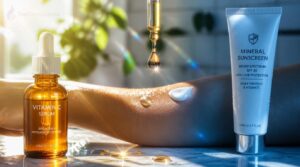
Sunscreen is good at its job, but it’s not perfect, and that’s where vitamin C steps in. Think of it as backup that covers the gaps your SPF leaves open. Here’s what makes this pairing work so well together.
Catching Radicals Sunscreen Misses
No sunscreen catches everything. UV radiation still slips through, sparking free radicals sunscreen alone can’t neutralize. That’s where vitamin C steps in, offering free radical interception as backup defense.
Think of it as reinforcement, not replacement. Your sunscreen blocks rays; vitamin C mops up leftover damage, tackling daily oxidative stress sunscreen coverage gaps allow through.
Vitamin E and Ferulic Acid
Team up vitamin C with vitamin E and ferulic acid, and you get real synergistic antioxidant blends. Vitamin E controls lipid phase defense while vitamin C works the water phase, and ferulic acid stabilizes both.
- Boosts photoprotection roughly four-fold
- Slows vitamin C oxidation
- Improves vitamin C bioavailability
- Reduces oxidative stress from multiple angles
Morning Application Benefits
Applying your vitamin C serum in the morning builds an antioxidant barrier formation before your skin meets the day’s UV rays and pollution. This creates real UV protection teamwork with sunscreen while adding pollution defense boost during peak exposure hours.
You’ll also notice an immediate brightening effect, perfect as a makeup base enhancement for a fresher look all day.
Why SPF Remains Essential
Can vitamin C replace sunscreen? Not a chance, and no serious formulator would tell you otherwise. Vitamin C fights free radicals; only SPF blocks UV rays directly.
You still need:
- Broad spectrum SPF 30+ for UVA/UVB defense
- Daily reapplication as sweat and time reduce coverage
- Consistent use to stop cumulative damage and pigment "reset"
Brighteners work best when SPF protects the progress you’re making.
Post-UV Skin Repair Support
Sun exposure drains your skin’s vitamin C by up to 70% within hours, so reapplying afterward matters. It restores levels in 30 minutes, offering antioxidant replenishment and easing inflammation.
Vitamin C also cuts MMP-9 by 50%, protecting collagen, while boosting DNA repair enzymes like photolyase. Together, that means real sun damage repair, better elasticity, and stronger barrier function.
What Makes Vitamin C Serum Effective
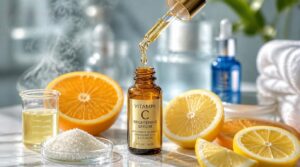
Not all vitamin C serums are created equal, and the difference often comes down to chemistry, not marketing. A great formula depends on the right concentration, the right acidity, and the right packaging working together. Here’s what separates a serum that actually performs from one that quietly loses its power on your shelf.
10–20% L-Ascorbic Acid
Concentration is where vitamin C earns its keep. 10-20% L-ascorbic acid hits the sweet spot for active ingredient stability and real results.
- Below 10%: often too weak
- 10-15%: gentle, great starting point
- 15-20%: stronger, visible skin elasticity improvement
- Above 20%: irritation risk climbs
- Sweet spot: potency meets tolerance
Formulation tolerance factors matter more than chasing higher numbers.
PH 2.5–3.5 Formulas
Getting the percentage right is only half the equation. pH must be very low, specifically 2.5-3.5, keeping L-ascorbic acid stable and skin-penetrable.
| pH Range | Effect |
|---|---|
| 2.5-3.5 | Stable, effective |
| Above 4 | Stability drops |
| Above 5 | Largely non-functional |
Buffering agents ease the pH shock against your skin’s natural 4.5-5.5 barrier. Always patch test first.
Gentler Stable Derivatives
Not everyone’s skin loves that low pH. That’s where stable vitamin C derivatives like sodium ascorbyl phosphate step in, offering a nonirritating formulation with reduced irritation and stability enhancement.
They work at nearer-neutral pH, pair well with other actives, and deliver gradual results, comparable brightening over 8-12 weeks, just gentler on sensitive skin.
Dark, Airtight Packaging
Formulation science only gets you halfway. The rest depends on the bottle.
- Amber or tinted glass blocking visible light
- Airless pumps limiting oxygen and moisture ingress
- Opaque tubes shielding contents during storage
Light protection, an oxygen barrier, and moisture control work together for real shelf life stability. Labels warning "store away from sun" aren’t fluff, they’re your potency insurance policy.
Oxidation and Failure Signs
Even the best packaging can’t stop oxidation forever. Your serum is telling you its story through color, scent, and texture.
| Sign | What It Means |
|---|---|
| Pale yellow | Fresh, full potency |
| Amber/orange | Major degradation |
| Sour smell | Active oxidation |
| Gritty texture | Time to toss it |
Trust your senses over the expiration date.
How to Use Vitamin C Safely

Knowing how vitamin C works is one thing, using it right is another. A few simple habits make the difference between glowing results and wasted product. Here’s what you need to know to get it right, step by step.
If you’re pairing your routine with sun protection, this guide to safe tanning with SPF shows how to keep your glow without undoing your skincare progress.
If you’re pairing your routine with facial oils, it helps to know which ones actually suit acne-prone skin—this guide to using olive oil for acne treatment breaks down safer application methods.
Correct Morning Application Order
Order matters more than most people think. Cleanse gently, pat dry, then apply vitamin C to slightly damp skin using upward circular motions. Wait 30-60 seconds for full absorption (look for a matte finish) before layering anything else.
- Cleanser removes residue that blocks absorption
- Damp skin helps actives penetrate deeper
- Waiting prevents pilling and wasted product
Moisturizer comes next, sealing everything in.
Daily Use With SPF 30+
Rarely does a serum work alone, and vitamin C is no exception. Your ascorbic acid step needs SPF 30 or higher right behind it, since sunscreen catches what vitamin C can’t fully block.
Apply sunscreen last, after moisturizer, covering all exposed skin. Reapply every two hours outdoors.
Together, they create daily photoprotection that’s far stronger than either product working solo.
Weeks 1–12 Expected Results
Patience pays off with vitamin C, since results unfold in stages, not overnight.
- Weeks 1–2: initial glow emergence, mild skin brightening
- Weeks 3–8: spot fading timeline, texture refinement, improved skin tone evening
- Weeks 8–12: firmness development, line smoothing, real collagen production gains
By twelve weeks, pigmentation softens and fine line reduction becomes genuinely visible.
Retinol and Acid Pairing
Can vitamin C and retinol share a routine? Yes, but timing strategy matters. Use vitamin C serum in the morning and retinol at night, avoiding overlap with strong acids to protect your skin barrier.
Patch test new actives first. If irritation shows up, space out acids and retinol until your skin adapts, since buffering with moisturizer eases oxidative stress on sensitive days.
Frequently Asked Questions (FAQs)
Can vitamin C serum be used during pregnancy safely?
Yes, in most cases. Dermatologists specializing in pregnancy skincare confirm vitamin C serum stays in the epidermis without meaningful systemic absorption. Stick to 10-20% ascorbic acid, patch test first, and always run an ingredient compatibility check before adding it to your routine.
Does vitamin C serum expire, and how can you tell?
Like a peeled apple browning in air, your serum turns from pale gold to amber once opened. That color shift, plus a musty smell, signals oxidation, so check the PAO symbol, usually three months.
Can men incorporate vitamin C serum into their routine?
Absolutely, skin doesn’t check gender before responding to antioxidant effects. Men’s skincare basics work the same way: cleanse, apply vitamin C, moisturize, then SPF.
Male skin often runs oilier, but melanin inhibition and barrier support benefits apply equally well each morning.
Can vitamin C serum be layered with niacinamide products?
Rumor says these two feud on skin, but that’s a myth. Apply vitamin C first, wait a minute for pH to settle, then niacinamide, moisturizer, and SPF. Result: brighter, calmer skin with real barrier support.
Keeping up this routine matters most if you’re easing off other actives, since what happens when you stop using hydroquinone cream shows how quickly unprotected skin can let old pigment resurface.
Conclusion
A billion angry free radicals attack your skin every single day, and vitamin C stands guard against every one of them. Now you know how does vitamin c serum work: low pH, stable L-ascorbic acid, and consistent morning use team up to brighten spots, rebuild collagen, and boost your SPF. Store it cold, seal it tight, and give it twelve weeks. Your reflection will thank you.