This site is supported by our readers. We may earn a commission, at no cost to you, if you purchase through links. This content is for general informational and educational purposes only and is not a substitute for professional medical, dermatological, or nutritional advice.
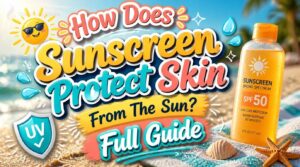
That thin layer of lotion on your skin is doing more chemistry than most people realize. Sunscreen doesn’t just sit there blocking light like a curtain. It actively absorbs, scatters, or reflects UV photons before they ever reach the living cells underneath.
That distinction matters, because UV radiation works fast and quietly. UVA sinks into your dermis and breaks down collagen without so much as a warning sunburn, while UVB scorches the surface and damages DNA in ways your body can’t always repair.
Understanding how does sunscreen protect skin from sun means understanding what it’s actually fighting, and how each ingredient earns its place in that fight.
Table Of Contents
- Key Takeaways
- What UV Radiation Does to Skin
- Sunscreen Absorbs UV Before It Damages Skin
- Mineral and Chemical Sunscreens Compared
- Why Broad-Spectrum SPF Matters
- Is Sunscreen Safe for Daily Use?
- Proper Application Keeps Skin Protected
- Combine Sunscreen With More Sun Protection
- Frequently Asked Questions (FAQs)
- Conclusion
Key Takeaways
- Sunscreen actively absorbs, scatters, or reflects UV rays before they reach your living skin cells, working against both UVA (which quietly ages skin and breaks down collagen) and UVB (which causes sunburn and DNA damage).
- SPF only measures UVB protection, so you need a "broad-spectrum" label to confirm you’re also covered against UVA, since a high SPF number alone won’t stop long-term aging or deeper damage.
- Reapplication matters more than SPF strength, since sunscreen loses about half its effectiveness after two hours regardless of whether you’re wearing SPF 30 or SPF 100, and swimming, sweating, or towel-drying wipes away protection immediately.
- Daily sunscreen use meaningfully lowers your cancer risk, cutting melanoma odds by about 50% and squamous cell carcinoma by about 40%, but it works best paired with shade, protective clothing, and applying about an ounce (a full shot glass) to your whole body.
Since UVA rays sneak through windows and speed up wrinkles year-round, this guide to understanding SPF levels breaks down what those numbers actually protect you from.
What UV Radiation Does to Skin

Before you can understand how sunscreen protects you, it helps to know what it’s protecting you from. The sun sends down two types of UV rays, and each one affects your skin differently. Here’s what happens beneath the surface when you step outside unprotected.
UVA rays quietly age your skin over time while UVB rays cause the burns you notice right away, which is why pairing SPF with a dermatologist-recommended anti-aging skincare routine can help address both kinds of damage.
UVA Penetrates Deeper Skin Layers
While UVB stays near the surface, UVA rays travel further, reaching deep into your dermis. Here, they trigger:
- Dermal collagen breakdown
- Connective tissue damage
- UVA1 oxidative stress
- Photoaging dermis effects
This deep skin aging happens quietly, without sunburn as a warning sign. In fact, UVA radiation generates reactive oxygen species that directly trigger MMP-1 production in dermal fibroblasts, breaking down collagen. That’s why broad spectrum photoprotection matters daily, not just on obviously sunny days.
UVB Causes Sunburn
Where UVA works quietly, UVB rays hit hard and fast, right at the surface. This is the ray behind that classic sunburn: redness, heat, swelling, tenderness.
Risk climbs during peak sun hours, at high altitude, and even under cloud cover, which doesn’t block UVB like you’d hope. Skin phototype and exposure intensity both shape how quickly that burn shows up.
UV Damages Skin Cell DNA
Beneath the sunburn lies something quieter: DNA damage inside skin cells. UV radiation creates lesions like cyclobutane pyrimidine dimers, plus oxidative markers such as 8-hydroxy-2′-deoxyguanine.
Nucleotide excision repair fixes most of this, but overwhelmed pathways leave mutations behind. Left unrepaired, those mutations can surface decades later as skin cancer, which is exactly what sunscreen aims to prevent.
UVA Accelerates Skin Aging
Not all damage shows up as a burn. UVA works slower, breaking down collagen and triggering oxidative stress that wears down elasticity over years. This is the heart of photoaging: fine lines, sagging, uneven texture.
That’s why broad spectrum protection (UVA and UVB) matters, since SPF alone won’t stop this quieter, cumulative process.
Repeated Exposure Raises Cancer Risk
Every sunburn leaves a mark your cells remember. Each exposure adds cumulative DNA damage, and repair systems can’t fix it all, so mutation accumulation builds year after year.
Genetics matters too: certain skin types face higher risk. Intermittent burns drive melanoma, steady exposure drives other cancers, and childhood sun habits shape lifetime risk.
Daily SPF and reapplication genuinely lower these odds.
Sunscreen Absorbs UV Before It Damages Skin

Sunscreen doesn’t just sit on your skin, it actively works against incoming UV rays. Every layer you apply sets off a small chain of events before damage can even start. Here’s what actually happens between application and protection.
UV Filters Form Protective Coverage
Think of sunscreen as a thin shield sitting right on your skin’s surface. That coverage only works if it’s actually there: UV filters need to form a continuous protective layer across every exposed area. Gaps mean unfiltered UV slips through.
This film provides broad spectrum UVA/UVB defense, but only when applied generously enough to hold its integrity.
Filters Convert UV Into Heat
Picture each filter molecule as a tiny sponge for UV energy. Chemical filters use ring-shaped structures that absorb UVA and UVB photons, exciting electrons briefly before they settle back down.
That energy doesn’t vanish, it converts to heat, dissipating harmlessly.
- Molecular energy conversion happens instantly upon absorption
- Photostability affects how long filters resist breakdown
- Photodegradation can reduce a filter’s protective power over time
Some UV Gets Scattered
Not all UV light gets absorbed. Mineral filters like zinc oxide and titanium dioxide also scatter incoming rays, deflecting them away from skin. Particle size matters here: smaller particles scatter diffusely in many directions, while larger ones send light forward, right toward you.
| Particle Size | Scattering Behavior | UV Protection |
|---|---|---|
| 15-50 nm | Diffuse, multidirectional | High |
| 1 µm+ | Forward-dominant | Low |
Less UV Reaches Skin Cells
UV intensity naturally drops as it travels deeper into skin, but sunscreen gives that drop a head start. Absorption and scattering together create a photon blocking layer right at the surface.
Less UV enters to begin with, so fewer rays reach cells in the epidermis and dermis. That’s the whole point of broad spectrum protection.
DNA Damage is Reduced
Here’s the real payoff: less UV reaching your cells means less DNA damage at the source. UV radiation causes thymine dimers, those molecular kinks that block replication.
- Fewer thymine dimers form
- DNA repair mechanisms stay supported, not overwhelmed
- Lower mutation risk over time
With broad spectrum UVA/UVB coverage, genetic integrity stays protected. That’s sunscreen efficacy working at the cellular level.
Mineral and Chemical Sunscreens Compared

Not all sunscreens work the same way, and that’s a good thing to understand before you pick one. Mineral and chemical filters take different paths to protect your skin, each with its own strengths. Here’s how they stack up.
Zinc Oxide Covers UVA
No single mineral covers more ground than zinc oxide. Its UVA protection range stretches from roughly 320 nm to 400 nm, giving you true UVA1 defense that titanium dioxide can’t match.
That’s what makes it the gold-standard mineral UVA shield in broad spectrum protection, working through scattering, absorption, and reflection to keep both aging and DNA damage at bay.
Titanium Dioxide Targets UVB
Where zinc oxide controls UVA, titanium dioxide zeroes in on UVB rays, the wavelengths behind sunburn. Its protection comes from scattering, not just absorption.
Performance depends on:
- Particle size (smaller means broader coverage)
- Crystal form (rutile vs. anatase)
- Formulation fit
- UVB absorption efficiency
Get those right, and you’ve got a reliable mineral sunscreen partner for broad spectrum protection.
Chemical Filters Absorb UV
Mineral filters scatter light, but chemical absorbers work differently. Ingredients like avobenzone, oxybenzone, and octinoxate use aromatic ring structures to soak up UV radiation, exciting electrons that release the energy back out as harmless heat.
It’s a fast molecular handoff. That energy to heat conversion happens before UV rays ever reach living skin cells underneath.
Stabilizers Prevent Filter Breakdown
Avobenzone breaks down fast in sunlight, so formulas add octocrylene to slow the process, keeping filters active far longer. Antioxidants like vitamin E and quercetin cut degradation nearly in half.
Encapsulation traps filters in tiny shells, boosting stability further. Film formers lock everything in place, resisting sweat and water while preserving even coverage.
Both Types Protect Effectively
When it comes down to it, the mineral-versus-chemical debate matters less than you’d think. Clinical testing shows both deliver equal SPF performance, comparable sunburn prevention, and similar anti-aging results. Here’s what really counts:
- Broad-spectrum coverage
- Consistent SPF accuracy
- Cancer risk reduction
- Proper application
- Regular sunscreen reapplication
Pick what you’ll actually wear correctly.
Why Broad-Spectrum SPF Matters
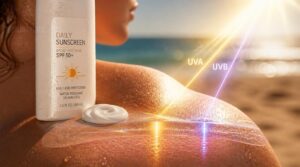
That number on the bottle only tells part of the story. To really know how protected you are, you need to understand what SPF measures and what it leaves out. Here’s what actually matters when you’re choosing a broad-spectrum sunscreen.
SPF Primarily Measures UVB Protection
That number on the bottle? It’s really shorthand for UVB radiation filtering, not total sun protection. SPF stands for Sunburn Protection Factor, calculated by comparing the minimal erythema dose on protected versus bare skin.
SPF 30 filters about 97% of UVB rays. Solid UVB protection, but it says nothing yet about UVA coverage.
Broad-Spectrum Includes UVA Protection
So how does a label earn the words "broad spectrum"? The FDA requires a Critical Wavelength Test, checking absorbance up to 400nm.
To pass, four things matter:
- Critical wavelength of at least 370nm
- UVA protection proportional to SPF
- UVA-to-UVB Ratio meeting minimums
- Verified PA Rating System results
That’s real UVA protection levels, not just a marketing claim.
SPF 30 Filters Most UVB
Ninety-seven percent of UVB rays blocked, that’s what SPF 30 effectiveness delivers when applied correctly. This UVB protection level makes it a reliable baseline for daily SPF use.
| SPF | UVB Blocked |
|---|---|
| 15 | 93% |
| 30 | 97% |
| 50 | 98% |
Small percentage jumps matter less than reapplication importance. That’s an SPF limitation worth remembering.
Higher SPF is Not Longer
Think a higher number buys you more time in the sun? It doesn’t. Sun protection factor measures filtration, not duration. SPF 30 and SPF 50 both need reapplication every two hours.
- Sweat reduces coverage fast
- Water resistance has limits
- Application amount matters most
- Reapplication beats higher SPF
- Real protection depends on habits, not the label
PA Ratings Measure UVA Protection
SPF tells you nothing about UVA, so how do you know your sunscreen guards against wrinkles and deeper damage? Look for PA ratings, a grading scale using Persistent Pigment Darkening to measure UVA protection.
| Rating | Protection Level |
|---|---|
| PA+ | Some |
| PA+++ | High |
| PA++++ | Very high |
Common on Asian formulas, PA labeling fills the gap SPF leaves behind.
Is Sunscreen Safe for Daily Use?

It’s a fair question to ask before you make sunscreen part of your daily routine. The good news is that decades of research back its safety, but a few details are worth knowing. Here’s what actually matters when picking a formula that works for you.
Benefits Outweigh Known Risks
Worried sunscreen might do more harm than good? The evidence says otherwise. Daily use cuts melanoma risk by 50% and lowers squamous cell carcinoma rates by 40%, while also delivering anti-aging benefits like preserved collagen and fewer wrinkles.
Add in reduced cancer incidence and long-term healthcare savings, and the case for broad-spectrum protection becomes hard to ignore.
Mineral Filters Suit Sensitive Skin
For sensitive or reactive skin, mineral sunscreen is often the gentler choice. Zinc oxide and titanium dioxide sit on the skin’s surface, reflecting UV rather than absorbing it, so there’s less potential for irritation.
- Lower irritation potential
- Immediate protection on application
- Photostable ingredients
- Dermatologist tested formulas
- Suitable for reactive or compromised skin
Some Ingredients May Cause Irritation
Mineral options aren’t the only path, but it helps to know what can trigger a reaction. Oxybenzone remains a top cause of allergic and photoallergic responses.
Preservatives, fragrances, alcohol solvents, and emulsifiers can also irritate skin, especially if it’s already sensitized. Photosensitivity varies person to person, so ingredient awareness matters as much as SPF number when choosing a fragrance-free, skin-friendly formula.
Patch Test Reactive Skin
If irritation keeps showing up, a dermatologist can run a patch test to pinpoint the allergen. Patches stay on for 48 hours, then get checked again at 96.
Once you know your triggers, these practical tips for managing skin allergies can help you build routines that keep your skin calm.
Reactions range from faint erythema to vesicles. Avoid UV, sweat, and water on the site during testing.
False negatives happen, but it’s still the most reliable way to confirm sunscreen sensitivity.
Choose Comfortable Protective Formulas
Since the best sunscreen is the one you’ll actually wear daily, comfort matters as much as SPF. Match texture to your skin and season:
- Oily skin: oil-free, matte gels
- Dry skin: hydrating creams with ceramides
- Sensitive skin: fragrance-free mineral formulas
- Active days: water-resistant, quick-absorbing lotions
Look for noncomedogenic, broad-spectrum labels regardless of finish.
Proper Application Keeps Skin Protected
Even the best sunscreen only works if you use it right. A lot of protection gets lost in small, everyday habits, not the product itself. Here’s what proper application actually looks like.
Apply Generously to Exposed Skin

Most people apply only half the sunscreen they need. The fix? Apply generously, about one ounce for full body coverage, roughly a shot glass full.
Skimping cuts your real SPF in half, letting more UV radiation reach skin cells. Cover every exposed area evenly, don’t leave gaps expecting broad spectrum protection to work with a thin, spotty layer.
Cover Commonly Missed Areas

Ears, scalp, neck, hands, and feet quietly take the brunt of daily UV radiation while sunscreen skips right past them.
- Ears: tops and behind-ear skin, common cancer sites
- Scalp: part lines and thinning spots need spray or stick sunscreen
- Neck and hands: constant exposure driving, walking, washing
- Feet: tops burn easily, even under sandals
Broad-spectrum protection only works if it actually reaches your skin.
Reapply Every Two Hours

Sunscreen isn’t a "set it and forget it" product. Its UV absorption capacity breaks down under sunlight, dropping to roughly 50% effectiveness after two hours, regardless of SPF number.
| SPF | Reapply Interval |
|---|---|
| 30 | 2 hours |
| 50 | 2 hours |
| 100 | 2 hours |
Set a phone alarm. Higher SPF doesn’t buy extra time between applications, broad-spectrum UVA/UVB protection still fades on schedule.
Reapply After Swimming or Sweating

Grab that towel and you wipe away more than water, sunscreen film goes with it. Reapply immediately after drying off, and don’t skip this step post-swim.
Sweat works the same way, breaking down coverage as it drips. Whether you’ve been swimming or sweating through a workout, treat wet or wiped skin as unprotected until you reapply.
Water Resistance Has Time Limits

Water resistant" isn’t the same as waterproof, and the FDA agrees, banning that claim outright.
Products earn 40 or 80-minute labels through real immersion testing, keeping at least 50% SPF retention afterward. Once that window closes, UV filters lose stability and protection fades.
Sweat shortens the clock further. Swimming, sweating, or towel drying all call for prompt reapplication, no exceptions.
Combine Sunscreen With More Sun Protection

Sunscreen works hard, but it can’t do the job alone. Even with perfect application, you’ll get better protection by backing it up with a few simple habits. Here’s what else belongs in your sun defense routine.
Wear Sun-Protective Clothing
Think of protective clothing as a wearable, always-on layer of sunscreen. Look for a UPF 50 label, blocking about 98% of rays, in tightly woven 100% polyester.
Prioritize:
- Long sleeves and collars for the neck
- Pants covering legs
- Dry, dark-colored fabric (dye absorbs UV)
Swap wet clothes for dry ones immediately, since moisture cuts protection a lot.
Add a Wide-Brimmed Hat
A wide-brimmed hat rounds out your sun protection package by shielding your face, ears, and neck where clothing can’t reach. Look for a 3-inch brim minimum, tightly woven straw or fabric, and ideally a neck flap.
Reflected UV from sand or water still sneaks under brims, so pair the hat with sunscreen on exposed skin.
Choose UV-Blocking Sunglasses
Your eyes need protection too. Look for sunglasses labeled UV400 or 100 percent UV protection, meaning they block UVA and UVB alike.
Wraparound frames add side coverage, while polarized lenses cut glare without guaranteeing UV blocking on their own. Gray, green, or brown tints work best.
Confirm labeling first, tint second.
Seek Shade During Peak Sun
Sunglasses guard your eyes, but your whole body needs a break from direct ultraviolet radiation too. Check the UV index before heading out, and seek shade between 10 a.m. and 4 p.m., peak sun hours when exposure runs highest.
- Park on the shady side of buildings
- Choose leafy, deep shade over thin cover
- Watch for reflective surfaces like sand or concrete
- Combine shade with sunscreen and clothing
- Treat shade as one layer, not the only one
Avoid Intentional Tanning
Here’s a hard truth: there’s no such thing as a safe tan. That golden glow just means your skin cells took UV damage and released melanin in defense.
If you’re chasing a sun-kissed look without the damage, exploring natural tanning alternatives like carrot oil can give your skin a warm glow while skipping the UV risk entirely.
There’s no such thing as a safe tan—that glow is just your skin’s damage response to UV exposure
Tanning beds are worse, often blasting 3 to 5 times midday sun intensity. Skip the bronzing altogether and let broad-spectrum SPF do its job instead.
Frequently Asked Questions (FAQs)
How much sunscreen should you apply to your face?
Most people apply far too little. Aim for a nickel-sized amount on your face alone, roughly a quarter teaspoon with your neck included, for the full SPF and broad spectrum UVA UVB protection listed on the bottle.
Do sprays and powders protect skin as well as lotions?
Yes, if the active ingredients match. Coverage consistency is the real challenge though: sprays and powders need careful application technique, rubbing in fully, to avoid gaps that lotion and cream naturally cover for reliable broad-spectrum protection.
How is SPF determined during laboratory testing?
Labs apply sunscreen at 2 mg/cm², expose skin to a solar simulator, then measure the minimal erythema dose against unprotected skin. This protected-to-unprotected ratio, averaged across participants, determines SPF, mainly reflecting UVB defense.
Are sunscreen sprays absorbed differently than creams or lotions?
Absorption itself doesn’t change, but coverage uniformity does. Sprays rely on droplet delivery and rub-in effectiveness for even film formation, while creams and lotions spread more reliably, giving mineral or chemical filters consistent skin contact for full protection.
Conclusion
A single teaspoon of sunscreen holds billions of molecules acting like tiny shields, absorbing UV photons before they ever touch your DNA.
That’s how does sunscreen protect skin from sun, one microscopic collision at a time.
It’s not glamorous science, but it’s dependable. Apply it generously, reapply it faithfully, and pair it with shade and clothing. Your skin keeps score of every unprotected hour. Give it fewer to count, and it will thank you for decades.