This site is supported by our readers. We may earn a commission, at no cost to you, if you purchase through links.

Dead skin cells accumulate faster than most people realize, and that built-up surface layer often blocks what your skincare routine is trying to do. Moisturizer applied over dead cells and oil sits on top, going nowhere. Body exfoliation at home removes that barrier, giving fresher skin a chance to absorb, reflect, and renew.
Regular exfoliation may also help even out skin tone, reduce the look of rough or bumpy patches, and support products targeting specific concerns. Choosing the right type of exfoliant, a safe frequency, and a few simple DIY recipes can make more difference than adding another serum to your shelf.
Table Of Contents
- Key Takeaways
- Full Body Exfoliation Benefits
- Choose Exfoliants for Your Skin Type
- How to Exfoliate Your Body at Home
- Easy DIY Body Scrub Recipes
- Exfoliation Frequency and Safety Precautions
- Frequently Asked Questions (FAQs)
- What is the best way to exfoliate my entire body?
- How can I do a full body exfoliation at home?
- How do Koreans exfoliate their skin?
- Do you exfoliate dry or wet?
- Can you exfoliate over stretch marks?
- Is body exfoliation safe during pregnancy?
- Should you exfoliate before applying self-tanner?
- Does exfoliation help with body acne?
- How long do homemade scrubs last?
- Conclusion
Key Takeaways
- Dead skin buildup blocks moisturizers and actives from reaching fresh skin, making exfoliation a more effective first step than adding new products to your routine.
- Matching your exfoliant to your skin type matters: physical scrubs suit normal or oily skin, while sensitive or dry skin responds better to low-strength chemical exfoliants like AHAs.
- Exfoliating once a week is the safest starting point, and sustained redness, stinging, or peeling is your signal to cut back immediately and let your skin recover.
- Always moisturize on slightly damp skin right after rinsing, then apply broad-spectrum SPF to protect freshly exposed cells from UV-triggered dark spots.
Full Body Exfoliation Benefits

Regular exfoliation does more for your skin than you might expect. From texture to tone, the benefits cover quite a range. Here’s what you can gain by making it part of your routine.
Smoother, more refined skin is one of the first changes you’ll notice, as regular exfoliation works to improve skin texture and smoothness over time.
Smoother Skin Texture
Remove dead skin cells regularly and your skin texture can feel softer within a few sessions. Physical exfoliation clears surface buildup, letting fresh cells reflect light more evenly. Homemade scrubs and consistent skin exfoliation both help over time.
- Reduces flaky buildup between cells
- Clears keratin plugs near pores
- Helps even turnover with regular use
- Improves moisturizer absorption on softened skin
Brighter
Smoother texture already sets you up for a brighter look. When dead skin cells build up, they scatter light unevenly and make your skin tone appear flat.
Regular exfoliation clears that surface layer, so fresher cells can reflect light more uniformly. The result is a natural skin glow, not artificial shine.
Even Tone
That brighter look naturally leads to another gain: more even skin tone. Dark patches form when melanin clusters in the upper layers after sun exposure or friction.
Exfoliation speeds up how quickly those pigment-rich cells shed from the surface. A consistent body scrub routine can gradually reduce the contrast between discolored patches and surrounding skin, working toward a more uniform tone.
Improved Product Absorption
Once you’ve cleared those pigment-rich cells, your skin is also better prepared to absorb what you apply next. Exfoliation removes the buildup of dead cells and surface oils that can block product contact, so moisturizers and targeted actives penetrate more evenly.
This is especially true when using a well-formulated exfoliating product—like those reviewed in this Olivia Quido brightening exfoliant breakdown—that pairs cell-clearing action with actives that target uneven tone simultaneously.
Apply your body lotion while your skin is still slightly damp for the best uptake.
Enhanced Skin Radiance
When your skin’s surface is more uniform, light reflects more evenly, and that’s what creates a real, visible glow. Gentle exfoliation can smooth rough patches that otherwise scatter light unevenly.
If you overdo it, though, you may irritate your skin and actually dull its radiance instead. Controlled, regular exfoliation lets your skin’s natural reflectiveness shine without disrupting moisture or tone.
Softer
The tactile softness you feel after a good scrub session isn’t accidental. When you use DIY body scrubs with fine natural ingredients like sugar, you’re removing dead surface cells that make skin feel rough.
Moisturize immediately after rinsing to lock in hydration before transepidermal water loss sets in. That step is what truly completes the skin softening process.
A rich, fast-absorbing body moisturizer lotion applied within minutes of rinsing helps seal in that fresh, smooth feeling before it fades.
Firmer Skin
Studies suggest the stratum corneum can hold up to 15 layers of dead cells at once.
Regular exfoliation clears that buildup, which may make your skin look visibly firmer and smoother over time.
Body scrubs won’t reshape deeper tissue, but removing uneven dead-cell layers reduces the visible appearance of cellulite and helps your skin tightening products absorb more effectively afterward.
Choose Exfoliants for Your Skin Type

Smooth, supple skin starts with selecting the right exfoliant for your body. Physical exfoliation, like scrubs and dry brushes, works well for normal or oily skin types. Chemical exfoliation using AHAs or BHAs usually suits sensitive or dry skin better, since it’s gentler and more controlled.
If you’re irritation‑prone, dermatologist recommendations consistently favor lower‑strength chemical exfoliants over grainy scrubs, which can trigger redness or barrier strain. A gentle body AHA exfoliant with a low-percentage formula can dissolve dead skin without the friction that aggravates sensitive or reactive skin.
- Oily or normal skin: tolerates more frequent physical or chemical exfoliation
- Dry or sensitive skin: benefits from mild AHAs formulated with humectants
- Rough, bumpy skin: responds better to BHAs or keratolytic acids than physical scrubs
Start with one new exfoliant at a time so you can clearly identify what’s working for you.
How to Exfoliate Your Body at Home
Exfoliating your body at home is straightforward when you follow the right steps. The process breaks down into three simple stages that keep your skin safe and help you get the best results. Here’s what to do from start to finish.
Prepare Skin and Supplies

Preparation may be the most overlooked step in skin care.
| Step | What to Do |
|---|---|
| Wash hands | Prevents bacteria transfer |
| Lay out your DIY body scrub | Ready at arm’s reach |
| Run a warm shower | Softens skin for scrubbing |
| Let skin absorb moisture | Damp, not dripping wet |
| Rinse exfoliation glove | Clears residue before use |
Follow these before reaching for your natural ingredients.
Exfoliate With Gentle Motions
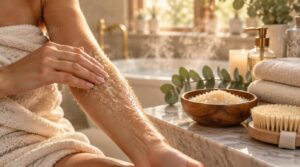
How you move matters as much as what you use.
- Exfoliate with short strokes along your skin lines
- Focus on rough spots like elbows and knees
- Limit passes to reduce irritation
- Stop if you feel burning or sharp pain
- Keep exfoliation brief per area
Gentle motions lift dead skin cells without stressing your skin texture.
Rinse, Moisturize, and Protect

Once you’ve finished exfoliating, rinse with lukewarm water to clear away any residual scrub particles. Pat skin dry gently, then apply your moisturizer while it’s still slightly damp. That damp layer helps your skin absorb hydration more effectively. End with a broad-spectrum sunscreen to guard against UV-related pigmentation on freshly exfoliated skin. | Step | Product Type | Key Benefit | |——|————-|————-| | Rinse | Lukewarm water | Removes residue, limits irritation | | Moisturize | Non-comedogenic lotion | Seals hydration, helps barrier repair | | Protect | Broad-spectrum SPF 30+ | Prevents post-exfoliation dark marks |
Easy DIY Body Scrub Recipes

Making your own body scrub is easier than you might think, and you likely already have most of the ingredients in your kitchen. Each recipe below uses simple, skin-safe ingredients that you can mix and customize at home. Pick the one that fits your skin type and preferences, then follow the steps to get started.
Sugar and Carrier Oil Scrub
Combine brown sugar and carrier oil at a 2:1 ratio for a simple DIY body scrub you can mix up in minutes. The sugar drives exfoliation while oil adds slip, letting you buff away dryness without overdoing it.
- Use fine brown sugar on sensitive areas
- Pick jojoba or coconut carrier oil for moisture
- Apply light pressure for even skin rejuvenation
Oatmeal and Honey Scrub
If the sugar scrub felt too rough for your skin, this homemade oatmeal and honey version is a gentler pick. Ground oatmeal offers mild exfoliation, and honey’s humectant properties draw moisture to your skin’s surface while you’re applying it.
| Component | Role | Tip |
|---|---|---|
| Ground oatmeal | Mild exfoliant | Grind finer for sensitive skin |
| Raw honey | Humectant | Use 1 part to 2 parts oats |
| Dwell time | Boosts soothing effect | Limit to 2-3 minutes |
| Water temperature | Protects skin barrier | Keep it lukewarm |
| Particle size | Controls intensity | Finer grind, gentler feel |
Patch test first on your inner arm before a full body application.
Green Tea Antioxidant Scrub
If you want to take skin brightening further, try this green tea antioxidant scrub. Green tea’s catechins, especially EGCG, may help reduce dullness from surface oxidation.
Mix one tablespoon of cooled green tea powder with two tablespoons of sugar and enough carrier oil to form a paste. Apply with gentle circular motions, rinse with warm water, and patch test first.
Exfoliation Frequency and Safety Precautions
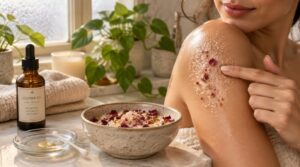
Starting with once a week lets your skin adjust before you gradually build up exfoliation frequency. Most people tolerate two to three sessions weekly, but skin sensitivity varies, so watch how yours responds after each session.
Before trying a new product, do a patch test on a small area and wait 24 hours. That simple step can catch reactions early.
Overexfoliation disrupts your skin barrier more easily than you might think. Sustained redness, stinging, or excessive peeling means you’ve gone too far. Cut back on sessions immediately and give your skin time to recover before reintroducing anything.
Overexfoliation breaks your skin barrier faster than you think—redness and stinging mean stop now
Avoid combining a physical scrub with a strong chemical exfoliant in the same routine. Layering methods raise cumulative irritation risk a lot.
Frequently Asked Questions (FAQs)
What is the best way to exfoliate my entire body?
Your best full body exfoliation always starts with your skin type. Gentle physical or mild chemical exfoliants on clean, damp skin, light circular pressure, a thorough rinse, and prompt moisturizing can all deliver smooth skin.
How can I do a full body exfoliation at home?
Full body exfoliation at home starts with warm water to soften skin, then a gentle scrub in circular motions. Rinse well and apply moisturizer right away to lock in hydration and protect your skin barrier.
How do Koreans exfoliate their skin?
Think of exfoliation as music, not a hammer. You’ll find that Korean routines rely on chemical exfoliants like lactic acid, using short, gentle passes on damp skin, rinsing quickly, then moisturizing to protect skin health.
Do you exfoliate dry or wet?
For most physical exfoliants, dampen your skin first. Wet skin softens the outer layer, letting the scrub distribute friction more evenly and reducing the risk of micro-tears.
Can you exfoliate over stretch marks?
Gentle? Yes. Aggressive? Avoid it. Stretch marks are sensitive scar tissue, so don’t use harsh scrubs or strong acids over them. Light exfoliation can improve skin texture without worsening irritation. Stop if you notice redness.
Is body exfoliation safe during pregnancy?
Body exfoliation can be safe during pregnancy if you use gentle pressure and light abrasion. Avoid harsh scrubs, skip irritated skin, and always patch test first.
Should you exfoliate before applying self-tanner?
Yes, exfoliating before self-tanner can give you a smoother, more even result. Clean, prepped skin lets the formula distribute more evenly. Just avoid over-scrubbing, since freshly irritated skin may grab color unevenly and look patchy.
Does exfoliation help with body acne?
Think of a clogged pore like a blocked drain. The right chemical exfoliant, especially salicylic acid, can help clear that buildup. But physical scrubs may irritate your skin and can actually make body acne worse.
How long do homemade scrubs last?
Most homemade scrubs last one to two weeks when stored in a clean, airtight jar away from heat and humidity. Scrubs containing honey or water-based ingredients may spoil sooner, so always keep your batches small.
Conclusion
Skin naturally renews itself roughly every 28 days, but dead cells don’t always shed evenly on their own. That’s exactly where body exfoliation at home tips make a real difference. Removing that stubborn buildup lets your moisturizers, oils, and targeted treatments actually reach fresh skin.
Pick the right exfoliant for your specific skin type, keep your frequency consistent, and always follow up with hydration. Small, repeatable habits like these compound into noticeably smoother, brighter skin.