This site is supported by our readers. We may earn a commission, at no cost to you, if you purchase through links. This content is for general informational and educational purposes only and is not a substitute for professional medical, dermatological, or nutritional advice.

A razor that pulls instead of glides has usually lost its edge, not its quality. Stropping alone can’t fix that. Once the bevel dulls, only a stone restores it.
The right honing stones for straight razors do more than sharpen. They give you control over the edge, from a Belgian coticule’s water-fed slurry to a 3000/8000 combination that moves from refinement to polish. Each material cuts differently, and each rewards a different habit at the bench.
Here are five stones worth owning, followed by the grits, strokes, and care routines that turn a dull blade into a shave-ready one.
Table Of Contents
- Key Takeaways
- 5 Honing Stones for Straight Razors
- Natural Vs. Synthetic Straight Razor Honing Stones
- Choosing Honing Stone Grits for Straight Razors
- How to Hone a Straight Razor
- Straight Razor Honing Frequency and Duration
- Cleaning, Flattening, and Storing Honing Stones
- Frequently Asked Questions (FAQs)
- Conclusion
Key Takeaways
- If your razor pulls or tugs even after stropping, the edge has dulled, and only honing on a stone can rebuild it, since stropping just aligns an edge you already have.
- Match your grit to the razor’s condition by starting around 800-1200 to set a damaged bevel, then moving through 3000-4000 and 8000 to finish, and remember that a well-kept razor often needs only a single finishing stone for touch-ups.
- Natural stones like coticules and Arkansas stones vary from piece to piece, while synthetic stones give you more predictable results, but your technique and the stone’s condition matter more than which type you choose.
- Good honing comes down to keeping the spine pressed to a flat stone, using light, edge-trailing strokes, checking the edge with a hanging hair test every 25 to 30 laps, and cleaning, flattening, and storing your stones dry afterward.
5 Honing Stones for Straight Razors
The right hone gives you control over every pass, so it pays to match the stone to your skill level and budget. The five options below cover natural and synthetic choices, from a single Belgian Coticule to a complete razor kit. You’ll see what each one offers before we move on to how to use them.
1. Belgian Coticule 100x40mm Sharpening Stone
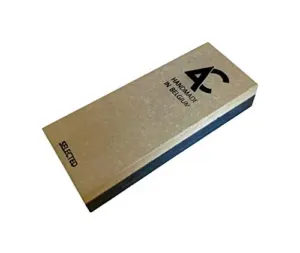
A single yellow Coticule can carry you from bevel work to a finished edge, which suits you if you’d rather master one stone than juggle several. This hand-quarried, flat-lapped Belgian hone measures 100 x 40 mm and stands 19 mm tall. Its finishing grit equivalent reaches up to 8000.
If you’re still deciding which grit or stone type suits your steel, this guide to choosing a honing stone explains how to match each one to your blade.
Use water only. No oil, no dry honing.
Only the yellow face does the work. The darker slate backing adds rigidity, so keep your razor off it. Expect some color variation from stone to stone, which won’t affect performance.
| Best For | Hobbyists and shavers who want to learn one natural stone well and use it to finish straight razors, knives, and chisels to a fine edge. |
|---|---|
| Stone Material | Natural Belgian Coticule |
| Grit Range | Up to 8000 equivalent |
| Dimensions | 100 x 40 x 19 mm |
| Lubricant | Water only |
| Razor Compatible | Yes |
| Other Tools | Knives, chisels, surgical blades |
| Additional Features |
|
- Finishes edges up to an 8000 grit equivalent, which is fine enough for straight razors and surgical blades
- Works as a one-stone system, since pressure and the amount of water change how it cuts
- Arrives hand-quarried and flat-lapped, with no cracks, so it is ready to use
- Only the yellow side can be used, because the darker slate backing is there for rigidity and must stay off the blade
- Needs water only, so oil and dry honing are out
- Natural color variation means your stone may not match the photos, though performance is not affected
2. Arkansas Sharpening Stone Set 10
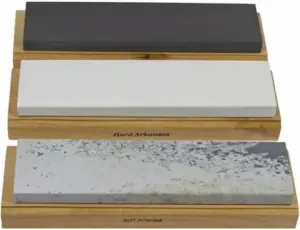
If you’d rather work through a progression, this Arkansas set gives you three natural stones: soft for coarse work, hard for fine, and black for extra-fine finishing.
Each stone measures 2 x 10 inches and sits on a wood base, so you can use it on the bench or hold it in hand. It’s made in the USA with a lifetime guarantee.
Inspect every stone on arrival. Some buyers report cracks or uneven surfaces, and natural variation can affect flatness.
| Best For | Hobbyists and serious home cooks who want a hands-on, step-by-step sharpening routine for high-carbon knives, such as Bob Kramer blades, and don’t mind checking natural stones for flaws. |
|---|---|
| Stone Material | Natural Arkansas stone |
| Grit Range | Coarse, fine, extra-fine |
| Dimensions | 2 x 10 inches |
| Lubricant | N/A |
| Razor Compatible | N/A |
| Other Tools | Kitchen knives, high-carbon blades |
| Additional Features |
|
- Three stones (soft, hard, and black Arkansas) give you a full progression from coarse to extra-fine
- The 2 x 10 inch stones sit on a wood base, so you can use them on the bench or in hand
- Made in the USA with a lifetime guarantee
- Some buyers report cracks in the stones
- Individual stones may have uneven surfaces
- Natural stone variation can affect flatness and consistency
3. Ultra Fine Whetstone 3000/8000 Grit Sharpening Stone
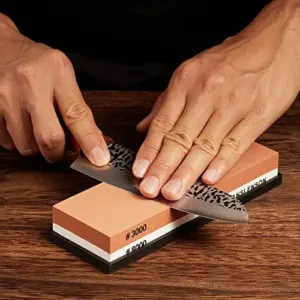
If you’d rather keep things simple, this double-sided stone covers the two stages most razors need. The 3000 grit side refines the bevel, while the 8000 grit side polishes it to a smooth, shave-ready finish.
Once the stone has done its work, this step-by-step guide to sharpening a straight razor shows how to hold the right angle and keep your strokes smooth and steady.
It measures 7 x 2.4 x 1 inches, weighs 1.2 pounds, and comes with an anti-slip base that keeps it steady under your strokes. Use water only, never oil.
Keep the surface clean and flat, since that’s what protects your edge over time.
| Best For | Hobbyists and home cooks who want a simple, water-only sharpening stone that can sharpen and polish razors, kitchen knives, and pocket knives. |
|---|---|
| Stone Material | Stone (brown and white) |
| Grit Range | 3000 / 8000 dual-sided |
| Dimensions | 7 x 2.4 x 1 inches |
| Lubricant | Water only |
| Razor Compatible | Yes |
| Other Tools | Chisels, scissors, garden tools |
| Additional Features |
|
- Two grits in one stone (3000 to refine the edge, 8000 to polish it) cover the two stages most razors need
- Water-only use means no oil mess, and it’s easy to clean
- The anti-slip base keeps the stone steady while you sharpen
- It won’t work with oil-based sharpening systems because it requires water
- The surface has to be kept clean and flat to keep working well over time
- Only the stone and base are included, so you’ll need to supply your own knife or blade
4. Kota Japan Dual Grit Whetstone Sharpener
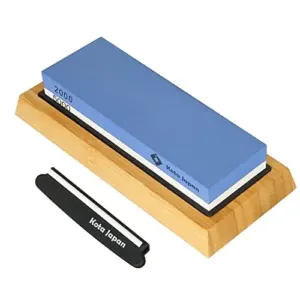
Kota’s dual grit stone follows the same 3000/8000 pairing, but it’s built to serve more than razors. The 3000 side sets and refines the edge, and the 8000 side polishes it for shaving.
That versatility extends to grooming tools too, and this guide on how to sharpen a beard trimmer shows the coarse-to-fine stone method.
It measures 7.25 x 2.25 x 1 inches and weighs 1.4 pounds. The non-slip bamboo base and silicone holder keep it steady, and it needs only a water soak.
Be realistic, though. Some users report inconsistent edge sharpness, and others mention the stone wearing down faster than expected.
| Best For | Home cooks and hobbyists who want one affordable, easy-to-use stone to sharpen and polish kitchen knives, pocket knives, scissors, and even woodworking tools or razors. |
|---|---|
| Stone Material | Carborundum (aluminum oxide) |
| Grit Range | 3000 / 8000 dual-sided |
| Dimensions | 7.25 x 2.25 x 1 inches |
| Lubricant | Water soak |
| Razor Compatible | Yes |
| Other Tools | Scissors, chisels, carving tools |
| Additional Features |
|
- Dual 3000/8000 grit sides let you set the edge and then polish it to a shaving finish
- Non-slip bamboo base and silicone holder keep the stone steady while you work
- Works on a wide range of tools, from kitchen knives and scissors to chisels and straight razors, and only needs a water soak
- Some users report difficulty getting consistently sharp edges
- Mixed feedback on durability, with reports of the stone wearing down or falling apart faster than expected
- Concerns about insufficient scratch protection during use
5. Grandslam Straight Razor Kit
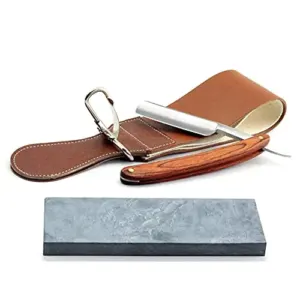
It’s a kit built for convenience, pairing a stainless steel straight razor with everything you need to maintain it. The 420 steel blade has a hollowed-out Poseidon Trident pattern, and the black wood handle slides ergonomically. You also get a two-sided 3000 grit stone and a long leather strop with a steel hanging hook.
Keep your expectations measured, though. Customers report mixed sharpness out of the box, inconsistent sharpening results, and uneven value, so plan to hone it yourself first.
| Best For | Beginners or budget-minded shavers, and barbers or home users, who want a complete straight razor kit with a stone and strop included and don’t mind honing the blade themselves before first use. |
|---|---|
| Stone Material | N/A |
| Grit Range | 3000 (2-sided) |
| Dimensions | N/A |
| Lubricant | N/A |
| Razor Compatible | Yes |
| Other Tools | Knives, chisels, planes |
| Additional Features |
|
- Stainless steel 420 blade with a distinctive hollowed-out Poseidon Trident pattern
- Comes with a 2-sided 3000 grit sharpening stone and a long leather strop with a steel hanging hook
- Black wood handle with an ergonomic sliding design, suitable for barber shops, salons, and home use
- Out-of-the-box sharpness gets mixed customer feedback
- Sharpening performance is reported as inconsistent by some users
- Value for money is rated with mixed reviews
Natural Vs. Synthetic Straight Razor Honing Stones
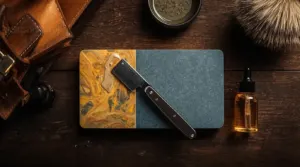
As for how they cut, a natural stone and a synthetic stone behave quite differently. A natural stone is a geological mixture, so cutting speed and finish can vary even between two stones from one quarry. A synthetic stone uses manufactured abrasive grains in a bonded matrix, which gives you predictable results from one stone to the next.
| Factor | Typical difference |
|---|---|
| Consistency | Synthetic stones are more uniform |
| Grit labels | Natural stones are only approximate |
| Lubricant | Water, oil, or slurry, depending on the stone |
| Flattening | Waterstones dish faster than oilstones |
Neither type guarantees a better edge. Your honing technique and the condition of the stone matter more, so choose the one whose lubricant, upkeep, and feel you’ll enjoy using.
Choosing Honing Stone Grits for Straight Razors
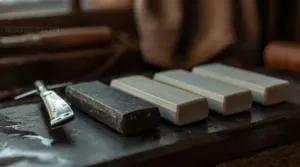
Picture a razor with a tiny chip near the heel. Starting on an 8,000 stone would take an hour and still leave the nick behind, while a 1,000 stone clears it in minutes.
Your grit size should match the razor’s condition:
- 800-1200 grit: sets the bevel on damaged or dull blades.
- 3000-4000 grit: erases bevel-setting scratches.
- 8000 grit: brings the edge close to shave-ready.
- 10,000-16,000 grit: polishes away microscopic marks before stropping.
A well-kept razor rarely needs the full grit progression. A single finisher usually controls touch-ups, though harder steels reward finer steps. Because bevel setting can consume 60-75% of total honing time, it pays to fully develop each stage before moving to a finer grit.
If you’re using a water stone, trust edge testing over numbers alone, since stone quality varies between brands and even between individual stones.
How to Hone a Straight Razor
Honing a straight razor comes down to a handful of steady habits, and you can learn them in two stages. First, you’ll get your stone and razor ready so the work starts on solid footing. Then you’ll practice spine-supported strokes and learn how to check the edge before you go any further.
Preparing Your Stone and Razor
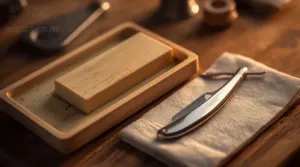
Honing goes wrong before the first stroke more often than you’d think.
| Step | Check | Result |
|---|---|---|
| Soak | Bubbles stop | Steady slurry |
| Wipe | Blade clean | No contamination |
Soak your water stone until bubbles stop, and confirm stone flattening is current, since hollow surfaces round the bevel. Wipe the razor with a soft cloth, then inspect the edge under bright light for nicks.
Spine-Supported Strokes and Edge Checks
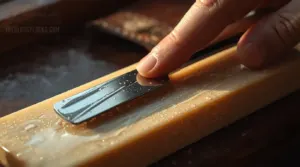
Think of the spine as your guide rail. Lay the razor flat with spine and edge both touching the stone, then glide it heel to toe, edge trailing. Use your index finger at the toe to keep the spine down, and let the weight of the blade do the work.
Treat the spine as a rail, keep it pressed to the stone, and let the razor’s own weight shape the edge
Check your edge every 25 to 30 laps with a hanging hair test, then confirm with a shave.
Straight Razor Honing Frequency and Duration
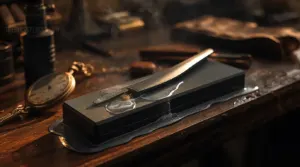
How often should you actually put your razor on a stone? Less often than you’d think, provided you strop before every shave.
Daily shavers usually need to hone every one to three months. If you shave only now and then, once or twice a year can be enough, since stropping keeps the edge aligned for longer. Skip the strop, and weekly honing may become necessary.
Let the blade tell you. Tugging or pulling during a shave, or failing the hanging hair test even after stropping, means it’s time.
A basic session takes about 20 to 50 edge-trailing passes, depending on the blade’s condition and your stone’s grit. Setting a new bevel on a coarse stone runs much longer, while finishing on a fine stone calls for light pressure and fewer passes.
Cleaning, Flattening, and Storing Honing Stones
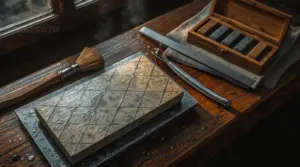
Honing takes care of the razor, but your stones need the same attention. Rinse each one under running water after every session and scrub it gently with a soft brush to lift metal particles and slurry. For stubborn buildup, use mild soap or a dedicated stone cleaning solution, then rinse well. Skip harsh chemicals, since they can damage the surface.
Flatten water stones before each session, because a dished stone rounds the edge instead of refining it. Draw a pencil grid on the surface, then lap it on a diamond plate or silicon carbide powder on glass until every mark disappears. Check the result with a straight edge.
Store stones dry, separated by grit, and wrapped or boxed against knocks. Damp storage can lead to cracking.
Frequently Asked Questions (FAQs)
What is the difference between honing and stropping?
Honing is a world apart from stropping. Honing grinds steel away to rebuild a new cutting edge, while stropping simply aligns and polishes the edge you already have, so it can’t fix a truly dull blade.
What causes a straight razor edge to chip?
Most chips come from sudden impact, like knocking the edge on a sink or hone.
Twisting, heavy pressure, or gritty stones can overload thin steel, and corrosion or brittle metal lowers edge durability even further.
How much does a good honing stone cost?
Picture a flat, fine-grained slab that turns dull steel into a clean, shaving-ready edge. Expect to pay roughly $40 to $80 for a solid 3000/8000 combination stone, while natural Belgian coticule options climb higher.
Do straight razors need professional sharpening occasionally?
Say you drop your razor on a tile floor and the edge catches a visible nick. No amount of stropping will fix that. It needs a full regrind, and only a professional can do it.
Otherwise, occasional honing is normal, and you can learn it yourself.
Conclusion
Picture a razor that tugged at your cheek last Sunday and glided through your stubble this Sunday. Nothing about the steel changed. You simply gave the bevel what it asked for: a clean, patient pass across the right stone.
That’s the real lesson behind choosing honing stones for straight razors. The stone matters, but your steady, spine-supported strokes matter more. Hone when the edge asks, check your work, and keep your stones flat. Control follows.