This site is supported by our readers. We may earn a commission, at no cost to you, if you purchase through links. This content is for general informational and educational purposes only and is not a substitute for professional medical, dermatological, or nutritional advice.
A 6k synthetic stone leaves scratches so uniform they look machined. A natural novaculite stone with the same label can finish two to four times finer, because its particles fracture and wear as you work.
That gap is why choosing between a natural vs synthetic honing stone takes more than comparing numbers on a box. Starter synthetic kits run around $85, while good Japanese naturals start near $125 and climb past $500. Each one also asks you to sharpen differently, from pressure to slurry to stroke.
Odds are your steel and your patience will settle the question. Here’s how grit, cost, and technique stack up.
Table Of Contents
Key Takeaways
- A natural stone’s crumbling particles leave shallower, varied scratches that often finish two to four times finer than its grit label suggests, while a synthetic’s uniform scratches can look polished yet roll under stress.
- You’ll get your best results by setting the bevel on a synthetic 1k stone, since most of your shave quality comes from that step, and then adding a natural stone later for a smoother finish.
- Natural stones cost more (roughly $125 to over $500 versus about $85 for a synthetic kit), come from finite deposits, and take longer to learn because you have to make slurry and relearn your pressure and strokes.
- Odds are soft natural stones glaze over on harder, carbide-heavy steels, so match your stone to your steel and budget, and test any natural stone before you trust it.
Grit Ratings and Scratch Patterns
How fine is a 6k stone? With a synthetic, the number holds up, because abrasive particle size is tightly controlled and the scratches stay nearly identical. A natural stone doesn’t play by those rules.
Novaculite is softer than aluminum oxide, so its particles fracture and wear as you work. That leaves a varied, shallower scratch pattern, which is why a natural often feels smoother and finishes finer than its label suggests, commonly two to four times finer on Japanese stones. Synthetics cut aggressively and uniformly, but at high grits those deep, even scratches can leave an edge that looks polished and still rolls under stress.
Once your razor has that finer edge, this guide to how to shave with a straight razor shows how to put it to use.
A natural stone’s crumbling grit leaves gentler, uneven scratches that finish finer than its number suggests, while a synthetic’s rigid sameness can look polished yet fail
Natural stones also contain inclusions from other rocks and have variable particle sizes, so assigning them a reliable grit number is difficult without testing. So don’t map a natural onto your grit progression by number alone. Trust magnification instead.
Why Natural Stones Need Slurry
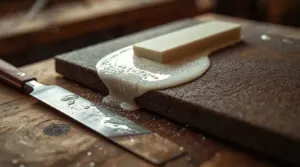
That variable particle size is also why a natural stone behaves so differently on the water side of things. Most of them are hard, dense rock with a tight surface, so they don’t release abrasive on their own the way a soft synthetic does. You have to make it.
Rub a small companion stone, often called a nagura, across the face with a little water. The milky film that builds up is slurry, and it’s loose, freshly broken particles sitting between your blade and the stone. Those particles roll and fracture under the steel, which is what gives you that shallow, varied scratch.
Skip it, and odds are the edge will skate and feel glassy without cutting much. Start with thicker slurry for faster work, then rinse it thinner as you finish.
Setting The Bevel at 1k
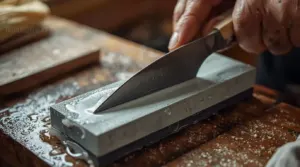
Slurry matters for finishing, but the real work starts on a synthetic. A 1k stone is where you set the bevel, and it’s the step that decides most of what follows. Synthetics cut fast and stay consistent, so you aren’t guessing how the stone will behave.
Your goal is simple: raise a burr along the whole edge on both sides. Odds are you’ll see the scratches from this stone reach the edge before you move on. If they don’t, keep going.
Once that burr runs the full length of the edge, you’re ready to flip the blade, and this step-by-step guide to sharpening razor blades with a stone shows how to match grit and angle to your steel.
- Flatten the stone first, since a dished surface rounds your edge.
- Use light pressure and a steady angle, alternating sides.
- Check that setting scratches reach the edge on both sides.
Skip this and you’ll spend ages chasing it on finer stones.
Polishing Above 8k
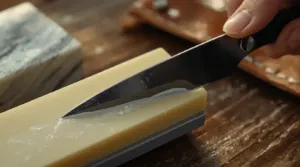
Once the bevel is set and you’ve worked through the middle grits, you’re ready to polish. Past 8k, you’re no longer removing much steel. You’re smoothing the scratches left behind until the edge looks and feels clean.
If you’d like a simple finishing setup, a double-sided honing stone for straight razors pairs a 3000 grit refining side with an 8000 grit polishing side.
Natural stone and synthetic stone both work well up here, and the difference you’ll notice is mostly in feel. A synthetic 8k stone often feels crisp and gives steady, repeatable results. A natural stone often feels softer and smoother under the blade.
Whichever stone you pick, this guide to choosing a honing stone helps you match grit and size to your blade so your strokes stay steady.
Keep your pressure very light, nearly the weight of the knife alone. Heavy pressure can round the edge or tear the fine burr you’re trying to remove.
Finish with a few feather-light strokes on each side. If you want an even higher shine, polishing compounds on a strop can take it further.
Cost, Availability, and Learning Curve
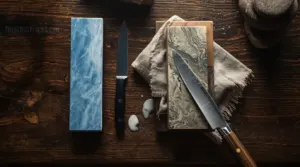
Why do so many people start with synthetics? Mostly because of cost. A synthetic starter kit runs around $85, while a quality Japanese natural stone often starts near $125 and can top $500 for premium grades.
Availability follows the same pattern. Natural stones come from finite deposits, and Japan’s Honyama mines have been closed since 1967, so you’ll usually deal with specialized importers. Synthetics are easy to find almost anywhere, in standardized grits.
The learning curve is steeper too. Every stone behaves a little differently, you’ll manage slurry, and your pressure and strokes need relearning because naturals cut slower. That’s why synthetics are the beginner-friendly sharpening option. The upside? Synthetics wear faster, so long-term cost per session ends up comparable.
Matching Stone to Steel
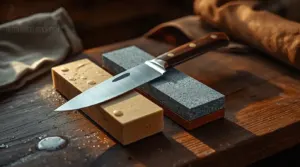
How hard is your steel? That question drives most of your stone choice. Softer stainless and carbon blades, usually around 56 to 58 HRC, sharpen happily on almost anything, so steel alloy compatibility rarely becomes a problem there.
Harder, wear-resistant alloys with lots of vanadium or chromium carbides are a different story. Odds are a soft natural stone will glaze over and stall, so a synthetic hone for bevel setting makes more sense, followed by a fine finishing stone.
Natural stone variability matters too. Two stones from the same quarry can cut very differently, so test before you commit to a particular grit range.
Stone durability and lifespan also differ. Diamond plates outlast most stones when you’re grinding high-carbide steels.
Frequently Asked Questions (FAQs)
How often should honing stones be flattened?
Odds are you’ll flatten a 1k stone every 4 or 5 sessions, since it dishes fastest. Finer stones above 8k can go 10 to 20 uses. Harder, abrasive steels shorten those intervals.
How should honing stones be stored and cleaned?
A stone is a quiet ledger of every edge you’ve sharpened. Soak synthetics, keep natural and diamond stones completely dry, and clean after each use. Usually, stone flattening every ten sessions keeps your surfaces true.
Can beginners combine natural and synthetic stones?
About 80% of shave quality comes from your bevel, so start there on a synthetic 1k. Synthetic stone uniformity makes beginner-friendly sharpening options easy; yes, finish later on a natural stone like a Belgian coticule.
Do natural stones wear out over time?
Yes, but slowly. Your natural stone sheds grains as you hone, and that wear shows up as a dished surface you’ll need to flatten now and then. With decent care, odds are it’ll outlast you.
What angle works best for straight razors?
Think of your bevel as a roof pitch: too flat and it collapses, too steep and it won’t shed anything.
Aim for 16 to 19 degrees. Below that, edges chip; above 20, shaving gets harsh.
Conclusion
Synthetics give you consistency, while naturals give you character. Neither is the better stone, only the better match. When you weigh a natural vs synthetic honing stone, start with your steel and your budget, then be honest about how much time you’ll spend at the bench.
If you want repeatable results, start with synthetics. If you want a refined edge and enjoy the craft, add a natural later. Your hands will teach you the rest.