This site is supported by our readers. We may earn a commission, at no cost to you, if you purchase through links.
The sharpest beaks don’t just happen—they’re engineered. A V-shaped beard transforms your jawline with surgical precision, carving a bold point that draws admiration and radiates control.
Most men settle for mediocre facial hair because they don’t know the exact angles, guard lengths, and trimming sequences that separate an amateur attempt from a masterpiece. Your face deserves better than guesswork.
Learning how to trim a V shaped beard isn’t about following trends—it’s about claiming your aesthetic authority and refusing to blend into the crowd. Master the technique, and you’ll never settle for an ordinary beard again.
Table Of Contents
- Key Takeaways
- What is a V Shaped Beard?
- Essential Tools and Products for Trimming
- Preparing Your Beard for a V Shape Trim
- Step-by-Step Guide to Trimming a V Shaped Beard
- Maintaining and Perfecting Your V Shaped Beard
- Frequently Asked Questions (FAQs)
- What is the best way to shape a V beard?
- What are common V beard trimming mistakes?
- How to groom a ducktail beard?
- What is the best way to trim a V-shaped beard?
- How often should I trim my V-shaped beard?
- Can I use a beard trimmer for a V-shaped beard?
- What tools are recommended for trimming a V-shaped beard?
- How long does it take to grow a V-shaped beard?
- Can patchy beards achieve a sharp V shape?
- What beard length works best for V shapes?
- Conclusion
Key Takeaways
- The V-shaped beard creates a sharp, tapered point at your chin that works best on oval, square, diamond, round, and heart-shaped faces when matched correctly to your facial structure.
- You’ll need a quality beard trimmer with adjustable guards (1-25mm), sharp scissors, a fine-toothed comb, and proper care products like pH-balanced shampoo, beard oil, and beeswax balm to execute and maintain the style.
- Start by outlining diagonal lines from your ears to your chin point, create a gradual fade from cheeks downward using progressively shorter guard lengths, then define clean necklines and cheek lines for symmetry.
- Maintain your V-shape with weekly trimming sessions to keep lines sharp, daily brushing and oil application for healthy growth, and don’t hesitate to book a barber when home attempts fail to deliver the precision you need.
What is a V Shaped Beard?
The V-shaped beard isn’t just another facial hair trend—it’s a statement of precision and style that takes your look from ordinary to sharp.
Mastering the art of trimming your neckline is essential to achieving that clean, defined V-shape that elevates your entire appearance.
This distinctive shape follows your natural chin line while creating a tapered silhouette that draws the eye downward and adds definition to your face.
Before you pick up your trimmer, you need to understand what makes this style unique, what it looks like when done right, and whether it’s the perfect fit for your face.
Defining The V-shaped Beard Style
A V-shaped beard forms a sharp, downward point at your chin, creating that distinct V outline. The style converges cleanly from wider cheek lines to a pronounced tip, balancing rugged texture with polished edges.
Your facial structure and hair texture both influence the final look. Master the right trimming techniques, and you’ll achieve perfect beard symmetry that draws admiration and frames your face with confidence.
For more on how specific face types suit this look, see a guide to suitable face shapes.
Key Features and Visual Appeal
Beard symmetry defines the V-shaped beard‘s visual balance. Your facial structure benefits from crisp beard contours—clean cheek lines taper gradually to a sharp chin point, enhancing your jawline.
The V-shaped beard offers a bold silhouette that flatters through contrast: darker density against skin creates depth, while precise trimming and smart beard shaping with your trimmer ensures both sides mirror each other perfectly.
Who Suits a V-shaped Beard Best
Now that you’ve seen what makes the V silhouette stand out, let’s talk face shapes and growth patterns. Not every beard suits every man, but the V-shaped beard works wonders if you match facial structure to beard styling:
- Oval faces handle almost any V point—your balanced proportions shine.
- Square jaws pair perfectly with a pronounced V that softens width.
- Diamond faces benefit from a sharp V to highlight your chin.
- Round faces need a deeper V point to add length.
- Heart-shaped faces should start the V higher to balance a narrow chin.
Hair texture and even growth matter too. Thick, dense facial hair holds crisp lines better during your beard trim, while patchy or sparse beard styles demand more frequent shaping to keep the V recognizable.
For further tips on matching beard styles to face type, check out this beard styling guide for every face shape.
Essential Tools and Products for Trimming

You can’t build a sharp V-shaped beard without the right arsenal. The tools you choose will make the difference between a clean, professional look and a choppy mess that screams amateur hour.
Start by mastering the fundamentals of how to trim a big beard before you even think about carving out those sharp V-shaped edges.
Let’s break down exactly what you need to get this style locked in.
Recommended Beard Trimmers and Guards
A quality beard trimmer is the foundation of any V-shaped beard. Choose models with adjustable guard lengths from 1mm to 25mm for varied trimming techniques.
The Philips Norelco Multigroom 9000 offers 12 guards and outstanding run time, while the Braun Series 9 provides 40 precise beard length settings. Look for self-sharpening trimmer blades and safety features that protect your skin during detailed work.
Scissors and Combs for Precision
Sharp scissors with titanium or carbon steel blades give you clean cuts without pulling. Pair them with a stainless steel fine-toothed comb for the scissor-over-comb technique—it guides hair at consistent elevation for precision trimming.
Ergonomic grips with finger rests reduce hand strain during longer sessions. Texturizing scissors soften edges when you need a less severe V shape, while pointed tips navigate tight contours effortlessly.
Beard Shampoos, Conditioners, Oils, and Balms
Quality beard care products fuel healthy hair growth and skin health beneath your V shape. Choose a pH-balanced beard shampoo with mild surfactants and a rinse-out beard conditioner for slip.
Apply non-comedogenic beard oil after drying to lock moisture, then finish with a beeswax-based beard balm for light hold. These grooming tips prevent itchiness and flyaways between trims.
Preparing Your Beard for a V Shape Trim
You can’t build a sharp V-shaped beard on a messy foundation. Proper prep work separates a clean, professional look from a patchy disaster that’ll have you starting over.
Here’s how to get your beard ready so every cut counts.
Cleansing and Conditioning Steps
Start with warm water to open follicles, then massage sulfate-free beard shampoo into your beard for 20 to 30 seconds. Rinse with cool water to seal everything in.
Apply a leave-in conditioner or rinse-out formula for 2 to 5 minutes to restore hair moisture. These beard care products form the foundation of proper beard hygiene and skin care before trimming.
Detangling and Drying Techniques
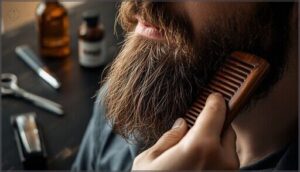
Once conditioning is done, grab a wide-toothed comb and work from the ends upward in small sections—this prevents breakage during beard grooming. Pat your beard with a microfiber towel instead of rubbing to avoid frizz. Let it air-dry or use low heat with a vented brush for even volume.
Detangling Tips for beard trimming:
- Apply beard oil before combing to loosen stubborn knots
- Use single-stroke motions with your comb, never forceful pulls
- Keep hair damp but not soaking for easier detangling
- A stainless steel trimmer helps resist snagging on coarse hair
Assessing Natural Beard Growth and Planning
Before you pick up a trimmer, stand in bright light and map where your facial hair actually grows—this isn’t guesswork. Thick coverage along the jawline complements a V-shaped beard, while patchy cheeks might need strategic trimming. Your hair texture and growth patterns determine the trimming strategy that flatters your facial structure.
| Growth Zone | What to Look For |
|---|---|
| Cheeks | Sparse patches or thick coverage—guides fade depth |
| Jawline | Even density from ear to chin for sharp V definition |
| Chin | Strong growth center anchors the V-shaped beard point |
| Neckline | Natural boundary below jaw sets your baseline |
| Mustache | Balance with beard length for unified beard shape |
Step-by-Step Guide to Trimming a V Shaped Beard
Now it’s time to transform your prepared beard into that sharp V-shaped masterpiece. This section breaks down each essential step in the trimming process, from establishing the initial outline to perfecting every angle.
Follow these techniques in order, and you’ll walk away with a beard that demands attention and respect.
Outlining The V Shape Along The Chin and Jaw

Think of your jawline as a canvas—the outline makes or breaks your V-shaped beard. Position your trimmer at the ear lobe, then angle diagonally down toward the chin point.
This chin line definition creates that sharp V shape anatomy. Keep the line crisp along your facial contours, stopping just before the neck. Mirror both sides carefully for perfect beard symmetry.
Creating a Gradual Fade From Cheeks to Chin
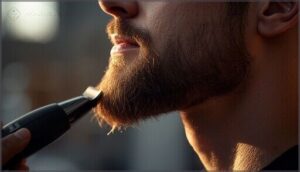
Now blend your V-shaped beard from cheek to chin. Start with a higher guard near the cheeks, then step down gradually as you move toward the jawline. This fade technique creates that smooth shift planning pros use.
Keep your trimmer at shallow angles—no hard lines. Work in small increments, roughly two-finger widths above the jaw, checking both sides constantly. The cheek blending should feel soft, letting your chin dominate the look.
Defining The Neckline and Cheek Lines
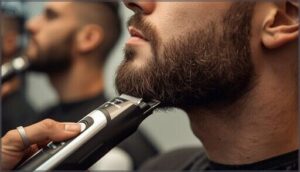
Your V-shaped beard trimming guide depends on sharp neckline techniques and cheek line styling. Position your neckline 0.5 to 1 centimeter above the Adam’s apple, following a soft U-curve that mirrors your jawline. For the cheeks, start where sideburns meet the upper cheek, then slope gently inward toward the chin.
- Keep the neckline above your collarbone to avoid a boxy look
- Use light, feathery strokes for cheek line styling instead of hard cutoffs
- Check facial contours and beard symmetry from multiple mirror angles
- Maintain your trimmer blade parallel to the jaw for smooth jawline refining
- Recheck lines after facial movements to confirm stability
This precision creates that commanding V-shaped beard silhouette.
Mustache Trimming to Complement The V Shape
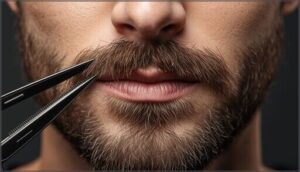
Your mustache peak should mirror the V-shaped beard’s geometry. Center a distinct peak under your nose, keeping the middle hairs slightly longer than the edges.
Trim with horizontal snips for beard symmetry, then taper gradually toward each mouth corner. Apply light balm to hold facial harmony. This mustache trimming technique locks in the commanding V silhouette—your beard trimming guide depends on it.
Finishing Touches for Symmetry and Sharpness
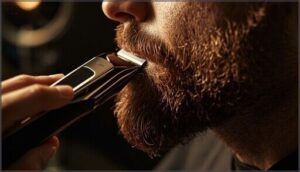
Step back and check your V-shaped beard from ear height using a handheld mirror. Compare both cheek lines—they should taper to matching points within half a centimeter.
Use a fine detail trimmer set to 0.5 millimeters for edge refining along the chin tip. Run scissors through stray hairs for sharpness techniques that finalize symmetry checks and beard contouring perfection.
Maintaining and Perfecting Your V Shaped Beard
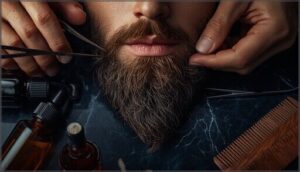
You’ve carved out that sharp V-shape, but the real challenge starts now.
Keeping those crisp lines and healthy growth requires a smart maintenance routine, not just hope and guesswork.
Let’s break down the daily habits, product strategies, and professional support that’ll keep your V-shaped beard looking razor-sharp week after week.
Weekly Trimming and Daily Grooming Routines
Your V-shaped beard won’t maintain itself—weekly trimming keeps those crisp lines sharp and prevents overgrowth from sabotaging your style. Set a consistent trimming schedule, like a Sunday reset, to keep the neckline and cheek lines clean.
Daily grooming tips include brushing twice to distribute oils and using a light beard balm for hold. Consistent beard maintenance separates amateurs from pros in men’s grooming tips.
Using Beard Oil and Balm for Healthy Growth
Your V-shaped beard thrives when you feed it the right fuel—oil composition matters. Apply beard oil to damp facial hair care, working jojoba and argan oils from roots outward to hydrate skin and soften growth. Lock in moisture with balm benefits that include beeswax hold and shea butter conditioning. This application routine delivers growth ingredients like vitamin E while boosting skin health, turning your beard maintenance and men’s grooming into a growth-friendly ritual.
- Oil first on damp beard – Massage carrier oils to follicles for maximum absorption
- Seal with balm – Lock moisture and add light hold without stiffness
- Daily consistency – Build healthier conditions for your V-shaped beard with beard care tips
When to Seek Professional Barber Services
Sometimes your V-shaped beard demands expert advice beyond DIY trimming techniques. Book a barber consultation when uneven growth persists after three home sessions, skin irritation lingers past two weeks, or your desired symmetry eludes casual attempts.
Professional guidance corrects trimming errors you can’t fix alone—drifting necklines, asymmetric cheek lines, or proportion imbalances. Barber services deliver the beard correction and precision your face deserves.
Troubleshooting Common V-shaped Beard Mistakes
Your V-shaped beard won’t look sharp if you ignore trimming errors that derail beard symmetry. Jawline issues like necklines cut too high erase the V silhouette, while cheek line mistakes—lines too low or uneven slopes—flatten your facial hair styling.
Fix beard styling techniques by checking both sides in natural light. Daily brushing prevents stray hairs from blurring your edges. These maintenance tips keep your V-shaped beard crisp between mens grooming tips sessions.
Frequently Asked Questions (FAQs)
What is the best way to shape a V beard?
Mastering the V-shaped beard is your ticket to razor-sharp confidence.
Start by outlining two angled lines from sideburns to chin, creating that pointed center, then gradually fade the cheeks shorter for dramatic contrast.
What are common V beard trimming mistakes?
Neckline errors destroy your V silhouette—trim too high and you’ll hollow out your chin.
Cheekline mistakes create lopsided facial hair. Edge precision demands steady hands, sharp scissors, and proper grooming techniques for perfect beard symmetry.
How to groom a ducktail beard?
Let’s cut to the chase: ducktail trimming starts with clean, conditioned facial hair.
Use scissors for precision, shape a rounded point at your chin, and maintain with weekly grooming and beard styling balm.
What is the best way to trim a V-shaped beard?
Start by outlining the V shape with a trimmer, then create a gradual fade from cheeks to chin using different guard lengths, and finish by defining sharp necklines and cheek lines.
How often should I trim my V-shaped beard?
Despite what you’ve heard, faster beard growth doesn’t mean constant trims.
Target every 1–2 weeks for sharp edge control and V-shaped precision, adjusting your trimming schedule based on individual growth rate and maintenance goals.
Can I use a beard trimmer for a V-shaped beard?
Absolutely. A quality beard trimmer with adjustable guards lets you taper from cheeks to chin, creating that sharp V silhouette.
Use precision tips for clean cheek lines and maintain blades for smooth trimming techniques.
What tools are recommended for trimming a V-shaped beard?
Quality beard trimmers with trimming guards, precision scissors, and a fine-toothed comb form your fundamental foundation.
Add a boar bristle brush, shaping tools, and clipper oils to master V-shaped beard trimming techniques professionally.
How long does it take to grow a V-shaped beard?
Most men achieve a defined V-shaped beard in 2–4 months.
Growth rate factors, beard density, and genetic influence determine your timeline.
Facial structure and hair texture affect how quickly the V silhouette becomes sharp and visible.
Can patchy beards achieve a sharp V shape?
Yes—prioritize sharp chin lines and clean cheek contours. V shape techniques use facial hair mapping and controlled fades to mask sparse areas, creating the illusion of density through strategic beard density tips and precision grooming.
What beard length works best for V shapes?
Your V shaped beard thrives at 6 to 12 mm on the chin point, while cheeks stay trimmed to 1 to 3 mm. This contrast sharpens your facial structure and highlights the peak.
Conclusion
Imagine this: a client walks in with uneven growth and zero definition. Twenty minutes later, he’s photographing his reflection from three angles. That transformation happens when you know how to trim a V shaped beard with intention.
Your trimmer isn’t a lawn mower—it’s a sculpting tool. Every pass refines your statement. Every angle sharpens your presence.
Stop treating your beard like an accident. Own the geometry, command the mirror, and let your jawline do the talking.