This site is supported by our readers. We may earn a commission, at no cost to you, if you purchase through links. This content is for general informational and educational purposes only and is not a substitute for professional medical, dermatological, or nutritional advice.
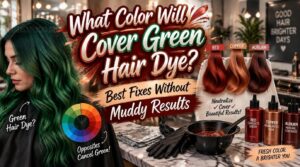
Green hair looked great for two weeks. Now it’s fading patchy, your roots are screaming, and you’re wondering what color will cover the green hair dye without turning your head into mud. Here’s the deal: red, copper, and auburn sit opposite green on the color wheel, so they cancel it out instead of fighting it.
But slap the wrong shade on the wrong base, and you’ll get swamp-water brown or slate-gray mush. The fix lives in the details: base lift, strand tests, and shade matching. Grab your gloves. Your color correction starts here.
Table Of Contents
- Key Takeaways
- What Color Will Cover Green Hair Dye?
- Why Do Red-Orange Tones Neutralize Green Hair?
- Which Color Covers Mint, Teal, or Dark Green Hair?
- How to Cover Green Hair Without Muddy Results
- Can You Fade Green Hair Dye at Home?
- Frequently Asked Questions (FAQs)
- What colors can I put over green hair?
- What color cancels out green hair dye?
- Will pink cancel out green hair?
- What happens if you put brown hair dye over green?
- How long does green hair dye last?
- Can I dye green hair blonde instead?
- Does green hair dye damage your hair?
- What developer should I use over green hair?
- How do I keep covered green hair from fading?
- Conclusion
Key Takeaways
- Red, copper, and auburn are your best covers for green hair because warm red-orange tones sit opposite green on the color wheel and cancel it out, but only if you lift your base to pale yellow first with 20–30 volume developer.
- Match the depth of your new shade to your specific green: mint needs mid-level copper or light auburn, teal calls for copper-red or strawberry blonde, and dark green requires rich warm brown, burgundy, or auburn to overpower it.
- Skip the mud by fading the green first with clarifying shampoo, running a strand test on a hidden 1–2 cm piece in natural light, and applying your color in thin, even sections with careful timing.
- You can fade green at home with clarifying shampoo, a ketchup mask, or a vinegar-baking soda rinse, but see a colorist after two failed attempts or if stubborn green lingers near your scalp.
What Color Will Cover Green Hair Dye?
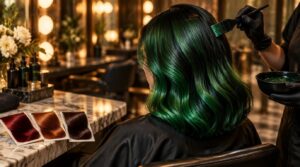
So you’ve got green hair and you’re ready for a change. Good news: you’ve got options, and they’re warmer than you might think. Let’s walk through your best covering shades, from fiery reds to deep, dark tones.
Before you commit to any of these shades, it helps to know whether you should wash your hair before dyeing it, since clean or day-old strands can change how your new color takes.
Red, Copper, and Auburn
Grab the warm side of the wheel. Red, copper, and auburn cancel out green hair because warm red-orange tones sit opposite green on the color wheel. But here’s the kicker: your base must lift to pale yellow first, or you’ll get muddy greens instead of shine.
Red, copper, and auburn cancel green hair—just lift your base to pale yellow first, or you’ll get mud
- Lift 1–2 levels with 20–30 volume developer
- Target a pale yellow base
- Pick true red/orange hues, skip cool cranberry tones
- Watch porosity; porous hair drinks pigment fast
Nail that, and copper goes gorgeous, not green.
Burgundy, Warm Brown, and Black
Not a red fan? No problem. Burgundy covers green hair dye beautifully on a level 7–9 base, its red-violet cast masks emerald and teal without turning orange.
Dark warm brown works too, packing red and yellow undertones that neutralize green.
Jet black? It’ll blanket green on pre-lightened hair, just don’t underprocess or you’ll get blue-black weirdness. Thin, even layers, y’all.
Pink, Purple, and Blue Limits
Dreaming of pastels? Here’s the honest scoop, y’all.
- Bright pink needs a base two levels lighter, or it goes muddy
- Purple shade works only on warm or neutral greens
- True blue wants a level-10 base, no shortcuts
- Blue and pink over cool greens? Slate city
Does purple cancel out green hair? Partially. The color wheel says red-orange wins. Strand test first.
If purple isn’t cutting it, our guide to fixing brassy hair color breaks down which corrector matches your specific unwanted tone.
Why Do Red-Orange Tones Neutralize Green Hair?
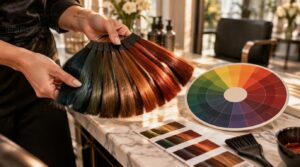
Here’s the science behind why red saves your bacon: hair color theory says opposite shades cancel out green tones. On the color wheel, green sits directly across from red-orange. That’s pigment cancellation at work.
Green dye carries blue-green chroma. Warm red-orange tones pack the complementary pigment, so when you layer them over green, they neutralize that cool cast instead of fighting it. Copper and auburn blends work the same trick, just with a softer landing.
One catch: your results depend on depth. Match your new shade to your current level, or you’ll get muddy soup. And blue-leaning greens (think teal) need extra warmth to fully surrender. Yellow-olive greens? They fold fast under copper.
Which Color Covers Mint, Teal, or Dark Green Hair?
How does your exact shade of green change the game? Turns out, not all greens fade the same.
Mint is pale and pastel, so it needs a mid-level copper or light auburn to cancel out green tones. Go too dark and you’ll overshoot into mud.
Teal sits in the middle, so a copper-red or strawberry blonde usually does the trick. Remember the color wheel: red sits opposite green, so red-leaning pigments win here.
Dark green is stubborn. You’ll need depth, like warm brown, burgundy, or auburn, to overpower those deep undertones. A light dye over dark green just gets ashy and sad.
Wondering what color covers green hair best overall? Red-orange families, every time. And always strand test before you commit.
How to Cover Green Hair Without Muddy Results
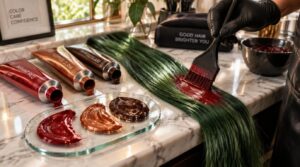
So you want to cover that green without turning your hair into a swampy, muddy mess? Good news: it all comes down to timing, depth, and technique. Follow these four steps and you’ll land a clean, even color instead of a murky mistake.
Fade Vibrant Green First
Here’s the deal: green loves to overstay its welcome. Before any new color goes on, you’ve got to fade that pigment down. Think of it as clearing the canvas.
- Clarify hard. Use a clarifying shampoo or chelating rinse to strip buildup.
- Watch the clock. Green shifts olive within 2–4 weeks of dyeing.
- Know your hair porosity. Lighter, less porous hair dumps dye faster.
Fading first keeps warm undertones intact, so your next shade lands clean, not muddy.
Choose The Correct Color Depth
Think of color depth like paint over a stained wall: too thin a coat, the stain bleeds through. Your green needs a warm, rich depth to win. Match your base level and skin tone, then pick a shade with enough red-orange punch.
Mid-range depths deposit the strongest pigment deposit. Go too light, and that greenish cast sneaks right back. Use swatch matching to lock your pick.
Perform a Strand Test
A client once skipped the strand test, slapped blue-based dye over faded green, and left with swamp sludge. Don’t be her.
A strands test is your crystal ball. Snip a hidden 1–2 cm piece, mix your color, wrap it in plastic, and wait 20–40 minutes.
Then check it in natural light. Green still winning? Pick warmer. Brick copper showing fast? Dilute or shorten your processing time.
Run a hair porosity test too; thirsty strands grab pigment quicker. Recording your results beats guessing, and dodging these common mistakes keeps your color correction from turning muddy.
Apply and Process Evenly
Even the best mix of the color solution fails if you slap it on like ketchup on fries. Sectioning is everything.
- Quarter the head with clips
- Work root to tip, thin slices
- Time every section, no overlap
- Watch for color bleeding at the hairline
Run a hair porosity test first, then a strands test. Applying and processing evenly means no patchy regrets.
A simple hair porosity test kit takes the guesswork out of how your hair will drink up color.
Can You Fade Green Hair Dye at Home?

Good news: you don’t have to live with that green forever. Before you reach for a red dye, you can fade it out at home with a few kitchen-cabinet tricks and the right shampoo. Here are four DIY methods to try, plus the moment you should wave the white flag and call a colorist.
Clarifying Shampoo
Here’s your new best friend: clarifying shampoo. It works like a paint scraper, lifting that stubborn green off your strands wash by wash.
Here’s the play-by-play: 1) Wet your hair with warm water. 2) Lather up for 2–3 minutes. 3) Rinse and repeat once.
Do this 1–2 times weekly, and your green hair will start its color fading journey.
Follow with conditioner, y’all.
Ketchup Hair Mask
Yep, ketchup for green hair is a real trick, y’all. That red pigment and tomato acidity help neutralize green and fade it at home.
Here’s the recipe: 1) Saturate your strands with plain ketchup. 2) Wait 20–30 minutes. 3) Rinse, then shampoo.
It’s temporary, not a full fix, so pair it with good hair preparation first.
Vinegar and Baking Soda
Ketchup’s cousin, the vinegar rinse, is next on the DIY hair dyeing menu. Mix a 1:1 baking soda paste with vinegar, apply to mid-lengths and ends only, wait 15–30 minutes, then rinse deep.
It lifts stubborn green hair dye by swelling the cuticle, but it’s drying, y’all. Always strand test first, then follow with a rich conditioner to rescue that swampy hair color.
When to See a Colorist
Sometimes that swampy hair color just won’t budge, no matter how much baking soda you throw at it. Here’s your cue to call in the pros.
Book a professional consultation after two failed at-home fixes, or if green lingers near your scalp or spreads across big sections. Salon color correction takes on stubborn unwanted tones safely.
Bring photos, note every dye you’ve used, and arrive with clean, dry hair. Drastic changes may take multiple sessions, so ask about maintenance too.
Frequently Asked Questions (FAQs)
What colors can I put over green hair?
Red, copper, and auburn work best for color correction, since warm tones cancel green on the color wheel. Burgundy and warm brown deepen it. Skip purple hair or blue overlays unless you pre-lighten first.
What color cancels out green hair dye?
You’ve got one shot at this, folks. Red-orange tones cancel out green hair dye. Think copper, auburn, true red. It’s basic color wheel magic: opposites neutralize. Blue-based shades won’t cut it.
Will pink cancel out green hair?
Short answer: not really. Pink won’t reliably cancel out green hair. On the color wheel, complementary colors matter, and green’s opposite is red. Bright pink adds cool tones, so you’ll likely get mud.
What happens if you put brown hair dye over green?
Picture forest moss dusted with cocoa: that’s brown over green. You’ll get olive or muted brown-green, not clean brown. Dark brown hair color covers better; light brown leaves yellowish lime hints. Strand test first.
How long does green hair dye last?
Here’s the honest scoop: green hair dye usually fades in one to three weeks. Expect noticeable color fading methods territory by five washes. Porous, bleached hair boosts hair color longevity, so treat it kindly.
Can I dye green hair blonde instead?
Yep, but here’s the truth: blonde won’t cover green, you must bleach out that pigment first. Color correction means lifting to pale yellow, strand testing, then toning. Otherwise you’ll get muddy green-blonde soup.
Does green hair dye damage your hair?
Green dye itself won’t wreck your hair, but the bleach underneath often does. Ammonia-based formulas lift the cuticle, so moisture escapes. Prioritize hair damage prevention with deep conditioning and bond builders.
What developer should I use over green hair?
Wondering what strength to reach for? Grab 20–30 vol developer. It shades warm reds over green hair without frying your strands. Check your hair porosity and dye absorption first, then strand test before committing.
How do I keep covered green hair from fading?
Oh, the irony: you fought that green for weeks, and now you’ll fight to keep the new shade. Lock it in with sulfate-free shampoo, cool rinses, UV protectant, and touch-ups every three weeks.
Conclusion
Last week, a client walked in with swamp-green ends and left with rich auburn waves. That’s the magic of knowing what color will cover the green hair dye.
Match your shade to your base, run that strand test, and trust red tones to cancel the green. Don’t rush the fade, and don’t skip the depth check.
Get those details right, and your hair goes from kelp forest to gorgeous. You’ve got this.