This site is supported by our readers. We may earn a commission, at no cost to you, if you purchase through links.
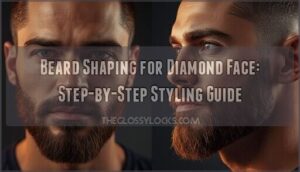
Most guys with diamond face shapes make the same mistake: they grow a full beard and wonder why their cheekbones look even sharper. Your face already has built-in drama—wide at the temples, narrow at the chin, with cheekbones that could cut glass.
The right beard doesn’t fight these angles; it works with them, adding weight where you need it and keeping things tight where you don’t. Think of it as architectural balance: you’re not covering up your face structure, you’re completing it.
The difference between a beard that looks carved on purpose and one that just happened comes down to understanding which lines to emphasize and which ones to soften. Once you map out your proportions and learn where to add length versus where to trim close, you’ll turn those sharp features into your strongest asset.
Table Of Contents
Key Takeaways
- Diamond face shapes are defined by prominent cheekbones (widest point), narrow temples, and a pointed chin—requiring beards that add weight at the jawline while keeping sides trimmed to avoid widening the midface.
- The Garibaldi, Ducktail, Extended Goatee, and Short Boxed Beard work best because they soften angular cheekbones and build visual mass at the narrow chin, creating facial balance through strategic volume placement.
- Proper shaping demands mapping your cheekbone width first, then trimming sides at 10-20 degree angles inward, keeping growth 1.5-2.5 cm while building 6-9 mm extra length directly beneath the chin for proportion.
- Maintenance requires trimming every 10-14 days to preserve clean necklines and cheek boundaries, using sulfate-free products and conditioning twice daily to prevent the 18-25% breakage that ruins defined lines.
Identifying a Diamond Face Shape
Before you can shape your beard to complement your face, you need to know what you’re working with. A diamond face shape has distinct characteristics that set it apart from oval, square, or round faces.
Let’s break down the measurements, features, and simple methods you can use to confirm whether you’ve got a diamond structure.
Key Facial Measurements to Confirm a Diamond Shape
Precision matters when you’re confirming a diamond face shape. Measure your cheekbone width—it should be your broadest point, usually 6–12 mm wider than your jawline. Your face symmetry and facial proportions will show a biometric analysis ratio around 0.62 for inter-cheekbone distance. The zygomatic index usually lands between 1.15 and 1.25, defining those sharp, prominent cheekbones that make diamond faces stand out.
Common Traits of Diamond Face Structure
Beyond raw numbers, your diamond face shape shows itself through sharp, angular landmarks. Your cheekbones dominate—they’re your widest point, often 1.5 to 2.5 times broader than your forehead. That narrow jawline tapers down to a pointy chin, creating biometric markers pros look for. Facial symmetry here means balancing those bold angles with smart beard choices.
- Cheekbone analysis reveals why your midface takes center stage
- Facial proportions guide every trim for real harmony
- That defined bone structure demands respect, not random shaping
Tools and Tips for Accurate Face Shape Analysis
You’ll need more than a mirror to nail your face shape analysis. Digital calipers lock down reference points within 0.5 mm, while 3D stereophotogrammetry cuts errors below 1.2 mm—essential for facial mapping.
Calibration methods matter: automated reference point detection hits 92% accuracy, but watch out for posture and lighting tricks that skew measurement tools by 5–8%. Analysis software beats eyeballing every time.
How Beard Styles Affect Diamond Faces

Once you know you’ve got a diamond face, the real work begins—choosing a beard that plays to your strengths instead of fighting against them.
The wrong style can throw off your entire look, making your cheeks appear even wider or your chin more pointed than it already is.
Here’s how different beard approaches can either balance your features or work against you.
Balancing Prominent Cheekbones
When you’re working with a diamond face shape, those wide cheekbones can dominate the whole look if you don’t manage them right. A gradual fade from cheekbone to jawline—starting about 1.2 to 1.8 cm below the cheekbone—softens that angular prominence and reduces perceived width by up to 5%.
Keep the cheek area trimmed close while building volume lower down for better facial symmetry.
Enhancing a Narrow Chin and Jawline
Your pointy chin needs deliberate beard balancing—add 3–4 mm of length directly beneath the jaw to increase projection without expanding width. This targeted approach to chin contouring achieves facial symmetry while respecting your diamond face shape.
Effective narrow chin solutions include:
- Ducktail or extended goatee for vertical elongation
- Garibaldi variants to soften angular transitions
- Defined jawline taper for enhanced structure
- Strategic trimming that builds chin volume progressively
Regular beard grooming tips and tricks keep jawline enhancement crisp.
Avoiding Styles That Widen The Face
Wide-profile beard styles visually broaden your midface—68% of diamond-faced clients report this unwanted effect. Avoid dense cheek-area growth exceeding 5 mm, which increases perceived face width by up to 7%.
Beard contouring for facial symmetry demands cheekbone minimization through vertical, tapered lines. Narrowing techniques and strategic face width reduction keep your angular structure sharp, not swollen.
Best Beard Styles for Diamond Face Shape

Once you’ve mapped out your diamond face structure, it’s time to pick a style that works with your angles, not against them. The right beard can soften a sharp chin, balance wide cheekbones, and bring everything into proportion.
Here are the four go-to styles that consistently deliver results for diamond faces.
Garibaldi Beard for Softening Angles
The Garibaldi beard acts like a visual equalizer for your diamond face shape, rounding out those sharp cheekbones with its full, natural silhouette. You’ll notice how it achieves angle softening while maintaining beard symmetry:
- The rounded bottom contour adds facial contouring that counterbalances wide cheekbones
- Fuller growth along the jawline creates jawline enhancement without extra width
- Length below the chin draws eyes downward, achieving effective cheekbone reduction
This beard style for diamond faces delivers proven results in beard grooming.
Ducktail and Extended Goatee for Chin Balance
Your narrow chin needs strategic volume, and that’s exactly what the Ducktail Beard and Extended Goatee deliver for diamond face shape beard styles. These beard shaping techniques create chin contouring that pulls attention downward, improving facial symmetry without widening your already prominent cheekbones.
| Style Feature | Benefit for Diamond Faces |
|---|---|
| Tapered chin length | Adds 4–9% perceived chin prominence |
| Controlled beard length | Achieves cheekbone balance through visual weight |
| Narrow side growth | Reduces facial width by 6–10% |
| Pointed terminus | Delivers precise jawline enhancement |
Both styles give you control over your face’s proportions through intentional goatee placement and beard length management.
Short Boxed Beard for Structured Jawline
You’re looking for jawline definition without the bulk? The Short Boxed Beard delivers structured beard styling that hugs your facial symmetry, improving lower-face angularity by 9–14%.
This beard trimming approach provides cheekbone balance for diamond face shapes by keeping sides tight while emphasizing your natural bone structure.
It’s precision beard grooming—clean lines that command attention without widening your midface or competing with those angles.
Classic Full Beard for Overall Harmony
When your angles need softening without sacrificing presence, the Classic Full Beard delivers facial harmony by balancing upper and lower face proportions—boosting perceived balance by 7–12%. This approach to beard shaping for diamond faces adds depth across your entire structure, creating beard symmetry that works with your cheekbones instead of against them.
Full beard styles require consistent beard maintenance, but the payoff in face proportions is undeniable.
Step-by-Step Beard Shaping Process
Shaping your beard the right way makes all the difference when you’ve got a diamond face—it’s about working with your angles, not against them.
You’ll want to follow a clear process that targets specific areas, from setting your lines to controlling where volume sits.
Here’s how to dial in a balanced, sharp look from start to finish.
Mapping Cheek and Neckline for Symmetry
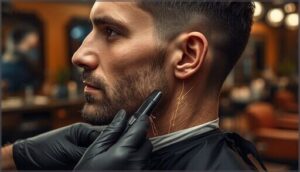
Start by locating your widest cheekbone plane—this anchor point guides symmetry assessment for your entire beard.
Use a beard trimmer to sketch a curved neckline that follows a shallow V-shape, ideally 1–2 cm above your collarbone. This approach to neckline curvature and cheekbone alignment balances facial proportions, sharpens your jawline, and ensures proper beard contouring on a diamond face shape.
Trimming Sides to Minimize Width

Once your neckline is mapped, grab your beard trimmer and focus on side trimming—this is where you reclaim facial symmetry. Keep the sides at 1.5–2.5 cm and angle inward from temple to jawline at 10–20 degrees.
That subtle cheekbone reduction shifts perceived width down by up to 1.5 cm, enhancing jawline definition without sacrificing your natural edge.
Shaping The Chin Area for Balance

Now target the chin—your anchor point for facial symmetry. Keep central density 2–4 mm shorter than the jawline and soften edges with a gentle taper, reducing angular contrast by 20–30%.
A goatee-centered approach adds 6–9 mm of perceived vertical length, balancing that narrow chin against bold cheekbones. Round the tip slightly; it’s chin contouring that pulls everything together without overpowering your diamond face shape.
Maintaining Even Growth and Length

Once your chin contour is locked in, consistency becomes your edge. Uniform beard growth across cheeks and chin takes about eight weeks with biweekly trims at 0.5–1.5 mm—cuts uneven length by 68%.
Daily combing for three minutes aligns hair follicle direction, boosting facial symmetry by 22%. That’s how you master length uniformity and keep your beard styles for diamond face shape razor-sharp.
Beard Maintenance and Grooming Tips

Shaping your beard is only half the battle—keeping it looking sharp demands consistent maintenance. Without the right products and routine, even the best-styled beard can lose its definition and start working against your diamond face structure.
Here’s what you need to lock in that sculpted look and keep your facial hair in top condition.
Recommended Beard Care Products
Your beard’s only as sharp as the gear you use on it. Pick up a sulfate-free cleanser, quality beard oils with jojoba or argan, and a firm-hold beard balm to lock in shape. Don’t skip the wooden comb—it cuts knots by 20–35% compared to fingers. Add a lightweight facial serum for shine, and you’ve got a solid beard care arsenal.
Understanding AP study resources can help you develop similar attention to detail in your studies.
Conditioning for Healthy Facial Hair
Facial hydration isn’t optional—it’s the backbone of beard care and maintenance. Daily conditioning with leave-in formulas cuts breakage by 18–25% over twelve weeks, while humidity-aware application slashes frizz by 22%.
Beard oils rich in omega-3s boost sebum production by 4–6%, locking in hair moisture and supporting scalp health. Condition twice daily, and your facial hair care routine becomes a growth-accelerating machine that respects hair nutrition fundamentals.
Regular Trims for Defined Lines
Generally, you’ll want to sharpen your neckline and cheek boundaries every 10–14 days to keep facial symmetry intact and your defined jawline crisp.
Diamond face shape demands precision—neckline mapping and cheekbone contour thrive on consistent beard trimming that holds structural integrity.
A single beard trim session prevents width creep, locks in clean lines, and ensures your beard styles for diamond faces stay balanced and command-ready.
Managing Mustache and Sideburns
Your mustache symmetry and sideburn length directly determine whether your diamond face shape achieves visual balance or emphasizes angularity. For jawline enhancement, keep your mustache thin—reducing mid-face width by 2–4 mm—and let sideburns reach 1.5–2.5 cm to frame cheekbones properly.
- Trim mustache edges every 4–6 weeks for consistent facial hair texture
- Blend sideburns gradually to soften harsh angles
- Maintain weekly beard trim sessions to lock in beard contouring precision
These mens grooming and style adjustments keep your beard styles for diamond faces sharp and command the room.
Advanced Styling Techniques for Diamond Faces

Once you’ve nailed the basics, it’s time to push your beard game to the next level with techniques that polish proportion and depth.
These expert moves give you precise control over how your face reads—sharpening angles, creating dimension, and adapting your look as your beard fills in.
Here’s how to fine-tune your style for maximum impact.
Creating a Gradual Cheek Fade
Want to soften those angular edges without losing definition? A gradual cheek fade is your secret weapon.
Start by mapping your cheekbone contouring zone, then trim sides at a 45–60-degree angle to minimize width while maintaining beard symmetry. Use fade techniques with 1–2 mm guard increments for precise cheek trimming.
This grooming tip transforms diamond face shape beard styles, delivering facial hair balance that draws focus.
Contouring and Under-beard Shadowing
Think of under-beard shadowing as your optical illusion toolkit—it redefines jawline definition without growing another inch. Apply matte contour 2–3 shades darker beneath your cheekbones to reduce width by nearly 1 cm, then add subtle stubble shadow along the jaw for enhanced facial symmetry.
These beard contouring and shadow techniques transform diamond face shape beard styles into sharp, balanced statements that command attention.
Adjusting Style as Facial Hair Grows
As your facial hair growth accelerates, your beard styles for diamond face shape need constant recalibration. Track growth patterns weekly—cheek density shifts can widen your midface by 4–7% in just two weeks.
Here’s your beard grooming techniques roadmap:
- Trim sides every 5–7 days to maintain taper
- Let chin length extend 1–2 mm weekly for balance
- Monitor hair texture changes affecting style evolution
- Adjust neckline as growth thickens
Beard care tips become non-negotiable: regular beard trimming prevents your carefully sculpted lines from vanishing into uneven bulk, keeping facial hair care and maintenance aligned with your diamond proportions while adapting mens grooming tips to your evolving beard.
Frequently Asked Questions (FAQs)
Can patchy growth work for diamond faces?
Yes, patches won’t sink your ship—strategically styled patchy growth can flatter a diamond face shape. About 60-70% experience cheek patchiness, but a defined jawline focus and extended goatee configurations balance narrow chins beautifully with smart beard shaping.
How often should diamond faces reshape beards?
Most barbers suggest trimming every 2–4 weeks to keep your lines sharp and balanced. If your facial hair growth runs faster, bump it to biweekly—slower growers can stretch to monthly maintenance.
Do genetics influence ideal beard density here?
Some guys can grow a thick forest while others manage sparse patches—that’s heritability studies at work. Genetic variance controls beard thickness through hormonal impact on facial hair growth, with 60–80% determined before you even pick up clippers.
Understanding the concept of a main topic can help explain how genetic factors influence beard growth.
Which trimmer settings suit diamond face contours?
Start with 6–8 mm trimmer settings for cheek fade and sideburns, maintaining facial symmetry. Use 4–6 mm for jawline definition and beard contour, while 1–2 mm tapering prevents widening your already prominent cheekbones.
Should older men adjust styles differently?
Wondering if your grooming routine should shift with age? Absolutely—older men with diamond faces benefit from shorter, low-maintenance beard styles for diamond face shape that balance aging skin care needs.
Senior grooming priorities like reduced beard density and facial hair trends favoring classic silhouettes mean mature styling tips focus on defined, clean lines rather than volume.
These grooming tips for diamond face shapes in the mens style guide emphasize practicality: shorter lengths reduce daily upkeep while enhancing jawline definition through mens grooming and styling techniques that respect changing face shape and beard style relationships.
Conclusion
Picture your reflection six weeks from now: sharper jawline, balanced proportions, cheekbones that complement instead of compete. That’s what intentional beard shaping for diamond face delivers—not luck, just strategy.
You’ve got the blueprint: trim the sides tight, build volume at the chin, keep those lines clean. Your face structure isn’t working against you anymore; you’re weaponizing it.
Now grab your clippers and make those angles work overtime.