This site is supported by our readers. We may earn a commission, at no cost to you, if you purchase through links. This content is for general informational and educational purposes only and is not a substitute for professional medical, dermatological, or nutritional advice.
Up to 90% of visible facial aging comes from UV exposure, not the calendar. That number usually stop people cold when I share it in the clinic. Most patients blame genetics or chalk the damage up to time, but the real culprit has been accumulating quietly across every sunlit decade.
The good news: your skin reacts to the right intervention with more strength than you might expect. The damage runs deep, but so does your capacity to rebuild. Knowing where to start makes all the difference in sun damage repair for aging skin.
Table Of Contents
- Key Takeaways
- How Sun Damage Ages Your Skin
- Can Aging Sun Damage Be Repaired?
- Best Ingredients for Sun Damage Repair
- Build Your Morning and Night Routine
- Top 9 Sun Damage Repair Products
- 1. Sun Damage Repair Resurfacing Cream
- 2. No7 Future Renew Face Serum
- 3. No7 Future Renew Night Cream
- 4. EltaMD UV Restore SPF 40 Mineral Sunscreen
- 5. Robanda Retinol Anti Aging Hand Cream
- 6. Medix 5.5 Retinol Collagen Cream Set
- 7. JUMISO Snail Mucin Peptide Essence
- 8. Sibu Sea Buckthorn Night Cream
- 9. Ombré Sun Protection Skin Supplement
- Professional Treatments for Sun-Damaged Aging Skin
- Treatment Costs, Results, and Safety
- Prevent Future Damage and Maintain Results
- Frequently Asked Questions (FAQs)
- Can skin care products reverse sun damage?
- What are the best treatments for sun-damaged skin?
- Is sun damage hard to treat?
- Can you reverse aging from sun damage?
- Can sun-damaged skin be repaired?
- Is it too late to fix sun-damaged skin?
- What is the new treatment for sun-damaged skin?
- How does diet affect sun damage repair?
- Can makeup protect against further sun damage?
- Are natural oils effective in sun damage treatment?
- Conclusion
Key Takeaways
- Up to 90% of visible facial aging comes from UV exposure, not genetics or time — making daily broad-spectrum SPF 30+ your single most impactful anti-aging tool.
- Retinol, vitamin C (10–20% L-ascorbic acid), and niacinamide are the three evidence-backed ingredients that do the real work on dark spots, collagen loss, and uneven texture.
- At-home products reach only 20–30 microns into the skin, while professional treatments like fractional laser and microneedling penetrate 10–15 times deeper — so severe damage needs clinical intervention to see structural change.
- Sun damage can’t be fully erased, but consistent treatment with the right actives produces meaningful, visible improvement at any age — the only thing that doesn’t work is waiting.
How Sun Damage Ages Your Skin

Sun damage doesn’t just sit on the surface — it works its way into your skin’s deepest support structures over time. Understanding exactly how that happens is the first step toward choosing treatments that actually make a difference. Here’s what’s going on beneath the surface when UV rays accelerate aging.
True skin resilience comes from within — explore the deeper benefits of healthy skin to understand why surface-level protection is only part of the story.
UV Radiation and Collagen Breakdown
When UV radiation hits your skin, it triggers a cascade that slowly dismantles your collagen. UVB rays fragment collagen proteins dose-dependently and activate MAPKs, suppressing new production for up to 24 hours. Research shows that UVB-induced collagen carbonylation reduces thermal stability and weakens cell adhesion, accelerating the photoaging cycle.
Three key mechanisms drive this:
- Triple helix degradation destabilizes collagen’s central structure
- UVB carbonylation alters how collagen interacts with cells
- Procollagen suppression accelerates your visible photoaging over time
Oxidative Stress and Chronic Inflammation
UV exposure doesn’t just break down your collagen. It also floods your skin with reactive oxygen species, generated by both mitochondria and NADPH oxidases. This tips your redox signaling balance toward oxidation.
Your body fights back through Nrf2 pathway activation, releasing glutathione and other antioxidant defenses. But chronic exposure overwhelms that system, locking in low-grade inflammation that silently accelerates photoaging.
Age Spots, Wrinkles, Rough Texture
That chronic inflammation shows up in ways you can clearly see. Age spots (solar lentigines) are flat, brown-to-black lesions on sun-exposed skin, produced by irregular melanin buildup.
Rough texture develops as damaged cells accumulate and fail to shed properly. Fine lines, the earliest wrinkle sign, can appear by your mid-twenties.
These aren’t random; they map every hour of unprotected sun.
Elasticity Loss and Visible Sagging
Beyond texture and spots, UV exposure quietly dismantles collagen and elastin, the two proteins your skin relies on for firmness and recoil. UV activates matrix metalloproteinases, enzymes that degrade both faster than your fibroblasts can rebuild them.
Gravity compounds that loss. You’ll notice it first in the cheeks and jawline, where elastin recoil loss translates directly into visible sagging.
Photoaging Versus Chronological Aging
Not all aging looks the same. Chronological aging progresses gradually, producing fine wrinkles, even pigmentation loss, and relatively intact collagen. Photoaging disrupts collagen production by 50%, drives mottled brown spots, and creates leathery texture that sun-protected skin rarely develops.
Up to 90% of visible facial aging traces back to UV exposure, not the calendar. That distinction shapes every treatment decision you’ll make.
Nine out of ten signs of facial aging come from the sun, not the passage of time
Can Aging Sun Damage Be Repaired?

The good news is that sun damage isn’t a life sentence — your skin has more capacity for renewal than most people realize. That said, "repair" looks different depending on where you’re starting from and what tools you’re working with. Here’s what you actually need to know before choosing your path forward.
What Reversal Realistically Means
Sun damage can’t be fully erased. UV rays cause DNA-level alterations that persist even with the best treatment available. That said, visible signs like dark spots and fine lines can improve meaningfully. Realistically, you can expect:
- Texture and tone improvements within 2 weeks of topical care
- Pigmentation fading after 2-3 months of consistent effort
- Deeper collagen remodeling over 3-6 months
At-home Versus Professional Results
The gap between at-home and professional results is real, and it matters. Daily retinol and vitamin C do work, just slowly.
Professional lasers reach 400 microns into the dermis; your topical serums reach only 20-30. That depth difference means professional treatments deliver faster, more structural change, while niacinamide, hyaluronic acid, and SPF from your routine protect and extend every gain.
Expected Timelines for Visible Improvement
Skin doesn’t keep a calendar, but treatments do.
- Microneedling: brightness within 7-10 days; collagen by week 12
- Chemical peel: peeling clears by day 10; peak fading 6-8 weeks
- Retinol 1%: sun spot fading after 3-6 months
- Fractional laser: smoothing at 4-6 weeks; full results by month 6
- Without maintenance: regression starts within 3-6 months
Areas Most Likely to Respond
The face responds fastest to sun damaged skin treatment, often showing visible change within weeks of starting vitamin C or retinol.
Hands and upper chest follow closely, their damage usually superficial enough to fade with consistent niacinamide and hyaluronic acid.
Neck skin and arms texture improvement take a little longer, but both areas respond measurably well with patience.
When Dermatologist Evaluation Matters
At-home results have real limits.
If you notice a lesion that bleeds, refuses to heal, or fits the ABCDE criteria for melanoma, seek immediate evaluation. Adults with high-risk skin, including Fitzpatrick I-III types, a history of blistering sunburns, or 40-plus moles, need annual skin cancer screening. Dermatologist evaluation also guides hyperpigmentation treatment and medical-grade care that over-the-counter products can’t match.
Best Ingredients for Sun Damage Repair
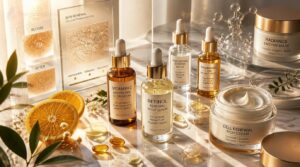
Not all ingredients on a skincare label actually earn their spot. For repairing sun-damaged skin, a handful of evidence-backed actives do the real heavy lifting. Here’s what dermatologists consistently reach for — and why each one matters.
Retinoids for Collagen and Turnover
Retinoids are the closest thing dermatology has to a proven reset button for photoaged skin. Fat-soluble retinol penetrates your stratum corneum and binds nuclear retinoid receptors, triggering accelerated cell turnover and new collagen formation in the papillary dermis.
Visible wrinkle improvement usually appears after 3 to 6 months of consistent use, with the best results arriving closer to 6 to 12 months.
Vitamin C for Spots and Protection
Where retinoids rebuild from within, vitamin C targets both dark spots and UV-triggered free radicals at once. At 10-20% L-ascorbic acid, it suppresses melanin production and delivers a real UV protection boost.
Look for:
- Dark spot fading via tyrosinase inhibition
- Antioxidant skin defense against oxidative stressors
- Stable, low-pH formula below 3.5
- Daily use as a key sun damaged skin treatment
Niacinamide and Azelaic Acid Benefits
Vitamin C takes care of the offense. Niacinamide and azelaic acid play an equally strong defense.
Niacinamide at 4-10% strengthens your skin barrier, reduces inflammation, and slows pigment transfer between cells. Azelaic acid works upstream, inhibiting tyrosinase to stop new melanin production while calming redness and clearing acne-causing bacteria. Together, they layer cleanly and target multiple sun-damage concerns without irritating each other.
AHAs for Texture and Brightness
Where niacinamide quiets inflammation, alpha hydroxy acids address rough texture and uneven tone by dissolving the bonds that hold dead cells to the surface. That physical clearing is what makes skin look brighter.
- Glycolic acid accelerates cell turnover most effectively
- Lactic acid smooths texture while hydrating
- Stay under 10% concentration for daily use
- Serums and toners deliver the most control
Peptides, Antioxidants, Ceramides, Repair Enzymes
Skin repair is a team effort. Each of these four ingredients targets a different part of your skin’s response to UV damage.
| Ingredient | Primary Function |
|---|---|
| Peptides | Signal collagen production via repair pathways |
| Antioxidants | Neutralize free radicals, reduce oxidative stress |
| Ceramides | Rebuild lipid barrier, lock in moisture |
| Repair enzymes | Activate skin renewal processes |
Peptide-antioxidant pairing is particularly effective because both target separate damage mechanisms at once.
Build Your Morning and Night Routine
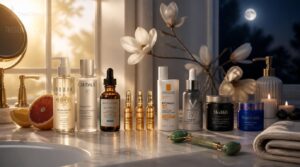
Knowing which ingredients to use is only half the equation — the other half is knowing how to use them together without undoing your progress. A well-sequenced routine makes the difference between real results and wasted product. Here’s exactly how to structure your mornings and nights for maximum repair.
Morning Application Order and Sunscreen
Order matters more than most people realize. Start with your cleanser, then apply thin serums like vitamin C or niacinamide while skin is still damp.
Hyaluronic acid goes next, then moisturizer. Sunscreen is always last. Choose broad-spectrum SPF 30 or higher and reapply every two hours outdoors. That sequence isn’t optional. It’s what makes your repair ingredients actually work.
Nighttime Retinoid and Moisturizer Steps
After cleansing, wait 15 to 20 minutes before applying retinol. Dot it onto your forehead, cheeks, chin, and nose, then smooth gently outward.
Follow with hyaluronic acid, then a moisturizer packed with ceramides and peptides to seal your barrier overnight. If irritation builds, drop retinol to every other night and keep niacinamide in your routine to calm things back down.
Seasonal Adjustments for Sensitive Skin
Your routine can’t stay static when the seasons turn.
- Switch to lighter textures in summer heat
- Limit chemical exfoliation to 1-2 times weekly
- Layer hyaluronic acid under your SPF each morning
- Add niacinamide to calm sensitivity triggers as they appear
In colder months, barrier repair strategies take over. A richer cream replaces your gel, and vitamin C stays consistent year-round.
Preventing Pilling and Ingredient Conflicts
Pilling happens when layers don’t bond right. Sunscreen is a common trigger when skin isn’t ready.
Let each product feel tacky-free before adding the next. Apply hyaluronic acid first, then niacinamide or retinol, then SPF. Too much product accelerates clumping.
Drier skin pills faster, so keeping your barrier hydrated gives vitamin C and SPF a smoother surface to work with.
Managing Retinol and Vitamin C Irritation
These two actives don’t share the same pH comfort zone.
Vitamin C in the morning, retinol at night prevents compounded irritation and keeps each active performing as intended.
Start retinol at one to two nights weekly, build gradually from there. On sensitive days, alternate them and buffer with ceramides or hyaluronic acid first, then add niacinamide to quiet any redness.
Top 9 Sun Damage Repair Products
Finding the right product can feel like searching for a needle in a haystack — especially when every label promises miracles. The nine options below cut through the noise, covering everything from daily protection to targeted repair for spots, texture, and elasticity. Here’s what’s worth your attention.
1. Sun Damage Repair Resurfacing Cream
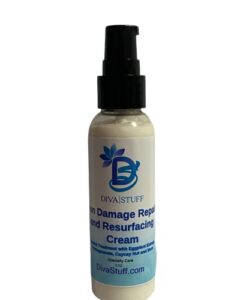
This treatment pump combines lavender, pomegranate, and vitamin C with turmeric, green tea, and bilberry butter to target the specific biology behind photoaging. Those aren’t decorative ingredients.
Vitamin C inhibits tyrosinase activity, which directly slows melanin overproduction at the root of your brown spots. Caycay nut oil delivers moisture without greasiness, so the formula absorbs quickly.
Use it as a spot treatment or all-over application on face, neck, or body. Expect visible results in weeks, not days.
| Best For | Anyone dealing with sun damage, brown spots, or actinic keratosis lesions who wants a targeted, science-backed treatment for face, neck, or body. |
|---|---|
| Product Form | Treatment Serum |
| Key Ingredient | Vitamin C & Botanicals |
| Primary Benefit | Sun spot & AK reduction |
| Fragrance | Yes (lavender) |
| Usage Frequency | Daily |
| Sensitive Skin | Yes |
| Additional Features |
|
- Packed with active ingredients like vitamin C, turmeric, and pomegranate that work together to slow melanin overproduction and visibly reduce brown spots and AK lesions
- Absorbs quickly and moisturizes without feeling greasy, making it easy to layer into your existing routine
- Versatile enough to use as a spot treatment or all-over application on face, neck, or other body areas
- The lavender scent can come across as bitter or overpowering to some users, though it does fade quickly after application
- The 2-ounce bottle feels small for the price, especially if you’re using it as an all-over treatment rather than just a spot corrector
- Results take consistent, long-term use — you’re looking at weeks or months before visible improvements show up
2. No7 Future Renew Face Serum
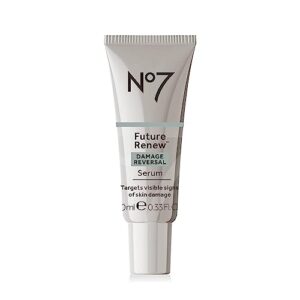
If that resurfacing cream is your workhorse treatment, think of the No7 Future Renew Face Serum as the precision layer underneath it.
Its patent-pending peptide formula signals skin to support its own renewal process, targeting fine lines and uneven tone. Niacinamide and vitamin C derivatives add brightening and barrier strength. It absorbs fast without greasiness, sits comfortably under makeup, and suits sensitive skin.
In consumer testing, 92% of women reported measurably less damaged-looking skin after eight weeks.
| Best For | Anyone who wants a lightweight, fast-absorbing serum that targets fine lines, uneven skin tone, and dullness — especially those with sensitive skin or who wear makeup daily. |
|---|---|
| Product Form | Serum |
| Key Ingredient | Proprietary Blend |
| Primary Benefit | Brightening & renewal |
| Fragrance | Unspecified |
| Usage Frequency | Daily |
| Sensitive Skin | Yes |
| Additional Features |
|
- 92% of women in consumer testing saw measurably less damaged-looking skin after just eight weeks
- Fast-absorbing, non-greasy formula sits comfortably under makeup and is dermatologist-approved for sensitive skin
- Peptide-powered formula works with skin’s natural renewal process, with brightening support from niacinamide and vitamin C derivatives
- Some users feel the size is too small given the price point
- Durability is inconsistent — reported longevity ranges from 45 days to premature breakage
- A portion of users prefer other serums on the market over this one
3. No7 Future Renew Night Cream
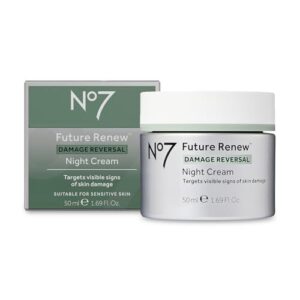
While the serum does the daytime repair work, your skin does its heaviest rebuilding at night.
That’s exactly where the No7 Future Renew Night Cream steps in. Its Peptology peptide technology is designed to work with your skin’s natural overnight repair cycle, targeting uneven tone, rough texture, and lost elasticity.
Some users with oily skin find the texture heavier than expected, so if that’s you, start with a small amount.
| Best For | Those with dry or mature skin looking for a clinically-backed overnight cream that targets fine lines, firmness, and skin texture while they sleep. |
|---|---|
| Product Form | Night Cream |
| Key Ingredient | Pepticology Peptides |
| Primary Benefit | Fine line & firmness |
| Fragrance | Unspecified |
| Usage Frequency | Nightly |
| Sensitive Skin | Yes |
| Additional Features |
|
- Pepticology peptide blend works with your skin’s natural repair cycle to visibly reduce fine lines and improve firmness overnight
- Absorbs quickly without a greasy finish, making it easy to use as part of a nightly routine
- Dermatologist-tested and suitable for sensitive skin, so it’s a safe pick for those with delicate complexions
- May feel too heavy for oily or combination skin types, which could lead to clogged pores or discomfort
- Some users have reported skin irritation or rashes, so a patch test is a smart first step
- Results aren’t instant — consistent nightly use over time is needed to see the full benefits
4. EltaMD UV Restore SPF 40 Mineral Sunscreen
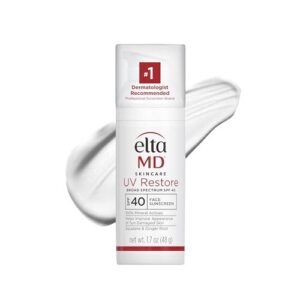
Nighttime repair only holds if you protect that progress during the day. Enter EltaMD UV Restore SPF 40, a 100% mineral sunscreen built specifically for sun-damaged, mature skin.
Zinc oxide and titanium dioxide deliver broad-spectrum UVA/UVB coverage, while squalane and ginger root extract keep skin moisturized and defended against oxidative stress. It’s fragrance-free, noncomedogenic, and dermatologist-endorsed. The texture runs thicker than chemical sunscreens, so some users notice a slight white cast. Apply it as your final morning step.
| Best For | Anyone with mature or sun-damaged skin who wants a mineral-based daily sunscreen that doubles as a lightweight moisturizer. |
|---|---|
| Product Form | Mineral Sunscreen |
| Key Ingredient | Zinc Oxide & Titanium Dioxide |
| Primary Benefit | Broad-spectrum UV protection |
| Fragrance | Fragrance-free |
| Usage Frequency | Daily |
| Sensitive Skin | Yes |
| Additional Features |
|
- 100% mineral formula with zinc oxide and titanium dioxide offers reliable broad-spectrum UVA/UVB protection
- Skin-loving ingredients like squalane and ginger root extract help smooth fine lines and support hydration
- Fragrance-free, dye-free, and noncomedogenic — gentle enough for daily use on sensitive or aging skin
- Can leave a noticeable white cast, especially on deeper skin tones
- Thicker texture may feel drying or be tricky to blend for some users
- Doesn’t always play nicely with certain foundations, which can result in a patchy or uneven finish
5. Robanda Retinol Anti Aging Hand Cream
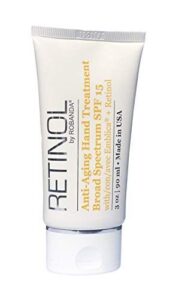
Your hands log more sun hours than almost any other body part, yet they’re the last place most people think to apply a retinol product. The Robanda Retinol Anti-Aging Hand Cream changes that.
It combines retinol, emblica brightening extract, and broad-spectrum SPF 15 in a non-greasy, fast-absorbing formula that targets age spots, crepey texture, and fine lines. The 3-ounce tube fits in your bag without a second thought. Fragrance-sensitive skin may want to patch-test first.
| Best For | Anyone who wants to target hand aging with a lightweight, travel-friendly retinol cream they can use every day. |
|---|---|
| Product Form | Hand Cream |
| Key Ingredient | Retinol |
| Primary Benefit | Age spot & wrinkle fading |
| Fragrance | Yes (added fragrance) |
| Usage Frequency | Daily |
| Sensitive Skin | No |
| Additional Features |
|
- Fast-absorbing, non-greasy formula that won’t leave residue after handwashing or during the workday
- Convenient 3-ounce TSA-compliant tube makes it easy to keep on hand wherever you go
- Helps reduce the appearance of age spots and crepey texture with regular use
- Fragrance and Red 3 dye may irritate sensitive skin
- Retinol is listed low in the ingredients, suggesting the concentration may be minimal
- The scent is off-putting to some users and tends to linger rather than fading quickly
6. Medix 5.5 Retinol Collagen Cream Set
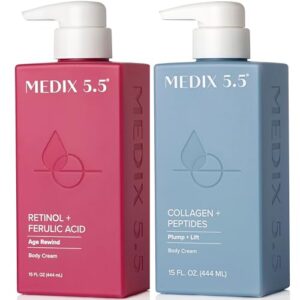
The Medix 5.5 Retinol Collagen Cream Set targets body-wide photodamage at a price that won’t strain your budget. At $31.99 for two creams, it pairs a high-dose retinol lotion with a collagen moisturizer designed to address sagging, crepey skin on the stomach, arms, and thighs.
The 5.5% retinol formula is potent for an over-the-counter product. Ferulic acid, vitamin E, and chamomile stabilize and soothe, reducing irritation on thinner skin.
Apply retinol at night, follow with the collagen cream, and remember: retinol increases UV sensitivity, so daily sunscreen is non-negotiable.
| Best For | Anyone looking to target body-wide signs of aging—sagging skin, fine lines, and crepey texture—on a budget, especially those new to retinol who want a gentler entry point. |
|---|---|
| Product Form | Body Lotion Set |
| Key Ingredient | Retinol & Collagen |
| Primary Benefit | Wrinkle & crepey skin repair |
| Fragrance | Yes (strong fragrance) |
| Usage Frequency | Daily |
| Sensitive Skin | Use with caution |
| Additional Features |
|
- Two-cream system pairs high-dose retinol with a collagen moisturizer for a more complete anti-aging routine
- 5.5% retinol is potent for an OTC product, backed by soothing ingredients like chamomile, vitamin E, and ferulic acid to minimize irritation
- At $31.99 for both bottles, it delivers solid value compared to single-product alternatives
- Retinol increases sun sensitivity, so daily sunscreen becomes a must-have addition to your routine
- Thick formula makes it hard to get the last bit out of the bottle
- Fragrance can be strong, and some users see no noticeable results even after finishing the bottle
7. JUMISO Snail Mucin Peptide Essence
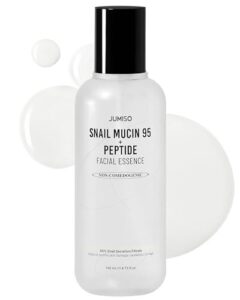
The JUMISO essence works differently from the retinoid-heavy products above. With 95% snail secretion filtrate paired with a five-peptide complex, it focuses on hydration and gentle collagen support rather than aggressive resurfacing. Panthenol, allantoin, and sodium hyaluronate strengthen the skin barrier while copper and palmitoyl peptides target firmness.
It absorbs in one to two minutes and layers cleanly under moisturizer or sunscreen. For sun-damaged skin sensitized by active treatments, this barrier-supporting essence provides recovery time without stalling progress.
| Best For | Anyone with oily, sensitive, acne-prone, or combination skin who wants a gentle, hydrating essence that supports barrier recovery—especially useful alongside active treatments like retinoids. |
|---|---|
| Product Form | Essence/Serum |
| Key Ingredient | Snail Secretion Filtrate |
| Primary Benefit | Hydration & firming |
| Fragrance | Fragrance-free |
| Usage Frequency | Daily |
| Sensitive Skin | Yes |
| Additional Features |
|
- Packs 95% snail secretion filtrate and a five-peptide complex into one lightweight formula for hydration and firming benefits
- Fragrance-free and non-comedogenic, making it safe for sensitive and breakout-prone skin
- Absorbs quickly and layers seamlessly under moisturizer or SPF without pilling or stickiness
- Some users notice a faint medicinal smell that may be off-putting
- Absorption can take several minutes depending on skin type, which may slow down your routine
- Application order instructions on the packaging aren’t always clear
8. Sibu Sea Buckthorn Night Cream
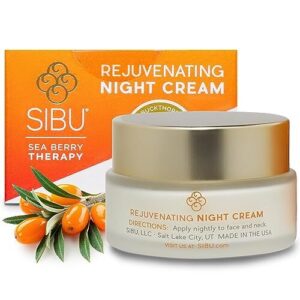
Sea buckthorn oil is one of the few plant sources containing all four omega fatty acids, which makes Sibu’s night cream a genuinely interesting option for sun-damaged skin. Himalayan sea buckthorn oil anchors the formula, supported by hyaluronic acid and olive, meadowfoam, and soybean oils for overnight hydration. Pumpkin seed and brussels sprout extracts add antioxidant support.
The bergamot and tangerine fragrance keeps the application pleasant. Some users report a waxy texture, so patch-test first.
| Best For | People with dry, sun-damaged, or aging skin who want an antioxidant-rich overnight treatment to reduce fine lines and wake up with softer, more radiant skin. |
|---|---|
| Product Form | Face Oil |
| Key Ingredient | Sea Buckthorn Oil |
| Primary Benefit | Anti-aging overnight repair |
| Fragrance | Yes (citrus essential oils) |
| Usage Frequency | Nightly |
| Sensitive Skin | Yes |
| Additional Features |
|
- Himalayan sea buckthorn oil delivers all four omega fatty acids, making it unusually effective for repairing sun-damaged and dehydrated skin overnight
- Hyaluronic acid combined with olive, meadowfoam, and soybean oils creates deep, lasting hydration without relying on harsh synthetic ingredients
- Free from parabens, GMOs, and artificial preservatives, and certified cruelty-free and vegan — a clean formula with real credentials
- Texture can be waxy, thick, or clumpy depending on the batch, so absorption isn’t consistent across users
- The fragrance fades quickly and some users detect an occasional fishy odor from the omega-rich oils
- No-return policies in some cases make it a riskier buy, especially given reports of products arriving dry or past their prime
9. Ombré Sun Protection Skin Supplement
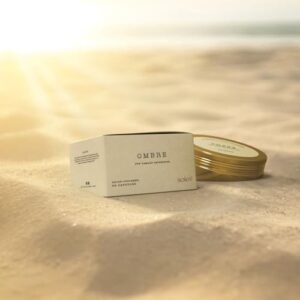
Most sunscreens protect from the outside in. The Ombré Sun Protection Skin Supplement works from the inside out, pairing Polypodium leucotomos extract with nicotinamide, curcumin, vitamin D, and omega-3 fatty acids to reduce UV-induced oxidative stress and inflammation. The formula is clinically shown to reduce skin cancer incidence by 30%.
Take two capsules daily, 20 to 30 minutes before meals. At $36 for 60 capsules, it’s a practical complement to your topical SPF, not a replacement for it.
| Best For | Anyone who wants to boost their sun protection from the inside out, especially those with a history of sun damage, aging skin concerns, or an elevated risk of skin cancer. |
|---|---|
| Product Form | Oral Capsule |
| Key Ingredient | Polypodium Leucotomos |
| Primary Benefit | Internal UV damage prevention |
| Fragrance | N/A (oral supplement) |
| Usage Frequency | Daily (2 capsules) |
| Sensitive Skin | Consult physician |
| Additional Features |
|
- Clinically shown to reduce skin cancer incidence by 30%, making it one of the few supplements with meaningful, measurable sun protection benefits
- Combines five active ingredients (Polypodium leucotomos, nicotinamide, curcumin, vitamin D, and omega-3s) that each target a different aspect of UV-related skin damage
- Easy to work into any routine — just two capsules a day alongside your regular SPF
- Won’t prevent sunburn on its own and isn’t a substitute for topical sunscreen, so it’s an add-on cost rather than a replacement
- At $36 for a 30-day supply, the ongoing expense adds up, especially since it only works with consistent daily use
- Results vary by skin type and sun exposure habits, and long-term safety data beyond the studied periods isn’t detailed
Professional Treatments for Sun-Damaged Aging Skin
When at-home products can only take you so far, professional treatments pick up where they leave off. Depending on your skin concerns — sun spots, deep wrinkles, lost volume, or rough texture — there’s a clinical option designed to target exactly that. Here are the main treatments worth knowing about.
Chemical Peels and Dermabrasion

Chemical peels and dermabrasion both work by triggering controlled skin regeneration through targeted surface removal.
For peels, depth drives results. Light glycolic or salicylic acid options handle surface texture with minimal downtime, while medium-depth TCA peels target age spots more aggressively. Deeper phenol peels are more dramatic but require significant recovery, so depth and technique should match your skin’s condition.
Fractional Laser and IPL Treatments

Where peels work from the surface inward, fractional lasers go deeper using targeted wavelength selection to create microscopic columns of treated tissue. This triggers collagen stimulation and cellular repair in specific treatment zones while sparing surrounding skin. Plan on three to five sessions.
IPL works well for age spots and spider veins but is less effective for wrinkles than fractional resurfacing.
Microneedling and Radiofrequency Options

Microneedling creates controlled dermal injury that stimulates collagen production. Radiofrequency microneedling targets the reticular dermis using adjustable needle depths for tighter, smoother skin.
- Fractional RF treats about 10% of the skin surface per pass
- Depth ranges from 0.5 mm perioral to 1.5 mm on the forehead and neck
- Results build progressively, with measurable improvements at 1, 3, and 6 months
Injectables for Volume-related Aging

While radiofrequency tightens from within, injectables restore what sun damage has taken: lost volume and skin elasticity. Chronic UV exposure degrades elastin and collagen, hollowing cheeks and deepening folds over years.
Hyaluronic acid fillers like Restylane work in the deep plane for natural projection, while biostimulators such as poly-L-lactic acid trigger fibroblast activation, driving collagen production and sustained dermal thickening.
Choosing Treatment by Skin Concern
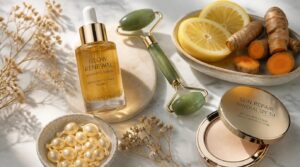
Every concern points to a different solution. Age spots call for IPL or chemical peels targeting pigment depth. Rough texture works well with AHAs and microneedling. For visible sagging, radiofrequency or fillers address laxity directly.
Your daily routine still matters between appointments: retinol, vitamin C, niacinamide, and ceramides keep repair going, while broad-spectrum sunscreen protects every result you’ve worked for.
Treatment Costs, Results, and Safety
Knowing what to spend — and what to expect — makes all the difference when you’re choosing between a drugstore routine and a dermatologist’s office. Costs vary widely, and so do results, downtime, and how different skin tones respond to each approach. Here’s a clear breakdown of what you need to know before committing to any treatment path.
At-home Regimen Cost Comparison
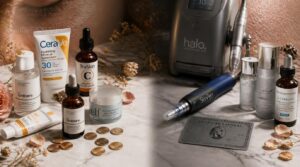
Building a solid at-home regimen doesn’t have to strain your budget. Entry-level retinol starts around $90 with SkinCeuticals Retinol 0.5, while midrange kits like Dr. Bailey’s complete set run $490 for four months of complete sun damage coverage.
Subscription services like Curology cut that to $24.99 monthly, letting you gradually add vitamin C and niacinamide without a large upfront cost.
Per-session Professional Treatment Costs
What you pay per session depends heavily on where you live and who performs the treatment. Light chemical peels start at $50-$400, while fractional CO2 laser runs $1,500-$3,000 for full-face work.
Board-certified dermatologists charge $200-$500 more than spa technicians. In Southern California, expect 20-30% premiums over inland clinics.
Single sessions always cost more, so ask about bundled pricing before committing.
Recommended Sessions and Maintenance
Most treatments require multiple sessions. IPL often needs 3 to 6 visits spaced 4 to 6 weeks apart, while microneedling runs 4 to 6 sessions monthly.
After completing your series, maintenance appointments every 6 months protect your results. Between visits, daily SPF 30+ sunscreen, retinol at night, and niacinamide actively support cell turnover acceleration and keep future damage in check.
Downtime, Side Effects, Skin Tones
Downtime varies more than most people ever realize. CO2 laser means one to two weeks of crusting and redness; microneedling needs just one to two days.
Darker skin tones carry a higher risk of hyperpigmentation after laser and medium-depth peels, so choosing an experienced provider is critical. After any procedure, daily SPF 30+ is non-negotiable for two to four weeks.
Tracking Progress With Consistent Photos
Photos don’t lie. Track your vitamin C, retinol, and niacinamide results with consistent weekly images.
- Same time of day, natural light, bare skin
- Same background, no filters, no editing
- Weekly photos for the first month of any new treatment
- AI tracks pigmentation shifts and redness levels
- Apps link images to your sunscreen and product log
Prevent Future Damage and Maintain Results
Repairing sun damage takes real effort — but letting new UV exposure undo that progress is the part most people overlook. Protecting your skin daily isn’t a bonus step; it’s what makes everything else stick. Here’s what that actually looks like in practice.
Broad-spectrum SPF 30-plus Daily
Think of broad-spectrum SPF 30+ as your skin’s daily non-negotiable, not an occasional add-on. The American Academy of Dermatology recommends it because SPF 30 blocks roughly 97% of UVB rays, and broad-spectrum coverage means you’re also shielded from UVA, which drives the collagen breakdown and dark spots you’ve worked hard to reverse.
Apply it every morning, rain or shine.
Correct Sunscreen Amount and Reapplication
Applying sunscreen is only half the equation. For your face, a nickel-sized dollop is the standard dose. Using less reduces your actual SPF protection to roughly a quarter of the labeled value.
Reapply every one to two hours outdoors, and sooner after swimming or sweating. Don’t skip your ears, eyelids, and the back of your neck either.
A gentle, fragrance-free eye cream for fine lines pairs perfectly with diligent eyelid sun protection to keep delicate skin looking its best.
Hats, Clothing, Shade, Timing
Sunscreen covers what it touches, but hats and clothing handle the rest.
A wide-brimmed hat shades your face, neck, and ears at once. Pair it with UPF 50+ fabric for coverage sunscreen can’t replicate.
Seek shade during peak UV hours, 10 a.m. to 4 p.m., to cut your UV dose by roughly 60%. Layering these habits protects what reapplication misses.
Avoiding Tanning Beds and Sunlamps
Hats and clothing guard against incidental UV exposure, but tanning beds are a different category entirely. They deliver deliberate, concentrated UV radiation, and the International Agency for Research on Cancer classified them as a human carcinogen in 2009.
Using one undoes the repair work you’ve invested in. Skip them entirely. Your skin will thank you.
Lifestyle Support and Skin Checks
Protecting your skin goes beyond UV shields. Sleep 7-9 hours nightly to support cell repair, and limit refined sugars that break down collagen. Antioxidant-rich foods strengthen your skin from within.
Monthly self-exams using the ABCDE criteria catch changes fast. Pair that with annual dermatologist visits, where dermoscopy identifies precancerous lesions early. Most skin cancers are highly treatable when caught early.
Frequently Asked Questions (FAQs)
Can skin care products reverse sun damage?
The short answer is yes and no. Skincare products can meaningfully reduce the appearance of sun damage, but they can’t fully erase it. Consistent use of retinol, vitamin C, and sunscreen delivers real, visible improvement.
What are the best treatments for sun-damaged skin?
Retinoids, vitamin C, and daily broad-spectrum SPF 30+ lead the lineup. For deeper damage, chemical peels, fractional laser, and microneedling deliver results that no serum can match alone.
Is sun damage hard to treat?
Not exactly. Sun damage responds well to consistent treatment, though results depend on severity and commitment. Daily sunscreen, retinoids, and antioxidant serums can meaningfully improve skin over months.
Can you reverse aging from sun damage?
You can’t fully erase it, but meaningful reversal is possible. Retinol, vitamin C, and daily sunscreen can visibly reduce dark spots, help rebuild lost collagen, and restore the skin texture you thought was permanently gone.
Can sun-damaged skin be repaired?
Yes, sun-damaged skin can meaningfully improve, though it won’t fully reset. Consistent use of retinol, vitamin C, niacinamide, and sunscreen rebuilds and protects, while professional treatments accelerate visible results.
Is it too late to fix sun-damaged skin?
No, it’s never too late. Sun damage is permanent, but its visible appearance can be meaningfully reduced with treatment. With consistent retinol, vitamin C, and daily sunscreen, most people see real improvement at any age.
What is the new treatment for sun-damaged skin?
The most exciting advances right now combine fractional laser resurfacing and microneedling with PRP, triggering collagen rebuilding through controlled injury and growth factor release, while DNA repair enzymes target photodamage directly at the cellular level.
How does diet affect sun damage repair?
Turns out your kale salad is doing more than making you feel virtuous. Antioxidant-rich foods and omega-3 fatty acids actively counter free radical damage and slow collagen breakdown from within. Cut sugar. Just drink water.
Can makeup protect against further sun damage?
Makeup with SPF adds a supplemental UV shield, but it can’t replace dedicated broad-spectrum SPF 30+ sunscreen. Reapplying foundation every two hours isn’t realistic, so your standalone sunscreen does the heavy lifting.
Are natural oils effective in sun damage treatment?
Natural oils bring antioxidant and emollient benefits to skin, but they can’t replace broad-spectrum sunscreen for real UVA and UVB protection. Think of them as useful additions to a solid routine, not standalone repair tools.
Conclusion
Every single ray of sunlight that ever touched your face left a permanent mark, stacked quietly across decades of cumulative exposure. But those marks can be rewritten.
Sun damage repair for aging skin isn’t about chasing youth or reversing time entirely. It’s about reclaiming control over what happens next.
With the right ingredients, consistent SPF protection, and professional guidance when needed, your skin has far more capacity to rebuild than most people will ever realize.