This site is supported by our readers. We may earn a commission, at no cost to you, if you purchase through links. This content is for general informational and educational purposes only and is not a substitute for professional medical, dermatological, or nutritional advice.
A beard that fights your face shape doesn’t look rough or rugged, it looks unfinished. But choose the right style and your jaw sharpens, your features balance, and the whole thing reads as intentional.
The best beard styles for men in 2026 range from low-maintenance stubble to bold long-form looks that take months to build. Each works best matched to your face shape, your hair, and how much time you’ll put into upkeep.
Below, you’ll find twelve styles across the full spectrum, with face shape guidance and maintenance details to help you wear yours with confidence.
Table Of Contents
- Key Takeaways
- Best Beard Styles for Men in 2026
- Choose Beard Styles by Face Shape
- Best Beards for Patchy or Thin Growth
- Pair Beard Styles With Modern Haircuts
- Choose Your Ideal Beard Length
- Maintain and Shape Every Beard Style
- Frequently Asked Questions (FAQs)
- What is the most attractive beard style for men?
- What is the 3 month beard rule?
- Are beards still in style in 2026?
- What type of beard looks best?
- What are the best beard styles for men?
- What type of beard is best for black men?
- What is the best beard style for men in 2025?
- How to choose a beard style?
- What is the best beard sculpting style?
- What are the different types of beard styles?
- Conclusion
Key Takeaways
- Your face shape is the single most important factor in choosing a beard style — oval faces can pull off almost anything, while round and square faces need chin-focused styles to add length and sharpen the jaw.
- The twelve styles covered in 2026 span from low-effort (5 o’clock shadow, short boxed beard) to high-commitment (Bandholz, Viking), so matching a style to your actual maintenance habits is just as critical as matching it to your face.
- Patchy or thin growth doesn’t disqualify you — styles like the goatee, Van Dyke, and chin strap concentrate density where growth is strongest, and short stubble makes sparse areas nearly invisible.
- Clean fundamentals — a defined neckline, combing before trimming, and checking symmetry under consistent lighting — do more for any beard than the specific style you choose.
Best Beard Styles for Men in 2026

Whether you’re starting fresh or rethinking your current look, the right beard style changes everything. These twelve styles cover the full range, from clean and low-maintenance to bold and statement-making. Pick the one that fits your face, your lifestyle, and the version of yourself you’re building toward.
For deeper guidance on matching your growth pattern to the right pick, this low-maintenance beard styles guide breaks down what actually works—and why simpler usually wins.
5 O’Clock Shadow
Though it looks easy, nailing a clean 5 o’clock shadow takes intention. It’s a short beard that lives in a tight beard growth window, so consistent beard maintenance keeps it looking right.
Lock it down with these beard trimming habits:
- Skip the razor every other day
- Trim on the lowest guard
- Moisturize to reduce redness
- Keep edges natural, never sharp
Short Boxed Beard
Ready to step it up? The short boxed beard takes that shorter length and gives it crisp, squared-off edges at your jaw and chin.
It’s built around two clean lines: your cheek boundary and chin outline. Lock those in first, and don’t trim the interior until they’re set. A 3-5mm guard keeps the overall volume tight and the shape readable.
Beard Fade
The beard fade swaps those sharp boxed edges for a soft gradient. Your hair tapers progressively shorter toward the neck or cheek, with no hard cutoff.
Beard fade blending works best when your haircut mirrors that same gradient, making both read as one connected look. Use shorter clipper guards as you move toward the fade point, never skipping blending passes.
Classic Goatee
The classic goatee beard trades soft gradients for sharp, centered structure. You’re keeping coverage tight to the chin and upper lip, with bare cheeks doing the defining work.
- Symmetry is everything; check both sides often
- Connect or separate the mustache to shift the silhouette
- Use short, frequent trims for crisp edges
- Best face shape compatibility: oval and square
Van Dyke Beard
Separate a full mustache from a chin goatee with shaved cheeks in between, and you’ve got the Van Dyke beard. That gap isn’t accidental.
That intentional separation is what sets the Van Dyke apart — explore the Van Dyke beard vs. goatee style differences to see how small grooming choices carry big visual impact.
It reduces visual width and focuses attention on your chin and mouth, sharpening your jaw.
Keep the cheek boundary consistent and the neckline tight. This is one of the most precise beard styles you can wear.
Balbo Beard
If sharp contrast is what you’re after, the Balbo Beard delivers. It pairs a trimmed mustache with a rounded chin beard and leaves your cheeks totally bare. That split between the two is the whole point.
Use a beard trimmer to sculpt tight chin edges and keep them crisp. It’s a strong choice for oval or oblong face shapes.
Chin Strap Beard
Over 60% of men with round faces say jaw-framing styles look slimmer. The chin strap beard delivers that by tracing the jaw, not the cheeks.
Beard Line Shaping matters:
- Start near the sideburn
- Trace to the chin
- Keep cheeks clear
- Anchor the chin point
Face Shape Compatibility peaks on rounder faces. Commit to Beard Neckline Definition and Beard Maintenance.
Ducktail Beard
Picture a neat, defined V-point dropping cleanly from your jaw. That’s the ducktail beard’s whole identity.
Trim the outer edges shorter, leave the center full, and set your neckline high so the V reads clearly. This beard trimming technique needs consistent chin growth to actually work. It’s one of the best beard styling tips for oval, round, and square faces.
Garibaldi Beard
The Garibaldi Beard wins on volume and relaxed ruggedness. Cheeks stay open, chin stays full. It suits most face shapes because the chin-forward structure adds length where it counts.
- Feather cheek lines, don’t edge them
- Shape the chin into a rounded base
- Merge the moustache down into the chin
Nail your beard care routine: trim the chin, leave sides soft.
Bandholz Beard
The Bandholz beard rewards patience above all. You grow it out, resist the urge to trim early, and let the length build a full, connected silhouette that carries real weight.
Keep your neckline clean while everything else grows freely. That contrast is what makes the long growth look intentional rather than neglected.
Expect early unevenness. It resolves as length sets.
Viking Beard
The Viking beard shapes long beard growth into something deliberate. Dense, even cheeks, a thick moustache, and a blocked lower edge create the rugged weight this style needs.
Four things that make it work:
- Even cheek density on both sides
- Full moustache merged into the beard
- Defined, broad lower edge
- Controlled side flare for your face shape
French Fork Beard
The French fork beard trades Viking volume for precision. Two mustache sections hang down each side of your mouth, split by a deliberate center gap.
That gap defines the whole style. Let it fill in and you’ve got a goatee. Consistent edge carving keeps the split sharp. Short growth won’t show the fork clearly, so let it develop before shaping.
Choose Beard Styles by Face Shape
The right beard doesn’t just look good — it works with what you’ve got. Your face shape determines which styles add definition, balance proportions, and make you look intentional. Here’s how to match your beard to your face.
Your face shape determines which beard styles add definition, balance proportions, and make you look intentional
Oval Face Beard Styles

You already won the face-shape lottery. Studies suggest oval faces are compatible with more beard styles than any other shape. Oval face beard styles cover the full spectrum. Here’s your shortlist:
- Short boxed beard – clean lines, controlled width
- Classic goatee – focused chin fullness, no bulk
- Chin strap – sharp beard architecture
- Beard fade – solid face shape compatibility
Round Face Beard Styles

Round faces need a different game plan than oval. Your goal is reducing cheek bulk while adding vertical length.
The best beard styles for round faces concentrate fullness at the chin, not the cheeks. Classic goatee, Van Dyke, and short boxed beard (kept tight) all deliver solid beard face shape compatibility.
Sharp sideburn lines and clean beard architecture do the rest.
Square Face Beard Styles

Your jawline’s already doing the heavy lifting. For a square face beard, you need beard architecture that builds length, not width. Keep those cheeks tight.
- Classic goatee for strong beard symmetry and vertical focus
- Beard fade to sharpen beard definition while tapering width
- Short boxed beard with controlled cheek lines
Beard and face shape matching wins when the chin leads.
Oblong Face Beard Styles

Proportions on an oblong face run long. Beard styles for oblong-rectangle faces focus on widening the jaw, not adding cheek volume.
| Style | Why It Works |
|---|---|
| Chin Strap | Jaw-focused, no side bulk |
| Short Boxed | Tight cheeks, strong base |
| Van Dyke | Chin-only weight |
| Ducktail | Pulls eye downward |
| French Fork | Counters vertical length |
Keep your cheeks close. Build at the chin.
Diamond Face Beard Styles

Picture those sharp cheekbones cutting across a room, your chin quietly narrowing below. That’s the diamond face beard challenge.
Smart beard styling means going chin-forward. A Van Dyke or Balbo keeps your beard outline tight at the sides and fuller at the chin, locking in face shape compatibility and beard balance. Keep the sides short. Lead with your chin.
Best Beards for Patchy or Thin Growth

Staring at a mirror and spotting bare islands between patches of solid growth is frustrating. It’s also fixable. Patchy beard styles like the goatee, Van Dyke, and chin strap concentrate density where your growth is strongest, so you’re working with your face, not against it.
Short stubble is your best cover. A 5 o’clock shadow keeps length so low that gaps become near invisible. Use beard combining techniques like gradual sideburn blends and defined cheeklines to reduce contrast between thick and thin zones.
Apply beard oil daily. Beard oil benefits include conditioning sparse follicles so light coverage looks even. Practice beard growth patience and give it six weeks. Anchor fullness at the chin for face shape compatibility, and you’ll look intentional.
Pair Beard Styles With Modern Haircuts
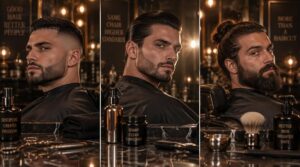
Your haircut either sells your beard or kills it.
Beard and haircut pairing is about balance. Here’s how to nail it:
- Fade haircut, tight outline: Beard styles with fade haircut need the sideburn blending cleanly into your cheek line or it looks disconnected.
- Slicked back hair with beard: Go short boxed or strap-style. Sleekness up top needs structure below.
- Man bun beard styles: Fuller jaw coverage balances the bun’s height. The top adds volume, so your beard should too.
- Pompadour beard style: Keep cheek lines clean and defined. The quiff already carries visual weight.
- Textured crop and stubble: Matte hair plus natural stubble reads as intentional. Over-groom either and you break it.
Commit to the pairing, not just the beard.
Choose Your Ideal Beard Length
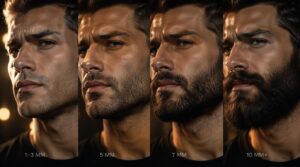
Length isn’t just a number. It’s the difference between a look that fits your face and one that fights it.
Your beard growth pattern should guide your call first. Patchy coverage means Short Stubble keeps thin spots less visible. More uniform density lets you push into Medium Stubble or Long Stubble without gaps becoming a distraction.
- Short Stubble (1-3mm): Sharp, clean, and works for nearly every face shape
- Medium Stubble (4-6mm): Adds definition without fully committing to a style
- Long Stubble (7-10mm): Builds real texture, ideal for moving into something longer
- Full Beard (10mm+): Needs solid cheek coverage to look intentional, not patchy
Length adds chin mass first, not cheek width. So if your side coverage is thin, staying shorter keeps the whole look deliberate.
Maintain and Shape Every Beard Style

Once you’ve locked in your length, the real work is keeping it there. Every beard style drifts without a consistent routine.
Set your neckline first. Draw an imaginary line from the top of your Adam’s apple toward the back of your jaw. Trim everything below it. That single move sharpens any style immediately.
Comb before you trim, always. It puts every strand in the same direction so your edges stay clean and even, not stepped or jagged. A wooden fine-tooth beard comb glides through evenly and reduces static, making it easier to lay strands flat before the trimmer touches them.
For longer styles like the Ducktail or Bandholz, scissors beat a trimmer for bulk control. Use your trimmer for the outline, scissors to manage flyaways without shrinking length.
Check symmetry under consistent lighting. Correct the fuller side first, then match it to the other.
Frequently Asked Questions (FAQs)
What is the most attractive beard style for men?
No single style wins universally, but short, well-kept facial hair comes closest. It reads as groomed, not extreme. Whether you prefer stubble or a trimmed boxed beard, clean upkeep almost always beats the style itself.
What is the 3 month beard rule?
Ever shaved too soon and regretted it? The three-month rule tells you to hold off trimming until your beard has had 12 full weeks to lengthen, so you can finally assess your actual growth density.
Are beards still in style in 2026?
Yes, beards are very much in style. Beard fashion trends 2026 favor full, trimmed, and stubble looks across urban grooming scenes. Whether you’re going sharp or relaxed, the right beard styles still command serious respect.
What type of beard looks best?
The beard that looks best is the one that balances your face proportions. It adds length where you’re short and width where you’re narrow. Clean cheek lines and solid edge control always seal the deal.
What are the best beard styles for men?
The right style depends on your face shape, growth pattern, and overall look. Five o’clock shadow is the easiest starting point, while a short boxed beard or beard fade brings noticeably sharper, cleaner facial structure.
What type of beard is best for black men?
Black mens beard styles work best when you lean into texture. Short boxed and faded cuts define edges over density, making tightly curled growth look intentional regardless of beard growth patience.
What is the best beard style for men in 2025?
No single style wins for every man. The best choice truly depends on your face shape, how your beard grows, and how much time you’re actually willing to put into your daily beard care routine.
How to choose a beard style?
Picture a guy who grew a massive Bandholz on a round face – it just looks rough. Match your face shape, growth density, and the maintenance routine you’ll realistically stick to. That narrows it down fast.
What is the best beard sculpting style?
The best sculpting style is the one that frames your face cleanly. Focus on a sharp cheek line, a defined chin shape, and a tight neck line. That outline does more than any specific style.
What are the different types of beard styles?
Take a guy who’s rocking a classic goatee but wants more presence. Beard styles break into stubble, boxed cuts, fades, chin straps, goatees, and full-length styles like the Garibaldi or Bandholz. Each one hits differently.
Conclusion
Picture yourself in the mirror, jaw looking sharp, beard sitting exactly where it should. That feeling isn’t luck. The best beard styles for men work because they’re chosen with intention, shaped with discipline, and matched to the face wearing them.
Nail your face shape, keep the lines clean, and stay consistent with the upkeep. Your beard doesn’t just change how the world sees you. It changes how you see yourself every single time you look.