This site is supported by our readers. We may earn a commission, at no cost to you, if you purchase through links. This content is for general informational and educational purposes only and is not a substitute for professional medical, dermatological, or nutritional advice.
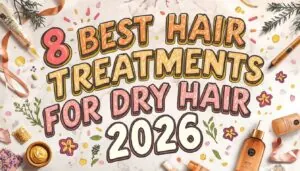
Dry hair isn’t just a texture problem—it’s a structural one. When cuticle layer lifts and lipids leach out, strands lose their ability to hold moisture, and no amount of regular conditioner fully reverses that.
Heat tools, chemical color, and even your pillowcase all chip away at the hair’s protective barrier over time, leaving it brittle, dull, and prone to snapping.
The right treatment works at the source, whether that’s rebuilding broken bonds, flooding the cortex with moisture, or sealing the cuticle shut.
These eight best hair treatments for dry hair do exactly that.
Table Of Contents
- Key Takeaways
- Top 8 Hair Treatments for Dry Hair
- Causes of Dry Hair Damage
- Best Ingredients for Dry Hair
- Moisturizing Masks and Leave-Ins
- Salon Treatments for Severe Dryness
- Choosing Treatments by Hair Type
- Daily Routine to Prevent Dryness
- Frequently Asked Questions (FAQs)
- What hair treatment is best for dry hair?
- What is the best hair treatment for dry, damaged hair?
- What is the best treatment for extremely dry hair?
- Which hair treatment is good for dry hair?
- What is the best salon treatment for dry, damaged hair?
- What is a good hair routine for dry hair?
- How often should I use hair masks?
- Can dry hair treatments cause color fading?
- What ingredients should I avoid in products?
- Are expensive treatments always more effective?
- Conclusion
Key Takeaways
- Dry hair is a structural problem, not just a texture issue — damage to the cuticle and lipid layer prevents strands from holding moisture, so real repair means targeting the source, not just the surface.
- Treatments fall into two distinct camps: bond-repair formulas (like K18 or Olaplex) that rebuild internal structure, and moisture-based masks (like hyaluronic acid or shea butter options) that flood the cortex and seal the cuticle — knowing which your hair needs makes all the difference.
- Daily habits like using sulfate-free shampoo, applying a heat protectant every time, and switching to a silk pillowcase quietly protect your results between treatment days.
- Price doesn’t predict performance — a well-formulated $10 mask with the right ceramides or humectants can outperform a $200 treatment, so reading ingredient lists matters more than chasing expensive labels.
Top 8 Hair Treatments for Dry Hair
Not all dry hair treatments are created equal, and finding the right one can make a real difference in how your hair looks and feels.
Knowing what actually works starts with understanding your options, like the ones broken down in this guide to the best conditioners for dry hair.
These eight options cover a range of needs, from bond repair to deep hydration, so there’s something here whether your hair is mildly thirsty or seriously stressed. Here’s what made the cut.
1. K18 Molecular Repair Hair Mask
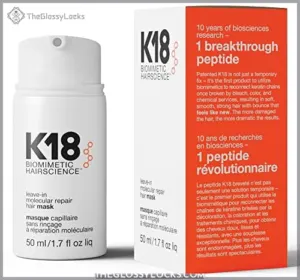
The K18 Leave-In Molecular Repair Hair Mask is genuinely different from most treatments on the market. Instead of coating your strands, its patented K18Peptide technology actually penetrates into the hair cortex to reconnect broken keratin chains — the kind of damage bleach, color, and heat leave behind.
You apply it to clean, damp hair, skip your regular conditioner, and leave it in. Four minutes later, your hair starts feeling softer and more elastic.
Consistent use builds real, lasting repair.
| Best For | Anyone with seriously damaged hair — think heavy bleaching, chemical treatments, or heat styling — who wants actual repair, not just a temporary fix. |
|---|---|
| Price | $75.00 |
| Net Weight | 1.7 fl oz / 50ml |
| Hair Type | All hair types |
| Treatment Time | 4 minutes |
| Rinse Required | No (leave-in) |
| Key Ingredient | K18Peptide |
| Additional Features |
|
- Repairs from the inside out by reconnecting broken keratin chains, not just masking damage with a coating
- Super easy to use — just leave it in for 4 minutes on clean, damp hair, no rinsing needed
- Works for all hair types, including color-treated, chemically processed, and gray-blending hair
- At $75 for 50ml, it’s a real investment that won’t work for every budget
- You have to skip your regular conditioner, which takes some getting used to
- Results build over time, so don’t expect a one-and-done miracle after the first use
2. Dove Bond Strength Hair Mask
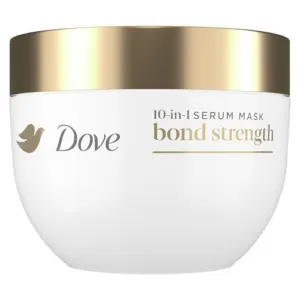
Not every great treatment has to cost a fortune. The Dove Bond Strength Hair Mask delivers real repair at under $10, making it one of the most accessible options on this list.
Its peptide complex works from the inside out, targeting weak, chemically damaged bonds much like pricier formulas do.
You apply it to clean, damp hair, leave it on briefly, then rinse.
Weekly use keeps breakage and frizz in check without weighing your hair down.
| Best For | Anyone with color-treated, bleached, or heat-damaged hair who wants a fast, effective repair treatment without spending a lot. |
|---|---|
| Price | $9.97 |
| Net Weight | 10.93 oz / 310g |
| Hair Type | Chemically damaged |
| Treatment Time | 1 minute |
| Rinse Required | Yes |
| Key Ingredient | Bio-Protein peptide complex |
| Additional Features |
|
- At under $10, it punches well above its price point — real bond repair without the salon price tag
- The 1-minute treatment fits easily into any shower routine, no waiting around
- Vegan and cruelty-free, so you can feel good about what you’re putting in your hair
- The fragrance is pretty strong — if you’re sensitive to scent, that’s worth knowing upfront
- You’ll get the best results using the full 4-step system, so the mask alone might underwhelm
- A few buyers have reported receiving unsealed or damaged packaging, which is a bit of a bummer for a hair treatment
3. Olaplex No 3 Bond Building Perfector
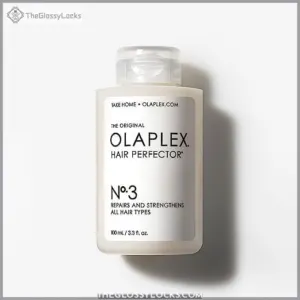
If you’re ready to step up from drugstore picks, Olaplex No. 3 is worth every penny of its $34 price tag. It targets disulfide bonds — the internal links that weaken from bleaching, color, and heat — rebuilding your hair’s structure from the inside out.
Apply it to damp hair before shampooing, leave it on for at least ten minutes, then rinse.
For extra softness on dry ends, try bagging them under a satin bonnet, and see this step-by-step baggy method guide for timing tips.
For best results, choose a formula suited to your specific concerns — you’ll find plenty of inspiration in these top-rated moisturizing masks for dry hair that target everything from heat damage to environmental dryness.
For general upkeep, once weekly works well. Struggling with severe breakage? Use it two to three times a week.
| Best For | Anyone dealing with damage from bleaching, coloring, or heat styling who wants to repair their hair’s structure rather than just mask the problem. |
|---|---|
| Price | $34.00 |
| Net Weight | 3.3 fl oz / 100ml |
| Hair Type | All hair types |
| Treatment Time | 3+ minutes |
| Rinse Required | Yes |
| Key Ingredient | OLAPLEX bond builders |
| Additional Features |
|
- Clinically proven to make hair 3× stronger after just one use — that’s not marketing fluff, it’s real results
- Works on every hair type, whether you’re rocking tight coils or pin-straight strands
- Doubles as a preventative treatment, so you can use it before a color appointment to protect your hair going in
- At $34 a bottle, using it two to three times a week adds up fast
- It’s not a moisturizer — if your hair needs hydration, you’ll still need a separate product for that
- You have to apply it correctly (damp hair, skip the scalp, wait at least three minutes) or you’re leaving results on the table
4. Amika Hydro Rush Moisture Mask Hyaluronic Acid
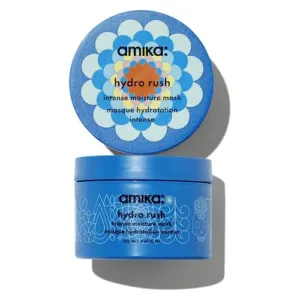
While Olaplex works from the inside out, the Amika Hydro Rush Moisture Mask addresses dryness from a different angle — flooding strands with moisture through hyaluronic acid, a humectant that pulls water deep into each fiber. At $44 for 250ml, it’s priced fairly for what it delivers: five times more hydration, noticeably easier combing, and 76% less breakage after a single use.
Apply it mid-length to ends, wait five to ten minutes, and rinse.
Curly, coily, or coarse hair especially benefits here.
| Best For | Anyone with dry, curly, coily, or coarse hair (type 2c–4c) who needs a serious moisture boost — especially after bleaching or chemical treatments. |
|---|---|
| Price | $44.00 |
| Net Weight | 8.8 fl oz / 250ml |
| Hair Type | Type 2c–4c |
| Treatment Time | 5+ minutes |
| Rinse Required | Yes |
| Key Ingredient | Hyaluronic acid |
| Additional Features |
|
- Hyaluronic acid pulls real hydration into the hair shaft, not just surface softness
- Makes detangling noticeably easier and cuts down on breakage after just one use
- Works great with heat caps or steamers if you want to take it up a notch
- $44 for 250ml is on the pricier side compared to similar masks
- Has a strong fragrance that might not work for scent-sensitive folks
- You’ll need to use it consistently — one-off treatments won’t get you far
5. Color Wow Money Hydrating Hair Mask
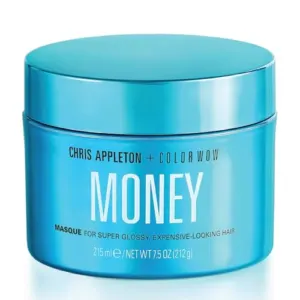
Color Wow’s Money Mask is built around Mediterranean marine extracts — blue sea kale and sea kelp — that hydrate without leaving any heaviness behind.
It targets the cortex, not just the surface, so moisture actually stays put between washes.
Hydrolyzed vegetable protein strengthens the cuticle and improves elasticity, making styling noticeably smoother.
At $45, it works for all hair types, including color-treated strands, and won’t dull your finish.
Use it weekly or whenever your hair feels brittle and thirsty.
| Best For | Anyone with thick, wavy, bleached, or color-treated hair who wants real moisture without the heavy, waxy aftermath. |
|---|---|
| Price | $45.00 |
| Net Weight | 11.36 oz / 322g |
| Hair Type | All hair types |
| Treatment Time | 10–20 minutes |
| Rinse Required | Yes |
| Key Ingredient | Deep conditioning agents |
| Additional Features |
|
- Absorbs fast and leaves hair genuinely soft, shiny, and easier to style — even after just one use
- Works on all hair types without buildup, so you can use it a few times a week if needed
- Penetrates deep enough to actually strengthen and repair, not just coat the surface
- At $45, it’s a tough sell when cheaper masks do a similar job for some people
- Gray hair users may not notice much difference at all
- The travel size only stretches to about 4 uses, which disappears fast if you have thick or long hair
6. Amika Soulfood Nourishing Hair Mask
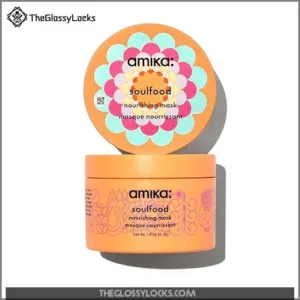
If your hair drinks up moisture and still feels thirsty, the Amika Soulfood Nourishing Mask was made for you.
Pair it with effective hair treatments for split ends and regular trims to keep dry, damaged strands from unraveling further.
Jojoba seed oil mimics your scalp’s natural oils, while sea buckthorn delivers omega fatty acids that restore elasticity and shine. Panthenol pulls moisture into the shaft and keeps it there.
Together, these ingredients do serious repair work, and our guide to the best hair masks for chemically damaged hair shows which formulas blend them most effectively.
Apply it to mid-lengths and ends for 5–10 minutes after shampooing, rinse clean, and your hair feels noticeably softer.
At $36 for 10.58 oz, it’s a solid weekly treatment for dry, coarse, or color-treated hair.
| Best For | Anyone with dry, color-treated, or coarse hair who wants a deep hydration boost without a lot of fuss. |
|---|---|
| Price | $36.00 |
| Net Weight | 10.58 oz / 300g |
| Hair Type | All hair types |
| Treatment Time | 5–60 minutes |
| Rinse Required | Yes |
| Key Ingredient | Jojoba oil, vitamin C |
| Additional Features |
|
- Jojoba oil and panthenol work together to actually lock moisture in, not just coat the surface
- Works on a wide range of hair types — fine, thick, curly, chemically processed
- Rinses clean with no waxy buildup left behind
- At $36 for 10.58 oz, it’s a splurge compared to drugstore alternatives
- The strong scent is a dealbreaker for anyone sensitive to fragrance
- Very dry hair may need a heavier mask — some users felt it didn’t go deep enough
7. Saryna Key Shea Butter Hair Mask
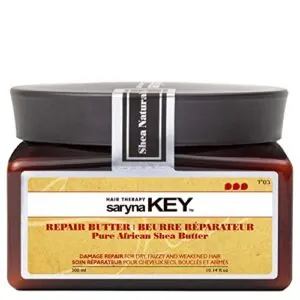
Pure African shea butter is the star ingredient here, and it shows. The Saryna Key Shea Butter Hair Mask packs vitamins A, E, and F alongside keratin and amino acids to rebuild moisture‑stripped strands from the inside out.
Massage it into damp hair after shampooing, leave it on for 2–5 minutes, then rinse. It’s especially effective for coarse, curly, or chemically processed hair.
At $31.99 for 10.56 oz, it’s a straightforward, no‑fuss treatment worth adding to your weekly routine.
| Best For | Anyone with coarse, curly, or chemically processed hair who wants a simple weekly treatment to restore moisture and tame frizz. |
|---|---|
| Price | $31.99 |
| Net Weight | 10.56 oz / 300g |
| Hair Type | Coarse, curly, chemically processed |
| Treatment Time | 2–5 minutes |
| Rinse Required | Yes |
| Key Ingredient | Shea butter, keratin |
| Additional Features |
|
- Loaded with vitamins A, E, F, keratin, and amino acids — your hair gets a real nutrition boost, not just a surface coating
- Works fast — just 2 to 5 minutes and you’re done, which makes it easy to fit into any shower routine
- Leaves hair noticeably softer, shinier, and easier to manage, with a scent that actually lasts
- At $31.99, it’s pricier than a lot of competing masks, so budget-conscious shoppers might hesitate to use it as often as needed
- Fine hair types may find it too heavy — some users report that "too soft" or weighed-down feeling after use
- Results can be hit or miss on severely heat- or color-damaged hair, and you’ll get the most out of it only if you’re also using the matching Saryna Key shampoo
8. Tgin Honey Miracle Hair Mask
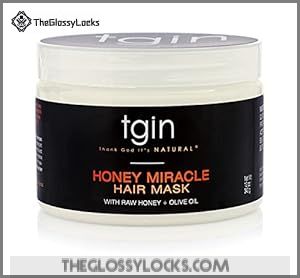
Raw honey has been a natural moisturizer for centuries, and TGIN put it to work in this mask.
The Honey Miracle Hair Mask combines honey, aloe vera, olive oil, and jojoba oil in a creamy, sulfate-free formula that detangles and deeply conditions in one step.
Apply generously after shampooing, cap it for 15 minutes under a dryer or up to 60 minutes without heat, then rinse.
It’s especially good for 3C–4C curls and runs just $18.48 for 8.47 oz.
| Best For | People with dry, color-treated, or heat-styled hair—especially those with 3C–4C curls who need serious detangling and hydration on wash day. |
|---|---|
| Price | $18.48 |
| Net Weight | 8.47 oz / 240ml |
| Hair Type | 3C–4C curls |
| Treatment Time | 15–60 minutes |
| Rinse Required | Yes |
| Key Ingredient | Honey, aloe vera, jojoba oil |
| Additional Features |
|
- Honey, aloe vera, jojoba, and olive oil work together to soften and add shine without weighing hair down
- Great slip for detangling tight curls, which means less breakage and a faster wash day
- Flexible enough to use as a weekly deep mask or a tiny leave-in on extra-dry strands
- At $18.48, it’s pricier than a lot of competing deep conditioners
- The thick texture can feel heavy on low-porosity hair unless you use heat or pre-poo first
- Recent formula tweaks moved honey down the ingredient list and added wheat protein, which may be a problem for protein-sensitive users
Causes of Dry Hair Damage

Dry hair rarely happens for just one reason — it’s usually a mix of daily habits and outside stressors working against your strands over time. Knowing what’s actually causing the damage is the first step toward fixing it for good.
Once you pinpoint the culprits — whether it’s heat tools, chlorine, or mineral buildup — you can follow targeted dry hair repair techniques that address each type of damage before it compounds further.
Here are the most common culprits to watch out for.
From over-washing to skipping conditioner, small habits often lead to painful knots, which is why this step-by-step guide to detangling matted hair comes in handy.
Heat Styling and Hot Tools
Every pass of a flat iron is a small act of stress on your strands. Ceramic and titanium plate materials transfer heat fast, so dwell time matters — linger too long and you’re inviting thermal damage.
Match temperature settings to your hair type, always apply a heat protectant beforehand, and don’t skip tool maintenance. Clean plates glide more evenly, meaning fewer repeat passes.
Chemical Coloring and Bleaching
Color and bleach work by using an alkaline environment to open the cuticle, letting chemicals penetrate deep into the cortex.
Higher oxidant strength means faster lightening — but also greater bond disruption, leaving strands brittle and porous.
Post-bleach conditioning isn’t optional; it’s essential.
Bond builders like Olaplex help reinforce what processing breaks down, and balancing protein versus moisture treatments keeps color-treated hair healthy and color fade prevention possible.
Over-washing and Harsh Shampoos
Chemical damage strips your hair’s defenses — and so does your shampoo, if you’re not careful.
Scalp oil regulation breaks down fast when you wash too often or lean on high detergent strength impact formulas. Sulfates are aggressive cleansers that pull moisture from the cuticle before it has a chance to settle. Frequent washing can cause rebound sebum production, leading to oily roots and dryness.
Watch for these warning signs:
- Dullness and roughness after every wash
- Color fade prevention becomes harder with frequent washing
- Scalp tightness or flaking between sessions
- Increased frizz from compromised cuticle protection strategies
Switching to sulfate-free formulas, spacing out wash days, and exploring cowashing and gentle cleansing methods gives your scalp health a real chance to rebalance.
Sun, Wind, and Dry Climates
Your shampoo habits aren’t the only culprit. Sun, wind, and dry climates quietly chip away at your hair’s moisture from the outside in.
UV protection strategies matter because ultraviolet rays break down color pigments and degrade proteins, accelerating sun-activated fading. Dry desert air pulls hydration straight from your strands, making deep conditioning masks and moisture-rich treatments non-negotiable.
Thermal swing care helps counteract repeated expansion and contraction from dramatic temperature shifts. Wind-resistant styling and protective styling reduce tangling and surface abrasion from dusty, arid airflow.
Friction From Towels and Pillowcases
What you sleep on and dry with matters more than most people realize. Rubbing a regular towel across damp hair roughs up the cuticle fast — damp strands have higher surface friction, making them vulnerable.
Switch to microfiber towels and practice gentle blotting with low pressure drying instead. A silk pillowcase facilitates nighttime hair slip, bedding fabric choice directly affects moisture retention, and protective styling shields ends from overnight friction.
Best Ingredients for Dry Hair
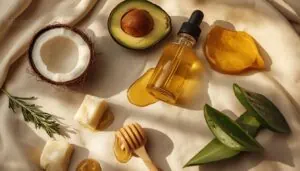
Not all ingredients are created equal for quenching dry hair. Some work deep inside the strand, while others seal the surface and lock everything in.
Here are the key ones worth knowing about.
Hyaluronic Acid for Moisture Retention
Think of hyaluronic acid as a sponge woven directly into your hair fiber — it can hold up to 1,000 times its weight in water. That’s why it’s a star ingredient in hydrating hair treatments and deep conditioning masks.
Hyaluronic acid acts like a sponge in your hair, holding up to 1,000 times its weight in water
Here’s what it does for dry hair:
- Surface Hydration Layer — Forms a viscoelastic film that slows moisture evaporation between washes
- Hydrogel Delivery Mechanism — Creates a gel-like network that releases hydration gradually throughout the day
- Molecular Weight Impact — Higher-weight molecules hydrate the surface instantly; lower-weight forms penetrate deeper for lasting results
- Moisture‑Rich Deep Conditioning and Mask Treatments — Amplifies the effect of your deep conditioning mask by locking absorbed water inside each strand
- Temperature Resilience — Maintains its hydrating hold even in dry climates or heated environments
Leave-in treatments with hyaluronic acid are especially effective because they stay on your hair, giving that viscoelastic film time to do its job.
Ceramides for Cuticle Repair
When your cuticle barrier breaks down, your hair loses moisture faster and frizz takes over. Ceramides handle that through lipid barrier reinforcement — they deposit directly onto the hair surface and rebuild what damage strips away.
Ceramide delivery systems in a deep-conditioning mask work alongside protein rebuilding ingredients, creating genuine protein ceramide synergy. That film-forming mechanism seals each strand, keeping your hydrating hair treatment working longer between washes.
Argan Oil for Softness and Shine
Argan oil earns its reputation as a go-to hydrating hair oil for good reason.
Packed with oleic acid, linoleic acid, and vitamin E, it delivers cuticle sealing that reduces frizz and boosts weightless shine without heaviness.
It also offers UV protection and helps scalp hydration, gradually improving oil absorption and building a silky hair texture — making it a quiet hero in any best hair mask routine.
Squalane for Lightweight Smoothing
If hair feels rough but you don’t want anything heavy weighing it down, squalane might be your answer. This plant-derived emollient — sourced from sugarcane or olives — mimics your scalp’s natural oils, making it incredibly compatible with dry hair care routines.
Here’s what makes it worth knowing:
- Delivers slip without grease, smoothing the cuticle without residue
- Provides barrier moisture support by reducing water loss between washes
- Works as a lightweight leave-in or hair mask booster
- Features an oxidation-stable formula that stays effective longer in your products
It’s one of the quieter hair smoothing ingredients, but it earns its place.
Polyglutamic Acid for Hydration Sealing
Most humectants donate moisture and move on — polyglutamic acid actually stays, forming a film-forming mechanism that seals hydration against your strand surface.
| What It Does | Why It Matters |
|---|---|
| Locks in long-lasting moisture | Keeps dry hair hydrated between washes |
| Reduces TEWL | Slows surface moisture evaporation |
Its humectant compatibility makes it ideal in hydrating hair treatments and hair masks targeting barrier reinforcement for dry hair care.
Shea Butter for Rich Nourishment
Think of shea butter as a full repair kit in one ingredient.
It delivers oleic softening to condition brittle strands, stearic protection to lock in moisture, and linoleic soothing to calm irritation.
Combined with vitamin enrichment from vitamins A and E, this powerhouse enhances barrier strengthening at the cuticle level — making it a cornerstone of deep conditioners and any hydrating hair treatment targeting lasting softness.
Moisturizing Masks and Leave-Ins
Not all treatments work the same way, and knowing which format fits your routine makes a real difference. Whether you’re dealing with daily dryness or serious breakage, there’s a mask or leave-in that can help.
Here’s what to know before picking the right one for your hair.
Weekly Deep-conditioning Masks

Once or twice a week is the sweet spot for a deep conditioning mask — enough to restore moisture without weighing your strands down. Apply to clean, towel-dried hair, focusing on mid-lengths and ends.
Application Timing matters: let it sit for the full recommended time. Adding a warm cap for Heat Enhancement boosts softness noticeably. Frequency Guidelines should adjust based on how your hair responds.
Leave-in Conditioners for All-day Softness

Where a weekly mask restores, leave-in conditioners for all-day softness keep that moisture going between wash days. Application Technique is straightforward — work a lightweight leave-in through damp hair, focusing on ends.
Product Texture matters: choose a milk or spray over heavy creams.
Look for eco-friendly formulations with glycerin or hyaluronic acid, and grab travel formats for on-the-go hydration.
Bond-repair Masks for Weak Strands
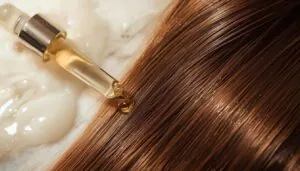
Leave-ins handle surface softness, but bond-repair masks go deeper — targeting the internal Disulfide Bond Restoration that chemical damage breaks down. Think of it as Protein Replenishment from the inside out.
Apply your bond-building reparative treatment like Olaplex or a K18 LeaveIn Molecular Hair Mask at mid-lengths through ends — Mid-length Application protects your scalp.
Follow Treatment Frequency Guidelines: weekly for mild damage, more often for brittle strands.
Rinse-out Masks Vs Leave-in Treatments
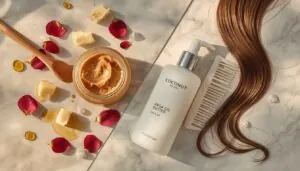
Once you’ve used a bond-repair treatment, knowing when to rinse matters just as much as what you apply. Rinse-out hair masks deliver concentrated moisture during a 5–10 minute window, then you wash them away — no residue, clean results. Leave-in conditioners stay on damp hair, supporting detangling impact and styling compatibility all day.
- Application Timing: Rinse-out masks work on wash day; leave-ins go on after towel-drying
- Concentration Differences: Masks use stronger conditioning agents for intensive repair; leave-ins are lighter for daily use
- Residue Management: Leave-in treatments remain on the hair shaft, while rinse-outs remove cleanly
Protein Balance for Brittle Hair
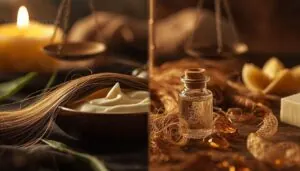
Getting your protein-moisture ratio right is honestly a balancing act.
Too much protein therapy for hair leaves strands stiff and even more brittle — classic over-protein symptoms. Too little and your hair elasticity improvement stalls.
Think of the protein-moisture cycle like a seesaw: your deep conditioning mask days should outnumber bond-building reparative treatment sessions, keeping that strength vs softness equilibrium steady with a smart protein timing strategy.
Salon Treatments for Severe Dryness
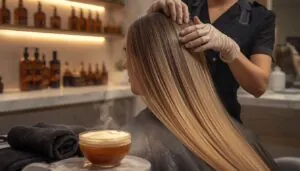
Sometimes at-home masks just aren’t enough, especially when your hair is seriously parched or broken down from years of color and heat. That’s where professional salon treatments come in — they go deeper, work faster, and tackle damage that no drugstore product can fully reverse.
Here are the top salon options worth knowing about.
Keratin Smoothing Treatments
Keratin treatments work by depositing hydrolyzed keratin chemistry deep into your hair’s surface, then using heat sealing — blow-drying followed by a flat iron pass — to lock in that smoothness.
Longevity factors like sulfate-free shampoos and avoiding chlorine can stretch results to six months.
Post-treatment care matters enormously, so skip heavy root oils and tight styles during the initial setting period.
Brazilian Blowout Services
A Brazilian Blowout works differently than a standard keratin treatment — it wraps each strand in a protective protein layer, smoothing the cuticle from root to tip for serious frizz reduction.
sets it apart:
- Certification requirements mean only licensed, Brazilian Blowout–certified stylists perform this service.
- ionic bonding spray seals results after rinsing.
- Treatment duration runs about 80 minutes.
- Formaldehyde safety requires proper salon ventilation.
- aftercare product line directly affects how long results last.
In-salon Deep-conditioning Masks
When your hair is parched beyond what a drugstore mask can fix, a professional deep conditioning mask changes the game. Stylists use a precise application technique — working mid-lengths to ends first — then apply heat activation through a steam cap or warm towel to open the cuticle.
Scalp safety stays a priority throughout.
Post-mask sealing with a lightweight serum locks in that moisture-rich deep conditioning result beautifully.
Bond-building Salon Treatments
Think of bond-building salon treatments as structural repairs happening beneath the surface.
During color or bleach services, Olaplex and K18 work through chemical service integration — reinforcing broken disulfide bonds while damage is actively occurring.
Your stylist uses sectional application technique for even coverage, times the bond repair timing precisely, then finishes with post-bond conditioning to smooth the cuticle and lock in strength.
When Salon Care Beats At-home Repair
Sometimes, at-home products just can’t reach the root of the problem — and that’s when a salon visit pays off.
Here’s when professional salon damage treatments make the real difference:
- Custom Diagnosis Matching pinpoints whether your dryness comes from porosity, buildup, or structural breakage
- Professional-Only Formulations deliver concentrated bond building treatments unavailable in retail
- Controlled Heat Penetration drives moisture deeper than any home steamer
- Professional Application Technique ensures even saturation, especially on curly or color-treated hair
- Professional Deep Conditioning Masks paired with safety ventilation standards keep the process effective and safe
Choosing the right salon treatment based on damage type — mild dryness versus severe breakage — is what sets benefits of salon treatments for dry hair apart from anything you can DIY.
Choosing Treatments by Hair Type
Not every dry hair treatment works the same way for every hair type, and using the wrong one can leave you frustrated with zero results.
Your curl pattern, texture, and hair history all shape what your strands actually need.
Here’s how to match the right treatment to your hair type.
Dry Straight Hair Needs
Straight hair has a sneaky problem: without natural curl to guide it, moisture struggles to travel from root to tip.
That’s why scalp moisture balance matters, but your focus should land on lengths and ends.
Use leave-in treatments and hydrating hair oil on those areas, apply a deep-conditioning mask weekly, and try low-friction drying with a microfiber towel.
Lightweight styling boosters, cuticle smoothing techniques, and silk pillowcase benefits round out the best routine.
Dry Curly Hair Needs
Curly hair faces a different battle than straight. Because of your curl pattern, natural oils can’t travel the shaft evenly — which means dryness hits harder and faster.
Curl porosity management starts with a deep conditioning mask weekly, followed by humectant layering using glycerin or aloe vera on damp hair. Finish with oil sealing techniques — argan or castor — to lock everything in.
Fine Hair Vs Thick Hair
Fine and thick hair need different strategies. Strand diameter effects change how products behave — lightweight leave-in formulas work better for fine strands, while thick hair drinks up a deep-conditioning mask more readily.
Here’s how each type breaks down:
- Fine hair — more heat damage susceptibility, lower product weighting tolerance
- Thick hair — benefits from richer hydrating hair products and protein versus moisture treatments for hair health
- Volume vs thickness — high density with fine strands still needs scalp breathability and hair porosity-aware care
Color-treated Hair Repair Priorities
Color-treated hair has its own checklist. After chemical processing, your strands need Bond Reconstruction, Color-safe Cleansing, and Cuticle Sealing to stay healthy.
| Priority | Why It Matters | What to Use |
|---|---|---|
| Moisture Lock | Color opens the cuticle, causing dryness | MoistureRich Deep Conditioning Masks |
| UV Protection | Sun fades color and dries strands | Leave-ins with UV filters |
| Heat Damage Prevention | Hot tools worsen post-color brittleness | Heat protectant before every style |
Bondbuilding technologies in hair care—like Professional Deep Conditioning Masks—work best alongside Color Protection routines that limit washing to two or three times weekly.
Severely Damaged Hair Vs Mildly Dry Hair
Not all dryness looks the same. Mildly dry hair feels rough but holds its shape when wet.
Severely damaged hair tells a different story — elasticity testing reveals gummy, over-stretched strands that won’t bounce back, while split end patterns and breakage localization cluster near over-processed ends. Those signs point to bond-building reparative treatment and consistent hair cuticle repair, not just a deep-conditioning mask.
Daily Routine to Prevent Dryness

Treating dry hair once a week helps, but what you do every single day matters just as much. Small, consistent habits are what keep moisture locked in between your mask sessions.
Here’s what your daily routine should include to stop dryness before it starts.
Gentle Sulfate-free Shampooing
Your shampoo is either working for your hair or quietly working against it. Sulfate-free formulas use gentle, amino acid-based surfactants that clean without stripping your scalp’s natural oils or disrupting scalp pH balance.
Look for low-foaming formulas with ingredient transparency — fragrance-free options reduce irritation risk.
The best shampoo for dry hair feels soft after rinsing, never tight.
Hydrating shampoos and gentle moisturizing shampoo choices make a real difference over time.
Conditioner After Every Wash
Think of conditioner as your hair’s post-wash armor. After shampooing, your strands need a moisturizing conditioner to restore slip enhancement and frizz reduction — that’s what cationic coating does, adhering to each strand for post-wash protection while rebalancing scalp pH balance.
- Improves detangling and slip instantly
- Reduces friction between fibers
- Seals in softness with humectants like glycerin
- Smooths the cuticle to minimize frizz
- Helps moisture retention between wash days
Heat Protectant Before Styling
Every time you reach for a heat tool, a good heat protectant is your first line of defense. Application Timing matters — distribute it evenly before styling for Even Coverage and proper Silicone Coating along each strand.
Most formulas handle Temperature Thresholds up to 450°F, offering real thermal protection without Weight Management issues. Don’t skip this step — heat damage prevention is non‑negotiable.
Silk Pillowcases and Low-friction Drying
Your pillowcase is doing more damage than you think. Cotton grabs and snags hair cuticles overnight, causing frizz and breakage. Switching to silk — ideally 22‑momme — puts slip surface mechanics to work, keeping cuticle alignment benefits intact while you sleep.
Three reasons silk enhances your hydrating hair care routine:
- Low-friction drying reduces cuticle disturbance on damp hair
- Nighttime moisture retention keeps strands from drying out against absorbent fabric
- Frizz reduction happens passively, no low‑heat styling required
Weekly Mask Schedule
Once or twice a week is the sweet spot for most dry hair types.
Apply your deep conditioning mask using sectioned application so every strand gets full coverage, focusing on Mid-Length Focus — ends first, scalp last.
A Warm Towel Boost traps heat to deepen absorption.
Add Detangling Integration while the mask sits, then follow with Post-Mask Conditioning for lasting softness.
Trims to Reduce Split Ends
No product can fix a split end — only a trim can. Using the dusting trim technique, your stylist removes just the frayed tips without sacrificing length.
For split end prevention, aim for micro trims every six to eight weeks.
Sharp scissors and the right cutting angle matter more than most people realize, since dull blades cause new damage instantly.
Regular split end detection at home keeps you ahead of breakage.
Frequently Asked Questions (FAQs)
What hair treatment is best for dry hair?
The best treatment for dry hair is a deep conditioning mask paired with leave-in treatments and hydrating hair oils — a simple, effective combo that works across budgets, including budget-friendly options and eco-friendly formulas.
What is the best hair treatment for dry, damaged hair?
For dry, damaged hair, the best treatment combines a bond-repair mask with deep conditioning — strengthening weak strands while restoring moisture.
Think of it as fixing the foundation before painting the walls.
What is the best treatment for extremely dry hair?
For extremely dry hair, a deep conditioning mask paired with leave‑in treatments and oil‑based treatments gives the best results.
Add scalp hydration, vitamin E enrichment, and nighttime oil treatments to restore softness fast.
Which hair treatment is good for dry hair?
deep-conditioning mask with moisture locking ingredients like hyaluronic acid or shea butter works well.
Leave-in treatments and lightweight oil help seal hydration, while protein enrichment keeps strands resilient between washes.
What is the best salon treatment for dry, damaged hair?
When hair is severely parched and breaking, salon-grade treatments go beyond what any at-home mask can reach.
A professional consultation helps identify whether you need bond repair, keratin treatment, or a Brazilian Blowout first.
What is a good hair routine for dry hair?
Start with a sulfate-free shampoo, rinse with cool water temperature, apply a deep-conditioning mask weekly, layer leave-in conditioners on damp strands, and seal with lightweight oil for lasting scalp hydration.
How often should I use hair masks?
Most people do well with a deep conditioning mask once or twice a week. Damage level adjustments matter — severely dry or processed hair often needs two to three sessions weekly.
Can dry hair treatments cause color fading?
Yes, they can — when the wrong products or habits tag along. Raised cuticle porosity, sulfate stripping, heat fading, UV damage, and product buildup are the quiet culprits behind color fade.
What ingredients should I avoid in products?
Watch for harsh sulfates, fragrance allergens, formaldehyde releasers, PEG polymers, and mineral oil. Choosing sulfate-free formulas, formaldehyde-free options, and silicone-free formulas helps protect dry hair from added damage and irritation.
Are expensive treatments always more effective?
Not always. A $30 mask with the right ceramides and humectants can outperform a $200 treatment. Ingredient efficacy and formulation science matter far more than price perception bias.
Conclusion
Studies show that 70% of women experience some degree of hair dryness due to heat styling alone—a number that climbs sharply with color treatments. Finding the best hair treatments for dry hair isn’t about chasing trends; it’s about understanding what your strands actually need.
Bond repair, deep moisture, and consistent daily habits work together to restore what damage strips away. Start with one targeted treatment, stay consistent, and your hair will respond.