This site is supported by our readers. We may earn a commission, at no cost to you, if you purchase through links. This content is for general informational and educational purposes only and is not a substitute for professional medical, dermatological, or nutritional advice.
Acne scars and active breakouts operate on completely different biological timelines—and mixing them up is the mistake that keeps most people stuck. A pimple clears in days, but the collagen damage underneath can reshape your skin’s surface for months or years. That’s not a flaw in your skincare routine; that’s just how wound healing works.
what changes the outcome is what you do next. The best way to fade acne scars isn’t one product or one dramatic treatment—it’s a layered strategy built around your specific scar type, the right active ingredients, and consistent daily habits that work with your skin’s repair process, not against it.
Table Of Contents
- Key Takeaways
- Identify Your Acne Scar Type
- Build a Daily Scar-Fading Routine
- Choose Ingredients by Scar Concern
- Top 10 Acne Scar Fading Products
- 1. Murad InvisiScar Acne Scar Treatment
- 2. Allies of Skin Azelaic Kojic Clarifying Serum
- 3. Hyper Skin Dark Spot Vitamin C Serum
- 4. Shark CryoGlow LED Face Mask Under Eye Cooling
- 5. Peace Out Salicylic Acid Acne Patches
- 6. SkinMedica Even Correct Brightening Pads
- 7. Differin Acne Treatment Gel
- 8. Neutrogena Retinol Stubborn Marks PM
- 9. The Ordinary Aloe NAG Serum
- 10. Hero Rescue Balm Post Blemish Cream
- Upgrade With Professional Treatments
- Frequently Asked Questions (FAQs)
- How to fade acne scars fast?
- Can acne scars be 100% removed?
- How do I get rid of acne scars naturally?
- What helps fade body acne scars?
- How long do acne scars take to fade naturally?
- Can diet or supplements help reduce acne scarring?
- Are home remedies effective for treating acne scars?
- Whats the difference between acne marks and scars?
- Do acne scars get worse with age?
- How long does acne scar fading actually take?
- Conclusion
Key Takeaways
- Acne scars come in distinct types — icepick, boxcar, rolling, and keloid — and each one needs its own treatment approach, so identifying yours first saves you time and money.
- A consistent daily routine built around retinoids, niacinamide, and broad-spectrum SPF 30 is your most reliable at‑home path to fading marks and preventing new ones.
- Ingredients work best when matched to your concern: retinoids for texture, azelaic acid for pigmentation, salicylic acid for clogged pores, and AHAs for surface renewal.
- When topicals plateau, professional options like microneedling, laser resurfacing, subcision, or fillers can create structural change that no serum can replicate.
Identify Your Acne Scar Type
Not all acne scars are the same, and treating the wrong type can waste time and money. Before picking a product or booking a procedure, you need to know exactly what you’re dealing with. Here are the main scar types and how to spot them.
In fact, there are six distinct acne scar types, each needing its own treatment strategy—which is why a one-size-fits-all approach rarely works.
Atrophic Depressed Scars
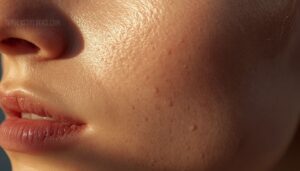
When acne heals without rebuilding enough tissue, it leaves depressed atrophic scars — sunken pits sitting below the surrounding skin. The root cause is insufficient collagen synthesis during wound repair. Understanding the common atrophic scar types helps guide treatment choices. Here’s what defines them:
- They form indented divots, not raised bumps.
- Shadowing appears under natural light.
- Texture feels uneven to the touch.
- Color may differ from nearby skin.
- Depth increases without treatment over time.
Icepick Scar Features
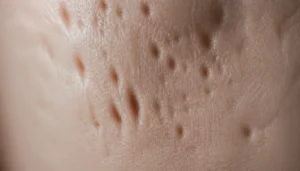
Of all the depressed atrophic scars, icepick scars are the hardest to budge. They form V-shaped pits with sharp edges that tunnel deep into the dermis — far deeper than their tiny surface opening suggests.
That narrow deep tract creates visible shadowing and a pockmarked texture.
Because of skin tethering at the base, these scars show strong treatment resistance to topicals alone, often requiring microneedling or fractional laser.
Boxcar Scar Features
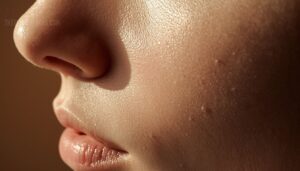
Boxcar scars look different from icepick scars right away. Instead of a deep narrow pit, you’ll see broad, oval depressions with sharp, well-defined edges that drop abruptly to a flat base.
They’re most common on the cheeks and temples, and because of that flat-bottomed shape, they catch shadows easily — especially in direct lighting.
Fillers, laser therapy, or chemical peels can help smooth them out.
Rolling Scar Features

Rolling scars are different from boxcar scars in one key way: there are no sharp edges. Instead, fibrous tethering bands pull the skin downward from beneath, creating a wave-like surface contour — gentle, sloping dips that blend into surrounding skin.
They appear most often along the cheeks and jaw, with depth variation across the affected area.
Raised Keloid Scars
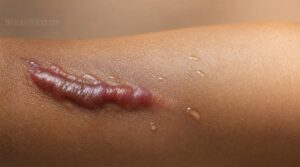
Unlike other acne scars, keloid acne scars grow beyond the original wound — sometimes doubling in size over months or years. They feel thick, rubbery, and often itch or cause pain. Common on the chest, shoulders, and earlobes, they won’t fade alone.
Keloid scars don’t stop at the wound — they keep growing, sometimes doubling in size, and they never fade on their own
Treatment options include:
- Corticosteroid injections to flatten raised tissue
- Silicone gel sheets worn nightly
- Pressure therapy to reduce regrowth
- Laser therapy for color and texture
- Surgical excision for severe cases
Build a Daily Scar-Fading Routine
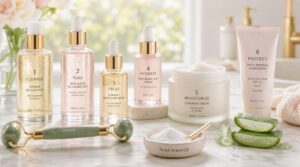
Building a scar-fading routine doesn’t have to be complicated — it just has to be consistent. A few targeted steps each day can make a real difference over time. Here’s what your daily routine should include.
Gentle Cleanser First
Think of your cleanser as the foundation — get it wrong, and everything you layer on top works harder than it needs to. A pH-balanced cleanser keeps your skin’s natural barrier intact while removing daily buildup.
Look for gentle surfactants and a hydrating formula with glycerin or sodium hyaluronate. Skip anything with sulfates or synthetic fragrance — your skin will thank you.
Treat Active Acne Early
Every new breakout is a chance for another scar — that’s why early acne management matters more than most people realize. Treating active inflammation before it deepens gives your skin a real shot at healing clean.
- Benzoyl peroxide targets bacteria and calms redness fast
- Salicylic acid clears pores and reduces postbreakout scar management needs
- Adapalene prevents new blockages before lesions form
Apply Targeted Serum
Once active acne is under control, a targeted serum becomes your next real weapon.
Look for one with retinol—it’s quietly one of the best ingredients for fading post-acne marks, as explained in this retinol anti-aging cream breakdown.
Apply two to three drops to clean fingertips, then gently tap across your face. Let it absorb for about five minutes before layering anything heavier. Start with the thinnest serum first if you use multiple.
Always patch test new actives on your inner arm for 48 hours beforehand.
Moisturize Barrier Daily
After serum, your skin needs a moisture seal. Ceramide-based moisturizers repair the outer barrier by filling gaps between skin cells, much like mortar between bricks.
Look for formulas that combine ceramides, cholesterol, and fatty acids — this trio mirrors your skin’s natural lipid composition.
Apply while skin is still slightly damp to lock in dermal hydration effectively.
Your diet, stress levels, and overall lifestyle play just as big a role as your moisturizer, so exploring holistic skincare habits that support long-term skin health can make a meaningful difference in how well your skin recovers.
Use SPF 30
Skipping sunscreen is one of the fastest ways to undo your scar-fading progress. UV exposure darkens hyperpigmentation and slows the fading process considerably.
- Choose broad spectrum protection — it shields against both UVA and UVB rays.
- Use SPF 30 benefits daily, even indoors.
- Apply enough product; under-application reduces real protection.
- Pick a water resistant sunscreen for active days.
- Reapply after swimming or sweating.
Choose Ingredients by Scar Concern
Not every scar reacts to the same ingredient, and using the wrong one can slow your progress. Knowing which actives target your specific concern makes the difference between results and frustration. Here’s what to reach for based on what your skin is dealing with.
Before layering targeted actives onto your scars, make sure you’re prepping properly with a gentle double cleansing routine so ingredients can actually absorb instead of sitting on residue.
Retinoids for Texture
Retinoids are one of the most well-studied ingredients for improving acne scar texture. They work by speeding up skin cell turnover, pushing fresher cells to the surface while helping your body produce more collagen beneath.
Options range from over-the-counter adapalene to prescription tretinoin. Expect visible texture improvement after 12 weeks of consistent nightly use.
Azelaic Acid for Marks
Where retinoids rebuild texture, azelaic acid targets the post-inflammatory hyperpigmentation — those stubborn brown or pink marks left after a breakout heals. It works by blocking tyrosinase, the enzyme your skin uses to produce melanin.
Less melanin means marks fade faster. At 15–20% concentration, it also calms inflammation and normalizes dead skin cell buildup, keeping your surface smoother over time.
Salicylic Acid for Pores
While azelaic acid works at the surface, salicylic acid goes deeper. It’s oil-soluble, which means it can slip into pores where water-based ingredients can’t reach. Once inside, it breaks down the dead skin and sebum buildup that leads to clogged pores and repeated breakouts.
For daily use, stick to 0.5–2% concentrations in leave-on serums or toners to exfoliate without over-irritating.
Niacinamide for Discoloration
Salicylic acid clears the path — and niacinamide steps in to address what’s left behind.
Post-inflammatory hyperpigmentation (PIH), those stubborn dark marks after a breakout heals, is where niacinamide shines. It works by blocking melanosome transfer — the process that moves pigment from melanin-producing cells into surrounding skin cells — reducing visible discoloration without harsh bleaching.
At 4–5% concentration, it also calms inflammation and reinforces your skin barrier.
AHAs for Exfoliation
When dead skin cells pile up on the surface, they can make acne scars look deeper and darker than they actually are.
That’s where alpha-hydroxy acids (AHAs) come in. Glycolic acid — the smallest AHA molecule — penetrates most effectively, while lactic acid works more gradually, making it gentler for sensitive skin.
Both loosen the bonds between dead cells, supporting steady skin cell turnover and a smoother surface over time.
Top 10 Acne Scar Fading Products
Finding the right product shouldn’t feel like a guessing game. These ten options cover a range of scar types and budgets, so there’s a good chance one fits exactly where you are in your routine. Here’s what’s worth putting on your shelf.
1. Murad InvisiScar Acne Scar Treatment
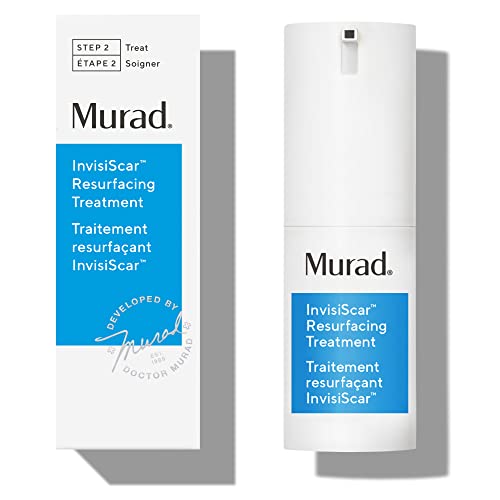
The Murad InvisiScar Acne Scar Treatment works on two levels at once. Salicylic acid (a beta-hydroxy acid) exfoliates dead skin and smooths uneven scar texture over time, while light-diffusing blurring powders create an immediate softening effect — useful under makeup.
Vitamin C and Centella Asiatica help fade discoloration and support healthier skin.
With twice-daily use over eight weeks, clinical testing showed 86% of users agreed that scars looked less discolored.
At $39 for 0.5 fl oz, it suits mild to moderate scarring best.
| Best For | Anyone dealing with mild to moderate post-acne scars who wants something that pulls double duty — fading marks over time while smoothing skin enough to wear under makeup. |
|---|---|
| Price | $39.00 |
| Volume / Size | 0.5 fl oz (14.8 mL) |
| Skin Type | All types |
| Key Active | Salicylic acid + Vitamin C |
| Scar / Mark Benefit | Yes |
| Fragrance-Free | Not specified |
| Additional Features |
|
- Works on two levels: gradual scar reduction with salicylic acid and Vitamin C, plus an instant blur effect you can see right away
- Doubles as a makeup primer, so it fits naturally into a morning routine without adding extra steps
- Centella Asiatica and Vitamin C are solid, well-researched ingredients for calming skin and fading discoloration
- Deep or stubborn old scars may see only modest improvement — this isn’t a dramatic resurfacing treatment
- You have to use it twice a day for about eight weeks to get real results, and progress stalls if you stop
- Can pill or feel greasy if your skin is dry or you’re already using other exfoliants like retinol — layering takes some trial and error
2. Allies of Skin Azelaic Kojic Clarifying Serum
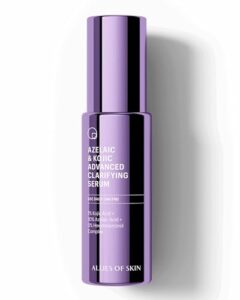
If post-blemish marks are your main concern, the Allies of Skin Azelaic Kojic Clarifying Serum targets them with a strong ingredient lineup.
It combines 10% azelaic acid to regulate pigmentation and reduce redness, plus 1% kojic acid to brighten dark spots. Bakuchiol, licorice extract, and aloe add calming, hydrating support.
Clinical data shows 33% clearer skin after one bottle. At $99, it’s a premium option — but it’s silicone-free, dermatologist-tested, and formulated for all skin types, including sensitive.
| Best For | Anyone dealing with post-blemish marks, uneven skin tone, or rosacea-related redness who wants a clinically backed, sensitive-skin-friendly serum. |
|---|---|
| Price | $99.00 |
| Volume / Size | 1 fl oz (30 mL) |
| Skin Type | All types including sensitive |
| Key Active | Azelaic acid + Kojic acid |
| Scar / Mark Benefit | Yes |
| Fragrance-Free | Yes |
| Additional Features |
|
- Solid one-two punch of 10% azelaic acid and 1% kojic acid — two well-researched brightening ingredients in one bottle
- Clinically shown to deliver 33% clearer skin after just one month of use
- Free of silicone, sulfates, and phthalates, and dermatologist-tested for all skin types including sensitive
- At $99 for 1 fl oz, it’s a real investment that won’t work for every budget
- The acid formula can irritate — you’ll want to patch test and ease in slowly
- Some users saw no change in stubborn dark spots even after six weeks of daily use
3. Hyper Skin Dark Spot Vitamin C Serum
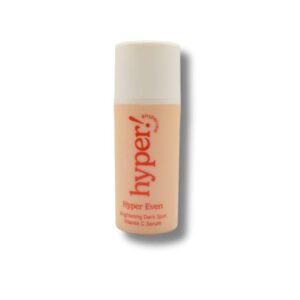
The Hyper Skin Dark Spot Vitamin C Serum hits acne scars from multiple angles. Its 15% vitamin C (3-O-ethyl ascorbic acid, a stable form) brightens PIH — that’s post-inflammatory hyperpigmentation, the dark marks left behind after breakouts.
Kojic acid, bearberry, and licorice work alongside it to target stubborn discoloration. A small amount of salicylic acid helps prevent new breakouts from forming.
It’s lightweight, absorbs fast, and suits all skin types — including sensitive skin.
| Best For | Anyone dealing with acne scars, dark spots, or uneven skin tone who wants a lightweight serum that works for all skin types, including sensitive skin. |
|---|---|
| Price | Not listed |
| Volume / Size | 1 oz (30 mL) |
| Skin Type | All types |
| Key Active | Vitamin C + Niacinamide |
| Scar / Mark Benefit | Yes |
| Fragrance-Free | Not specified |
| Additional Features |
|
- Stable vitamin C formula brightens PIH and dark spots without irritating skin
- Lightweight and fast-absorbing — no greasy or sticky feeling after application
- Packed with extras like Hyaluronic Acid, Niacinamide, and Peptides for added skin benefits
- Some users report irritation or swelling, especially near the eye area
- May not do much for deep or severe sun damage like solar lentigo
- Results are hit or miss — it doesn’t work equally well for everyone
4. Shark CryoGlow LED Face Mask Under Eye Cooling
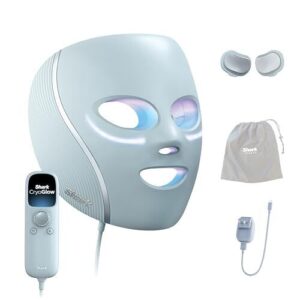
Light therapy isn’t just for med spas anymore. The Shark CryoGlow LED Face Mask brings red, blue, and infrared light together in one hands-free device, targeting acne, texture, and inflammation at home.
Its InstaChill under-eye cooling soothes puffiness and tightens the look of skin — no serums needed. Four preset modes keep sessions short, from 4 to 8 minutes.
At $349, it’s an investment, but consistent daily use can deliver real, visible results over 12 weeks.
| Best For | Anyone who wants to tackle fine lines, acne, and under-eye puffiness at home without booking a spa appointment. |
|---|---|
| Price | $349.00 |
| Volume / Size | 7.99 × 5.89 × 8.63 in |
| Skin Type | All types |
| Key Active | Red, Blue & Infrared LED |
| Scar / Mark Benefit | Yes |
| Fragrance-Free | Not applicable |
| Additional Features |
|
- Four targeted light modes mean you’re not guessing — each session has a clear purpose, and they’re short enough to actually stick with
- The InstaChill cooling system is a genuinely nice touch, especially after a rough night’s sleep or a long day on screen
- Hands-free design with a remote makes it easy to zone out and let it do its thing
- Battery only lasts 3–4 sessions per charge, so if you forget to plug it in, you’re waiting
- The cooling pads can feel uncomfortably intense for sensitive skin — some users describe it as borderline burning
- A few reports of the device failing early, which is a real concern at $349
5. Peace Out Salicylic Acid Acne Patches
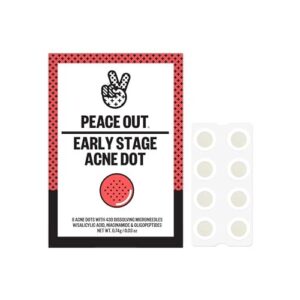
Think of these as tiny, targeted treatments you press directly onto a blemish.
Peace Out Salicylic Acid Acne Patches combine encapsulated 2% salicylic acid with niacinamide, retinyl acetate, and aloe vera to exfoliate inside the pore, calm redness, and support skin repair — all at once.
The hydrocolloid layer draws out impurities while the actives get to work.
Press the textured side onto clean, dry skin for 20 seconds, and wear for at least 6 hours.
| Best For | Anyone dealing with early-stage breakouts who wants a quick, targeted treatment without committing to a full skincare routine. |
|---|---|
| Price | Not listed |
| Volume / Size | 8 patches |
| Skin Type | All types |
| Key Active | Salicylic acid + Niacinamide |
| Scar / Mark Benefit | Yes |
| Fragrance-Free | Not specified |
| Additional Features |
|
- The microneedle technology actually gets salicylic acid below the skin surface, so it’s working where a regular patch can’t reach.
- Niacinamide helps calm redness at the same time, so you’re treating the bump and the angry skin around it.
- Easy to use anywhere — just press and go, day or night.
- Only 8 patches per tube, which goes fast if you’re dealing with frequent breakouts.
- They’re not invisible — you’ll notice them, and so will other people up close.
- Oily or humid skin can mess with the adhesion, so they may not stay put when you need them most.
6. SkinMedica Even Correct Brightening Pads
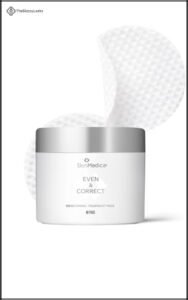
Where the Peace Out patches go deep into one spot, these pads cover the whole picture.
SkinMedica Even & Correct Brightening Pads deliver 10% glycolic acid across your full face and neck, dissolving dead skin cells and fading post-inflammatory hyperpigmentation over time. The alcohol-free formula won’t strip your barrier. Wipe one pad over clean skin, let it dry, then layer your moisturizer and SPF 30 on top. At $48 for 60 pads, that’s a solid daily investment in brighter, smoother skin.
| Best For | Anyone dealing with uneven skin tone, dark spots, or dullness who wants a simple, full-face exfoliation they can work into their daily routine. |
|---|---|
| Price | $48.00 |
| Volume / Size | 60 pads |
| Skin Type | All types |
| Key Active | Glycolic acid (AHA) |
| Scar / Mark Benefit | Yes |
| Fragrance-Free | Not specified |
| Additional Features |
|
- 10% glycolic acid gently dissolves dead skin and fades hyperpigmentation without alcohol stripping your barrier
- Pre-soaked pads make it quick and mess-free — swipe and go
- Preps skin so your serums and moisturizers actually sink in better
- You’ll need SPF 30 every single day, and even after you stop using them for about a week
- Sensitive skin may experience tingling, redness, or peeling, especially at first
- Not safe during pregnancy or breastfeeding, which rules it out for a chunk of potential users
7. Differin Acne Treatment Gel
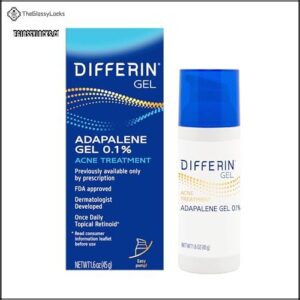
While the SkinMedica pads handle surface-level brightening, Differin works deeper — right at the source.
Differin Acne Treatment Gel uses 0.1% adapalene, an FDA-approved retinoid that speeds up skin-cell turnover and clears clogged pores before they become new scars. Apply a thin layer each night to clean skin. It takes at least 12 weeks for visible texture improvement, so stick with it. At $23.97 for a 45 g pump, it’s one of the most affordable long-term scar-prevention tools you’ll find.
| Best For | Anyone dealing with persistent acne who wants to prevent new breakouts and reduce long-term scarring with a dermatologist-backed, over-the-counter option. |
|---|---|
| Price | $23.97 |
| Volume / Size | 45 g (1.59 oz) |
| Skin Type | Acne-prone |
| Key Active | Adapalene 0.1% |
| Scar / Mark Benefit | Yes |
| Fragrance-Free | Yes |
| Additional Features |
|
- FDA-approved 0.1% adapalene works at the source — clearing clogged pores and cutting inflammation before scars form.
- Gentle, no-frills formula: water-based, oil-free, fragrance-free, and non-comedogenic, so it won’t make breakouts worse.
- At $23.97 for a 90-day supply, it’s hard to beat the value for a clinically proven retinoid.
- The first few weeks can bring dryness, peeling, or a purging phase — your skin needs time to adjust.
- You have to pair it with a moisturizer and sunscreen daily, which adds steps to your routine.
- Results take at least 12 weeks of consistent use, so patience is non-negotiable.
8. Neutrogena Retinol Stubborn Marks PM
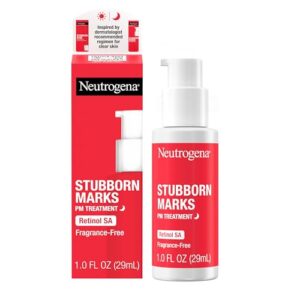
Differin targets prevention, but if post-acne marks are already there, Neutrogena Stubborn Marks PM goes to work on what’s left behind. This $15.99 nighttime treatment combines retinol with ascorbic acid — vitamin A to boost cell turnover and vitamin C to brighten discoloration.
Sodium hyaluronate keeps skin hydrated while the retinol does its job. Apply a thin layer to clean skin every evening.
If redness or flaking starts, drop to a few nights per week until your skin adjusts.
| Best For | Anyone dealing with lingering dark spots and uneven skin tone left behind after acne clears up. |
|---|---|
| Price | $15.99 |
| Volume / Size | 1 fl oz (30 mL) |
| Skin Type | Acne-prone |
| Key Active | Retinol SA |
| Scar / Mark Benefit | Yes |
| Fragrance-Free | Yes (marketed) |
| Additional Features |
|
- Retinol SA speeds up cell turnover overnight, which gradually fades post-acne marks and smooths texture while you sleep.
- Oil-free and non-comedogenic, so it won’t clog pores or make existing breakouts worse.
- At $15.99, it fits neatly into a full AM/PM acne routine without breaking the bank.
- Retinol can cause irritation, flaking, or mild burning at first — your skin needs time to adjust.
- It increases sun sensitivity, so skipping sunscreen the next morning isn’t really an option.
- Some customers have reported pump issues and a faint syrup-like smell, despite the "unscented" label.
9. The Ordinary Aloe NAG Serum
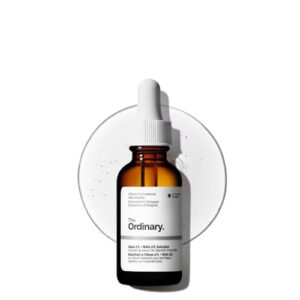
After targeting marks with retinol, sometimes you need something gentler in your corner. The Ordinary Aloe NAG Serum delivers aloe barbadensis leaf extract and N-acetyl glucosamine (NAG) — a compound that interrupts melanin transfer — to quietly fade post-acne discoloration over time.
Palmitoyl pentapeptide-4 reinforces your barrier while glycerin keeps skin hydrated. At $14.50 for 30 mL, it’s budget-friendly but requires consistency. Apply a few drops twice daily, and expect gradual results over several weeks.
| Best For | Anyone dealing with post-acne marks or uneven skin tone who wants a gentle, affordable serum they can layer into an existing routine. |
|---|---|
| Price | $14.50 |
| Volume / Size | 0.99 fl oz (30 mL) |
| Skin Type | All types including sensitive |
| Key Active | NAG + Aloe vera 2% |
| Scar / Mark Benefit | Yes |
| Fragrance-Free | Yes |
| Additional Features |
|
- Aloe and NAG work together to fade dark marks and calm irritated skin without being harsh
- Fragrance-free and lightweight — absorbs fast and plays well with other actives like niacinamide or retinol
- At $14.50, it’s easy to justify adding to your routine without breaking the bank
- The 30 mL bottle goes quickly if you’re using it twice a day, so expect to restock often
- Results take weeks of consistent use — don’t expect overnight changes
- Sensitive skin folks should still patch test first, since mild irritation is possible even without fragrance
10. Hero Rescue Balm Post Blemish Cream
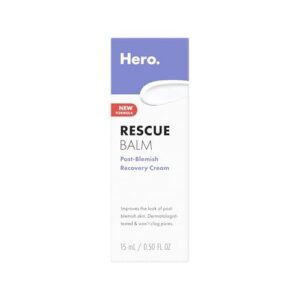
When a blemish finally clears, Hero Rescue Balm steps in. This $12.88 post-blemish cream targets the raw, dry skin left behind — not the scar itself.
Dab a rice-sized amount onto the area after cleansing. Shea butter, panthenol, and glycerin rebuild your skin barrier while dimethicone seals moisture in.
It won’t fade established hyperpigmentation, but it creates the right healing environment early on. Think of it as first aid for freshly healed skin.
| Best For | Anyone dealing with raw, irritated skin right after a blemish clears — especially if your skin runs dry or sensitive. |
|---|---|
| Price | $12.88 |
| Volume / Size | 15 mL (0.96 oz) |
| Skin Type | Sensitive and acne-prone |
| Key Active | Barrier-support formula |
| Scar / Mark Benefit | Yes |
| Fragrance-Free | Not specified |
| Additional Features |
|
- Soothes and hydrates freshly healed skin fast, which is exactly when it needs the most support
- Gentle enough for sensitive and acne-prone skin, and dermatologist-tested to back that up
- Tiny tube fits anywhere — your bag, your desk, your car — for quick touch-ups on the go
- Won’t do anything for older scars or existing dark spots — it’s early-stage healing only
- At 15 mL, heavy users will burn through it quickly and need to restock often
- Results are mostly anecdotal, so what works great for one person might not do much for another
Upgrade With Professional Treatments
When at-home products stop moving the needle, professional treatments can go deeper—literally. A dermatologist can target your specific scar type with tools that stimulate real structural change in your skin. Here are the five options worth knowing about.
Microneedling for Collagen
Think of microneedling — also called collagen induction therapy — as controlled healing. Tiny needles create micro‑injuries that trigger your skin’s natural repair response, boosting collagen production over time.
Most plans include 3–6 sessions, spaced several weeks apart. Deeper needle settings target acne scars more effectively.
Afterward, keep it simple: gentle products, no actives, and daily SPF.
Laser Resurfacing Options
Laser resurfacing takes your results up a notch.
Ablative lasers — like the Fractional CO2 laser or Er:YAG resurfacing — remove thin surface layers to stimulate deep collagen repair.
Nonablative lasers, including Fraxel and IPL, heat deeper layers without breaking the skin, so recovery is faster but results take longer to appear.
Your dermatologist tunes depth and energy to match your scar type.
Subcision for Rolling Scars
Rolling scars are caused by fibrous bands that tether skin to deeper tissue — and subcision cuts right through that.
Your clinician inserts a tri-bevelled needle, commonly 18–20 gauge, just beneath the scar and sweeps it to release those bands. That lifts the depression from below.
Expect short-term bruising and swelling as your skin remodels.
Fillers for Depressed Scars
Depressed scars are fundamentally empty spaces — and dermal fillers fill them back in. Hyaluronic acid fillers deliver immediate lift by placing volume directly beneath the depression.
Collagen-stimulating options like poly-L-lactic acid work more gradually through scar remodeling. Results from hyaluronic acid last four to six months, so plan for repeat sessions.
Steroids for Raised Scars
Raised hypertrophic scars and keloids respond well to intralesional steroid injections. Your dermatologist injects triamcinolone acetonide directly into the scar tissue, suppressing fibroblast activity and slowing excess collagen production.
Most patients need multiple sessions, spaced several weeks apart, for gradual flattening. Risks include localized skin thinning, so dosage stays low.
Combining injections with pulsed dye laser improves results noticeably.
Frequently Asked Questions (FAQs)
How to fade acne scars fast?
Start with SPF, a retinoid, and a brightening serum used consistently. These target collagen loss, hyperpigmentation, and skin turnover simultaneously — the fastest at-home path to visible fading without professional procedures.
Can acne scars be 100% removed?
Acne scars are permanent skin changes — complete removal is rare. Most treatments reduce visibility by 30–70%, not erase scars entirely. Microneedling, fillers, and laser resurfacing improve appearance, but full eradication remains unlikely.
How do I get rid of acne scars naturally?
You can’t fully erase acne scars naturally, but consistent topical care helps. Vitamin C, niacinamide, and aloe vera gradually fade marks. Daily sunscreen prevents darkening. Results take months.
What helps fade body acne scars?
Body acne scars — especially postinflammatory hyperpigmentation — fade with daily body sunscreen SPF 30, consistent retinoids, and chemical peels. Microneedling boosts collagen, while a collagen-boosting diet promotes skin repair from within.
How long do acne scars take to fade naturally?
Think of your skin like a slow river — it moves, but on its own schedule. Red and dark marks can take 3 to 12 months to fade naturally, while depressed scars rarely disappear without help.
Can diet or supplements help reduce acne scarring?
Diet alone won’t erase scars, but it can slow new damage. Reducing refined sugars lowers insulin spikes that trigger inflammation. Adding omega-3s and vitamins A, C, and E promotes collagen repair from the inside out.
Are home remedies effective for treating acne scars?
Home remedies can help fade post-inflammatory marks and improve skin texture over time, but they can’t rebuild lost collagen or release deep tethering beneath atrophic scars. Think of them as maintenance, not a cure.
Whats the difference between acne marks and scars?
Acne marks are flat color changes — red, pink, or brown — left by postinflammatory hyperpigmentation. Acne scars involve actual collagen loss or excess scar tissue, altering your skin’s texture permanently.
Do acne scars get worse with age?
Yes, they can. As skin loses collagen and fat volume with age, depressed scars often look deeper. UV damage accelerates this. Starting treatment early protects your long-term skin health.
How long does acne scar fading actually take?
The honest answer? It depends on the scar. Red marks can fade in 3–12 months. Dark PIH takes up to 2 years. Deeper atrophic scars rarely improve without treatment.
Conclusion
Fading acne scars is less like flipping a switch and more like tending a garden—slow, deliberate, and deeply rewarding when you work with the right conditions. The best way to fade acne scars combines knowing your scar type, using clinically proven ingredients, and protecting your skin daily.
Since irritated skin heals poorly, it also helps to understand how long your skin barrier takes to heal before layering on active ingredients.
Nothing about that process is passive. Every serum you apply, every SPF step you don’t skip—it all adds up.
Your skin is already healing. Now you’re just giving it better tools.