This site is supported by our readers. We may earn a commission, at no cost to you, if you purchase through links. This content is for general informational and educational purposes only and is not a substitute for professional medical, dermatological, or nutritional advice.

Most electric razors fail not from heavy use, but from neglect between shaves. Hair clippings and skin oils left on the cutting head harden within hours, clogging foil pores and increasing drag against your skin.
Caring for electric razors isn’t complicated, but the details matter. A razor stored in your bathroom, charged on a cheap cable, and never lubricated will degrade in months. The same razor, maintained correctly, can deliver a close, comfortable shave for years.
These six tips cover everything from daily cleaning to knowing exactly when worn parts are costing you performance.
Table Of Contents
- Key Takeaways
- Clean Your Electric Razor After Every Shave
- Deep Clean and Sanitize Weekly
- Lubricate Blades and Foils Correctly
- Store Your Razor to Prevent Damage
- Protect Battery Life and Electrical Safety
- Replace Worn Parts Before Performance Drops
- Frequently Asked Questions (FAQs)
- Do I need to lubricate my electric razor?
- What is the lifespan of an electric razor?
- How do I care for my electric shaver?
- Can I use rubbing alcohol to clean my electric razor?
- Can electric razors be used in the shower?
- How long should I charge a new razor?
- What causes razor blades to become dull faster?
- Are replacement parts compatible across different brands?
- How do I know when battery needs replacing?
- Can I use regular soap instead of special cleaners?
- Conclusion
Key Takeaways
- Clean your razor after every shave and deep-clean it weekly—residue hardens within hours, clogging foil pores and dulling performance fast.
- Store your razor in a cool, dry place outside the bathroom, since humidity corrodes foil housings faster than any other factor, and never seal it in airtight containers.
- Protect battery life by charging between 40–80%, unplugging once full, and using only the original or certified charger, since heat and voltage spikes kill Li-ion cells prematurely.
- Replace foils and blades every 12–18 months with genuine, model-matched parts—tugging, motor whine, and slower shaves signal worn components, not battery failure.
Clean Your Electric Razor After Every Shave
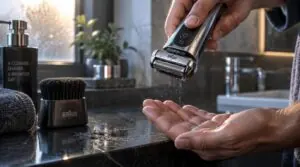
Always remove hair clippings, skin oils and debris from your razor the moment you finish shaving. Residue left on the foils hardens quickly, increases drag on the cutting surface, and starts clogging fine pores within hours. Daily cleaning isn’t negotiable. It’s what separates a razor that lasts years from one that dulls in months.
Even a single session leaves behind trapped hairs, hardened cream film, and microbial growth that compounds fast — razor cleaning steps that prevent blade burns and corrosion break that cycle before it starts.
The process is simple. Right after your shave, tap the cutting head firmly against your palm to knock loose clippings free. Then use the included brush to clear the foil surface with short, careful strokes. You’re done in well under a minute. For a more thorough clean, a dedicated electric razor cleaning brush set gives you the right bristle shapes to reach every corner of the foil without damaging delicate mesh.
Cleaning your electric razor this way prevents clogging, protects blade alignment, and keeps every shave feeling as close and clean as the first one.
Deep Clean and Sanitize Weekly
Weekly deep cleaning goes beyond the quick rinse—it targets the sebum, dead skin, and bacteria that daily cleaning misses. How you clean depends on whether your razor is waterproof or non-waterproof, so the method matters. Here’s what to do for each type, plus how to dry everything properly afterward.
Waterproof Razor Cleaning
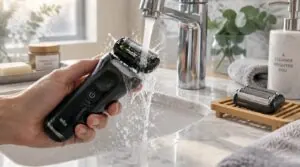
With a waterproof rating, your razor’s built for rinsing. Open the head, run warm water through the mesh guards for 10 to 20 seconds, and add a drop of mild soap if there’s visible buildup. Don’t use hot water; it warps the foil frame.
If buildup persists after rinsing, the electric shaver troubleshooting guide walks through deeper cleaning steps that can restore full performance.
After rinsing, place it on a heat-free rack and air dry for 20 minutes before reassembly.
Non-Waterproof Razor Cleaning
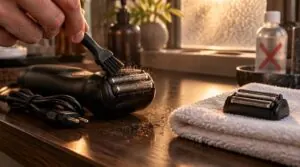
Non-waterproof models can’t take the same rinse approach. For your daily quick clean, unplug the razor first, then use a dry brush for debris removal from head slots and exposed blade edges.
Skip isopropyl alcohol altogether; it strips blade lubricants and softens the plastic housing. If moisture hits the head, air drying with blades removed for 12 hours isn’t optional.
Drying to Prevent Odors
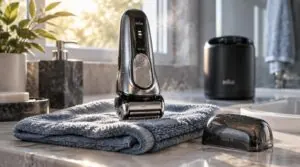
Whether your razor is waterproof or not, air drying after every rinse is non-negotiable. Blot the head, shake out trapped droplets, then leave the razor head-down on a dry surface with the cover off.
Enclosed holders kill airflow and spike humidity, accelerating bacterial growth inside foil crevices.
Moisture plus skin residue creates odor fast. Full evaporation is the only standard.
Lubricate Blades and Foils Correctly
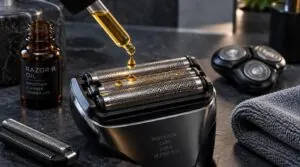
Because friction degrades cutting performance faster than anything else, lubrication isn’t optional. Blade lubrication techniques differ between foil and rotary models, but the basic principle stays the same: apply razor oil to the cutting interface, not the outer housing.
For foil shavers, place one small drop directly onto the foil screen, then run the shaver for five seconds. This spreads the oil across the active cutting path. For rotary heads, apply a drop to each cutter dial.
Lubricate your electric shaver once a week, always after it’s fully clean and dry. Wet or soapy surfaces dilute oil on contact. Too much product builds sticky residue inside the cutters and kills glide. The right amount maintains sharpness and extends blade life.
Store Your Razor to Prevent Damage

Storage conditions matter more than most people realize. Humidity is your razor’s biggest enemy, and bathroom shelves put it directly in the line of fire. Move it to a cool, dry place, like a bedroom drawer or a cabinet outside the bathroom. That single change does more for product lifespan extension than most cleaning routines combined.
Humidity is your razor’s biggest enemy—move it out of the bathroom and it will outlast any cleaning routine
Use a breathable pouch or the original case if you have one. Airtight containers trap moisture and accelerate corrosion around foil housings and metal contacts. Keep the blade guard or foil cap on whenever the razor isn’t in use. Loose parts left nearby cause dents, scratches, and alignment problems.
Stand it upright or horizontal with vents clear. Never rest it on a damp towel.
Protect Battery Life and Electrical Safety
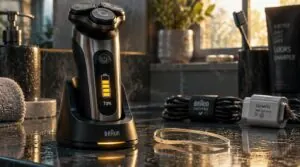
Think of a depleted Li-ion cell like a stretched rubber band: it never fully snaps back. Your razor’s battery life is finite. Most cells hit end-of-life after 300-500 charge cycles, and performance starts fading well before that point.
Keep charging between 40-80% rather than draining it flat and topping back to 100%. Avoid overcharging by unplugging once the indicator hits full. Leaving it on the base overnight builds heat, and sustained heat kills cells fastest. Charging above 35°C visibly accelerates battery degradation.
Use your original charger or a certified one that meets electrical safety standards. Incompatible chargers trigger voltage spikes, bypassing protection circuits. If you won’t use it for weeks, keep it at 50-60% charge to minimize long-term capacity loss.
Replace Worn Parts Before Performance Drops
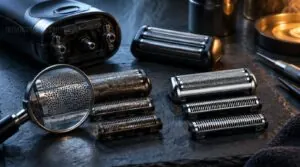
Your razor won’t announce when it’s failing. Knowing what to watch for keeps you ahead of the drop in performance. These three checkpoints tell you when it’s time to act.
Blade and Foil Wear
Blades don’t last forever. Even with daily care, mechanical wear and tear sets in between 50 and 150 uses, depending on how coarse your hair is.
Hard water minerals embed in foil perforations and speed up abrasive damage. Sweat and shaving oils corrode the metal over time, widening those tiny holes.
Plan for foil replacement every 12 to 18 months.
When that time comes, swapping in fresh electric razor foil replacement heads keeps your shaver cutting like new.
Noise, Tugging, and Slow Shaves
Your razor’s telling you something. Motor whine during full-width strokes signals cutter gap wear past 0.2–0.3 mm. Tugging starts when foil perforations lose even contact, usually after 6–12 months of regular use.
Dull oscillating blades raise torque demand, slowing each shave by 15–30 seconds per pass. That sluggishness isn’t battery failure. It’s worn foil reducing micro-cut efficiency. Act right now.
Compatible Replacement Parts
Wrong parts destroy your cutting assembly fast. Match the exact series, whether Precision, Nano, or Ultra, and verify connector and foil size against your model number. Component compatibility isn’t optional.
Follow manufacturer guidelines on replacement intervals, usually every 12 to 18 months. Same-brand cleaning and lubrication modules keep lubrication channels fitting correctly. Genuine replacement parts protect performance and your skin. When it’s time to swap, browsing genuine foil and cutter sets helps you match the exact series your shaver needs.
Frequently Asked Questions (FAQs)
Do I need to lubricate my electric razor?
Yes, but only if your manufacturer says so. Many foils are pre-lubricated and sealed. If oiling is required, apply clipper oil to pivot points after cleaning, never on foil surfaces. This protects blade sharpness and extends razor longevity.
What is the lifespan of an electric razor?
An electric razor is like a good pair of shoes: treat it well and it lasts. Expect 5–7 years with regular maintenance, up to 8–10 years for high-end models. Replace worn out foils and blades every 12–24 months to protect razor longevity.
How do I care for my electric shaver?
A neglected shaver can lose 30% of battery capacity in a year. Yours deserves better. Rinse it after every shave, do a weekly deep cleaning routine, oil the blades, store it dry, and charge smart.
Can I use rubbing alcohol to clean my electric razor?
The theory that isopropyl alcohol is a safe all-purpose cleaner? Only partly true.
For electric razor maintenance, spot-clean non-waterproof models sparingly, rinse washable heads instead, dry fully, and avoid saturation near circuitry to prevent bacterial growth, skin irritation.
Can electric razors be used in the shower?
Some can. Check the label first. Shower safe models rated IPX7 or higher handle wet and dry shaving. Nonwaterproof models risk short circuits and moisture damage prevention starts with keeping them completely dry.
How long should I charge a new razor?
Sure, just plug it in for five minutes and hope for the best. Wrong. Foil razors need 8–12 hours initially; NiMH models take 14–16; Li-ion only 1– Complete the full first charge for proper battery health optimization.
What causes razor blades to become dull faster?
Here’s the truth: dull blades come from dense or fibrous hair chipping the edge, residue buildup embedding grit, poor lubrication, misaligned cutting geometry, and motor strain. Each shave compounds the damage, eroding cutting edge integrity.
Are replacement parts compatible across different brands?
Short answer: no. Brands design replacement blades and foils for their own razor families. Even if a part mounts, mismatched geometry, interlocks, and contacts cause vibration, safety issues, and warranty compliance problems. Stick with your original brand.
How do I know when battery needs replacing?
Your razor used to run 45 minutes per charge, now it dies at That’s your battery failing. Watch for shortened runtime, slow charging, and heat during charge cycles. Swelling? Stop using it immediately.
Can I use regular soap instead of special cleaners?
Many people assume any soap works, but testing proves otherwise. Yes, mild soap is fine for light external cleaning during your daily cleaning routine. Rinse thoroughly, dry completely, and never soak your razor. Fragranced or antibacterial bars damage seals.
Conclusion
Maybe you’re thinking this sounds like too much work. It isn’t. Thirty seconds of cleaning after each shave and a weekly deep clean take less time than one bad shave caused by a dull, clogged head.
Caring for electric razors comes down to three habits: clean it, lube it, replace worn parts. Do that, and your razor stays sharp, your skin stays comfortable, and your wallet keeps its money. Your face will notice the difference within days.