This site is supported by our readers. We may earn a commission, at no cost to you, if you purchase through links. This content is for general informational and educational purposes only and is not a substitute for professional medical, dermatological, or nutritional advice.

Natural" on a skincare label means almost nothing legally. Brands apply the term freely, and a product can carry botanical claims while listing synthetic compounds near the top of its ingredient list, where weight matters most.
That gap between perception and formulation is where skin reactions, wasted money, and mismatched products happen most. Knowing how to start natural skincare the right way means reading past the front of the bottle, matching ingredients to your actual skin type, and building a routine one product at a time.
This guide gives you the clinical framework to do exactly that.
Table Of Contents
- Key Takeaways
- What Does Natural Skincare Mean?
- How Do You Identify Your Skin Type?
- How Do You Choose Natural Products?
- How Do You Build Your Routine?
- How Do You Transition Safely?
- Frequently Asked Questions (FAQs)
- What is the 4-2-4 rule in skincare?
- Do I need a license to sell skin care?
- How to start skin care for beginners?
- How can I make my own natural skin care?
- How do I start a skincare routine?
- What makes a natural skin care routine “natural”?
- What is a natural skin care routine?
- Can you make a natural skin care recipe ahead?
- What is a beginner’s basic skincare routine?
- Should you make your own skincare?
- Conclusion
Key Takeaways
- "Natural" on a skincare label is a marketing term with no legal definition, so ingredient lists — not front-of-bottle claims — are your only reliable guide to what’s actually in a product.
- Identifying your skin type before choosing any product is essential, since the wrong ingredients can compromise your skin barrier even when they’re plant-derived.
- Certifications like ECOCERT or NATRUE confirm ingredient thresholds, and INCI ordering by weight reveals whether a product’s "natural" positioning is genuine or superficial.
- Transitioning to natural skincare safely means introducing one product at a time, patch testing for 24–48 hours, and waiting two weeks between changes to accurately trace any reactions.
What Does Natural Skincare Mean?

Labels like "natural skincare" represent a marketing category, not a regulated standard. No single government body defines the term consistently across countries, so brands apply it freely. A product marketed as plant-derived or natural can still contain purified, chemically standardized compounds that share little with their original whole-plant form.
Understanding which ingredients genuinely benefit your skin makes it easier to cut through the marketing noise, as this guide to top natural skincare ingredients shows.
Natural ingredients also vary batch to batch based on growing conditions, harvest timing, and extraction method. That variability changes a formula’s chemical composition in ways you won’t see on the label.
What "natural" signals is sourcing intent, not a safety guarantee. Plant-derived actives can irritate just as synthetic ingredients can, especially certain essential oil constituents. Knowing what the term covers gives you real control over exactly what goes on your skin.
How Do You Identify Your Skin Type?

Choosing the right natural ingredients starts with knowing your skin type — and that’s something you can determine at home with a simple test. Your skin type shapes every product and formulation decision in your routine. Here’s how to identify it accurately and match it to the botanicals that perform best for your biology.
At-Home Skin Type Test
How you approach this skin analysis test shapes every skin type outcome. Use a fragrance-free cleanser, avoid actives for 24-48 hours first, then observe in natural light after 30-60 minutes without touching your face.
Oily zones signal oily or combination skin. Tightness indicates dry skin. Persistent redness after cleansing points to sensitive skin reactivity, not simple dryness or excess oiliness.
Understanding these distinctions helps you build a routine that actually works — explore skin-type-matched routines for healthier skin to move beyond guesswork.
Ingredients for Each Skin Type
Once you’ve identified your skin type, your ingredient choices become clear. Oily skin benefits from niacinamide and salicylic acid, two plant-derived actives that reduce sebum and clear pores without compromising your skin barrier. Dry skin calls for ceramides and glycerin.
Sensitive skin needs colloidal oatmeal, allantoin, and not much else. Always keep your natural ingredients strictly fragrance-free to avoid reactivity.
How Do You Choose Natural Products?

Choosing natural products comes down to knowing what you’re actually buying. The label and the certifications on it tell you more than any marketing claim ever will. Two areas in particular will sharpen your product selection immediately: reading certifications and ingredient labels, and knowing which ingredients to limit or avoid.
Certifications and Ingredient Labels
A 2023 survey found that 73% of consumers check ingredient labels but don’t understand INCI, directly risking your dermatological safety.
Understanding what’s actually in your products can protect your skin — beard oil ingredients and their effects on skin health are worth knowing before your next purchase.
Organic certification logos like ECOCERT or NATRUE confirm natural ingredient thresholds; cross-check them against official registries. INCI ranks ingredients by weight, so ingredient transparency starts at the top. Synthetic ingredients listed early often signal a product misrepresenting its natural ingredients.
Ingredients to Limit or Avoid
Since natural products carry sensitization risk, knowing what to limit matters. Avoid essential oils in leave-on formulas; their volatile compounds raise your contact dermatitis odds. Citrus-derived ingredients add photosensitivity risk without sunscreen.
For sensitive skin, stick to hypoallergenic ingredients and skip synthetic fragrances. Stacking botanical preservatives in one formula compounds allergen exposure, triggering microbiome shock and reducing skin irritation thresholds.
How Do You Build Your Routine?
Building a natural skincare routine doesn’t have to be complicated. A minimal, well-sequenced routine protects your skin without overwhelming it. Here’s what that structure looks like, step by step.
Starting with a natural skincare starter kit takes the guesswork out of building a routine that actually works for your skin.
Cleanse and Moisturize

Your cleanser sets the tone for everything that follows. pH-balanced formulas reduce barrier disruption, so choose natural cleansers with mild surfactants and keep contact time short. Always rinse with warm water, not hot.
Apply your natural moisturizer while skin’s still damp to lock in hydration retention before water evaporates. Occlusives and humectants working together quickly restore your skin barrier effectively.
Look for a natural ceramide barrier moisturizer that combines both occlusives and humectants for the most effective overnight repair.
Apply Mineral Sunscreen

Think of mineral sunscreen as a shield for your skin barrier. Zinc oxide and titanium dioxide particles sit on your skin’s surface, physically deflecting UV radiation rather than absorbing it.
Apply enough to form a visible, even film across your face and neck, because gaps in coverage mean gaps in broadspectrum protection. Reapply every two hours after sweating or swimming.
How Do You Transition Safely?
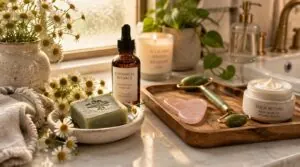
Switching to natural skincare isn’t just a product swap—it’s a process that requires patience and methodical attention. Your skin needs time to adjust, and rushing that switch is where most people go wrong. Two practices in particular will protect your skin and your progress as you make the shift.
Patch Test New Products
Your skin barrier doesn’t negotiate. Patch test new products on your inner arm for 24 to 48 hours before full application.
Watch for:
- Redness or swelling at the test site
- Itching or bumps signaling sensitivity
- Warmth persisting after initial contact
Sensitive skin can react even to natural ingredients. Introducing one product at a time keeps your skin sensitivity management accurate.
Avoid Common Beginner Mistakes
The biggest mistake beginners make is changing everything at once. Your skin barrier can’t identify which product caused a reaction if you introduce five simultaneously. Stick to pH-balanced formulas, swap one at a time, and wait two weeks between changes.
Swap one product at a time; your skin barrier cannot pinpoint the culprit if five change at once
Don’t assume "natural" means irritant-free. Botanical actives affect sensitive skin as intensely as synthetic fragrances. Gradual product swapping protects you.
Frequently Asked Questions (FAQs)
What is the 4-2-4 rule in skincare?
The 4-2-4 rule is a structured onboarding cadence designed for natural skincare. You’ll open with four steps, narrow to two steady essential steps, then expand back to four, letting your skin barrier gradually adapt safely.
Do I need a license to sell skin care?
There’s no single federal license required for simply reselling finished skincare.
If you manufacture or process products, FDA facility registration under MoCRA is mandatory.
State business licenses and seller’s permits are almost always required too.
How to start skin care for beginners?
You don’t need ten products to start. Choose a gentle cleanser, a moisturizer matched to your skin type, and sunscreen.
Natural skincare performs best when you build barrier repair habits one step at a time.
How can I make my own natural skin care?
Almost nobody realizes how few ingredients an effective DIY skincare formula actually requires. Start with plant-derived actives, match each one carefully to your barrier repair or hydration goal, and always preserve every water-based product properly.
How do I start a skincare routine?
Research consistently shows that skincare routines with three or fewer steps have the highest adherence rates over time. Pick a gentle cleanser and a moisturizer that’s right for your skin type, then add mineral sunscreen.
What makes a natural skin care routine “natural”?
It comes down to what’s in your formulas. A routine earns the label when it relies on plant-derived actives and minerals over synthetic fragrances or fillers. The ingredient list, not marketing, tells the real story.
What is a natural skin care routine?
Think of it as a foundation, not a passing trend. A natural skincare routine consistently uses plant-derived actives and minerals to cleanse, moisturize, and protect your specific skin type without synthetic irritants or harsh chemicals.
Can you make a natural skin care recipe ahead?
Millions batch their DIY skincare weekly, but water-heavy natural ingredients don’t stay stable for long.
Make small batches, store them in opaque containers, label your make date, and discard anything that smells or looks off.
What is a beginner’s basic skincare routine?
Your basic natural skincare routine has three steps: cleanse with a pH-balanced formula, moisturize based on your skin type, and finish with mineral sunscreen each morning to protect your skin barrier integrity from UV damage.
Should you make your own skincare?
Nothing signals control over your skin quite like blending raw materials in your kitchen. DIY formulation skips professional safety assessments, introduces real microbial contamination risk, and delivers inconsistent concentrations that ignore your actual skin type.
Conclusion
A client switches to a new "natural" moisturizer, breaks out within a week, and blames botanicals entirely. The real culprit was fragrance, sitting fifth on the ingredient list. That’s exactly why knowing how to start natural skincare means reading formulations carefully, not front-of-bottle claims.
Choose one product. Patch test it. Add the next. Your skin adapts in layers, and your routine should too. Do this deliberately, and the results won’t just be safer. They’ll last.