This site is supported by our readers. We may earn a commission, at no cost to you, if you purchase through links. This content is for general informational and educational purposes only and is not a substitute for professional medical, dermatological, or nutritional advice.
Most shower caddies fail within 18 months—not because of cheap materials, but because the wrong type ended up in the wrong shower. That stat hits differently when you’re picking shampoo bottles off a wet floor at 7 a.m.
The choice between hanging and standing shower caddies shapes more than just your storage situation; it determines how much floor space you reclaim, how your walls and fixtures hold up over time, and whether your caddy still looks decent two years from now.
Understanding the structural and practical differences between hanging and standing shower caddies puts that decision firmly in your hands.
Table Of Contents
- Key Takeaways
- Hanging Vs Standing Shower Caddies
- Installation and Setup Differences
- Space Usage and Shower Footprint
- Stability and Weight Capacity
- Cleaning and Maintenance Needs
- Plumbing and Surface Impact
- Accessibility and Daily Convenience
- Materials and Rust Resistance
- Top 3 Shower Caddy Options
- Choosing The Better Shower Caddy
- Frequently Asked Questions (FAQs)
- Conclusion
Key Takeaways
- Hanging caddies reclaim up to 40% more floor space in stalls under 5×5 feet, making them the clear winner for tight showers, rentals, and anyone who’s tired of shuffling around a base that eats into every inch.
- Standing caddies distribute weight straight down through their legs rather than stressing your showerhead or plumbing, which means they handle heavier bottle loads—up to 20 lbs total—without the swinging, sliding, or pipe‑joint strain that overloaded hanging models can cause.
- Your material choice quietly determines how long the caddy actually lasts: 304 stainless steel and anodized aluminum both resist daily steam and soap buildup well, while cheaper coated wire or standard rubber suction cups tend to fail within a season if you’re not on top of maintenance.
- Installation method shapes your long‑term surface damage risk—suction cups need nitrile or silicone construction and weekly re‑pressing to hold reliably, adhesive strips can lift tile paint if removed without heat and a plastic scraper, and tension‑pole models avoid all of that by anchoring between floor and ceiling without touching a single wall.
Hanging Vs Standing Shower Caddies

Picking the right shower caddy comes down to one fundamental question: do you want it hanging in the air or standing on the floor? Each approach has its own trade‑offs around space, stability, and how much work you’re willing to put into installation and upkeep.
If you hit the gym regularly, your needs shift a bit—shower caddies designed for gym bags prioritize portability over the permanence that a home setup demands.
Here’s a closer look at the key differences that actually matter.
Core Design Differences
A hanging shower caddy and a standing shower caddy solve the same problem from opposite directions. The vertical orientation of a hanging model lets it suspend shelves above the floor entirely, relying on hooks, rings, or suction cups for its structural support. A freestanding design, by contrast, plants itself on the shower floor, using a weighted base or tension pole to stay upright without touching a single wall.
| Feature | Hanging Caddy | Standing Caddy |
|---|---|---|
| Structural Support | Mounted hardware | Floor-based or tension pole |
| Material Integration | Plastic/resin with hooks | Metal frames with trays |
| Height Placement | Fixed at 72–84 inches | Adjustable, floor-level |
That difference in load path shapes everything else. A wall-mounted design channels bottle weight back into whatever it’s anchored to — a showerhead, a stud, or a suction cup — while a standing caddy distributes that same weight straight down through its legs. Adjustable shelving appears in both types, though standing models make reconfiguration for larger bottles noticeably easier.
Best Use Cases
Where each caddy type truly earns its place depends on how you actually use your shower day to day.
| Use Case | Best Caddy Type | Key Advantage |
|---|---|---|
| Compact Shower | Hanging | Zero floor footprint |
| Family Storage | Standing | Heavy load capacity |
| Rental Solution | Portable | Easy move, no damage |
A hanging shower caddy is hard to beat in tight spaces — suction-cup models work especially well as a rental solution since they leave walls untouched. Standing caddies handle family storage better, holding larger bottles without crowding the floor. Dorm-friendly portable caddies split the difference, doubling as bathroom organization tools you can carry between shared bathrooms effortlessly.
Bathroom Size Considerations
Your bathroom’s square footage quietly dictates which caddy actually works for you. In a standard 32-by-32-inch shower stall, a freestanding caddy consuming 12–24 inches of floor length leaves almost no room to move comfortably.
A hanging shower caddy reclaims that floor space entirely — a straightforward space saving organization win in any compact layout planning situation where every inch genuinely counts.
Planning a separate wet zone helps increase floor space in small showers.
Quick Comparison Overview
Once you’ve settled on the right size, it helps to see the tradeoffs side by side.
| Feature | Hanging Caddy | Standing Caddy |
|---|---|---|
| Setup Speed | Under 5 minutes | Place and position |
| Space Savings | Full floor freed | 12–24 in. footprint |
| Weight Limits | ~16 oz per shelf | Up to 20 lb total |
| Pipe Safety | Risk if overloaded | No plumbing contact |
Installation and Setup Differences
How you install a shower caddy shapes everything from how long it lasts to whether it damages your walls. Hanging and standing models each come with their own setup quirks, and the method you choose matters more than most people expect. Here’s how the main installation types break down.
Showerhead Hanging Caddies
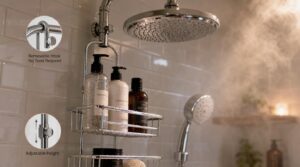
Most showerhead caddies need zero tools and about two minutes to install — you simply slide the removable hook design over the pipe and adjust. They accommodate standard stems from 0.75 to 1.25 inches and offer an height adjustment range for taller setups.
Most over-the-showerhead caddies hold three to five bottles comfortably within easy arm’s reach.
Door-mounted Hanging Caddies
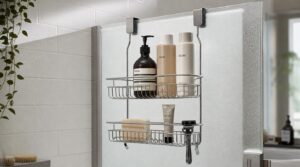
Unlike showerhead models, door hook installation mounts directly onto the door’s top edge — no tools, no damage, done in under a minute.
Models like the mDesign 2-Tier Over Door Shower Caddy with Hooks fit doors 1 to 1.75 inches thick and feature non-slip pads to protect the surface. Adjustable height and a rust-resistant finish make this over-the-door organizer a practical, lasting choice.
Suction and Adhesive Options
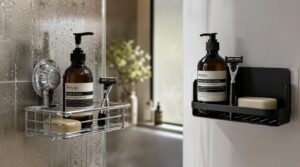
Suction and adhesive options work best when you understand what’s actually holding them in place. Suction cup reliability depends entirely on a clean, dry, non-porous surface — glass and ceramic tile give you the strongest seal, while textured or painted walls undermine grip fast. Suction seal maintenance means re-pressing cups every few weeks to restore the low-pressure bond before it quietly fails.
Dual-mode bonding systems pair a suction mounting base with an adhesive backing layer, giving you a meaningful safety margin when either method alone would fall short. The adhesive tack levels on these hybrid designs are usually low-to-medium, so adhesive replacement stays simple — peel, clean, apply a fresh strip, done.
Floor Placement Setup
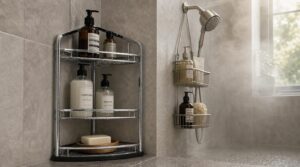
Floor placement is the simplest installation you’ll encounter — set it down, done. A non-slip base is non-negotiable on wet porcelain or acrylic; without it, even a weighted base shifts underfoot. Corner placement tucks triangular units neatly into unused space, while slim profiles as narrow as 6 inches keep the center path clear.
- Ventilation tips: choose open-wire shelving to let air circulate and slow soap scum buildup
- A freestanding caddy with a weighted base resists tipping without any wall contact
- Easy move: this portable caddy relocates between bathrooms instantly, no tools required
- Adjustable shelves increase capacity to fit tall shampoo bottles alongside shorter containers
Tension-pole Standing Models

A tension-pole caddy skips drilling entirely. The tension pole design wedges firmly between floor and ceiling using compression alone — no anchors, no damage.
Most models adjust from 7 to 10 feet via telescoping sections, and surface grip pads protect tiles while maximizing friction. Setup takes minutes, making this portable shower caddy ideal for renters.
Standard load limits reach 250–400 pounds.
Space Usage and Shower Footprint
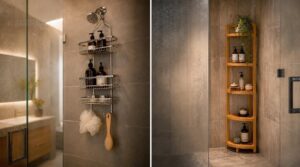
Where you put your caddy matters just as much as which one you pick. A hanging model and a standing one can both organize your shower well, but they carve up the space in completely different ways. Here’s how each type works with real-world shower layouts.
Zero-floor Hanging Storage
A hanging shower caddy’s greatest advantage is simple: zero floor contact.
By mounting to a vertical rail system along the wall, over-the-showerhead caddies, or wall-mounted caddies using an adhesive strip, every shelf floats above the floor entirely.
That means no wet base sitting in standing water, no blocked drain access, and no sacrificed square footage — which matters enormously in a tight stall.
Corner Floor Storage
Corner floor storage flips the script. Instead of reaching upward, a corner standing caddy tucks into the angle where two walls meet — its triangular footprint filling space that would otherwise go completely unused. Most units stand 24 to 72 inches tall, so they increase vertical storage without consuming shower floor area the way a wider freestanding unit would.
Removable baskets and adjustable feet keep things practical, letting you level the caddy on uneven tile and pull each bin out for a proper rinse. A moisture-resistant finish — usually powder-coated steel or treated wire — withstands daily steam exposure without rusting through within a season.
Small Shower Stalls
Small stalls — usually under 5×5 feet — punish every wrong decision.
A hanging caddy recovers up to 40% more usable floor area compared to freestanding shower containers by moving storage completely off the ground. When floor space optimization is the priority, that difference is immediately noticeable during daily use.
Bathtub Shower Layouts
Bathtub-shower combos play by different rules than standalone stalls.
A tub rim shelf sits right on the tub edge, giving you a stable, floor‑free surface without committing to wall anchors.
Pair it with a compact hanging shower caddy overhead, and you’re doubling your storage without crowding the floor or the doorway.
Shared Bathroom Space
Shared bathrooms demand a smarter approach to storage. A hanging shower basket takes zero floor space — critical when two or more people need clear movement paths of at least 24 inches.
A freestanding shower caddy tucked into a corner holds heavier bottle sets per user.
Combine both for clean user storage allocation without crowding anyone out.
Stability and Weight Capacity

Once you start stacking shampoos, conditioners, and body wash, weight adds up faster than you’d expect. Whether your caddy holds steady or starts shifting under that load depends a lot on the type you choose. Here’s what you need to know about how each design withstands the pressure.
Heavy Bottle Support
Standing caddies have a clear edge here.
A base rating of 20 lb keeps bottles stable without stressing the structure, while cross bracing distributes weight evenly across multiple contact points.
Support arms built from 12-gauge stainless steel resist bending even with full-sized conditioner bottles. Adjustable arms accommodate diameters from 9 to 15 inches, and corrosion-resistant coatings handle constant moisture without degrading capacity over time.
Swinging and Sliding Risks
Hanging caddies — whether over-the-showerhead or tension-rod models — introduce a real swinging and sliding risk once loaded past their weight capacity limit. A heavy conditioner bottle shifts the center of gravity, and any nudge sends the whole unit swaying.
In tight stalls, that swing impact force can knock items loose or scuff door seals through repeated near-contact wear.
Tipping Concerns
Floor-based designs carry their own hidden risk: tipping under load. Freestanding pole models, especially those using adjustable tension rods for nonpermanent mounting, can topple sideways when bottles cluster on one side.
- Top-heavy loading shifts the center of gravity
- Uneven floor surfaces exacerbate instability
- Weighted-base corner models resist tipping far better
- Sudden impacts — a dropped shampoo bottle — can trigger a fall
Suction Cup Failure
Suction cups look deceptively reliable — until they don’t. Surface preparation is everything here: oils, soap residue, or even a quick steam from a hot shower create micro-gaps that slowly let air in. Clean the tile with isopropyl alcohol, dry it completely, then wait a full minute before pressing the cup down. That single habit eliminates most premature failures.
Temperature swings quietly accelerate the problem. Hot showers soften the rubber, altering the seal’s integrity, while repeated exposure to harsh cleaners degrades cheaper foam-compound cups over time. Choose nitrile or silicone cups — they hold elasticity across bathroom temperature ranges far better than standard rubber. Once you notice moisture forming a ring around the cup’s edge, the seal is already compromised. Replace worn cups immediately rather than re-pressing them onto the same spot without proper drying, which almost always speeds up the next failure.
Weighted-base Stability
A weighted base works by keeping the center of gravity low, so even a fully loaded shelf won’t wobble when you reach past it quickly.
Models with circular base design resist tipping from any direction equally.
Pair that with non-slip foot pads and a low profile base, and you’ve got standing stability that a hanging caddy simply can’t match.
Cleaning and Maintenance Needs
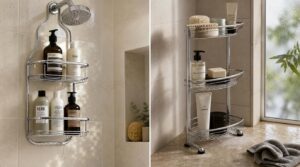
Keeping your shower caddy clean sounds simple until you’re wrestling with soap crust in hard-to-reach corners. The type you choose — hanging or standing — makes a real difference in how much effort that upkeep actually takes. Here’s what to evaluate across the five main maintenance factors.
Soap Scum Buildup
Soap scum is basically a waxy film that forms when fatty acids in bar soap react with calcium and magnesium ions in hard water.
Both caddy types collect it, but hanging models — like the iDesign York Lyra Jumbo — trap buildup in hard-to-reach undersides.
Standing designs, such as the iDesign Forma 3-Tier, feature drainage holes that help rinse residue away faster.
Mold-prone Areas
Where soap scum leaves off, mold picks up. Hanging caddies are particularly vulnerable — their enclosed undersides and bracket joints trap moisture long after the water stops, creating exactly the above-60% humidity conditions that feed mold colonies.
Standing caddies, with their open bases and drainage holes, dry faster and give mold far less to work with.
Easy Lift-out Cleaning
That mold problem gets a lot easier to manage when your caddy actually comes apart. Lift-out design lets you pull the whole unit free — no tools, no wrestling with brackets — so you can scrub every surface properly.
- Quick-release clips or magnets detach shelves in seconds
- Detachable shelves expose hidden corners where scum builds
- Non-porous surfaces resist mold when dried promptly
- Silicone seals around joints prevent soap adhesion
- Seal maintenance keeps joints clean and stain-free
Drainage and Drying Speed
Once a caddy is clean, keeping it dry is the next battle. Drainage geometry — the layout of holes, slits, and corner notches — determines how fast water clears the shelves.
Standing caddies benefit from turbulent airflow patterns in open corners, which boosts evaporation by roughly 30 percent compared to closed wall zones where humidity levels stay stubbornly high.
Replacement Part Costs
Keeping a caddy running long-term comes down to parts, and the costs differ noticeably between types.
Suction cups and rubber gaskets for hanging models usually run $2–$6 each, while mounting hardware sets cost $5–$15.
Standing caddy floor base replacements land between $10–$40.
OEM parts cost 10–40% more than aftermarket, though fitment is more reliable — worth factoring into your long-term budget.
Plumbing and Surface Impact
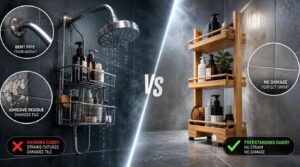
Most people focus on looks and storage space when picking a caddy, but the impact on your plumbing and bathroom surfaces deserves just as much attention.
Whether it’s stress on your showerhead or adhesive residue left behind on tiles, the wrong choice can create problems that outlast the caddy itself.
Here’s what you need to know across five key areas.
One of those areas—close shaving techniques for the neck—covers the prep steps that make the biggest difference before a blade even touches skin.
Showerhead Strain Risks
Most people don’t realize that overloaded hanging caddies can quietly stress the very plumbing behind your shower wall.
Over-the-showerhead caddies — including popular models like the iDesign York Lyra Jumbo Hanging Shower Caddy — transmit pressure directly onto the showerhead fixture when loaded beyond capacity, potentially cracking concealed pipe joints and triggering slow leaks that go undetected for weeks.
Adhesive Removal Damage
Adhesive strips seem renter-friendly until removal day arrives.
| Risk | Cause | Solution |
|---|---|---|
| Paint lifting | Strong bond on painted walls | Use paint-safe removal technique |
| Microscratch damage | Metal tools during scraping | Plastic scraper + microfiber cloth |
| Finish dulling | Harsh solvents like acetone | Isopropyl alcohol or citrus-based cleaner |
Apply gentle heat, use gentle solvent use methods, and always test an inconspicuous spot first — the iDesign York Lyra Jumbo relies on adhesive strips that can pull drywall paint clean off if yanked without softening the bond first.
Suction Mark Concerns
Suction cups leave more than a failed grip behind. Surface deformation can occur when cups stay pressed against tile or acrylic for weeks, temporarily distorting the finish’s top layer.
You’ll sometimes notice color variation — a pale or shadowed ring — especially on damp, unsealed surfaces.
Consistent drying protocol between uses slows adhesion wear greatly and helps materials recover faster.
Floor-safe Storage
Standing caddies rest entirely on the shower floor, exerting zero force on plumbing — no showerhead strain, no pipe stress. Here’s what makes floor-based storage genuinely low-risk:
- No wall anchoring required
- No adhesive or suction contact
- Adjustable shelving fits most corner spaces
- Nonslip features protect tile surfaces
- Fully portable between bathrooms
Rental Bathroom Suitability
Renting means one rule matters above everything else: don’t damage what isn’t yours.
That’s why standing caddies are the smarter default — no adhesive strips, no suction cups failing on humid tile, no showerhead strain. They’re fully portable, rust‑resistant, in stainless steel or aluminum, and move between bathrooms without tools. For renters, that kind of flexibility isn’t a bonus — it’s the whole point.
For renters, a standing caddy’s tool-free portability and zero-damage design isn’t a bonus — it’s the whole point
Accessibility and Daily Convenience

Beyond installation and plumbing concerns, how a caddy fits into your daily routine matters just as much.
The right choice depends on who’s using the shower, how items are arranged, and whether your setup can adapt when life changes.
Here’s how hanging and standing caddies compare across the everyday details that actually affect your experience.
Bottle Reach Height
Where you place your caddy determines whether grabbing shampoo feels easy or awkward.
Hanging caddies naturally position bottles at chest-to-shoulder height — sitting right in your ergonomic reach zone without stretching.
Standing models vary more, but adjustable shelves let you dial in the best bottle placement precisely. A wall-mounted unit usually offers a 5–20 cm adjustable range, giving you real height customization options for different users sharing one shower.
Children’s Access
Adults rarely think twice about grabbing a bottle at shoulder height, but for a five-year-old, that same shelf might as well be on the ceiling. Child reach height usually tops out around 0.9–1.0 meters, so height positioning matters enormously in a child safe bathroom.
A few practical features make the biggest difference:
- Adjustable shelves let you lower a tier to 90 cm for preschoolers
- Color coded labels help kids find their shampoo without handling every bottle
- Detachable bottle access lets small hands retrieve items at a comfortable angle
- Safety grip handholds reduce slipping on wet, soapy fingers
Detachable Showerhead Clearance
Once kids have their shelf dialed in, clearance becomes your next consideration — especially if you’re using a detachable showerhead.
Hanging caddies and flexible hoses don’t always coexist comfortably. A 60–80 inch hose can snag on over-the-showerhead caddies, and magnetic docking collars on modern detachable heads need unobstructed clearance to seat properly.
Quick Relocation Options
If your situation changes — a move, a renovation, a new roommate — a portable shower caddy wins every time.
Standing models relocate, no tools required for installation, while hanging versions, relying on suction cups or adhesive strips, need surface prep all over again.
You can shift a standing caddy between bathrooms in seconds, which makes it the smarter pick for anything temporary.
Shared-user Organization
Sharing a caddy with roommates adds a layer of complexity that relocation alone can’t solve. Ownership zones — defined shelf sections per person — prevent the classic "whose shampoo is this?" standoff.
A simple labeling system and a posted rotation schedule for peak-hour access keep things civil, while assigned cleaning duties guarantee nobody inherits someone else’s soap scum.
Materials and Rust Resistance

The material your caddy is made from determines how long it survives daily steam, soap, and humidity before it starts looking rough. Some options hold up for years without a spot of rust, while others start flaking after a single season. Here’s what you need to know about the most common materials on the market.
Stainless Steel Durability
Stainless steel is one of the few materials that actually earns its reputation in a wet environment.
Grade 304 stainless steel delivers yield strengths between 215 and 505 MPa, giving your caddy a sturdy backbone that holds up under daily load.
For coastal or high-humidity bathrooms, grade 316’s molybdenum content raises pitting resistance and corrosion resistance considerably, making it the smarter long-term choice.
Plastic and Acrylic Caddies
Plastic and acrylic caddies sidestep the rust conversation entirely — no corrosion risk, no matter how steamy your bathroom gets.
Acrylic’s clear, glass-like finish suits minimalist spaces and lets you spot an empty bottle at a glance.
Most use snap-together assembly, so installation is genuinely simple.
They’re lightweight, come in wide color variety, and work across hanging, over-the-door, and tension pole caddy configurations.
Aluminum Rust Resistance
Aluminum’s secret weapon is its natural oxide protection — a thin Al₂O₃ film forms within moments of air exposure and, impressively, self-heals if scratched. An aluminum caddy basically maintains its own corrosion-resistant finish without much help from you.
Look for anodized options; the anodizing process thickens that oxide layer by several micrometers, meaningfully boosting material durability in humid bathroom conditions.
Coated Wire Options
Coated wire caddies punch above their weight in the rust-resistance category. Enamel, PVC, and polyurethane coatings bond directly to a steel core, blocking moisture at the surface level before corrosion ever gets started.
- Finish colors include black, white, chrome, and clear gloss
- Weight support reaches 3–5 kg per shelf with reinforced joints
- Dielectric strength exceeds 1,000 V/mm for safe wet-zone handling
- Coatings resist soap scum, simplifying routine cleaning considerably
Bathroom Humidity Performance
Every material you choose for your shower caddy faces a daily stress test — and humidity is the main examiner. Bathrooms usually hold 40–60% relative humidity, spiking well above 60% during showers. Pairing rustproof materials with good ventilation keeps both your caddy and your walls in better shape long-term.
| Material | Humidity Resistance | Best For |
|---|---|---|
| 304 Stainless Steel | Excellent | Long-term wet environment durability |
| Coated Wire | Good | Budget moisture resistance |
| Plastic/Acrylic | Very Good | Condensation-prone spaces |
Top 3 Shower Caddy Options
Knowing the differences between hanging and standing caddies is one thing — finding the right product is another. These three options cover the most common shower setups, from tight rentals to family bathrooms with heavy daily use. Here’s what made the shortlist.
1. ShowerGem Acrylic Wall Mount Caddy
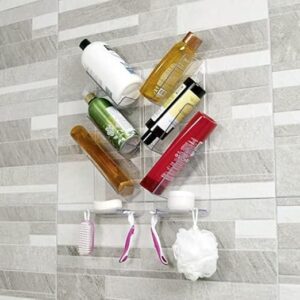
The ShowerGem Acrylic Wall Mount Caddy is a wall‑hanging option that skips suction cups entirely, relying instead on removable adhesive discs that bond to tile or plastic without drilling. Each unit measures just 3 × 5 × 15 inches, so it won’t crowd your shower.
Angled shelves tilt bottles forward for easy dispensing, and the clip‑off shelf design makes cleaning straightforward.
Sold as a set of two, it holds containers up to 28 oz — though the 24‑hour curing period means you can’t rush setup.
| Best For | Anyone who wants a clean, rust-free shower organizer without drilling holes or dealing with suction cups that keep falling off. |
|---|---|
| Material | Acrylic |
| Rust Resistance | Yes, acrylic is rust-proof |
| Water Drainage | Built-in drainage slots |
| Installation Type | Adhesive wall mount |
| Price Range | ~$53 |
| Mold Resistance | Yes, acrylic resists mold |
| Additional Features |
|
- No rust, ever — acrylic holds up way better than metal caddies over time
- Angled shelves are a small but genuinely useful touch, especially when a bottle is almost empty
- Shelves pop off for cleaning, and the drainage slots mean no gross standing water
- The adhesive isn’t always included in the box, which is a frustrating surprise at $53
- You have to wait a full 24 hours before loading it up — not ideal if you’re mid-move
- Shallow shelf depth means bigger bottles might hang over the edge a bit awkwardly
2. YeYeBest Adjustable Corner Shower Organizer
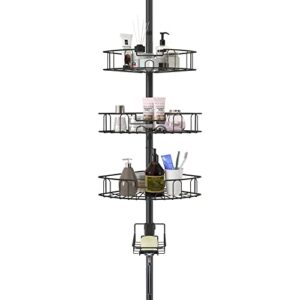
If the ShowerGem felt like a precision tool, the YeYeBest Corner Organizer takes a different approach — bulkier, bolder, and built to hold a full household’s worth of bottles.
Its tension-pole system adjusts from 39 to 125 inches, so it fits low-ceiling bathrooms and tall shower spaces without modification.
Four baskets stack vertically in the corner, keeping the floor clear while supporting up to 12 lb per shelf.
No drilling required — just twist, lock, and load.
| Best For | Families or shared households that need serious storage space and have a corner shower or tub with a solid ceiling to anchor the pole. |
|---|---|
| Material | Stainless steel/alloy iron |
| Rust Resistance | Partial, steel baskets may rust |
| Water Drainage | Open-grid shelf design |
| Installation Type | Tension pole, no drill |
| Price Range | Mid-range |
| Mold Resistance | Partial, open grid reduces mildew |
| Additional Features |
|
- Fits almost any ceiling height — the 39 to 125-inch range covers everything from a cozy apartment bathroom to a tall custom shower.
- Four shelves hold a lot, and the open-grid design means water drains fast so you’re not dealing with soggy shelves or mildew.
- No drilling at all — twist the pole into place and you’re done, walls and tiles totally intact.
- The springs in the tension rod can rust out after a few months, and if they fail, the whole unit comes down with everything on it.
- It runs wide, so in a smaller shower stall it can feel cramped or sit unevenly against the walls.
- The instructions are a bit of a puzzle — no labeled parts, which makes setup take longer than it should.
3. Madesmart Expandable Bath Shelf
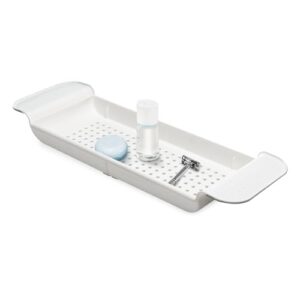
Where the YeYeBest fills every corner with baskets, the Madesmart Expandable Bath Shelf keeps things minimal.
It stretches from 21.8 to 30.87 inches to bridge most standard tubs, locks in place with soft‑grip ends — no tools, no mounting hardware — and drains fast through built‑in holes.
At $19.99, it’s the straightforward pick if you want a clean surface for soaps, razors, and bath toys without committing to a permanent setup.
| Best For | Anyone who wants a no-fuss, tool-free bath shelf that fits most standard tubs and keeps daily essentials within reach without a big commitment. |
|---|---|
| Material | BPA-free plastic |
| Rust Resistance | Yes, plastic is rust-resistant |
| Water Drainage | Large drainage holes |
| Installation Type | Rests on tub edge |
| Price Range | $19.99 |
| Mold Resistance | Yes, plastic resists mold |
| Additional Features |
|
- Adjustable length (21.8–30.87 in) means it fits most tubs right out of the box
- Built-in drainage holes keep water moving, so soap scum and puddles don’t pile up
- BPA-free plastic won’t rust or grow mold the way metal or bamboo options can
- Feels a bit flimsy under heavier loads — it’s not built for big shampoo bottles stacked three deep
- Won’t sit flush on tubs with built-in fixtures or raised edges along the rim
- At $19.99, the plastic construction doesn’t feel quite as premium as metal alternatives
Choosing The Better Shower Caddy

The right caddy really comes down to your specific situation — your bathroom size, your lease terms, and how much you actually want to scrub around fixtures every week. A few clear-cut scenarios make the decision pretty straightforward. Here’s how each type stacks up where it matters most.
Best for Small Bathrooms
In a small shower, every square inch counts.
A hanging over-the-showerhead caddy eliminates floor contact entirely, reclaiming up to 40% more usable space in stalls under 5×5 feet. Corner shower caddies and wall‑mounted options improve dead corner space without shrinking your footprint.
When floor space is your scarcest resource, a floor‑free design simply wins.
Best for Renters
Renters don’t have the luxury of drilling into tile or leaving screw holes behind.
That’s where renter-friendly mounting shines — showerhead caddies attach via adjustable hooks with no drilling, door-mounted models clamp over glass without touching walls, and suction cups or adhesive strips grip smooth surfaces cleanly.
When it’s time to move, everything lifts away without a trace.
Best for Easy Cleaning
Standing caddies win here — lift the whole unit out, hose it down, and you’re done.
Look for stainless steel or acrylic with drainage holes and rounded tray corners so water doesn’t pool.
Easy-access baskets let you clean underneath bottles without moving everything.
Some models even include dishwasher-safe components, cutting scrubbing time dramatically.
Final Buying Checklist
Before you buy, run through these essentials: installation time and tools required, your shower’s exact dimensions, and whether the caddy’s weight capacity per shelf fits your bottles.
Confirm the material is rust‑resistant — 304 stainless steel or sealed acrylic holds up best.
Check warranty coverage, available replacement parts, and whether the design allows height adjustability for long-term value.
Frequently Asked Questions (FAQs)
Can shower caddies work in outdoor shower spaces?
Yes, shower caddies absolutely work outdoors — provided you choose weather-resistant materials like stainless steel or teak, prioritize drainage design features, apply UV protection coatings, and clean them regularly to prevent mineral buildup.
Are shower caddies safe for walk-in showers?
Shower caddies are safe in walk-in showers when properly installed. Choose wall-mounted permanent caddies with rust-proof stainless steel, verify load capacity limits, and use anti-slip features to prevent accidents.
Do shower caddies fit over glass shower doors?
Yes, many shower caddies fit over glass shower doors. Look for models with rubberized edge pads to protect the glass and hooks designed for doors up to 24 inches wide and ¼-inch thick.
How do shower caddies handle extreme water pressure?
Most shower caddies handle water pressure better than you’d expect — open-grid drainage holes and angled shelves prevent water buildup, while 304 stainless steel and reinforced mounts resist sustained pressure without warping.
Conclusion
hanging and standing shower caddies aren’t just about aesthetics—they’re about choosing a system that actually fits your life. Hanging models free your floor and suit tighter spaces; standing ones handle heavier loads with quiet, grounded reliability.
Match your choice to your shower’s layout, your surface type, and how many people share the space. Get that alignment right, and your caddy won’t just survive 18 months—it’ll earn its place for years.