This site is supported by our readers. We may earn a commission, at no cost to you, if you purchase through links. This content is for general informational and educational purposes only and is not a substitute for professional medical, dermatological, or nutritional advice.
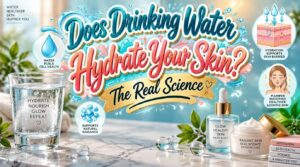
Somewhere between your third glass of water and your skincare routine, a well-meaning myth took root: drink more water, get better skin. It sounds logical. It’s also not quite how your body works.
Your kidneys filter and redistribute every sip you take long before any of it reaches your face. Drinking water hydrates your skin about as directly as filling a bathtub hydrates your hair. For most adequately hydrated people, extra glasses produce negligible changes in surface moisture.
What actually controls your skin’s hydration levels is your barrier function, and understanding that distinction changes everything about how you care for your skin.
Table Of Contents
- Key Takeaways
- Does Drinking Water Hydrate Your Skin?
- How Drinking Water and The Skin Barrier Affect Hydration
- What Does Scientific Evidence Say About Water and Skin Hydration?
- Can Drinking More Water Prevent Dry Skin and Wrinkles?
- How to Hydrate Your Skin More Effectively
- Frequently Asked Questions (FAQs)
- Is it better to sip or chug water?
- How long does it take for water to hydrate your skin?
- Will drinking water fix dehydrated skin?
- Can drinking water reduce acne or breakouts?
- Does water temperature affect skin hydration levels?
- Can overhydration negatively impact your skin?
- Does skin absorb water during bathing?
- Are certain water types better for skin?
- Does alkaline or mineral water hydrate skin better?
- Do herbal teas count toward skin hydration?
- Conclusion
Key Takeaways
- Drinking water doesn’t directly hydrate your skin — your kidneys redistribute every sip systemically before it ever reaches your face, making extra glasses largely ineffective for surface moisture in already-hydrated people.
- Your skin’s barrier function, not water intake, controls hydration by limiting transepidermal water loss (TEWL); a damaged barrier lets moisture escape faster than any amount of drinking can replace it.
- Dry skin and dehydrated skin are distinct conditions requiring different fixes — dry skin needs lipid-restoring barrier repair, while dehydrated skin responds to humectants like hyaluronic acid.
- The most effective skin hydration routine combines drinking enough water (not excessively), moisturizing within two minutes of showering on damp skin, and protecting your barrier from harsh cleansers and over-exfoliation.
Does Drinking Water Hydrate Your Skin?
How well does drinking water hydrate your skin? Less than you think. It’s one of the most persistent dermatological myths out there, and it sounds logical enough that people repeat it without question. Drink more, glow more. Right?
The real secret to that lit-from-within look lies in your skin’s surface barrier, as explored in this guide to the science behind true skin hydration.
Here’s the reality. When you drink water, it enters your bloodstream and distributes through your organs. Your skin receives some, but the outermost layer, where dryness actually shows up, doesn’t absorb moisture from systemic hydration like a sponge. Transdermal water absorption from the inside out is simply not that efficient.
Chronic dehydration is real and can certainly make your skin look dull and sallow. But for most people already drinking adequately, a few extra glasses won’t noticeably change your skin’s surface moisture.
How Drinking Water and The Skin Barrier Affect Hydration
Understanding what actually controls skin hydration means looking at two things: how water moves through your body and how your skin barrier grips moisture loss. These aren’t the same process, and confusing them is where most myths take root. Here’s what’s really going on.
Water Distribution in The Body

After drinking water, it doesn’t head straight to your skin. Your water intake enters the bloodstream, distributes across fluid compartments, and gets flagged by your kidneys almost immediately.
Fluid balance is tightly regulated, with ADH controlling how much your kidneys reabsorb or excrete. By the time systemic hydration fully settles, any meaningful effect on skin hydration is modest and indirect.
Skin Barrier and TEWL

The skin has its own dedicated gatekeeper. Skin barrier function controls how much water stays in the stratum corneum by limiting transepidermal water loss (TEWL), the water constantly evaporating from your skin’s surface. Targeted TEWL skin barrier repair serums reinforce this gatekeeping function by replenishing the lipids and humectants the stratum corneum needs to hold water effectively.
Overnight, when TEWL peaks and cellular renewal accelerates, learning about overnight moisture retention methods can help you choose the right occlusive support before the damage quietly accumulates.
When the hydrolipid barrier is intact, water loss stays low and your skin stays comfortable. Disrupt it, and TEWL climbs fast, no matter how much you drink.
Rebuilding a compromised barrier often calls for a targeted skin barrier repair cream formulated with ceramides or fatty acids to restore what disruption strips away.
What Does Scientific Evidence Say About Water and Skin Hydration?

So the barrier controls moisture. Does the scientific evidence actually back up the claim that drinking water can hydrate your skin?
Not really. Most controlled trials find little to no consistent improvement in skin hydration or dryness when participants simply increase their water intake. When effects do appear, they’re small, short-lived, and often tied to concurrent changes in skincare.
Here’s what the research consistently shows:
- Corneometry scores (the standard measure of epidermal hydration) rarely shift with water intake alone
- Already well-hydrated people see almost no benefit
- Dryness ratings and hydration metrics often don’t move together
- Study methods, durations, and baseline hydration vary, making comparisons difficult
Water intake matters for overall health. It just isn’t the main driver of skin hydration.
Skin moisture is primarily maintained at a deeper cellular level, which is why deep skin hydration treatments target those underlying layers rather than the surface.
Can Drinking More Water Prevent Dry Skin and Wrinkles?

The short answer is: it depends on what’s actually going on with your skin. Dry and dehydrated skin aren’t the same condition, and mixing them up leads to a lot of wasted effort. Here’s how to tell them apart—and why that distinction matters for wrinkles.
Dry Vs. Dehydrated Skin
Most people treat these as synonyms. They’re not.
Dry skin lacks lipids, so your barrier leaks water faster. Dehydrated skin reflects a water deficit in the stratum corneum, appearing tight and dull even on oily skin. Your skin hydration levels and dehydration risk depend on different triggers entirely. Addressing both issues at once means reaching for a moisturizer for dry dehydrated skin that pairs barrier-rebuilding lipids with humectants like hyaluronic acid.
| Dry Skin | Dehydrated | |
|---|---|---|
| Cause | Lost lipids | Low water |
| Solution | Barrier repair | Humectants |
Dehydration Vs. Skin Aging
Confusion here is completely understandable. Dehydration causes temporary dehydration lines that plump back once you rehydrate. But the skin aging process is a different beast entirely.
Cutaneous aging reflects years of UV damage, oxidative stress, and collagen breakdown, not yesterday’s water intake. Dermal hydration can smooth fine lines briefly, but wrinkles rooted in structural tissue loss? Water won’t fix those.
Wrinkles from structural aging won’t yield to water—only time, UV, and collagen loss write those lines
How to Hydrate Your Skin More Effectively

So if chugging more water isn’t the answer, what actually works? The good news is that a few targeted habits can make a real difference. Here’s what’s worth your attention.
Drink Enough, Not Excessively
Drinking water hydrates your skin only to a point. Dehydration genuinely disrupts internal hydration, tightening skin and dulling your complexion. But once you’re adequately topped up, extra glasses add little to overall skin hydration. Your kidneys filter the surplus before it ever reaches your face.
Match your daily water consumption to thirst and urine color, not a viral wellness target.
Moisturize Damp Skin
Step out of the shower and your skin is primed. That damp surface is your best window for skin hydration, before evaporation takes over.
- Moisturize damp skin within 2 minutes
- Pat dry gently; don’t rub
- Choose creams for better moisture retention
- Focus on drier areas first
- Reapply after washing hands
Surface hydration drops fast without a moisturizer to seal it.
Protect The Skin Barrier
Your skin barrier does the heavy lifting here. When the lipid matrix is intact, it controls Transepidermal Water Loss (TEWL), keeping moisture where it belongs. Damage it with harsh cleansers or over-exfoliation, and no amount of drinking water compensates for that.
Focus on barrier repair: gentle cleansing, ceramide-rich moisturizers, and avoiding known irritants. Reducing water loss is the real win.
Frequently Asked Questions (FAQs)
Is it better to sip or chug water?
Neither wins a trophy. Your body regulates water absorption regardless of pace, smoothing out all timing differences naturally.
What actually matters for internal hydration is simply hitting your daily total and protecting your skin barrier.
How long does it take for water to hydrate your skin?
There’s no reliable timetable. Drinking water affects your skin through internal hydration, meaning it travels your entire bloodstream first. Skin physiology sits at the end of that process, so epidermal moisture simply doesn’t shift predictably.
Will drinking water fix dehydrated skin?
Drink an entire lake and dehydrated skin will probably still flake. Transepidermal Water Loss (TEWL), not thirst, is the real culprit. A damaged barrier drives water loss faster than drinking water can restore cellular hydration.
Can drinking water reduce acne or breakouts?
If only acne were that simple. Breakouts depend on sebum regulation, clogged pores, and bacterial activity, not cellular hydration alone. Drinking more water won’t fix those root causes, no matter how much you pour in.
Does water temperature affect skin hydration levels?
As for drinking water, the temperature barely moves the needle on skin hydration. Topically, though, hot water raises transepidermal water loss by stripping protective skin oils; cold water helps seal the barrier instead.
Can overhydration negatively impact your skin?
Too much water floods the system. Hyponatremia, a dangerous sodium drop, disrupts your biological hydration mechanisms, triggering water retention that visibly puffs your skin and reduces normal skin turgor without actually improving cutaneous water loss.
Does skin absorb water during bathing?
Step into a hot shower and your stratum corneum briefly swells with water. That’s surface hydration, not deep tissue absorption.
Your skin barrier tightly limits water uptake, and evaporation quickly undoes nearly all of it.
Are certain water types better for skin?
Hard water minerals like calcium can disrupt the skin barrier, but there’s no strong evidence that switching to soft or mineral water meaningfully improves how drinking water hydrates your skin. Barrier care trumps water type.
Does alkaline or mineral water hydrate skin better?
Mineral water won’t hydrate your skin better than plain tap. No consistent evidence backs the idea that pH or dissolved minerals meaningfully improve skin moisture retention. Your barrier integrity matters far more than water chemistry.
Do herbal teas count toward skin hydration?
Herbal teas count toward preventing dehydration just as well as plain water does. They’re mostly water themselves. Watch out for caffeine-heavy blends though; those can nudge urine output up and reduce skin moisture retention slightly.
Conclusion
The theory that drinking water directly hydrates your skin is appealingly simple, and almost entirely wrong. Does drinking water hydrate skin to any meaningful degree? For most people who aren’t already dehydrated, the honest answer is barely. Your kidneys route every sip long before your face sees any of it.
What actually moves the needle is your skin barrier. Moisturize damp skin, protect that barrier, and drink enough water. That’s the real routine worth trusting.