This site is supported by our readers. We may earn a commission, at no cost to you, if you purchase through links. This content is for general informational and educational purposes only and is not a substitute for professional medical, dermatological, or nutritional advice.
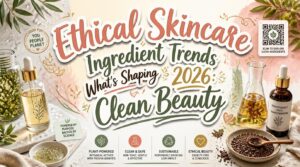
Your moisturizer’s ingredient list used to be a mystery. Now brands slap QR codes on jars so you can trace that squalane back to the actual olive farm. That shift didn’t happen by accident.
Shoppers got tired of vague "natural" claims and started demanding proof, and formulators answered with lab-grown collagen, fermented postbiotics, and upcycled coffee-ground actives that work as hard as they sound. Ethical skincare ingredient trends for 2026 combine clinical performance with real accountability, no more choosing between effective and responsible.
You’ll want to know which claims hold up and which ones are just clever marketing dressed as a spa day for the planet.
Table Of Contents
- Key Takeaways
- What’s Driving Ethical Skincare Ingredient Trends in 2026?
- Top Ethical Skincare Ingredients for 2026
- Sustainable Innovations Reshaping Skincare Formulations
- Benefits of Ethical Ingredients for Skin and Planet
- How to Evaluate Ethical Skincare Claims
- Frequently Asked Questions (FAQs)
- What are the skincare ingredient trends for 2026?
- What is the most ethical skincare brand?
- What is the 1% rule in skincare?
- What are the current trends in skin care?
- Why is ethical sourcing important in cosmetics?
- Are cosmetic ingredients sustainable?
- Are organic skincare products ethical?
- What influenced the organic skincare industry?
- Are organic skin care products the future of beauty?
- What is the skin trend in 2024?
- Conclusion
Key Takeaways
- Ethical skincare in 2026 blends real accountability with clinical performance, so you’re no longer stuck choosing between effective and responsible products.
- Look for verifiable proof like QR codes, batch-level traceability, and third-party audits, since these turn vague sourcing claims into facts you can actually check.
- Standout ingredients like plant-based squalane, lab-grown collagen, upcycled food-waste actives, and biotech peptides show that sustainable sourcing doesn’t mean sacrificing results.
- Spotting greenwashing comes down to checking for specifics, certifications like COSMOS or Ecocert, and third-party verification instead of trusting vague claims or future pledges.
What’s Driving Ethical Skincare Ingredient Trends in 2026?
You want products that actually match what’s on the label, and in 2026, that expectation is reshaping the entire industry. Formulators like me are paying attention to five forces pushing brands toward real accountability. Here’s what’s driving that shift.
Transparent Ingredient Sourcing
Trust starts with the label. You want to know where an ingredient came from, who farmed it, and how it got to your bottle.
If you’re curious how sourcing transparency plays out in personal care products, this guide to choosing hypoallergenic shaving cream breaks down what ingredient labels should actually tell you.
That’s why ingredient traceability systems matter now. QR codes, blockchain dashboards, batch-level origin tracking, they turn vague sourcing claims into verifiable facts you can actually check before buying. Brands increasingly rely on blockchain-based traceability platforms to record ingredient transactions from origin to manufacturer, giving consumers a transparent trail to verify.
Fair Labor Expectations
Knowing where an ingredient comes from is only half the story. You also want to know the hands that harvested it were treated fairly, paid a living wage, and kept safe on the job.
That’s why fair trade ingredients now hinge on real proof: overtime rules followed, safe workplaces maintained, and workers free to organize without pushback.
Proven Product Efficacy
Fair labor matters, but does the product actually work? That’s where clinical efficacy earns its keep.
You want proof: an 8-week study showing 28% fewer fine lines, or 84% of testers reporting smoother texture in six weeks.
- Brightness gains of 15% in 4 weeks
- Dermatologist-tested stability over 2 years
- Optimized dosing for results without irritation
Affordability Versus Sustainability
So why does clean skincare cost more? Sustainable ingredients run 10 to 40% higher upfront, but durability and less waste often balance that out within 6 to 12 months.
Economies of scale help too, prices drop as more brands adopt these formulas. Price sensitivity is real, but affordable alternatives keep expanding as sustainable beauty scales up.
Authentic Brand Values
When a brand’s mission actually matches its ingredient choices, you feel it. Look for purpose-driven partnerships, quarterly progress updates, and real storytelling, not just a green logo.
Ask yourself:
- Does their sourcing map match their claims?
- Do they publish setbacks, not just wins?
- Is sustainability a standard, not a slogan?
That’s authentic brand values in action.
Top Ethical Skincare Ingredients for 2026

So what’s actually going into these ethical formulas? You’re about to meet five ingredients turning heads in labs and on ingredient labels alike. Here’s what’s earning its spot in your routine this year.
From plant-derived squalane to biofermented actives, this guide to natural facial skin care ingredients breaks down why each one deserves a place on your shelf.
Plant-Based Squalane
Sharks used to supply squalene. Now olives, sugarcane, and wheat germ do, hydrogenated into stable, plant-based squalane that resists oxidation.
Check labels for "100% plant-derived squalane" and a COA confirming purity, since INCI just says "Squalane." It layers beautifully with acids, retinoids, and peptides, hydrating without clogging pores. Sustainable sourcing you can actually verify? That’s clean beauty done right.
Upcycled Food-Waste Actives
Once destined for landfills, coffee grounds, citrus peels, and spent grains now show up as upcycled food-waste actives in your serum.
- Coffee byproducts deliver caffeine and chlorogenic acids for brighter, less puffy skin
- Citrus peel polyphenols offer roughly 12 hours of antioxidant protection
- Aquafaba proteins create stable, plant-based emulsifiers
This is waste valorization in action, circular beauty that actually performs.
Fermented Botanicals and Postbiotics
Think of fermentation as a tiny factory inside your bottle, breaking botanicals into more potent, stable compounds. Postbiotics support your skin’s microbial balance without live bacteria involved.
| Process | What Happens | Skin Benefit |
|---|---|---|
| Fermentation | Metabolites form | Better penetration |
| Postbiotics | Peptides, acids | Barrier support |
| Control | Consistent batches | Reliable results |
Your skin gets stability and transparency, all from one smart process.
Lab-Grown Collagen
No sharks required. Lab-grown collagen comes from microbial fermentation, where engineered organisms produce human type I collagen in controlled bioreactors.
Purification removes impurities, yielding formulation-ready collagen without animal tissue. You get animal-free plumping power, zoonotic risk reduced, and post-translational tweaks for real compatibility.
Sustainable sourcing meets biotech innovation, no farms, no fins, just science doing skin a solid.
Biotech-Derived Peptides
Precision is the whole game here. Biotech-derived peptides use engineered peptide sequence design, tripeptide motifs built for fibroblast binding and real collagen stimulation.
Amino acid modifications, like D-amino acids, boost protease resistance so results last.
- Enhanced skin penetration through the stratum corneum
- Signaling chains that calm redness
- Firmer skin in 6-12 weeks
Formulation stability keeps these bioactive compounds working, no shortcuts, just science that delivers.
Sustainable Innovations Reshaping Skincare Formulations

Great ingredients need great formulas to back them up. You’ll want to know what’s happening behind the scenes, where science meets sustainability in some pretty clever ways. Here’s what’s changing how your products get made.
Synthetic Biology
If rare plant actives sound precious, that’s because they used to be. Synthetic biology now lets labs reprogram microbes with engineered gene circuits and metabolic pathways, fermenting compounds like edelweiss stem cells without stripping a single farm. Biosensors monitor the process, genome editing fine-tunes yield, and biocontainment keeps everything safe. It’s biotech doing nature’s job, minus the guilt trip.
Synthetic biology lets labs ferment precious plant actives from reprogrammed microbes, doing nature’s job without stripping a single farm
Water-Smart Formulation
Editing microbes for actives is one thing, but what about the water those formulas swim in? Water reduction cuts usage 25%, thanks to microemulsion tech and concentrated formats. Multi-phase systems deliver full efficacy with 40% less water.
Optimized humectants pull moisture from the air itself, easing water pollution and supply strain. Small tweaks, big conservation win!
Biodegradable Formulas
Saving water is great, but what happens after your product goes down the drain? That’s where biodegradable formulas step in.
Plant surfactants like decyl glucoside break into harmless bits within days. Starch based carriers dissolve in weeks, releasing actives cleanly.
Pair that with compostable packaging, and you’ve got true cradle to grave sustainability, no lingering microplastics, just clean skin and a clear conscience!
Circular Marine Ingredients
The ocean’s got its own upcycling game. Marine collagen peptides, pulled from fishery byproducts, boost hydration and elasticity. Algal polysaccharides form protective films on skin, while omega fatty acids strengthen your barrier.
Sustainable fisheries and traceable catch data keep it honest. That’s circular economy thinking, straight from the sea to your serum!
Minimalist Multifunctional Formulas
Less can genuinely be more. All-in-one skincare now packs cleansing, hydration, and barrier support into one multi-benefit formula, thanks to smart emulsifiers balancing oil and water phases.
You get minimal ingredient lists, fewer irritants, and simplified beauty routines. Add refillable minimalist packaging, and it’s innovation with less clutter, more payoff. A spa day, simplified!
Benefits of Ethical Ingredients for Skin and Planet

Here’s the thing about ethical ingredients—they’re not just good for your conscience, they’re good for your skin, too. You get real, measurable perks on both ends, from your bathroom shelf to the planet you share. Let’s look at what you’re actually gaining.
Effective High-Quality Actives
Ethical doesn’t mean weaker. Lab-grown collagen peptides (3-5 kDa) penetrate deeper, boosting elasticity at just 0.5-2%. Biotech peptides show linear firming results within 4 weeks, with fermentation batches keeping actives consistent. Third-party testing confirms potency and stability, so you’re not trading performance for principles. Sustainable sourcing now delivers real, clinically validated results.
Fewer Potential Irritants
Redness and stinging shouldn’t be the price of a clean routine. Ethical formulas skew minimal, so you get fewer triggers by design.
- Fragrance free, sulfatefree cleansing
- Mild, parabenfree preservatives
- Alcohol free toners
- Hypoallergenic formulas for sensitive skin
Soap free bases skip harsh surfactants that strip your barrier. Simpler labels, calmer skin. That’s the trade worth making.
Reduced Resource Consumption
Picture a factory using less water and power just by rethinking how it works, that’s water-smart sourcing in action. Closed loop systems reclaim water, dry concentrate formats slash shipping weight, and refillable packaging cuts waste. Localized manufacturing shortens transport too.
| Practice | Savings | Impact |
|---|---|---|
| Closed loop irrigation | 40% less water | Healthier soil |
| Dry concentrates | 80% lighter shipping | Fewer emissions |
| Local sourcing | 50% less transport | Cleaner air |
Protected Biodiversity
Where do your ingredients actually come from? That question matters more than ever.
Ethical sourcing protects habitats when brands choose regenerative agriculture and local sourcing over land conversion. Wild-harvested plants, like edelweiss stem cells grown synthetically, ease pressure on rare species.
Currently, 17.36% of Earth’s land sits protected, supporting genetic flow and adaptability, so your skincare choices ripple outward.
Lower Production Waste
Ever wonder what happens to the scraps left behind when your serum gets made? Smart brands don’t waste them.
Closed loop recycling feeds manufacturing scrap back into production, while waste to value programs turn leftovers into new actives. Add digital tracking and on-demand production, and you get real material optimization, less surplus, fewer discarded batches, cleaner factories everywhere.
How to Evaluate Ethical Skincare Claims
So how do you tell real ethics from clever marketing? You need a few simple checks before trusting any label. Here’s what to look for.
Cruelty-Free Versus Vegan

If a label says cruelty-free, that’s about testing, not ingredients. Certified cruelty-free means no animal testing at any stage, but the formula might still use animal-derived ingredients like carmine.
Vegan certification goes further, excluding those ingredients entirely. With animal testing bans spreading globally, check both labels, not just one, for real ingredient transparency.
COSMOS and Ecocert Standards
So how do you verify those claims? Look for COSMOS certification, run by a nonprofit that harmonizes organic standards across brands. It requires 95% organic plant ingredients, with tiers like CERTIFIED and APPROVED signaling different compliance levels.
Ecocert audits verify these thresholds directly, protecting certification integrity so labels actually match what’s inside the bottle.
Third-Party Supply Chain Audits

Certificates only mean something if someone checks the receipts. That’s where third-party audits come in, examining facilities and documents against a clear audit scope, with auditor independence keeping results honest.
Good audits require data traceability, corrective action timelines, and real remediation verification, not just paperwork promises. That’s how supply chain transparency actually protects certification integrity.
Cosmetic Safety Regulations

Beyond audits, look for real regulatory compliance. The Modernization of Cosmetics Regulation Act now requires facility registration renewal, adverse event reporting, and stricter ingredient safety testing.
Brands following labeling compliance standards, with a responsible person accountable for annual listing updates, aren’t cutting corners. That paperwork trail, paired with third-party certifications, is your real proof of ingredient transparency and safety.
Greenwashing Warning Signs
So how do you spot greenwashing before it lands in your cart? Watch for vague eco claims like "natural" with zero specifics, unverified certifications, or hidden supply chains.
Red flags include:
- No third-party proof
- Overstated benefits
- Missing ingredient data
- Future pledges, not results
Honest labeling backed by green chemistry means transparency you can actually check, not just trust.
Frequently Asked Questions (FAQs)
What are the skincare ingredient trends for 2026?
Your 2026 lineup leans on plant-based actives like squalane, upcycled coffee grounds, fermented botanicals, lab-grown collagen, and biotech peptides.
Cruelty-free, water-saving formulas cut your carbon footprint while upcycled materials turn waste into real, effective skincare.
What is the most ethical skincare brand?
Tata Harper stands out, with a high brand transparency score, Vermont farm-grown ingredients, COSMOS and Leaping Bunny cruelty-free certification, plus sustainable packaging use and third-party audit verified ethical sourcing across their entire supply chain.
What is the 1% rule in skincare?
Ingredients above 1 percent must appear in descending label order, giving you real ingredient concentration labeling to judge. Below that line, order’s random. It’s your quickest tool for spotting genuine actives versus marketing filler in any formula.
What are the current trends in skin care?
Funny how your skin and the planet crave the same fix: barrier repair, fragrance-free care, ceramide cholesterol blends, neutral pH cleansers, and water-saving, plant-based, cruelty-free formulas replacing harsh, wasteful ingredients everywhere.
Why is ethical sourcing important in cosmetics?
Over 65% of shoppers now hunt for eco-conscious brands. Choosing ethically sourced cosmetics backs fair wage enforcement, biodiversity preservation, and transparent supply chains, so your routine helps real people and a healthier planet, not just prettier skin.
Are cosmetic ingredients sustainable?
Picture a jar of olives pressed into silky squalane instead of shark liver oil. That’s your answer: some ingredients are genuinely sustainable, others aren’t. Look for certified, biodegradable, or upcycled ingredients with transparent sourcing to protect your skin and the planet.
Are organic skincare products ethical?
That lavender in your moisturizer comes from a real farm, so organic certification alone isn’t proof of ethics. Look for fair trade partnerships, biodiversity preservation, and ingredient transparency too. Organic and ethical often overlap, but you’ve got to verify both.
What influenced the organic skincare industry?
Remember when "organic" just meant a wilted lettuce label? Now it’s a full consumer demand shift toward transparency and safety. You’re seeing plant-based growth, supply chain transparency, and certification standards reshape formulas, driven by health concerns and real accountability.
Are organic skin care products the future of beauty?
The proof’s in the pudding: organic skincare’s future looks bright. High-potency plant extracts, third-party certifications, and growing consumer demand for ingredient transparency all back that up, though price and accessibility will decide how fast mainstream adoption actually happens.
What is the skin trend in 2024?
Think of 2024 as skin’s comeback year. You saw a shift toward healthy aging, with ingredients boosting collagen, strengthening your skin barrier, and supporting microbiome balance, all while fermented actives delivered real hydration and glow.
Conclusion
Test the claim that "clean" always means better, and you’ll find depth, not gimmicks. Lab-grown collagen and upcycled actives prove that performance and principle can coexist in the same jar. That’s the real story behind ethical skincare ingredient trends this year.
You don’t need to choose between what works and what’s right anymore. Read labels, ask questions, and trust formulas backed by proof, not slogans. Your skin, and the planet, notice the difference. Small steps, big change!