This site is supported by our readers. We may earn a commission, at no cost to you, if you purchase through links. This content is for general informational and educational purposes only and is not a substitute for professional medical, dermatological, or nutritional advice.
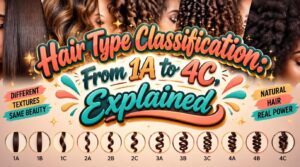
About 60% of people misidentify their curl pattern, often because they assess hair while it’s damp, styled, or weighed down by product. That single error sends them toward routines built for the wrong hair type, which explains a lot of persistent frizz, dryness, and disappointment.
Hair type classification gives you a consistent framework for reading your hair accurately. It covers curl pattern, strand diameter, porosity, and density, each telling a different part of the story. Knowing your exact type, from 1A to 4C, lets you match products and techniques to what your hair actually needs.
Table Of Contents
- Key Takeaways
- Hair Type Classification Systems
- Hair Types 1A Through 4C
- How to Classify Your Hair Type
- Texture, Porosity, and Density
- Hair Type Limitations and Changes
- Frequently Asked Questions (FAQs)
- How do I classify my hair type?
- What are the top 3 rarest hair types?
- Is my hair type 2A, 2B, or 2C?
- What are hair types 1, 2, 3, and 4?
- What is hair type?
- What is the condition of hair loss?
- How many types of hair types are there?
- What is a hair type chart?
- How are hair strands classified?
- What is a type 1 hair?
- Conclusion
Key Takeaways
- Most people misidentify their curl pattern because they assess hair when it’s damp or product-laden rather than fully air-dried and product-free.
- Curl pattern alone doesn’t tell the whole story — porosity, strand diameter, and density each reveal how your hair actually behaves and which products will work for it.
- Multiple classification systems exist for a reason: Andre Walker labels curl shape, L’Oréal’s Curl Meter scores curl behavior scientifically, and LOIS/FIA add porosity and geometry data for greater precision.
- Your hair type isn’t permanent — humidity, length, chemical treatments, and even the season can shift your apparent curl pattern without any change to your follicles.
Hair Type Classification Systems
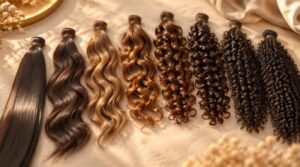
Several hair type classification systems exist, each developed with a different purpose and methodology. The one you’re most likely familiar with is the Andre Walker system, but it’s not the only framework worth knowing. Understanding how these systems differ helps you use them more accurately.
Pairing a classification system with hands-on technique makes a real difference, and professional hair styling tips for home use can help you apply what you learn about your hair type in practical, everyday ways.
Andre Walker System
The Andre Walker Hair Typing System divides hair into four categories: Type 1 Straight Hair Types, Type 2 Wavy, Type 3 Curly, and Type 4 Coily Hair Types. Each category splits into subtypes A through C based on the degree of curl tightness.
It’s strictly pattern-based, so it won’t tell you anything about your hair’s porosity, density, or strand thickness.
L’Oréal Curl Meter
Where the Andre Walker Hair Typing System gives you a pattern label, L’Oréal’s Curl Meter scores curl behavior across dimensions using high-magnification imaging of a small hair sample:
- Curl diameter and helix tightness
- Twist direction and clumping tendency
- Frizz indicators and strand direction consistency
A sample can yield scores that don’t match across scalp regions, giving you a detailed picture.
LOIS and FIA Systems
Two systems use measurement-based scoring. The LOIS system combines shaft structure, hair porosity, and hair density into a 0-100 index. The FIA system maps fiber angles into curl pattern bins.
Both systems gain extra precision when applied to highly coiled textures, where the physics behind 4C hair shrinkage can cause dramatic discrepancies between measured and actual strand length.
| Feature | LOIS | FIA |
|---|---|---|
| Output | 0-100 index | Geometry bins |
| Method | Shaft scoring | Fiber angles |
| Porosity | Tracked | Limited |
| Use | Formulation | Research |
Both convert results to consumer-friendly labels you can use across systems.
Hair Types 1A Through 4C
The Andre Walker system organizes hair into four main types, each split into A, B, and C subtypes based on curl intensity. Your pattern falls somewhere along that spectrum, from pin-straight to tightly coiled. Here’s what each type looks like and how to tell them apart.
Type 1 Straight Hair
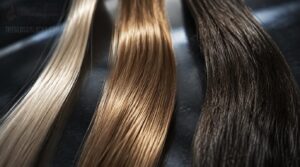
Type 1 registers a curl index of zero on the L’Oréal Curl Meter. The Andre Walker Hair Typing System splits Type 1 Straight Hair into 1A, 1B, and 1C.
If your roots lean straight while your ends wave slightly, understanding Type 2 wavy hair characteristics can help you identify where your texture actually falls on the spectrum.
1A is finest, with scales that lay completely flat. 1B holds more body. 1C is coarser and resists heat styling. Knowing your subtype means you’ll make smarter product choices every time.
For 1C hair especially, reaching for a quality heat protectant spray for coarse hair before styling can mean the difference between smooth results and unwanted damage.
Type 2 Wavy Hair

When your hair air-dries into a visible S-shaped wave pattern without forming spirals, you’re working with Type 2. Waves start at the crown and run uniformly down the shaft, with shrinkage between 25–50% of stretched length.
Since waves can vary across your scalp, understanding all three hair texture factors together helps you pinpoint exactly which Type 2 subcategory your strands fall into.
Low to medium porosity is common, though high porosity amplifies frizz noticeably. Medium texture and density are typical, but a fine-medium mix can occur.
Type 3 Curly Hair
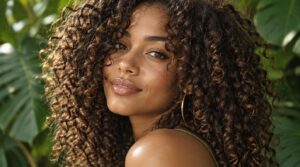
Recognize type 3 by its visible ringlets and spirals, which form consistent curl clumps along the strand. Observe your hair while damp, since dry shrinkage can obscure the pattern.
Your hair porosity and strand texture both influence how well ringlets hold shape, so build your hair care routine and product selection around moisture retention and curl definition.
Type 4 Coily Hair
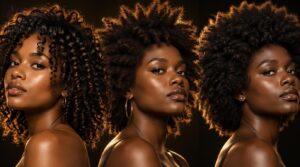
Densely packed coils that spring back almost immediately when stretched, shrinking to a fraction of their actual length. That’s what sets Type 4 coily hair apart.
Subtypes 4A, 4B, and 4C each differ by curl definition: 4A shows tighter S-curls, 4B has a zig-zag pattern with noticeably less definition, and 4C displays virtually no clearly visible curl pattern at all.
How to Classify Your Hair Type
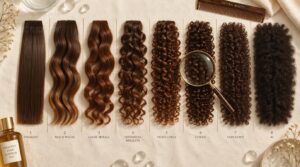
Studies show roughly 60% of people misidentify their curl pattern on the first attempt because they assess styled or damp hair rather than air-dried strands.
Start with a wash-and-air-dry cycle. Evaluate a consistent section, like the mid-crown, under natural light. Your hair texture classification depends on this baseline.
Check these markers before you classify:
- How strongly your strand bends or loops along its length
- Whether your coils form tight, dense rings or larger spirals
- How much shrinkage occurs from wet to dry
- Whether front and back sections share the same pattern
- How consistently your curl holds without product
Strand thickness and hair density levels affect how your pattern appears. Hair porosity types also shift perceived curl definition, so isolate single strands for accuracy.
For the most precise read on strand diameter, a hair strand thickness micrometer removes the guesswork that comes from comparing strands by eye alone.
Texture, Porosity, and Density
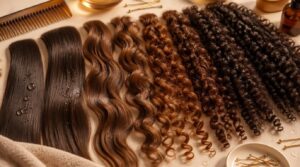
Curl pattern tells you the shape of your hair, but texture, porosity, and density determine how it actually behaves. These three factors guide which products and techniques will work for you. Each one measures something distinct, and understanding all three gives you a more complete picture of your hair’s needs.
Curl pattern shows shape, but texture, porosity, and density reveal how your hair truly behaves
Fine, Medium, Coarse Texture
Strand diameter is what hair texture actually measures, not your curl pattern.
| Texture | Diameter | Behavior |
|---|---|---|
| Fine | Narrowest | Lays flat |
| Medium | Intermediate | Moderate body |
| Coarse | Widest | Structurally rigid |
Thicker strands resist deformation, so coarse hair looks fuller and heavier. Fine strands separate easily and lie close to the scalp. Texture can also vary across different scalp regions on the same head.
For managing that structural rigidity, coarse hair smoothing treatments can soften strands without stripping the natural volume that makes coarse hair so distinctive.
Low, Medium, High Porosity
Porosity measures how easily your hair absorbs moisture. Low porosity hair has a tight cuticle, so water and products sit on the surface longer. High porosity hair absorbs quickly but also loses moisture fast. Medium porosity falls between the two. For low porosity hair specifically, lightweight low porosity hair moisturizers like aloe-based leave-ins work best, since heavier creams tend to build up without penetrating.
To run a quick hair porosity test, drop a clean strand in water and see whether it sinks or floats.
Low, Medium, High Density
Like porosity, hair density is a separate property. It measures strand count per scalp area, not how thick individual strands feel. Low density shows more scalp; high density shows less.
Part your hair to check. Type 4 Coily often appears fuller than its actual count because tight curls gather at the surface. Type 1 Straight reads more accurately because it lies flat.
Hair Type Limitations and Changes
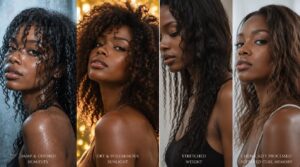
Even with texture, porosity, and density mapped out, your classification still isn’t fixed. Hair type limitations and changes are real, and knowing them stops you from chasing a category that was never stable.
Several factors shift your apparent curl pattern without any change to your follicles:
- Seasonal humidity makes wave and curl definition swell or deflate based on your porosity
- Length and weight straighten curls mechanically, so shorter hair can read as a looser type
- Chemical processing degrades elasticity, changing how tightly curls spring back
- Wet versus dry observation produces different results, since most systems classify dry-curl appearance
Treat your type as a working reference, not a fixed identity. It can shift with seasons, cuts, and chemical history.
Frequently Asked Questions (FAQs)
How do I classify my hair type?
To classify your hair type accurately, start on dry, product-free strands in consistent lighting. Observe your curl pattern at mid-lengths and ends, then assess strand thickness, porosity, and hair density using a hair type chart.
What are the top 3 rarest hair types?
Who actually tracks which curl patterns appear least often? No classification system, including the Andre Walker Hair Typing System, measures prevalence. Without frequency data, naming the top three rarest hair types remains speculation, not fact.
Is my hair type 2A, 2B, or 2C?
Your subtype comes down to curl definition when dry. 2A shows loose, flat S-waves with minimal bend. 2B has more visible bends and early curl formation. 2C produces tighter, consistently clumped curls along the fiber.
What are hair types 1, 2, 3, and 4?
Think of a straight line slowly spiraling into a tight coil. Hair types 1 through 4 map that exact progression: from flat and straight, through waves and loose ringlets, all the way to dense coils.
What is hair type?
Hair type describes the natural pattern your strands take when left to dry without any manipulation. It refers specifically to your curl, wave, or coil shape, and it’s entirely separate from texture, porosity, and density.
What is the condition of hair loss?
It’s not about your curl pattern. Hair loss conditions describe real changes in your scalp’s follicle density over time, triggered by hormonal shifts, sudden shedding events, or localized damage like scaly patches and painful bumps.
How many types of hair types are there?
It depends on the system. The Andre Walker method gives you 12 hair types on the standard hair type chart, spanning 1A through 4C. Add texture, porosity, and density, and combinations multiply well beyond that.
What is a hair type chart?
A hair type chart maps curl pattern and strand shape into labeled categories, guiding your product choices and styling methods.
How are hair strands classified?
Strands are classified by visible curl pattern, observed in dry hair, from straight (1) to coily (4). Secondary traits like porosity, texture, and density help improve the picture your follicle shape alone can’t fully provide.
What is a type 1 hair?
Think of a blank canvas: Type 1 hair is completely straight, forming no waves or curls from root to tip. Type 1A sits flat with minimal volume; Type 1B adds slight natural bend and body.
Conclusion
Studies show that hair porosity affects product absorption by up to 40 to 40%, yet most people skip evaluating it entirely. That gap is exactly where routines break down.
Hair type classification works best when you treat it as a full picture: curl pattern, porosity, density, and strand diameter together. No single factor tells the whole story. Map each one accurately, and you stop guessing. Your hair gives you the answers; you just need the right framework to read them.