This site is supported by our readers. We may earn a commission, at no cost to you, if you purchase through links. This content is for general informational and educational purposes only and is not a substitute for professional medical, dermatological, or nutritional advice.
Most people grab whatever conditioner sits on the drugstore shelf, assuming a chemist somewhere sorted out the hard part. That assumption holds up—until your hair tells you otherwise. Breakage, dullness, or a scalp that reacts to an ingredient you can’t pronounce start raising questions worth answering.
The homemade vs. store-bought hair moisturizer debate isn’t about declaring a universal winner; it’s about identifying the best choice for your hair. Commercial formulas deliver consistent performance and years-long shelf life, while DIY blends let you control every drop of what touches your strands. Understanding how these differences manifest in ingredients, cost, and real-world results empowers you to stop guessing and start choosing.
Table Of Contents
- Key Takeaways
- Homemade Vs Store-Bought Hair Moisturizer
- Ingredient Safety and Hair Health
- Cost, Convenience, and Shelf Life
- Performance for Different Hair Needs
- Best Choice for Your Routine
- Frequently Asked Questions (FAQs)
- What can I use as a substitute for hair moisturizer?
- Can DIY moisturizers replace protein treatments effectively?
- How does climate affect homemade moisturizer performance?
- Which option works better for childrens hair?
- Does water quality impact moisturizer absorption?
- Can homemade blends cause product buildup over time?
- Conclusion
Key Takeaways
- DIY moisturizers give you full ingredient control and cost as little as $0.20–$0.50 per use, but their 2–4 month shelf life and sterility risks make them a significant commitment to maintain safely.
- Commercial formulas win out on consistency and convenience — clinically tested, shelf-stable for up to two years, and ready to use without measuring anything.
- Curly and coily textures benefit from DIY shea-based blends, while fine, oily, or color-treated hair usually performs better with sulfate-free store-bought options.
- Ingredient percentages aren’t optional details — whether you’re mixing at home or reading a label, getting the humectant-to-emollient ratio wrong is the fastest way to end up with sticky, greasy, or ineffective hair.
Homemade Vs Store-Bought Hair Moisturizer
Choosing between homemade and store-bought hair moisturizer isn’t always straightforward — both have real trade-offs worth knowing. The right pick often comes down to your hair type, lifestyle, and what you’re actually trying to fix.
If you’re still unsure which direction fits your hair best, this organic hair moisturizer reviews and comparison guide breaks down real options side by side so you can make a more informed call.
Here’s a breakdown of the key differences to help you decide.
Key Differences Explained
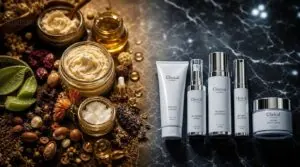
When you flip a bottle of store-bought conditioner and scan the ingredient list, you’re looking at years of formulation science — preservatives, pH adjusters, cationic surfactants. DIY hair conditioner skips all that for natural hair oils and butters you control entirely.
| Factor | Homemade | Store-Bought |
|---|---|---|
| Ingredient purity | You choose every component | Standardized blends |
| Texture control | Fully adjustable | Fixed formula |
| Shelf life | 2–4 months | 12–24 months |
| Carbon emissions | Lower sourcing footprint | Petrochemical-dependent production |
Best for Each Hair Type
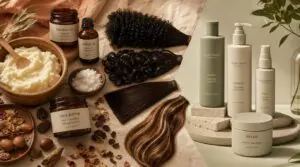
Hair type is the starting point for everything — porosity matching, texture-specific blends, and seasonal moisture needs shape what actually works.
| Hair Type | Best Option |
|---|---|
| Curly/Coily | DIY with karite butter |
| Fine/Oily | Retail market silicone-free formulas |
| Dry/Damaged | Natural oils for hair, length-based application |
| Color-treated | Store-bought sulfate-free for moisture retention |
Natural Versus Formulated Ingredients
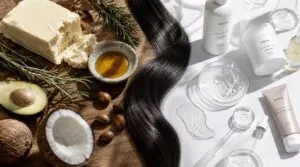
Once you know your hair type, the next question is what’s actually in your product. Natural ingredients — think raw oils and butters — vary in potency depending on harvest conditions. Formulated ingredients deliver ingredient consistency through controlled lab processes, meeting strict regulatory standards. Choosing natural sources also reduces hazardous solvent waste.
Understanding these differences helps in making informed choices. Here’s a quick breakdown:
| Factor | Natural vs. Formulated | |
|---|---|---|
| Active Potency | Variable vs. Consistent | |
| Eco Footprint | Lower chemical load | Higher stability |
| Stability Mechanics | Shorter shelf life | Longer-lasting |
| Ingredient List Scrutiny | Simpler, recognizable | Complex but tested |
| DIY Haircare Products | Flexible blending | Fixed commercial formulas |
Both the commercial hair care market and home recipes offer real moisturization techniques for hair — your call depends on priorities.
Short-term Versus Long-term Results
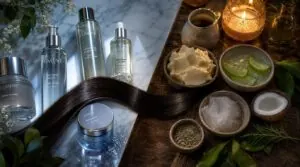
Ingredients shape results — but so does timing. Store-bought formulas deliver instant shine and cut detangling time by 20–40 seconds per pass.
But if you’re prioritizing long-term scalp health, organic hair treatment options can support your microbiome without sacrificing that same smooth, manageable finish.
Your homemade hair moisturizer builds slower wins: consistent moisture retention and breakage prevention emerge after 4–12 weeks. Think of it like skincare — daily scalp hydration stacks up quietly.
| Result Type | DIY vs. Store-Bought |
|---|---|
| Instant Shine | Commercial wins |
| Detangling Time | Commercial wins |
| Moisture Retention | DIY builds stronger |
| Breakage Prevention | DIY leads long-term |
Ingredient Safety and Hair Health
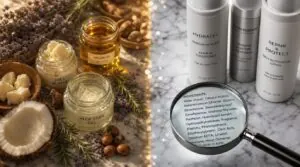
What’s actually in your hair moisturizer matters more than most people realize. Whether you’re mixing your own or grabbing something off the shelf, the ingredients tell the whole story — from how safe it is to how well it actually works.
Before committing to either option, understanding these components is essential. The choices you make directly impact both safety and effectiveness, making ingredient knowledge a critical first step.
Oils, Butters, and Humectants
The building blocks of any moisturizer come down to three categories, and understanding them changes everything: Sebum-Mimicking Oils (like jojoba) mirror your scalp’s natural output without clogging follicles, while coconut oil penetrates the cuticle directly. Barrier-Boosting Butters (e.g., shea butter) seal moisture in, and Plant-Derived Humectants (such as glycerin) pull water toward the strand.
Key ingredients and their functions include:
- Jojoba balances oily and dry scalps equally
- Shea butter reduces moisture loss through a protective layer
- Glycerin draws hydration from surrounding air
- Antioxidant Oil Preservation with vitamin E prevents rancidity
Texture-Balancing Ratios through smart oil blending with natural ingredients determine whether your final product feels rich or lightweight.
Preservatives and Shelf Stability
Without preservatives, your DIY formulation has roughly a 2–4 month window before microbial growth wins. That’s where preservative types matter: antioxidants handle oxidative damage, while antimicrobials tackle bacteria and mold.
Antimicrobial efficacy depends heavily on pH compatibility — most preservatives work best in acidic conditions around 3.5–5.5. Store-bought products achieve this through Stability Testing and regulatory compliance in cosmetics.
Your DIY formulation rarely achieves this.
Sulfates, Silicones, and Parabens
Three ingredients dominate label debates: sulfates, silicones, and parabens. Here’s what regulatory limits and the science actually say:
- Sodium lauryl sulfate strips natural lipids — sulfate-free formulas use milder surfactants instead of synthetic detergents
- Silicones offer shine but raise environmental persistence concerns in waterways
- Paraben concerns are real but overstated — concentrations stay within approved limits
- Ingredient transparency lets you choose silicone alternatives and paraben-free options confidently
Scalp Sensitivity Risks
Your scalp isn’t just skin — it’s a living ecosystem with its own microbiome balance that harsh ingredients can throw off fast. Before committing to any DIY hair treatment, patch testing on a small area catches irritant reactions early.
Uneven dilution and coverage, plus sterility and contamination issues from non-sterile tools, raise real DIY vs professional haircare concerns worth taking seriously.
Ingredient Percentages Matter
Think of ingredient percentages as the difference between medicine and poison — the dose is everything. In DIY haircare routines, your homemade hair mask might use glycerin, but humectant ratio balance matters: too much causes stickiness, too little does nothing.
In DIY haircare, ingredient percentages are everything — the wrong dose turns medicine into poison
Preservative safety thresholds sit between 0.5–2%, and emollient dosing precision prevents greasy buildup. These specific measurements ensure formulations remain stable and functional without adverse effects.
Active concentration impact and viscosity percentage control are what separate effective formulation percentages from guesswork. Precision in these areas transforms experimental mixtures into reliable, purposeful products.
Cost, Convenience, and Shelf Life
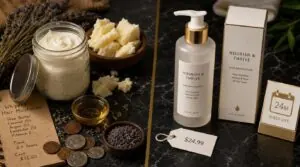
Ingredients are only part of the equation — what you spend, how much time you have, and how long your product actually lasts matter just as much.
Whether you’re blending at home or grabbing something off a shelf, each choice carries real trade-offs in your wallet and your weekly routine. Here’s a closer look at what those differences mean in practice.
DIY Per-use Costs
A single batch—say, 6 ounces of oils and butter—can stretch across 60 or more applications, which is where batch size economics really shifts the numbers in your favor.
Your per-use cost often lands between $0.20 and $0.50, especially when you factor in reusable container savings over time.
Essential oil markup can nudge that figure slightly higher, but ingredient price scaling keeps overall costs manageable.
Store-bought Price Ranges
Store-bought pricing follows a predictable brand tier pricing ladder worth knowing before you spend:
- Drugstore basics: $5–$12 for 8 ounces
- Mid-range or organic labels: $12–$22
- Salon-grade formulas: $15–$30+
Size discounts and promotion frequency can drop prices 20–50%, improving your cost-benefit analysis of hair products considerably.
Retail channel impact matters too — online shipping often adds $2–$6, quietly erasing any deal you thought you found.
Prep Time Versus Ready-made
Beyond pricing, your time has real value too. DIY products usually take 5–20 minutes per batch — measuring, melting, mixing — plus planning frequency for restocking. That’s actual effort.
Ready-made moisturizers require nothing beyond opening the container. This time gap is significant if efficiency matters to you.
If time-efficient hair routines are a priority, honestly factor this into your cost-benefit analysis of homemade treatments.
Refrigeration and Expiration Dates
Time isn’t the only variable here — shelf life is. Homemade hair treatments skip preservatives, so product stability drops fast. Most DIY blends last 2–4 months; many require refrigeration to maintain haircare ingredient safety.
Commercial moisturizers, by contrast, carry label date guidance of 12–24 months. Cold chain integrity is crucial with DIY — storage temperature has a real impact, and ignoring it creates genuine DIY hair treatment risks.
Travel and Daily Practicality
Daily life doesn’t pause for your hair routine — and neither should you. Store-bought moisturizers win here, hands down. Travel-size packaging with leak-proof caps and TSA-approved containers makes them genuinely grab-and-go. Quick rehydration formulas absorb fast, fitting neatly into time-efficient hair routines without sacrificing results.
- Portable application tools like lotion sticks prevent mid-flight mess
- Budget hair care options under $5 cover multiple trips
- Reapply every 4 hours on long flights to counter dry cabin air
Performance for Different Hair Needs
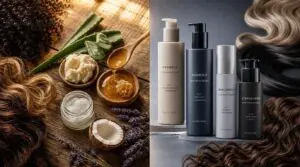
Not every moisturizer works the same way for every head of hair — and that gap matters more than most people realize. Your hair type, texture, and condition all shape how well a formula actually performs.
How homemade and store-bought options stack up across the most common hair needs.
Dry or Damaged Hair
Dry or damaged hair is fundamentally a compromised structure — microfissures in the cuticle let moisture escape faster than it can be replaced. Cuticle repair and moisture retention must work together to manage dry hair effectively.
For treatment, homemade options like castor oil masks support breakage prevention, but if hair lacks protein balance, store-bought formulas with panthenol offer more reliable product efficacy for scalp hydration. The priority is addressing both structural damage and hydration simultaneously.
Curly and Coily Textures
Curly and coily textures demand a different playbook. Pattern shrinkage alone — up to 75% for tight coils — signals how much moisture work your hair is doing. High hair porosity means water rushes in but escapes just as fast, so your sealant strategy matters: layer homemade hair treatments like shea butter over water-based leave-ins.
For detangling methods, fingers beat combs. Adjust humectant levels seasonally for real humidity adaptation and frizz control.
Fine or Oily Hair
Fine and oily hair is fundamentally a balancing act — you need to moisturize your hair without smothering it. Lightweight emulsions beat heavy emollients here every time. Think sebum management over deep saturation: a diluted glycerin spray or aloe-based leave-in works as a practical, low-cost hair treatment.
Scalp exfoliation keeps follicles clear, while dry shampoo tips extend freshness. These practices maintain scalp health without compromising hair porosity resilience.
Volume boosters like rice water serve as smart conditioner alternatives, avoiding the risk of tanking hair porosity resilience.
Color-treated Hair Concerns
Color-treated hair is essentially high-porosity hair waiting to happen. Chemical processing lifts cuticles, accelerating fade and increasing breakage risk. That’s why sulfate-free, paraben-free formulas aren’t just marketing—they’re practical porosity control.
For UV shielding and fade prevention, prioritize antioxidant-rich oils with deep oil penetration, such as argan. These ingredients fortify hair against environmental damage while locking in moisture.
Toner refresh treatments and breakage prevention serums complete dry hair management. Use these to moisturize your hair between salon visits, maintaining vibrancy and strength.
Frizz Control and Shine
Frizz is fundamentally a cuticle problem — when the surface layer lifts, moisture escapes and light scatters instead of reflecting. Here’s what actually controls it:
- Cuticle Smoothing using light-reflective polymers in commercial formulas creates a gloss-boosting seal instantly.
- Humectant Balance prevents over-absorption in humidity, keeping strands smooth rather than puffy.
- Oil Sealant application — castor oil especially — locks the cuticle after effective natural hair masks.
- Heat Styling Guard products preserve cuticle integrity post-blow-dry, maintaining shine.
- Oil Penetration from natural hair care ingredients helps you moisturize your hair from within, not just coat it.
Best Choice for Your Routine
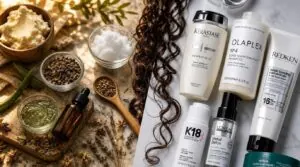
The right moisturizer isn’t about picking a side — it’s about knowing what actually fits your life. Your hair type, schedule, and budget all play a role in that decision.
Here’s how to figure out which approach works for you.
When Homemade Works Best
Homemade moisturizers genuinely shine when your hair needs something specific — fast. Rapid Customization is the real advantage here: you control every ingredient, adjust ratios batch by batch, and build a natural haircare routine around your scalp’s actual needs.
| Scenario | Why Homemade Wins |
|---|---|
| Sensitive scalp | Fragrance-Free Formulas eliminate common irritants |
| Dry, coarse texture | Heat-Stable Blends with shea and castor oil deliver targeted moisture |
Small-Batch Freshness ensures your ingredients stay potent, while Local Ingredient Access keeps things practical. When ingredient synergy matters — combining oils, humectants, and natural ingredients for effective hair masks — you are simply the best formulator for your own hair.
When Store-bought is Better
Store-bought wins when consistency matters most. Clinically tested formulas offer regulatory compliance and scientifically formulated blends with specialized additives—like behentrimonium chloride for slip—that deliver reliable product performance every time.
Consistent viscosity, packaging protection, and ingredient efficacy backed by consumer trust in brands simplify the cost-benefit analysis. When dependable results are needed without measuring anything, reach for the bottle.
Best Moisturizer Substitutes
Not ready to commit to either side? Your pantry may already have what you need.
Coconut oil and shea butter seal in moisture fast, while argan oil and almond oil absorb without heaviness.
Add glycerin humectant to draw in hydration, or layer mango butter over castor oil for dry ends.
Rose hip oil works beautifully as a lightweight hair conditioner finisher.
Simple Routine Pairing Tips
Once you’ve found your go-to ingredients, pairing them smartly makes all the difference. Try leave-in layering — a lightweight leave-in conditioner followed by a silicone-free seal to lock hydration without buildup.
Add a midweek boost for dry spells, and alternate overnight heavy hair mask treatments with daytime light creams.
Seasonal adjustments keep your scalp health and hair care routine consistent year-round.
As temperatures shift throughout the year, it helps to know that whether hair gel actually causes hair loss is largely a myth, since it only sits on the hair’s surface without harming your follicles.
Final Buying Checklist
Before you buy — or blend — run through this quick checklist to avoid regret.
- Set Budget Limits first; know your ceiling before comparing options
- Do a Feature Alignment check: does this match your actual hair goals?
- Confirm Compatibility — sulfate-free, paraben-free, and right for your texture
- Always review the Return Policy and scan ingredient lists for full ingredient transparency
That cost-benefit analysis takes five minutes and saves months of frustration.
Frequently Asked Questions (FAQs)
What can I use as a substitute for hair moisturizer?
Think of your pantry as a backup beauty supply store. Lightweight humectant options like aloe vera gel or honey can moisturize your hair effectively.
Castor oil and almond oil work as rich oil-blend substitutes.
Can DIY moisturizers replace protein treatments effectively?
DIY moisturizers can’t replace protein treatments. They improve softness and moisture, but they don’t restore structural strength.
If your hair breaks easily, you need actual protein — moisture alone won’t fix that.
How does climate affect homemade moisturizer performance?
Climate quietly sabotages your homemade blend before it touches your hair.
Humidity influences, temperature stability, UV exposure, and airflow evaporation all shift how natural ingredients perform, affecting scalp nourishment and overall moisturization techniques for hair.
Which option works better for childrens hair?
For kids’ hair, store-bought wins on safety and consistency. These products offer paraben-free, sulfate-free formulas with clear labels, which reduce allergen potential and simplify parental decisions.
By eliminating guesswork in homemade mixing, they deliver reliable texture suitability without compromising on safety.
Does water quality impact moisturizer absorption?
Yes, it does. Hard water deposits, chlorine damage, and water pH impact how well any moisturizer absorbs — leaving even the best natural hair product performing below expectations on your strands.
Can homemade blends cause product buildup over time?
Absolutely — heavy oil film, polymer buildup, mineral scaling, and silicone residue can all quietly accumulate.
Without proper preservation, spoilage speeds up residue layering, quietly compromising hair health and natural haircare ingredients’ effectiveness over time.
Conclusion
Your hair is the final judge in the homemade vs. store-bought hair moisturizer debate—and it doesn’t lie. If breakage persists or your scalp reacts, your formula isn’t working, regardless of the label.
DIY gives you control; commercial products give you consistency and safety margins that kitchen blending can’t replicate. Neither wins universally.
What wins is paying attention—to ingredients, to your hair’s response, and to what your specific routine actually demands.