
This site is supported by our readers. We may earn a commission, at no cost to you, if you purchase through links.
Most people pull off their henna too early and wonder why the color looks lackluster. The sweet spot isn’t a mystery—it’s a science based on your hair’s porosity, your natural base color, and how deep you want that coppery glow to go.
Leave henna on for two hours and you’ll get a whisper of warmth; push it to six and you’ll achieve the richest red-orange tones the plant can deliver. Beyond six hours, you’re gambling with dryness for zero color payoff.
Timing henna isn’t guesswork—it’s about reading your hair’s signals and adjusting your window accordingly.
Table Of Contents
- Key Takeaways
- How Long Should You Leave Henna on Hair?
- Factors Influencing Henna Processing Time
- What Happens if You Leave Henna on Longer?
- Preparing Hair for Henna Application
- How to Mix and Apply Henna Paste
- Setting and Covering Hair During Processing
- Rinsing and Aftercare Following Henna
- How Often Should You Reapply Henna?
- Tips to Maximize Henna Color and Longevity
- Frequently Asked Questions (FAQs)
- Does henna work on all hair types and textures?
- Can I use henna if I am pregnant or breastfeeding?
- What are some good brands or recipes for henna hair dye?
- What can I do if I don’t like the color after applying henna to my hair?
- Can henna cover gray hair completely?
- Does henna work on bleached or highlighted hair?
- Will henna damage chemically treated or permed hair?
- Can you mix henna with other natural dyes?
- Is henna safe during pregnancy or breastfeeding?
- Conclusion
Key Takeaways
- Henna processing time ranges from 2 to 6 hours depending on your desired color intensity—2 hours yields subtle warmth, while 6 hours delivers maximum red-orange saturation without risking dryness.
- Your hair’s porosity directly controls dye uptake speed, with high-porosity hair absorbing color rapidly but fading unevenly, while low-porosity strands require extended processing times due to tightly sealed cuticles blocking penetration.
- Extending henna beyond 6 hours strips moisture from your hair shaft and increases stubborn scalp staining without adding any color benefit, making proper timing essential for both results and hair health.
- Post-application care determines color longevity—wait 24 to 48 hours before shampooing to allow dye fixation, then use sulfate-free products and minimize heat styling to preserve vibrancy for 4 to 6 weeks between applications.
How Long Should You Leave Henna on Hair?
You don’t need guesswork regarding timing your henna application. The sweet spot depends on what shade you’re after and how your hair reacts to natural dye.
Here’s what you need to know about processing times to get the color right without overdoing it.
Standard Processing Times (2–6 Hours)
Most henna formulations recommend a processing window of 2 to 6 hours to balance color depth with hair health. Your ideal timing depends on porosity and the shade you’re chasing:
- 2–3 hours yields subtle reddish-brown tones on medium-porosity hair
- 4–5 hours delivers richer copper hues on darker bases
- 6 hours maximizes dye uptake for deepest red-orange shades
- Strand tests confirm dye release within your target window
- Exceeding 6 hours risks dryness without added color benefit
Adjusting Time for Desired Color Intensity
Dialing in your ideal shade means matching processing time to dye uptake goals. For lighter copper-to-brown tones, cut your window to 2 hours—just enough for color deposit without overwhelming porous strands.
Medium intensity hits at 3–4 hours, balancing richness with predictability.
Deep, vibrant results demand 5–6 hours, though your hair porosity effects and base color will shape final shade customization every time.
Minimum and Maximum Safe Durations
No matter your color depth goals, safe limits hold firm: never drop below 2 hours or you’ll sacrifice dye uptake, and never exceed 6 hours unless you want brittle, parched strands.
Keep henna on hair between 2 and 6 hours—any less wastes the dye, any more dries out your strands
That 2–6 hour window gives your hair porosity enough processing time for proper henna application without risking scalp staining or overdrying—critical benchmarks in henna hair dyeing and effective hair coloring methods.
Factors Influencing Henna Processing Time
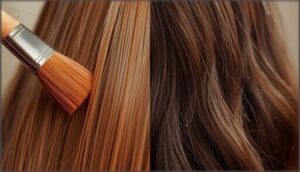
Henna doesn’t follow a one-size-fits-all timeline. Your hair’s unique characteristics and the specific conditions you create during application directly affect how long the dye needs to sit.
Understanding these variables puts you in control of your results.
Different dyes fade at different rates, so choosing a long-lasting hair color from the start can save you time and maintenance down the road.
Hair Type and Porosity
Your hair’s internal structure dictates how quickly and evenly henna takes hold. Understanding your porosity levels and hair texture enables you to customize processing time with precision:
If your strands are already compromised, learning how to fix burnt hair from a curling iron becomes essential before applying henna to avoid further stress.
- High porosity accepts dye rapidly but may fade unevenly, requiring vigilant moisture absorption management
- Medium porosity delivers predictable color retention and balanced dye uptake across the entire shaft
- Low porosity demands extended processing due to tightly sealed cuticle health blocking penetration
Natural Hair Color and Condition
Your starting color sets the foundation for how henna transforms your hair. Lighter natural tones yield vibrant copper or auburn results, while darker hair develops subtle reddish highlights rather than dramatic shifts.
To keep those henna tones vibrant longer, consider switching to an organic shampoo and conditioner set that won’t strip the color.
Grey hair accepts pigment aggressively, often creating brighter, more saturated shade variance.
If you’re concerned about chemical exposure, DIY hair treatments for damage can help maintain vibrancy while keeping grey strands healthy and conditioned.
Previously damaged strands absorb unevenly, producing patchy color depth that demands extended processing and strategic hair texture assessment.
Targeting these trouble spots with proven strategies for extending demi-permanent color helps you balance porosity issues while maximizing shade retention between salon visits.
Henna Quality and Freshness
Powder quality governs how intensely your henna hair dye stains and how long you’ll wait for results. Fresh henna sourced from reputable suppliers produces richer, faster color—finely ground powder releases dye more efficiently than coarse, aged stock.
- Store sealed containers in cool, dry spaces to preserve freshness for 6–12 months
- Test dye release by mixing a small batch before full henna application
- Verify batch numbers and expiration dates for consistent quality control
- Choose organic or certified products for predictable natural hair dye outcomes
- Avoid moisture-exposed powder that clumps and weakens staining power
Freshness testing prevents patchy disappointment and wasted processing hours.
Mixing Ingredients and Additives
Your choice of mixing liquids and additives dramatically alters how quickly henna paste releases dye and how long you’ll process. Lemon juice accelerates dye release with citric acid, shortening processing time by 30–60 minutes compared to plain water. Essential oils mask earthy scent, while salt additives intensify color depth—each adjustment reshapes your henna application timeline and final natural hair dye outcome.
| Additive | Primary Function | Impact on Processing Time |
|---|---|---|
| Lemon Juice | Accelerates dye release through acid content | Reduces time by 30–60 minutes |
| Essential Oils | Masks scent, adds antimicrobial properties | Minimal time impact, enhances experience |
| Salt | Enhances color development and vibrancy | May extend time by 15–30 minutes |
| Warm Water | Hydrates powder for standard dye release | Baseline processing (2–6 hours) |
Understanding these henna hair benefits helps you customize your henna hair dye for predictable, controlled results.
Environmental Temperature and Heat
Temperature control functions as your invisible timer—warmth accelerates dye release, while cold stalls it entirely. Manage ambient effects and thermal processing to lock in predictable henna application outcomes.
- Moderate ambient heat (75–85°F) speeds dye release, cutting processing time by 30–45 minutes
- Warm towel wraps intensify color development during heat application without overprocessing
- Cold environments extend required henna hair dye contact beyond standard ranges
- Excessive heat dries paste, creating uneven natural hair care results
- Consistent temperature ensures uniform hair color techniques performance throughout your session
What Happens if You Leave Henna on Longer?
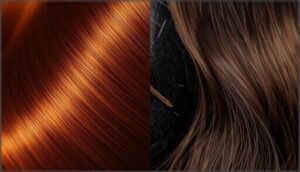
You might be tempted to leave henna on longer than recommended, thinking more time equals better color. While extended processing can deepen the shade, it also introduces risks you need to understand before pushing past that six-hour mark.
Here’s what actually happens when henna sits on your hair for too long.
Effects on Color Depth and Shade
Extended processing time deepens henna’s red-orange tones, shifting your hair color toward richer brick-red hues. Lighter bases—think blonde or light brown—show more dramatic color variation and tone enhancement, while darker hair reveals subtler shade shifts.
Dye penetration increases with time, intensifying natural hair coloring, but color stability depends on even paste coverage. Gray strands brighten vividly since there’s no melanin buffering pigment uptake during longer processing time.
Risk of Hair Dryness or Scalp Staining
Leaving henna on too long strips moisture from your hair shaft, especially if you have high hair porosity. Your strands lose natural oils, leaving them brittle. Premium henna quality matters; lower-grade blends intensify dryness.
Scalp staining becomes more stubborn with extended processing, as dye penetrates deeper into the skin. Apply a protective barrier cream along your hairline for effective scalp protection, and prioritize moisture balance with immediate conditioning to support natural hair coloring and scalp care.
Managing Overprocessing
If you’ve overprocessed, assess your hair porosity first—highly porous strands show color damage and hair breakage faster. Stop reapplications immediately to prevent henna buildup and scalp irritation.
Deep-condition weekly using protein-free formulas to combat overprocessing risks. Trim brittle ends to remove irreversible damage.
Remember, organic hair dye like henna requires precise dye uptake and processing windows; respecting those limits protects your hair coloring results long-term.
Preparing Hair for Henna Application
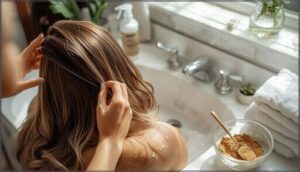
Proper preparation sets the foundation for even color and lasting results with henna. You’ll need to address a few key steps before you ever mix your paste.
Following these practices ensures the dye bonds effectively and minimizes unwanted surprises.
Cleaning and Drying Hair
Before you coat your strands in henna, proper hair preparation and scalp cleansing set the stage for vibrant color uptake. Wash thoroughly with a sulfate-free shampoo, stripping away all styling products and oils—this maximizes paste adhesion and dye release. Dry completely, leaving hair just barely damp to secure saturation. Skip conditioner entirely; it creates a barrier that blocks henna’s natural hair treatment benefits.
- Wash hair with gentle, sulfate-free shampoo to remove buildup
- Verify scalp is completely free of oils and styling residue
- Towel-dry or air-dry until hair feels only lightly damp
- Avoid using conditioner before henna application to prevent blocking dye release
Performing a Patch Test
Twenty-four to forty-eight hours before the full henna application process, you need to test for skin sensitivity and allergy detection. Mix a small amount of henna paste, apply it to your inner forearm or behind your ear, then wait.
Watch for redness, itching, swelling, or blistering—all signals of potential dye allergens or reaction times worth documenting. This strand test guards your henna safety before committing your entire head to hair color transformation.
Sectioning Hair for Even Coverage
Once you’ve cleared your patch test, proper hair partitioning transforms your henna application process. Divide your hair into at least four vertical sections using clip techniques to guarantee even coverage across every strand.
- Start with a middle-first partition to catch crown and nape areas
- Secure each section with sturdy clips during sectional application
- Work methodically through one section before moving forward
- Apply henna paste generously from root to tip
- Maintain consistent pressure for uniform natural hair dyeing results
This systematic approach prevents missed spots and reduces your overall processing time.
How to Mix and Apply Henna Paste
Mixing henna paste correctly determines how well the dye releases and how evenly it coats your hair. Your choice of liquid, the texture you create, and the tools you use all shape your final results.
Let’s break down each step so you can apply henna with confidence and precision.
Choosing Mixing Liquids (Water, Lemon Juice)
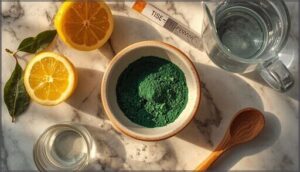
Your choice of liquid dictates how quickly henna releases its natural dye. Water alone works, but acidic additives like lemon juice lower liquid pH levels, accelerating dye release rates and boosting color intensity. Warm water enhances uptake better than cold.
Experiment with mixing ratios—too much acid can dry hair, while teas add subtle tonal shifts. This balance shapes paste consistency and your final herbal hair coloration outcome.
Paste Consistency and Dye Release Time
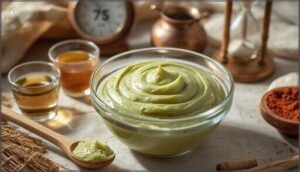
For ideal herbal hair coloration, your henna paste should resemble thick yogurt—spreadable but not runny. Henna quality and paste thickness directly affect organic dye activation timing and final hair color depth.
Dye release factors include temperature control and mixing ratios; natural henna activates in 4–6 hours at room temperature. Adding acidic liquids extends processing by 1–2 hours, while warmth (75–85°F) speeds release.
Application Tools and Protective Measures
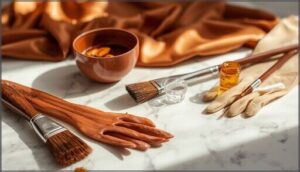
Before you crack open that henna paste, gather your protective arsenal to prevent staining disasters. Non-Metal Utensils and a Nonmetallic Bowl avoid iron contamination, while Protective Gloves shield your hands during mixing and application. Consider these essentials:
- Apply Barrier Creams or petroleum jelly along your hairline to block skin staining
- Drape Cape Protection over shoulders to safeguard clothing from permanent marks
- Use an Applicator Brush or Tinting Brush for precise, even distribution from roots to ends
These Henna Brushes guarantee professional results without the mess.
Setting and Covering Hair During Processing

Once you’ve applied henna paste to your hair, proper covering becomes your next critical step. The right enclosure method locks in moisture and heat, which directly impacts how well the dye penetrates your hair shaft.
Here’s how to secure your henna application for ideal color development and minimal mess.
Using Plastic Wrap or Shower Cap
Once you’ve applied your henna hair dye, covering hair determines how well the color develops. Plastic wrap offers excellent heat retention and molds around sectioned strands for uniform coverage, while a shower cap provides reusable comfort and protects clothing from staining.
Both methods support effective hair care and maintenance during processing, but removal methods differ—plastic wrap peels away with paste, caps require separate rinsing.
Retaining Moisture and Heat
Henna paste thrives in warm, humid conditions—moisture retention and heat application accelerate dye release while supporting even color absorption. Pre-warmed caps or gentle thermal wraps maintain processing humidity without overwhelming your strands.
- Apply a warm towel over your plastic wrap for consistent heat
- Keep ambient temperature moderate to prevent paste dehydration
- Monitor cap usage duration to avoid excessive dryness
- Balance humidity control with breathable coverage for ideal hair nourishment and conditioning
Preventing Drips and Stains
Protecting your workspace starts before the first drop hits. Apply a thin layer of petroleum jelly along your hairline and ears—this blocks dye transfer to skin. Wear protective gloves throughout every step of applying henna hair dye.
Drape an old towel around your shoulders for drip control. Wrap hair with plastic within ten minutes to contain staining.
Prompt cleanup with mineral oil prevents pigment set.
Rinsing and Aftercare Following Henna
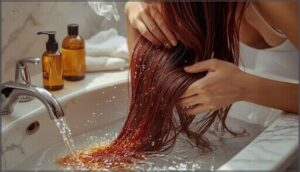
Once your henna has processed, the work isn’t finished—how you rinse and care for your hair determines whether your color sets properly or fades prematurely.
The next 48 hours are critical for locking in vibrancy and preventing dryness. Here’s what you need to do immediately after removing the henna paste.
Thorough Rinsing Techniques
After the recommended processing time, removing all henna residue without damaging your hair cuticle requires patience. Follow these steps to restore shine and seal in your herbal hair treatment:
- Start with lukewarm rinse water temperature; massage gently to lift particles without breaking strands.
- Continue rinsing until water runs completely clear, ensuring thorough residue removal.
- Finish with cool water rinsing to promote cuticle closure.
- Apply sulfate-free conditioner to seal and protect your organic hair care investment.
Avoiding Shampoo Immediately After
Once you’ve rinsed clear, don’t reach for shampoo just yet. Waiting 24 to 48 hours allows dye fixation and color retention to stabilize as henna molecules bind to your hair’s keratin surface. This shampoo delay prevents mechanical friction from abrading pigment before cuticle closure completes. Your aftercare discipline directly impacts vibrancy—gentle cleansing later protects your investment in natural hair color.
| Wait Period | Benefit |
|---|---|
| 24 hours | Basic dye fixation and initial color retention |
| 48 hours | Enhanced pigment binding and reduced fade risk |
| 72 hours | Maximum saturation for high hair porosity types |
Conditioning and Restoring Moisture
After that shampoo delay, your strands need intentional nourishment. Henna alters hair porosity, demanding deep conditioning with protein-free formulas to restore moisture balance.
Follow this routine:
- Apply a humectant care leave-in treatment (glycerin-based) to damp hair
- Use organic hair care masks weekly for sustained hair conditioning
- Rinse with cool water to seal cuticles and lock in hair nourishment
How Often Should You Reapply Henna?

Henna’s color usually lasts four to six weeks on your hair shaft before it starts to fade. How often you reapply depends on your washing routine, hair growth rate, and the vibrancy you want to maintain.
Here’s what you need to know about timing your next application.
Recommended Reapplication Intervals
Most people reapply henna every four to six weeks to combat color fade rates and address root regrowth. Your hair porosity affects henna longevity—porous strands show washout faster, shortening reapplication schedules.
If you’re using organic hair dyeing for hair nourishment, monitor how quickly your henna hair dye fades. Adjust your hair care routine and reapply earlier if swimming or sun exposure accelerates fading.
Maintaining Color Vibrancy
Vibrancy tips start with smart product choices and protective habits. Color preservation demands your attention to washing routines, heat exposure, and UV damage. Henna maintenance revolves around these organic hair dyeing strategies:
- Switch to sulfate-free shampoos that protect your hair color from premature natural fading.
- Wash with lukewarm water instead of hot to minimize pigment loss.
- Apply moisture-rich masks regularly for color enhancement and hair care.
- Shield your henna from UV rays using hats or protective sprays.
Considerations for Root Touch-Ups
Root growth rates dictate your touch-up scheduling—most people need henna hair dye every 4–6 weeks to maintain gray hair coverage and root color matching. Shorter processing on roots prevents overreach onto previously treated lengths, preserving your overall henna hair care tips routine.
Fresh roots require 2–4 hours for gray coverage tips that blend seamlessly. Track hair growth cycles and apply color fade prevention strategies between sessions.
Tips to Maximize Henna Color and Longevity
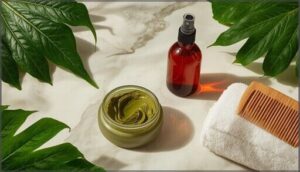
You’ve invested hours in your henna application, but the real work starts after you rinse. Your daily hair care routine determines whether that rich color fades in weeks or lasts for months.
These three strategies will help you lock in your henna’s vibrancy and extend the life of your color.
Using Sulfate-Free Hair Products
Conventional shampoos strip your hard-won henna vibrancy with harsh sulfates like sodium lauryl sulfate. Sulfate-free benefits include gentle cleansing that preserves scalp lipids and hair moisture—key to color preservation. Studies confirm product compatibility with organic hair products extends dye longevity.
Follow these chemical-free hair care tips:
- Choose sulfate-free shampoo formulations without ammonium lauryl sulfate.
- Expect reduced foaming but enhanced strand protection.
- Wash less frequently; users report longer intervals between cleansing.
- Verify compatibility with henna to minimize alkaline fade.
Minimizing Heat Styling
Heat Damage Prevention starts with your daily choices. Thermal tools—flat irons, curling wands, blow-dryers—accelerate cuticle damage and strip henna pigment faster than washing alone.
Color Preservation Techniques demand Low Temperature Tips: air-dry whenever possible, use heat protectants sparingly, and limit styling to 300°F maximum.
| Heat Source | Risk to Henna Color | Scalp Protection Methods |
|---|---|---|
| Flat Iron (450°F) | Severe fade, protein damage | Avoid or reduce to 300°F |
| Blow-Dryer (High) | Moisture loss, cuticle lift | Cool setting, 6-inch distance |
| Curling Wand | Uneven color oxidation | Heat protectant serum required |
| Sun Exposure | UV-triggered pigment breakdown | Wear hat, UV-blocking spray |
Embrace air-drying and protective styles—your Chemical-Free Hair Care routine depends on it.
Gentle Hair Care Practices
Your Ayurvedic Hair Care routine protects henna investment. Natural Shampoo—sulfate-free formulas—prevents moisture stripping, while Scalp Massage stimulates circulation without disrupting pigment bonds.
Deep Hair Masking weekly restores elasticity after Herbal Hair Color processing. Gentle Combing with wide-tooth tools reduces breakage, and Hair Oil Benefits include cuticle sealing and color retention.
This Chemical-Free Hair Care approach extends vibrancy by minimizing mechanical and chemical stress on your dyed strands.
Frequently Asked Questions (FAQs)
Does henna work on all hair types and textures?
Henna is compatible with all hair textures, from straight to coily, as it binds to keratin in every hair type.
However, porosity factors and color deposit vary—high-porosity hair absorbs natural dye effects faster than low-porosity strands.
Can I use henna if I am pregnant or breastfeeding?
Most health experts recommend consulting your healthcare provider before using henna during pregnancy or breastfeeding. Pure, body-art quality henna is generally safe, but contaminated products with chemical additives may pose prenatal risks.
When evaluating the safety of henna products, consider the importance of methodological rigor in scientific studies.
What are some good brands or recipes for henna hair dye?
Ironically, most “henna” hair dyes contain little pure Lawsonia inermis. Trusted natural brands include The Henna Guys, Henna Sooq, and Godrej Nupur.
DIY herbal blends combine pure henna powder with lemon juice, coffee, or indigo for color variations and ayurvedic hair care benefits.
What can I do if I don’t like the color after applying henna to my hair?
If your henna hair dye result disappoints, start with clarifying shampoo to gently fade intensity.
For uneven tone adjustment or color correction, try color-depositing conditioners, or consult professionals for safe henna removal and damage repair options.
Can henna cover gray hair completely?
You’d expect full coverage from a natural dye, but henna won’t deliver that across every gray strand. Melanin-free hair lifts color unevenly, often requiring multiple applications for uniform gray hair coverage and improved henna color depth.
Does henna work on bleached or highlighted hair?
Chemically lightened strands absorb henna unevenly, often yielding orange or copper tones due to Porosity Issues and color correction challenges.
A strand test reveals how Plant-Based Dye interacts with Bleach Damage Repair needs before full application.
Will henna damage chemically treated or permed hair?
You won’t damage permed or chemically treated hair with henna alone, but high porosity from prior treatments can cause uneven color uptake, faster fading, or extra dryness without proper conditioning.
Can you mix henna with other natural dyes?
Yes, you can combine henna with indigo for darker tones, cassia for lighter copper results, or amla for cooler browns. These herbal mixtures expand your natural hair coloring palette through thoughtful dye combinations.
Is henna safe during pregnancy or breastfeeding?
Pure henna without additives is generally safe during pregnancy and breastfeeding, though evidence is limited. Avoid products with PPD or synthetic dyes, patch test first, and consult your healthcare provider before use.
When exploring the effects of henna, consider checking language related resources for more information.
Conclusion
Like any craft that demands patience, henna rewards those who respect the clock. Knowing how long to leave the henna on hair transforms guesswork into mastery—two hours delivers subtle warmth, six hours unlocks full saturation.
Your hair’s porosity and base tone dictate the window, but the principle stays constant: honor the process, protect your strands, and you’ll earn color that deepens with every wash instead of fading into regret.
- https://www.ncbi.nlm.nih.gov/pmc/articles/PMC4471652/
- https://www.sciencedirect.com/science/article/pii/S1319610311002687
- https://blog.welikemakingourownstuff.com/2012/12/homemade-hairdye-my-first-experience.html
- https://www.youtube.com/watch?v=-_ErRO6u0U8
- https://x.com/godofprompt/status/1990526288063324577