This site is supported by our readers. We may earn a commission, at no cost to you, if you purchase through links. This content is for general informational and educational purposes only and is not a substitute for professional medical, dermatological, or nutritional advice.

Most people who start using Rogaine make the same critical error: they treat their hairline like the crown of their head, applying minoxidil with broad, sweeping motions that miss the delicate recession zones where thinning actually begins.
The hairline demands precision; those temple corners and frontal edges require targeted application directly onto exposed scalp, not just a casual spray-and-go approach that leaves medication sitting uselessly on hair strands.
Understanding how to apply Rogaine to the hairline correctly means learning to part systematically, measure precisely, and massage the formula into the exact areas experiencing miniaturization—a technique that separates those who see genuine regrowth from those who wonder why their expensive treatment isn’t working after months of daily use.
Table Of Contents
- Key Takeaways
- How to Apply Rogaine to The Hairline
- Best Practices for Daily Rogaine Application
- Maximizing Rogaine Effectiveness on The Hairline
- Common Mistakes to Avoid With Rogaine
- Managing Expectations and Side Effects
- Frequently Asked Questions (FAQs)
- Can Rogaine be used on other areas of the scalp besides the hairline?
- How often should Rogaine be applied to the hairline?
- Can Rogaine be used in combination with other hair loss treatments?
- Can women use Rogaine on the hairline?
- Does Rogaine work on completely bald areas?
- Can women use mens 5% Rogaine formula?
- Will Rogaine affect hair color or texture?
- Can I use Rogaine with hair dye?
- Conclusion
Key Takeaways
- Rogaine Application requires targeted application directly onto exposed scalp skin at the hairline’s recession zones—not on hair strands—using systematic parting and precise massage techniques to ensure minoxidil reaches miniaturized follicles where thinning actually occurs.
- Consistent twice-daily application spaced 12 hours apart, with at least four hours of absorption time before washing, determines treatment success far more than product choice between foam and liquid formulations, which deliver comparable regrowth outcomes.
- Common application errors that sabotage results include applying to wet scalp (blocking absorption), using incorrect dosages, washing too soon after treatment, and inconsistent dosing patterns that interrupt the hair growth cycle and trigger renewed shedding.
- Visible regrowth unfolds gradually over 6-12 months following an initial shedding phase at weeks 2-8, with results dependent on maintaining unwavering daily commitment rather than expecting accelerated outcomes from overuse or sporadic application.
How to Apply Rogaine to The Hairline
Applying Rogaine to your hairline requires precision and consistency to achieve best results. The application process starts with selecting the right formula for your needs, then preparing your scalp properly before each use.
Many users find that pairing Rogaine with nourishing hair masks designed to support growth helps strengthen follicles and improve overall scalp health.
Understanding the correct technique and coverage strategy ensures minoxidil reaches the targeted areas where your hairline needs support.
Many people explore various Minoxidil treatment options to find what works best for their specific hair loss pattern and lifestyle.
Choosing Foam Vs. Liquid Rogaine

Your choice between Rogaine foam and liquid minoxidil depends on scalp sensitivity, hair texture, and lifestyle preferences. Foam formulations lack propylene glycol, reducing irritation risks for sensitive individuals, while liquid may cause greasiness or flaking.
Some users also explore beard growth products formulated with minoxidil to improve facial hair density and thickness.
Both deliver similar hair regrowth outcomes, with foam offering quicker drying and better cosmetic acceptability. Studies confirm comparable minoxidil absorption rates, so prioritize whichever formulation you’ll apply consistently twice daily.
Preparing Your Scalp and Hairline

Before you apply Rogaine, you need to verify your scalp and hairline are completely dry, as moisture interferes with minoxidil absorption and reduces treatment effectiveness. Proper scalp preparation maximizes follicle stimulation and minimizes scalp irritation risks:
- Wash your hairline with a gentle, sulfate-free shampoo to remove oils and product buildup
- Towel-dry or blow-dry your hair completely—dampness blocks minoxidil penetration
- Wait 10-15 minutes after washing to verify ideal scalp dryness
- Avoid applying moisturizers or styling products beforehand
- Part your hair to expose thinning areas for targeted treatment
Clean scalp health creates the foundation for successful Rogaine therapy.
Step-by-Step Application Technique
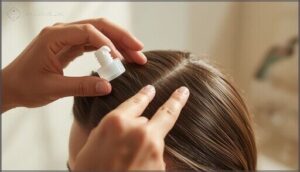
Once your scalp is dry, measure exactly 1 milliliter of liquid Rogaine or dispense half a capful of foam onto your fingers.
For additional guidance on maintaining scalp health while using topical treatments, explore these proven healthy scalp care strategies.
Part your hairline in multiple rows to expose thinning zones, then apply the minoxidil directly to visible scalp skin—not your hair shafts.
Gently massage the product into your frontal and temple areas until absorbed, ensuring proper minoxidil absorption for maximum hair regrowth.
Tips for Even and Targeted Coverage
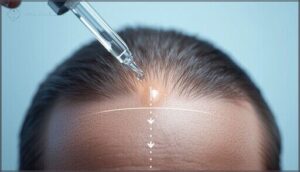
To guarantee minoxidil reaches every follicle that needs it, you’ll want to develop a systematic approach that leaves no thin patch untreated.
Start with hairline mapping: mentally divide your frontal zone into three sections—left temple, center, right temple. Apply one-third of your minoxidil dosage to each area using targeted application strokes. This coverage pattern guarantees proper scalp preparation and consistent Rogaine distribution across all thinning regions.
For longer-term improvement alongside topical treatments, natural remedies for thinning hair in men like proper sleep and stress management can enhance your overall regrowth strategy.
Best Practices for Daily Rogaine Application

Applying Rogaine consistently matters more than most people realize; missing doses or applying it haphazardly can greatly reduce your results.
Your hairline won’t respond to minoxidil unless you establish a reliable routine that allows the medication to work as intended.
The following guidelines will help you build a daily application schedule that maximizes effectiveness while fitting seamlessly into your life.
Ideal Frequency and Timing
Consistency drives Minoxidil Application success. Apply Rogaine exactly twice daily, spacing Dosing Intervals 12 hours apart to maintain steady Absorption Rates. Most patients choose morning and evening Application Schedules, which simplifies Treatment Durations over months.
Timing Considerations matter—if you miss a dose, resume your routine without doubling up. This disciplined approach to hair growth stimulation ensures ideal minoxidil concentration reaches follicles, maximizing your hair loss treatment outcomes.
Allowing Proper Absorption
Patience determines Topical Efficacy. After applying Rogaine, leave your scalp untouched for at least four hours before washing or swimming; this contact time allows Minoxidil Uptake through the stratum corneum to reach Hair Follicles where growth occurs.
Studies show approximately 1.4 percent of applied minoxidil penetrates intact skin during proper Scalp Preparation, so premature rinsing undermines Absorption Rates and compromises your hair loss treatment results.
Incorporating Rogaine Into Your Routine
Building Rogaine into your daily habits works best when you anchor the application to existing routines, like brushing your teeth or making your morning coffee. Set your minoxidil bottle near items you use twice daily; this visual cue prevents missed doses that delay hair growth results.
Consistency delivers the Rogaine benefits your receding hairline needs, transforming hair loss treatment from obligation into automatic scalp health maintenance.
Maximizing Rogaine Effectiveness on The Hairline

Applying Rogaine correctly is only part of the equation; your daily habits and overall scalp health directly influence how well minoxidil works on your hairline.
Beyond the application itself, certain lifestyle choices, complementary treatments, and maintenance routines can greatly improve your results.
The following strategies will help you create an environment where Rogaine can perform at its best.
Scalp Care and Cleanliness
A clean, healthy scalp creates the ideal environment for minoxidil absorption, directly influencing how well Rogaine can stimulate your hair follicles and support regrowth along your hairline.
Wash regularly with a gentle shampoo to remove oil, dirt, and product buildup; this hair care tip ensures effective scalp treatment. Consider scalp exfoliation weekly to unclog pores and boost hair loss prevention.
Avoid heavy styling products that coat the hair follicle, and skip dry shampoo on application days for maximum absorption.
Lifestyle Factors That Support Hair Growth
Your daily habits—from what you eat to how you manage stress—can either fuel your hair follicles or starve them, making lifestyle choices just as critical as applying Rogaine itself.
Your daily habits fuel or starve your hair follicles, making lifestyle choices as critical as applying Rogaine itself
Dietary changes rich in protein, iron, and vitamin supplements support minoxidil’s effects; stress reduction through meditation or an exercise routine improves circulation.
Sleep patterns matter, too; seven to eight hours nightly optimizes hair growth and minimizes hair loss.
Combining Rogaine With Other Treatments
Stacking treatments amplifies hair restoration when done correctly, but timing and medical oversight prevent adverse minoxidil interactions. Consider these evidence-based combinations:
- Finasteride therapy: Oral or topical finasteride blocks DHT, targeting androgenetic alopecia from a different angle than Rogaine’s circulation boost.
- PRP injections: Schedule platelet-rich plasma sessions separately to avoid interfering with minoxidil absorption.
- Laser treatment: Low-level devices complement daily Rogaine without chemical conflict.
- Corticosteroid use: Topical steroids may reduce scalp irritation under dermatologist guidance.
Common Mistakes to Avoid With Rogaine

Even with the best intentions, applying Rogaine incorrectly can undermine your results and waste your time. Simple missteps in dosage, technique, or consistency often explain why some users don’t see the hair regrowth they’re hoping for.
Understanding these common pitfalls will help you use minoxidil effectively and avoid the frustrations that derail treatment success.
Overuse and Underuse
Many people fall into the trap of thinking more Rogaine equals faster results, or they skip applications when life gets busy, but both extremes can sabotage your hair regrowth goals. Exceeding the recommended minoxidil dosage won’t accelerate hair growth; instead, it increases scalp irritation risk and potential side effects.
Conversely, inconsistent application disrupts treatment duration effectiveness, prolonging hair shedding phases and delaying visible regrowth on your scalp.
Incorrect Application Methods
Even with the right frequency, poor technique can derail your hair regrowth. Incorrect dosing or excessive application doesn’t speed results—it triggers scalp irritation and increases minoxidil absorption systemically, raising side effect risks.
Watch for these common application errors:
- Applying Rogaine to wet or damp scalp, blocking proper absorption
- Letting minoxidil run beyond your hairline, causing unwanted facial hair growth
- Using the product on irritated or broken skin
- Washing your scalp within four hours of application
Inconsistent Application Patterns
Missing doses or sporadic application undermines even perfect technique, since minoxidil demands consistent twice-daily use to maintain the hair growth cycle it stimulates. Skipping applications causes regrowth variability and triggers renewed hair shedding as follicles revert to their dormant state.
| Application Pattern | Impact on Hair Regrowth |
|---|---|
| Daily consistent use | Maximum follicle stimulation, steady progress |
| Missing 2-3 doses weekly | Interrupted growth cycle, delayed results |
| Weekend-only application | Minimal effectiveness, wasted product |
| Random inconsistent dosing | Increased scalp irritation, application errors |
Managing Expectations and Side Effects

Starting Rogaine means committing to a process that unfolds over months, not weeks. You’ll need to understand what’s normal during treatment and what signals a problem worth addressing.
Here’s what to expect as you begin using minoxidil on your hairline, including timelines for results, common side effects, and when it’s time to consult a dermatologist.
Hair Regrowth Timeline and What to Expect
Rogaine sets realistic expectations: patience wins this battle. Initial shedding between weeks 2 and 8 signals that minoxidil response has begun, not failure. Regrowth patterns emerge gradually, with treatment outcomes unfolding over months:
- Months 3-4: Early vellus hair regrowth appears; baseline stabilization occurs
- Months 6-12: Noticeable thickening develops; maximal cosmetic benefit arrives for most users
- Beyond 12 months: Maintenance phase begins; continued daily use preserves hair restoration gains
Recognizing Normal Vs. Concerning Side Effects
Minoxidil tolerability separates expected nuisances from red flags that demand immediate action. Mild scalp irritation, temporary itching, and initial hair shedding qualify as normal responses; your scalp adapts within 2-4 weeks. Concerning signs include persistent burning, facial swelling, chest pain, or rapid heartbeat—allergic reactions requiring discontinuation.
| Normal Side Effects | Concerning Symptoms |
|---|---|
| Mild scalp dryness, flaking | Severe rash, blistering |
| Temporary shedding (weeks 2-8) | Unwanted facial hair growth |
| Light itching at application site | Dizziness, rapid pulse |
When to Seek Professional Advice
Persistent symptoms or unusual reactions transform routine monitoring into a clinical imperative that demands expert evaluation. Consult a dermatologist if you experience chest pain, facial swelling, or dizziness after Rogaine application; these warrant immediate medical consultation.
Schedule a scalp examination if no hair regrowth appears after 12 months, as professional guidance reveals treatment alternatives and tackles underlying hair loss diagnosis issues affecting your baldness treatment outcomes.
Frequently Asked Questions (FAQs)
Can Rogaine be used on other areas of the scalp besides the hairline?
Yes, you can apply Rogaine to any area of the scalp experiencing hair loss. Minoxidil works effectively on the vertex, crown, and frontal regions, targeting all zones where follicles remain active and responsive.
How often should Rogaine be applied to the hairline?
Think of Rogaine application like taking daily vitamins—consistency matters. You should apply minoxidil twice daily, once in the morning and once at night, to maintain effective hair growth promotion and maximum treatment duration.
Can Rogaine be used in combination with other hair loss treatments?
Combining Rogaine with Finasteride Therapy or PRP Treatment can boost hair growth promotion. LLLT Devices and Hair Transplant procedures also complement minoxidil treatment.
Combination Therapy often delivers better hair restoration options compared to using Rogaine alone.
Can women use Rogaine on the hairline?
Like a key fitting only certain locks, Rogaine works for women’s hairline thinning when applied correctly to scalp skin—not facial areas.
Women’s formulations (2% or 5% foam) treat frontoparietal hair loss effectively, though scalp irritation and unwanted facial hair require careful monitoring.
Does Rogaine work on completely bald areas?
Unfortunately, no—topical minoxidil won’t restore hair where follicles have completely died. Rogaine stimulates miniaturized but living follicles, improving thickness and slowing hair loss rather than achieving complete regrowth on slick bald spots.
Can women use mens 5% Rogaine formula?
The FDA approves 5% minoxidil foam for women once daily, but labels on men’s versions warn against female use despite identical formulations—a puzzling regulatory distinction dermatologists routinely navigate in clinical practice.
Will Rogaine affect hair color or texture?
Rogaine and minoxidil don’t alter hair color or texture in most users. However, new hair growth may initially appear finer or lighter before maturing.
Scalp sensitivity or minoxidil side effects remain rare but warrant monitoring for hair follicle health.
Can I use Rogaine with hair dye?
You can dye your hair while using Rogaine, but skip minoxidil for 24 hours before and after coloring to prevent scalp sensitivity and guarantee even color results on clean, dry hair.
Conclusion
Mastering how to apply Rogaine to the hairline isn’t rocket science, but it requires the same deliberate precision a surgeon brings to delicate work. Your hairline won’t recover from haphazard application; it thrives on consistent, targeted treatment delivered exactly where miniaturization occurs.
Measure your dose, part systematically, massage thoroughly, and maintain unwavering daily commitment. Results don’t materialize from wishful thinking—they emerge from disciplined technique executed correctly, twice daily, without exception or compromise.