This site is supported by our readers. We may earn a commission, at no cost to you, if you purchase through links. This content is for general informational and educational purposes only and is not a substitute for professional medical, dermatological, or nutritional advice.
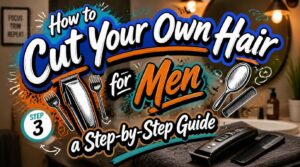
Twelve bucks in guards and a spare hour beats a forty-dollar barbershop trip that gets booked out two weeks. That’s the math driving more guys to pick up clippers and handle it themselves at home.
Here’s the catch: a bad cut doesn’t grow out overnight, and one wrong pass with a 2 guard can turn a quick trim into a hat-wearing month. The difference between a clean fade and a disaster comes down to angles, sectioning, and knowing when to stop.
That’s exactly what you’re about to learn. Grab your clippers, set up two mirrors, and let’s get you cutting like you’ve done this for years.
Table Of Contents
- Key Takeaways
- Gather Tools and Prep Hair
- Top 5 Tools for Men’s Haircuts
- Cut Sides, Back, and Top
- Check, Style, and Fix Mistakes
- Frequently Asked Questions (FAQs)
- What is the best way for a man to cut his own hair?
- What is the 3 2 1 rule for haircuts?
- How do I cut my man’s hair at home?
- Is it hard for guys to cut their own hair?
- How do you cut hair if you are a beginner?
- How to cut men’s hair at home?
- Can you cut your own hair?
- How do you cut your own hair at home?
- Does a man need a haircut?
- Is it easy for a man to give himself a haircut?
- Conclusion
Key Takeaways
- Start with a bigger guard than you think you need, since it’s easier to go shorter later than to fix hair you’ve already cut too short.
- Set up two mirrors, wash and section your hair, then work sides, back, and top in that order so each part guides the next.
- Use clippers for length and blending but switch to scissors for the top, since clippers won’t give you the control that area needs.
- Check your work often in a hand mirror as you go, and fix rough spots with small, careful trims instead of rushing or over-correcting.
Gather Tools and Prep Hair

Before you touch a clipper to your head, you need to get your setup right. A good cut starts with the basics: your mirrors, your hair, and how you section it off. Here’s exactly what to nail down first.
Since the right tool makes or breaks your results, take a minute to check out this guide on choosing the best cordless hair clippers for your hair type before you start.
Set Up Mirrors
Before you touch a clipper, get your two-mirror technique dialed in: a large-sized mirror on your bathroom wall paired with a handheld mirror, 8 inches or bigger.
Adjust mirror height with telescoping hooks so you see the crown without straining your neck. Angle flexibility lets you check the back and sides—stability features keep everything locked so your hands stay free for cutting.
Consider using a three-way mirror setup for improved visibility during your haircut.
Wash and Dry Hair
Wash your hair before you cut it. Use lukewarm water, massage shampoo into your scalp for a solid minute, and rinse clean.
- Sulfate-free shampoo for thick hair
- Volumizing shampoo for fine hair
- Conditioner on mid-lengths and ends only
- Cool water rinse to seal cuticles
Towel dry until damp, then wet hair so it’s damp and part it down the middle.
Comb Natural Part
Damp hair from your wash is ready to work with, so comb it straight back and let gravity show you your natural part — it’ll sit where your scalp curves, lined up with your eyebrow peak. Use a comb thumb to carve it in.
This baseline guides your whole cut, from sectioning hair into parts to blending guards later.
Section The Top
With that part set, comb your hair from the crown down to each ear to mark clean side sections. Clip the top out of the way if it’s long enough to flop into your workspace.
Now run a horizontal zigzag part across the crown — this splits top from sides and keeps your hair sectioning even before clippers touch anything.
Choose Longer Guards
Grab your clippers and start with a bigger guard than you think you need — an 8 guard, not a 2. Longer guards give you room to fix mistakes before going shorter.
Coarse or curly hair? An 8 controls it well. Fine hair benefits too, cutting bulk without looking sparse. Gradual length reduction beats overcutting every time.
Top 5 Tools for Men’s Haircuts
Good tools make the difference between a haircut you’re proud of and one you hide under a hat. You don’t need a full barbershop setup, but the right clipper or trimmer will save you time and give you cleaner results. Here are five options worth putting in your kit.
Once you’ve got the right clippers, pairing them with this guide to keeping your beard neat and clean helps you maintain those crisp lines between sessions.
1. Andis Professional Master Corded Cordless Hair Clipper
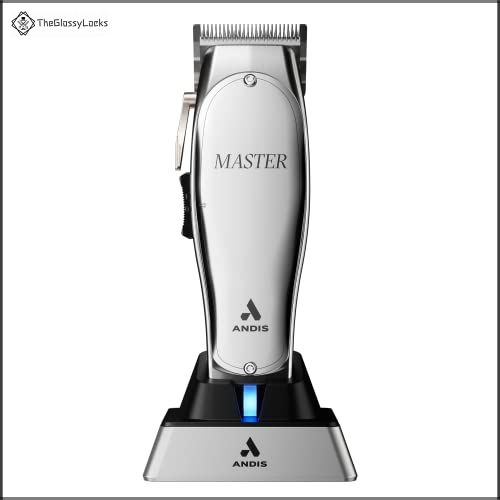
This clipper is the workhorse you build your whole cut around. It runs a 7,200 SPM rotary motor that stays steady even in thick, coarse hair, so you won’t get that annoying drag mid-cut.
The adjustable carbon steel blade shifts from 000 to 1, letting you fade and mix without swapping guards constantly. Go cordless for up to 90 minutes, or plug in when you need full, uninterrupted power.
| Best For | Barbers, stylists, and home users who want a powerful, do-it-all clipper for close cutting, detailing, and fading on any hair type. |
|---|---|
| Power Source | Corded/Cordless |
| Blade Material | Carbon steel |
| Battery Runtime | Up to 90 minutes |
| Charging Method | Charging stand adapter |
| Weight | 2 pounds |
| Included Accessories | Stand, brush, oil |
| Additional Features |
|
- Overlap blades deliver crisp, clean lines on hair, beards, sideburns, and mustaches
- Adjustable 000–1 blade with fast feed action lets you fade and mix without swapping guards
- Corded/cordless flexibility with a steady 7,200 SPM motor, even in thick hair
- Battery life may fall short for busy professional shops needing frequent recharging
- Battery isn’t user-replaceable, so a failed battery means sending it in for factory service
- Blade set screws can strip the plastic nubs if over-tightened during maintenance
2. BaBylissPRO FXONE GoldFX Trimmer Shaver
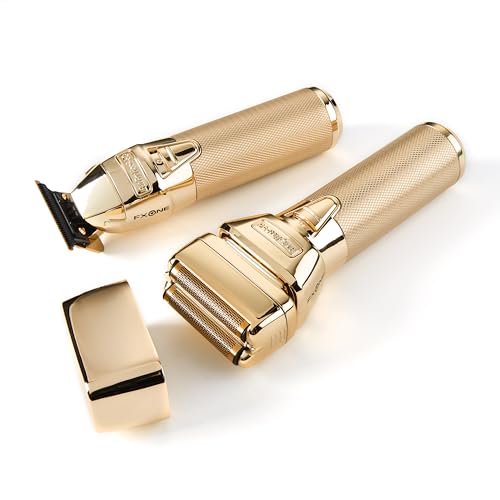
Once your fade’s roughed in, this is what takes care of the fine detail work. The GoldFX pairs a zero-gap T-blade running at 7,200 RPM with a foil shaver hitting 20,000 SPM, so crisp lines and a close, hypoallergenic shave come from one tool.
It’s tool-only, meaning you’ll need an FXONE battery separately. Worth it if you want sharp edges without a second device cluttering your counter.
| Best For | Barbers and grooming enthusiasts who want precise line-ups and a close, irritation-free shave in one compact tool. |
|---|---|
| Power Source | Cordless (battery sold separately) |
| Blade Material | Gold DLC/Titanium |
| Battery Runtime | Depends on FXONE battery |
| Charging Method | Quick-release battery swap |
| Weight | 1.53 pounds |
| Included Accessories | Tool-only, none included |
| Additional Features |
|
- Zero-gap T-blade delivers crisp, precise lines and detailing
- Hypoallergenic foil shaver offers a close shave with less skin irritation
- Quick-release battery system makes swapping power easy for extended use
- Battery and charger are sold separately, adding to the total cost
- Some users report inconsistent trimmer blade performance
- Foil shaver may not shave as close as rotary systems for certain hair types
3. Andis Slimline Pro T Blade Trimmer
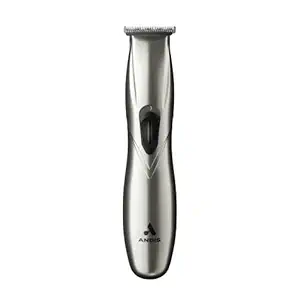
Think of this one as your detail brush after the clippers do the heavy lifting. Its carbon steel T-blade stays sharp for outlining necklines, sideburns, and hairline edges with real precision.
Cordless runtime hits about two hours, plenty for a full cut plus cleanup. Four attachment combs come along for length options.
Keep oil on the blade regularly, since a few users report rust or battery issues down the line. Still, for tight detailing work, it earns its spot in your kit.
| Best For | barbers, stylists, and home users who need precise detail work like outlining necklines, sideburns, and hairlines. |
|---|---|
| Power Source | Cordless |
| Blade Material | Carbon steel |
| Battery Runtime | Up to 2 hours |
| Charging Method | Premium charging stand |
| Weight | 4 ounces |
| Included Accessories | Four attachment combs |
| Additional Features |
|
- Self-sharpening carbon-steel T-blade delivers close, accurate cutting for edging and fading
- Cordless design with up to 2 hours of runtime, plus a charging stand and four attachment combs for flexibility
- Slim, lightweight build makes it comfortable for extended use, including on kids
- Some users report battery degradation or failure after around 6 months
- Blade needs regular oiling to stay in good shape
- Occasional complaints about rust or issues with the head mechanism over time
4. Philips Norelco All-in-One Trimmer MG3939/50
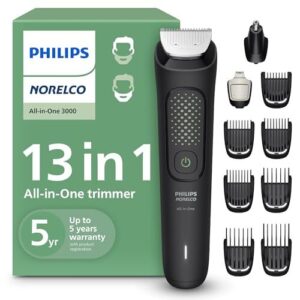
Need a Swiss Army knife for grooming? The Philips Norelco MG3939/50 covers head, beard, nose, and body with 13 attachments and self-sharpening blades. Dial in lengths from 0.5mm to 16mm—so you won’t get stuck with just stubble or buzz.
USB charging gives you 60 minutes cordless runtime, but you’ll need your own wall adapter. All parts rinse clean under water, making post-cut cleanup fast.
It’s a practical, all-in-one kit for home barbers.
| Best For | Anyone who wants one tool to handle beard, head, nose, and body grooming without buying separate trimmers for each job. |
|---|---|
| Power Source | Cordless |
| Blade Material | Full metal self-sharpening |
| Battery Runtime | Up to 60 minutes |
| Charging Method | USB-A cable |
| Weight | 11.36 ounces |
| Included Accessories | 13 attachments included |
| Additional Features |
|
- Self-sharpening blades stay sharp without oiling, so there’s less maintenance to worry about
- 13 attachments and 8 length settings (0.5mm–16mm) cover nearly every grooming style
- Fully rinseable under water for quick, easy cleanup
- Wall adapter isn’t included, so you’ll need your own USB power source to charge it
- Blades aren’t replaceable, meaning the trimmer’s lifespan depends on how well the self-sharpening feature holds up
- Not built for wet shaving with foam or gel—it’s meant for dry use or rinsing only
5. BaBylissPRO GOLDFX+ Cordless Hair Clipper
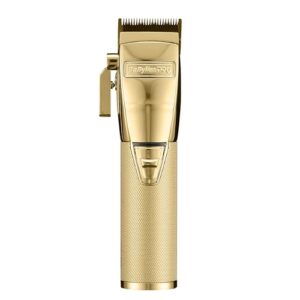
Want raw power without a cord in your way? The GOLDFX+ packs a high torque brushless motor that stays strong on thick, coarse hair in corded or cordless mode. Dual voltage means it works anywhere you travel.
The all-metal housing and knurled grip hold steady, even wet. DLC titanium blades paired with a 5-detent taper arm let you dial in fades with precision, while USB-C charging keeps you cutting through a full shift.
| Best For | Home users and professional barbers who want a durable, all-metal cordless clipper that delivers precise, consistent cuts across all hair textures. |
|---|---|
| Power Source | Cordless |
| Blade Material | DLC/Titanium gold taper |
| Battery Runtime | Up to 3 hours |
| Charging Method | USB-C connection |
| Weight | 1.83 pounds |
| Included Accessories | Accessories sometimes missing |
| Additional Features |
|
- All-metal construction with DLC/Titanium gold taper blade offers durability and precise cutting
- Upgraded N1 brushless motor with dual ball bearings maintains consistent power on thick or coarse hair without overheating
- 5-Detent Taper Arm with audible clicks makes length adjustments quick, accurate, and repeatable
- Some buyers have reported receiving used or repackaged units instead of new ones
- Certain shipments have been missing accessories like the cleaning brush, holder, or storage box
- Higher price point may not suit casual or occasional users looking for a budget option
Cut Sides, Back, and Top
Now that your hair’s washed, sectioned, and your clippers are set up, it’s time for the real work. You’ll move through the sides, back, and top in a specific order, so each part sets up the next one for a clean shift. Here’s exactly how to handle each section.
Trim Sides First

Start clippers dry with a 2 guard for a safe, even length on the sides. Keep the blade flush, tilt at a slight angle, and stroke upward against hair growth.
Work bottom to nape, then mix toward the crown so short sides meet longer top hair gradually—no harsh lines, just a smooth, confident flow.
Cut Back Carefully
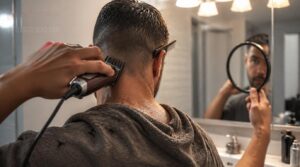
The back is the trickiest spot since you can’t see it directly, so grab your hand mirror now and check it often as you go.
Keep the same guard, comb hair upward with light tension, and run clippers against growth in short, controlled strokes.
Work in small sections — check, cut, recheck — before moving on.
Blend With Scooping Motions
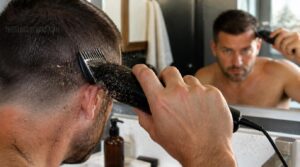
Once the back looks even, it’s time to smooth those lengths so nothing looks choppy. Tilt clippers to a 45-degree angle, blade down, and use scooping motions to pull the clippers away from your head. Flick your wrist upward as you go — this softens edges. Follow your head’s contour, progress guards from 2 to 4, and let a vertical comb guide each pass.
Scissor-cut The Top

Grab your styling scissors now — clippers won’t give you the control top hair needs. Comb a section straight up, cut straight across for your blunt cutting baseline, then point cut lightly for texture. Work front to back with five strokes, no skipped coverage, using earlier layers as your reference. Finish by cross-checking side to side.
Trim Neckline and Sideburns
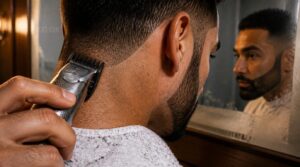
Clean edges finish the job. Use the Neckline Tape Method or follow your natural hairline curve, then taper your neckline with a size 2 guard at the occipital ridge, gliding upward.
Match sideburns to ear width, then apply the Tapered Sideburn Technique—angled along your jawline. Soften transitions with trimmer corner softening and merge your hairline until edges disappear naturally.
Check, Style, and Fix Mistakes

The clippers are down and the top’s cut, but you’re not done yet. Now it’s time to check your work, catch anything you missed, and style it up right. Here’s how to walk through that final stretch step by step.
Inspect With Hand Mirror
Your eyes will lie to you under bad lighting, so get the two-mirror technique working before you judge anything. Hold the handheld mirror 6-8 inches back, tilted 45 degrees toward the wall mirror. Keep it parallel to your scalp, elbow braced for stability, and check the crown, sides, and nape before moving on to fixes.
Even Out Rough Spots
Found a rough patch? Fix it with light trimming, not panic. Switch to a lower guard or point-cut stray hairs 1-2mm shorter than surrounding length. Use scissor over comb for stubborn lines clippers missed.
Check symmetry side to side in the mirror. An imperfect but acceptable cut beats an over-corrected one, so trim small and reassess often.
Style Before Final Cuts
Wet hair lies flat and hides mistakes, so style your hair immediately after cutting it. Blow-dry into your usual part and run a style direction check, watching how it falls.
Do a natural fall test for cowlicks, then a quick volume assessment. Look for spots where short sides don’t yet mix short hair on the sides with longer hair on top.
Avoid Cutting Too Short
Hair doesn’t grow back overnight, so treat every guard size like a one-way street.
Hair doesn’t grow back overnight, so treat every guard size like a one-way street
- Start with guard 4, not 1
- Use finger guides for small trims
- Keep a backup plan ready
- Get a second opinion before going shorter
Go one length longer than usual. Regrowth takes 4-6 months, so patience beats regret every time.
Plan Regular Touch-ups
One good cut deserves a repeat performance. Set a reminder every 3-4 weeks for skin fades, or 6-8 weeks if you’re keeping it longer.
Track growth at your temple weekly, log which products stretch your style, and adjust for summer versus winter growth rates. Consistency beats guesswork, and your learning curve shrinks every time you pick up the clippers.
Frequently Asked Questions (FAQs)
What is the best way for a man to cut his own hair?
Like a sculptor working clay, you shape hair through patience, not speed. Start with a proper mirror setup, wash and section your hair, then mix with clippers and detail with scissors before a final inspection.
What is the 3 2 1 rule for haircuts?
This proportion guideline splits your head into three zones: top, sides, neckline, using a 3:2:1 ratio. It works with any face shape or hair texture, giving you clean guard-size transitions and smooth blending between lengths.
How do I cut my man’s hair at home?
Set up two mirrors, pick your clipper guard sizes, and comb wet, detangled hair back. Use straight-up strokes on the sides, scissor over comb on top, then taper the neckline for a clean, even home haircut.
Is it hard for guys to cut their own hair?
Picture a guy attacking his mullet with kitchen scissors, praying to the hair gods. Funny, but avoidable. With proper mirror setup and hair sectioning, it’s genuinely manageable, not some barbershop-only skill reserved for professionals.
How do you cut hair if you are a beginner?
Practice on mannequin hair first if you can. Wash and detangle with a comb, section into parts, then use clippers on a small guard setting, trimming conservatively before you work the areas where the sides meet the longer top.
How to cut men’s hair at home?
Like a barbershop straight out of an old western, cutting men’s hair at home just needs damp hair, a mirror setup, and a clipper guard set. Wash, section, smooth with scooping motions, then finish clean.
Can you cut your own hair?
Yes, you can, with the right prep, tools, and technique. It works best for straight or wavy hair types. Go slow, avoid cutting too short, and expect some trial and error before you master it.
How do you cut your own hair at home?
Cutting corners? Not here—cutting hair means bright lighting, a damp towel dry, mirrors set at two angles, sectioned hair, and a small clipper guard blending sides into longer top hair, then a final mirror check.
Does a man need a haircut?
Regular cuts aren’t just vanity. They cut scalp irritation, boost confidence, and signal professionalism. Beyond looks, grooming lowers stress and saves cash long-term—proof that mastering how to cut your hair at home pays off in health and wallet.
Is it easy for a man to give himself a haircut?
Think of it like learning to parallel park: awkward at first, doable with practice. Most guys nail basic trims within 2-4 weeks, and simple styles only take a few tries before they look sharp and clean.
Conclusion
A thousand YouTube tutorials and one pair of clippers just saved you a small fortune in barbershop bills. That’s the real payoff of learning how to cut your own hair for men: control, confidence, and a few extra bucks in your pocket every month.
Go slow, check both mirrors, and stop before you think you’re done. Your clippers won’t make mistakes. Your patience will. Master that, and you’ll never dread a bad haircut day again.