
This site is supported by our readers. We may earn a commission, at no cost to you, if you purchase through links. This content is for general informational and educational purposes only and is not a substitute for professional medical, dermatological, or nutritional advice.
Your shaver ran for an hour when it was new. Now it quits halfway through your jawline, and you’re left with one clean cheek and one rough one.
That slow decline isn’t random. Most shaver battery wear comes from habits you can change: how deeply you drain the cell, where you store it, and how hard the motor works. A lithium-ion cell can last about 2,000 cycles with shallow charging, but only 300 when you run it flat every time.
Learning how to extend electric shaver battery life starts with a few small adjustments. Here’s where to begin.
Table Of Contents
- Key Takeaways
- Which Charging Habits Extend Shaver Battery Life?
- Use Compatible Chargers and Keep Contacts Clean
- Protect Your Shaver From Heat and Moisture
- Reduce Motor Strain With Shaver Head Maintenance
- Diagnose Short Electric Shaver Battery Runtime
- Check Whether Your Shaver Battery Is Replaceable
- Frequently Asked Questions (FAQs)
- Conclusion
Key Takeaways
- Charge your shaver after a few shaves instead of running it flat, because shallow charging can give you about 2,000 cycles compared with roughly 300 for full drains.
- Unplug it once it’s full, use the charger made for your model, and keep the contacts clean so the battery isn’t stressed.
- Store your shaver in a cool, dry spot away from bathroom heat and steam, since both wear down the cells and the electronics.
- Clean and oil the shaver head and replace worn foils, because a dull blade makes the motor draw more power and drain the battery faster.
Which Charging Habits Extend Shaver Battery Life?
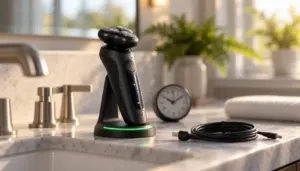
How you charge your shaver shapes how long its battery lasts. Two habits matter most, and you can control both. Here’s what to know about each one.
For shavers with long runtimes and easy USB charging, see this guide to the best electric shaver for women.
Partial Charging for Lithium-Ion Batteries
A lithium-ion battery doesn’t need to be drained before you recharge it. Unlike older battery types, it has no memory effect, so topping up early won’t shrink your capacity later.
Charge your lithium-ion shaver whenever it suits you, because topping up early costs it nothing and leaves its lifespan untouched
In fact, shallow use is easier on the cells. Charge cycle depth matters most. A battery that swings from 100% to 0% wears faster than one that moves between 20% and 80%, because the extremes put the most stress on the electrodes. Research on depth of discharge effects shows that NMC cells reach roughly 2,000 cycles at 20% depth of discharge, compared with only about 300 cycles at 100%.
Charge your shaver after a few shaves, not once it dies.
Overcharging and Leaving It Plugged In
Charging early is easy on the cells. Leaving the shaver on the charger for days is a different story.
Most modern shavers shut off the charging circuit 15 to 30 minutes after the battery is full. Still, a cell held at full charge in a warm bathroom ages faster. Over time, that’s how lithium-ion degradation sneaks in.
Older NiMH shavers are riskier. A basic trickle charger can overcharge them because it can’t sense when they’re full.
If you’re shopping for a newer model, this guide to electric shavers for beginners compares options that charge fully in about two hours.
- Unplug once the indicator says full.
- Don’t store the shaver on its dock.
- Use the cord for long sessions, if your model allows it.
Use Compatible Chargers and Keep Contacts Clean
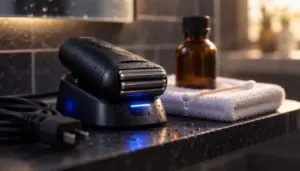
Charging habits only help if the charger is right. Match the voltage on the charger to the voltage printed on your shaver. Too high can fry the circuits. Too low means slow or no charging. Extra amperage is fine, since the shaver draws only what it needs.
Keep your charging contacts clean, too. Oxidation adds resistance and causes patchy charging.
| Check | What to do | How often |
|---|---|---|
| Voltage | Match charger to shaver | Every new charger |
| Contacts | Wipe with 70% isopropyl alcohol | Monthly |
| Drying | Wait 60 seconds | After cleaning |
Protect Your Shaver From Heat and Moisture

A good charger won’t help if the shaver sits somewhere hot or damp. Heat wears down lithium-ion cells, and charging above 45°C speeds that damage. Keep it in a cool spot, ideally around 15°C, and never in a closed car.
If you’re packing it for a trip, keep it around 40–60% charge and browse these beard trimmers for travel for options that pack easily.
Moisture is the bigger risk. Bathroom humidity condenses on the shaver and seeps into the electronics, where electronic component corrosion sets in. Store it in a bedroom drawer. Take the cap off after drying a shaver so air can circulate.
Reduce Motor Strain With Shaver Head Maintenance
A dull blade makes your motor work harder, and that drains the battery faster. Cutting each hair takes more force, so the motor draws more current and sounds louder and harsher.
Good shaver head cleaning stops the problem early. Residue, skin oils, and clippings restrict blade movement. Soap scum and minerals also form an abrasive paste that wears edges down.
Keep these habits:
- Clean the head after every shave.
- Add two drops of light oil to each foil or comb.
- Replace foil heads every 12 to 18 months.
Don’t wait for the motor to struggle.
Diagnose Short Electric Shaver Battery Runtime

A shaver that quits early isn’t always a dead battery. Before you blame the cells, you need to know what normal looks like for your model. The two points below show you how to compare your runtime and spot real wear.
Compare Runtime With Your Model’s Rating
A 60-minute rating rarely means 60 minutes of real shaving. Most brands test with the motor running under light or no load, so the number reflects a best case.
Expect about 40 to 45 minutes in daily use. Thick stubble, firm pressure and tricky areas like the neck all pull more power.
Check the manual for how the maker defines runtime. Is it motor-on time or total time? Then time your own shaves for a week and add them up. If your total sits near that range, your battery is fine.
Recognize Signs of Battery Wear
Your shaver slows down. It dies early. It warns you too soon. These are the first signs of battery degradation, and they’re easy to spot once you know them.
Watch for these three:
- Sudden shutoffs mid-shave, even when the low-battery indicator shows charge left.
- Longer charging that never reaches a full light.
- Excess heat or a weak motor under load.
Poor battery capacity retention usually shows up this way. Swelling, leaks, or a chemical smell mean you should stop using the shaver.
Check Whether Your Shaver Battery Is Replaceable
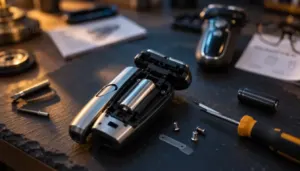
Think a dead battery just means a dead shaver? Not always, but it depends on the model.
Start with the case. If you see a battery cover or two Phillips screws on the underside, you can replace a battery yourself. Entry-level Panasonic models with AA or AAA cells are the easiest.
Premium shavers are different. Braun, Norelco, and Remington units aren’t user-serviceable, and opening waterproof models can break the seal. Check your manual first. Then find a battery replacement guide.
Frequently Asked Questions (FAQs)
How long do electric shaver batteries last?
You might think a shaver battery should last as long as the shaver. Usually, it won’t. Most lithium-ion cells hold up for three to five years before capacity drops noticeably.
What should I do with an old shaver battery?
Don’t toss it in the trash or household recycling. Once you replace a battery, take the old one to a battery recycling drop-off. Tape over the metal contacts first. Never puncture, crush, or burn it.
How long should I store my shaver unused?
You can leave a Li-ion shaver unused for up to a year if you prep it right. Charge it to 40–60%, keep it in a cool dry place, and top it up every 3–6 months.
Does shaving frequency affect battery lifespan over time?
A shaver used 2–3 minutes daily for five years still held a charge. Frequency barely matters. Only total percentage discharged counts, and age usually wins first. Avoid running it near empty.
Is it safe to travel with my electric shaver?
Airlines only require approval for batteries above 100 Wh, and your shaver’s falls far below that. Yes, you can carry it. Switch on the travel lock, and keep it in a shockproof shaver case too.
Conclusion
Why let a good shaver die early?
Knowing how to extend electric shaver battery life comes down to a handful of habits. Charge it before it hits empty, unplug it once it’s full, and keep it away from heat and steam. Wipe the contacts, clean the heads, and use the charger made for your model.
If runtime drops, compare it with your model’s rating and check whether the battery can be replaced. Small habits win.