This site is supported by our readers. We may earn a commission, at no cost to you, if you purchase through links. This content is for general informational and educational purposes only and is not a substitute for professional medical, dermatological, or nutritional advice.
One in five Americans will develop skin cancer by age 70. Most cases trace back to habits formed decades earlier: a childhood sunburn, years of tanning beds, sunscreen applied only at the beach. Melanoma rates have climbed for years, yet most cases are preventable with consistent, informed choices.
Choosing a mineral formula with zinc oxide, like the SPF 50 face sunscreen from Colorescience, is one of the simplest ways to protect your skin, and our guide to the best sunscreen for skin cancer prevention compares more options.
You don’t need a dermatology degree to protect your skin. You need a clear system, one that covers sun exposure, sunscreen, clothing, and regular skin checks. Learning how to prevent skin cancer starts with small daily habits that add up to real protection over a lifetime.
Table Of Contents
- Key Takeaways
- Prevent Skin Cancer With Daily UV Protection
- Choose and Apply Sunscreen Correctly
- Wear Sun-Protective Clothing and Accessories
- Avoid Tanning and Protect Children
- Check Your Skin and Know Risks
- Frequently Asked Questions (FAQs)
- What are 5 ways to prevent skin cancer?
- What does early-stage skin cancer look like?
- What are the 7 warning signs of skin cancer?
- How can I prevent skin cancer naturally?
- How can we avoid skin cancer?
- How can you prevent skin cancer naturally?
- Can a healthy lifestyle prevent skin cancer?
- How to early detect skin cancer?
- Can skin cancer be cured?
- How effective are different types of protective clothing?
- Conclusion
Key Takeaways
- Broad-spectrum SPF 30+ sunscreen, applied generously and reapplied every two hours, is your daily non-negotiable, since most people use only half the amount needed and lose real protection.
- Timing and coverage matter as much as sunscreen itself: avoiding peak sun (10 a.m.–4 p.m.), seeking real shade, and wearing UPF-rated clothing, hats, and UV400 sunglasses all cut cumulative UV exposure.
- Tanning beds carry no safe exposure level and raise melanoma risk by 75% when used before age 35, so skipping them entirely is one of the most important choices you can make.
- Monthly skin self-exams using the ABCDE rule, plus annual dermatologist visits, catch changes early and give you the best shot at catching skin cancer while it’s still highly treatable.
Prevent Skin Cancer With Daily UV Protection

Skin cancer prevention starts long before you reach for sunscreen. Your daily habits around sun exposure matter just as much as any product you apply. Here’s what you need to know to build smarter UV protection into your everyday routine.
Beyond timing and shade-seeking, pairing consistent UV habits with a solid anti-aging skincare routine helps repair and protect skin that’s already seen sun exposure.
Check The UV Index
A quick habit sets the tone for daily protection: check the UV Index before you head out. This 1-to-11+ scale forecasts UV intensity for your ZIP code, with 3-7 signaling moderate to high risk. No thermometer needed either; a shorter midday shadow means stronger UV exposure.
Keep in mind that reflective surfaces like sand and water can intensify UV exposure, so extra caution is warranted near beaches or snow. Use that forecast to plan activities and match your sunscreen strength accordingly.
Avoid Peak Sun Hours
Once you’ve checked the UV Index, the next move is timing. Between 10 a.m. and 4 p.m., UV rays peak, sharply raising sunburn risk. Sunburns compound your lifetime skin cancer odds, especially in kids.
Catching skin changes early makes all the difference — explore early detection strategies and skin cancer prevention tips to stay ahead of what sun exposure can quietly set in motion.
- Reschedule errands for early morning or evening
- Treat this window as prime shade-seeking time
- Combine timing with broad-spectrum sunscreen
- Watch for shorter shadows as your cue
Seek Shade Outdoors
Not all shade is equal. A dense oak canopy can stretch safe exposure from 20 to 100 minutes, while HDPE fabrics block nearly 100% of UV rays.
| Shade Type | UV Block | Best Use |
|---|---|---|
| Tree canopy | ~SPF 10 | Parks, yards |
| Portable canopy | Up to 95% | Beach, travel |
| HDPE structure | ~98–100% | Fixed setups |
Less visible sky means better protection.
Consider Clouds and Reflections
Cloudless skies aren’t required for burns. Thin clouds barely dent UV and can scatter it worse. Even under canopy, reflected UV sneaks in from below.
Watch for:
- Snow (up to 80% reflection)
- Wet sand near shorelines
- Concrete and pavement glare
Broad-spectrum, water-resistant sunscreen still matters, especially outside peak sun hours.
Limit Cumulative UV Exposure
Every unprotected minute outdoors adds up, whether you’re gardening at noon or walking to your car at dusk. Cumulative sun exposure drives lifetime skin cancer risk, so track daily sun time like you would calories.
| Strategy | Action | Benefit |
|---|---|---|
| Monitor UV | Check index daily | Plan smarter |
| Schedule breaks | Move indoors midday | Cuts peak dose |
| Plan evenings | Shift activities later | Lowers total UV |
Choose and Apply Sunscreen Correctly
Sunscreen only works if you’re using the right kind and using it correctly. A lot of protection gets lost through small mistakes, like skipping easy-to-miss spots or waiting too long to reapply. Here’s what actually matters, from SPF strength to the details people tend to overlook.
Choosing sunscreen actually starts with knowing your skin, since picking skincare products suited to your skin type helps you avoid formulas that clog pores or leave a greasy residue you’re tempted to skip reapplying.
Use Broad-Spectrum SPF 30

SPF alone won’t cut it. You need broad-spectrum protection, meaning defense against both UVA and UVB rays, not just the burning kind SPF measures.
SPF 30 filters roughly 97% of UVB rays, a solid baseline for daily use. Make broad-spectrum SPF 30+ your everyday habit, rain or shine, since up to 90% of UV rays penetrate clouds anyway.
Choose SPF 50 Outdoors
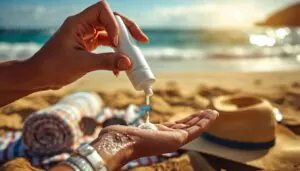
A day hike or beach afternoon calls for more firepower. Choose SPF 50 broad-spectrum UVA/UVB sunscreen, ideally water-resistant, since sweat and swimming strip protection fast.
Water-resistant SPF 50 for sports holds up through roughly 80 minutes of immersion. Still, reapply every two hours, or sooner after toweling off. Seek the shade when you can, and cover up between applications.
Apply The Right Amount
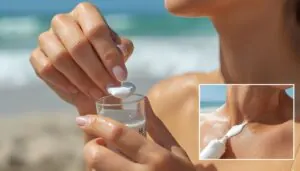
Most people apply barely half the sunscreen needed, cutting SPF 50 protection to roughly SPF 17. Use a generous amount: about one ounce (two tablespoons) for your body, applied 15-20 minutes before heading out.
- Face and neck: two-finger line
- Body: shot-glass amount
- Ears, feet, scalp: don’t skip them
- Reapply after swimming or sweating
Reapply Every Two Hours

Think sunscreen lasts all day? It doesn’t. UV rays and sweat break it down, so reapply every two hours during continuous outdoor activity, no matter how thorough your first application was.
Swimming or heavy sweating shortens that window considerably. Towel-drying strips protection almost instantly, so refresh immediately afterward rather than waiting for the clock to hit two hours.
Protect Lips and Scalp
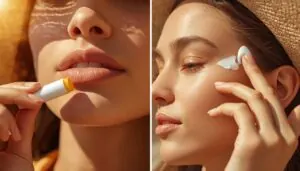
Your lips and scalp burn just as easily as anywhere else, yet most people skip both. Use lip balm with SPF 30-50+ daily; zinc oxide adds a physical barrier and blocks actinic cheilitis, a precancerous condition.
For your scalp, apply mineral sunscreen along part lines, or wear a wide-brimmed hat. Reapply after swimming or sweating.
Wear Sun-Protective Clothing and Accessories

Sunscreen alone can’t cover every inch of skin you expose to the sun. What you wear matters just as much, acting as a physical shield UV rays can’t easily get through. Here’s what to look for when building your sun-protective wardrobe.
Choose UPF-Rated Clothing
Since fabric alone won’t reliably block UV rays, choose UPF-rated clothing tested to standard labeling protocols. Look for UPF 30-49 (very good) or UPF 50 (excellent) on the label.
- Check for lab-tested UPF ratings
- Prefer polyester or blended fabrics over 100% cotton
- Note that dark colors don’t guarantee more protection
- Confirm proper garment care instructions
- Verify labels list both UPF value and category
Cover Arms and Legs
Once you’ve picked a UPF fabric, put it to work by keeping arms and legs covered. The CDC notes that long sleeves and long pants block more UV than bare skin, especially once the UV Index hits 3 or higher.
Rash guards and UPF arm sleeves offer flexible coverage for sports without a full shirt.
Wear Broad-Brimmed Hats
A broad-brimmed hat covers what sunscreen and sleeves miss: your face, ears, and neck.
- A shaded nose and cheeks
- Ears tucked from direct rays
- A neck free of red patches
- A UPF-rated woven crown
- A chin cord holding firm in wind
Choose a 3-inch brim with full coverage around the circumference, not just the front, for real protection.
Select UV400 Sunglasses
Your eyes and eyelids need the same rigor you’d give your skin. Look for UV400 lens materials like polycarbonate, which naturally block rays to 400nm.
| Feature | Why It Matters |
|---|---|
| UV400 rating | Blocks UVA/UVB fully |
| Wraparound coverage | Shields reflective glare |
| Polarized UV400 | Cuts glare, blocks UV |
| Label verification | Confirms real protection |
Favor Tightly Woven Fabrics
Not all cotton shirts protect equally. Fabric thread density determines UV blocking, so run a weave tightness check: hold material up to light. Little transmission means good coverage.
Consider these factors:
- Thicker fabrics reduce UV pathways
- Dark, tight weaves outperform loose ones
- Full coverage wear beats partial protection
- UPF-rated fabric adds measurable defense
Combine tightly woven fabric with broad spectrum UV defense for reliable protective clothing strategies.
Avoid Tanning and Protect Children

Some of the biggest risks to your skin come from habits, not just weather. Tanning beds and unprotected sun exposure in childhood both leave lasting marks on your risk for skin cancer. Here’s what you need to know to protect yourself and the kids in your life.
Skip Tanning Beds Completely
A base tan offers SPF 3 at best, basically nothing against real UV damage.
Skip tanning beds completely: first-time use before 35 raises melanoma risk 75%, squamous cell carcinoma risk jumps 83%. Sunlamps and tanning beds are WHO Group 1 carcinogens, no safe exposure exists.
Get vitamin D from fortified foods or supplements instead.
Keep Newborns Shaded
Under six months, skin has no business meeting direct sun. Stay in the shade, use a dark stroller canopy (light fabric lets UV scatter through), and add covers on car windows. Watch reflective surfaces near water or pavement.
Sunscreen isn’t recommended yet, so shade and light clothing do the work, while you also watch for overheating.
Protect Children During Peak Hours
Between 10 a.m. and 4 p.m., a child’s skin takes the brunt of peak UV. Schedule outdoor play earlier or later, monitor the UV index, and pack portable shade.
- Check hourly UV forecasts
- Schedule practices before 9 a.m.
- Bring umbrellas or shade tents
- Use sunscreen for infants 6 months+
- Reapply broad-spectrum SPF every 2 hours
Prevent Childhood Sunburns
Ten minutes. That’s all it takes for young skin to burn.
It takes just ten minutes of unprotected sun for a child’s skin to burn
Keep sunscreen for children 6 months and older within reach, apply a small amount generously, and reapply every 2 hours. Seek shade during peak hours, watch for reflective surfaces like water or sand, and start early skin monitoring so sunburns, not scars, stay in the past.
Model Sun-Safe Habits
Children rarely follow instructions; they follow eyes. When you apply sunscreen, wear UPF clothing, and seek shade, your child is three times more likely to adopt those same habits.
Support this with:
- Applying sunscreen together each morning
- Wearing hats during shared outdoor time
- Discussing sunburns honestly
- Praising shade-seeking
- Signing a family sun safety contract
Check Your Skin and Know Risks

Sun protection is only half the equation. Knowing your own skin, and paying attention when something changes, matters just as much. Here’s what to watch for and when to get it checked.
Perform Monthly Skin Exams
Once a month, set aside ten quiet minutes for a full body mapping exam. Use two mirrors for hidden area checks: scalp (part your hair), ears, eyelids, lips, and genitals.
This monthly self-review, or skin selfexamination, catches changes early. Track spots consistently. If anything looks new or off, see a dermatologist for professional dermatological skin monitoring.
Follow The ABCDE Rule
Once you spot a mole worth a second look, run the ABCDE rule:
- Asymmetry – halves don’t match
- Border irregularity – notched, blurred edges
- Color variation – multiple shades in one spot
- Diameter tracking – larger than 6mm
- Evolution monitoring – changes in weeks
Any single feature warrants dermatologic surveillance.
Watch for Non-Healing Lesions
A mole isn’t the only thing worth tracking. Non-healing lesions, sores lasting past four weeks, deserve equal suspicion.
| Sign | Timeframe | Concern |
|---|---|---|
| Bleeding, crusting | 2+ weeks | Possible carcinoma |
| Scar-like patch | No healing | Basal cell carcinoma |
| Scaly, rough area | Persistent | Squamous cell carcinoma |
Watch for lesion recurrence after apparent healing. Actinic keratosis often masquerades as "just dry skin.
Schedule Professional Skin Exams
Self-checks catch what they catch. That’s why an annual dermatologist screening matters: a full-body exam covers scalp, ears, between toes, areas you’d never think to check.
Bring notes on changing spots, plus photos if you have them. Remove polish and makeup beforehand. Your primary doctor can refer you if something looks concerning enough to warrant specialist eyes.
Recognize Higher-Risk Factors
Not everyone faces equal odds. A family history of melanoma raises your risk 74%, while fair complexion, blistering sunburns, and over 50 moles compound that further.
Immunosuppressive therapy, high altitude living, and rare conditions like xeroderma pigmentosum add more weight.
Know your personal risk profile, then tailor your protection and exam frequency accordingly.
Frequently Asked Questions (FAQs)
What are 5 ways to prevent skin cancer?
No single habit works alone, but five do the job together: daily SPF use, sun avoidance during peak hours, protective clothing, skipping tanning beds, and monthly skin cancer screening. Combined, they build a real sun safety routine, not just occasional protection.
What does early-stage skin cancer look like?
Early lesions often show texture changes, scaly patches, or waxy bumps: think basal cell carcinoma’s pearly look or squamous cell carcinoma’s rough surface.
Watch for border irregularity, color variation, and size evolution, all hallmarks of actinic keratosis or early skin cancer.
What are the 7 warning signs of skin cancer?
Watch for Asymmetry Check, Border Irregularity, Color Variation, Diameter Alert, and Evolving Mole changes, plus new itching, bleeding, or non-healing sores.
Examine your skin monthly for skin cancer early detection, since sunscreen use alone can’t replace vigilant patient education.
How can I prevent skin cancer naturally?
Antioxidant-rich foods support skin health, but they can’t replace broad-spectrum SPF 30+ sunscreen. Pair a water-resistant formula, shade-seeking habits, and balanced vitamin D intake with regular skin exams for real, lasting protection.
How can we avoid skin cancer?
You avoid it through daily habits: seek shade, wear UPF clothing, and apply broad-spectrum sunscreen with SPF 30 or higher, reapplying every two hours.
Add monthly skin self-checks and sensible child sun protection, and your risk drops considerably over time.
How can you prevent skin cancer naturally?
The safest tan is no tan at all. True prevention isn’t a supplement, it’s behavior: seek shade, dress in protective fabric, stay hydrated for skin repair, and pair broad-spectrum sunscreen with genuine sun avoidance during peak hours.
Can a healthy lifestyle prevent skin cancer?
A healthy lifestyle helps your skin’s repair processes and immune function, but it can’t replace daily sunscreen use and UV protection. Diet, sleep, and stress management help overall skin health; they don’t substitute for broad-spectrum SPF.
How to early detect skin cancer?
Monthly self-exams and mole change documentation catch atypical moles early. Set self-exam reminders, track skin lesions over time, and pair this with annual dermatologist consultations, since professional screening benefits often reveal precancerous lesions your eyes alone might miss.
Can skin cancer be cured?
Curable cases hinge on catching cancer early. Basal and squamous cell carcinomas boast high cure rates when caught before spreading, especially with prompt surgery or Mohs procedures.
Consistent sun protection, broad-spectrum SPF 30 daily, and monthly skin checks all support long-term prognosis.
How effective are different types of protective clothing?
Effectiveness varies widely: UPF 50+ fabrics block 98% of UV rays, while plain cotton allows 20% through. Dark, tightly woven, dry fabrics outperform light, wet, or loosely knit ones, especially paired with wide-brimmed hats and UV-blocking sunglasses.
Conclusion
A million sunburns won’t teach your skin half as much as one honest look in the mirror each month. That’s the real secret behind how to prevent skin cancer: small, unglamorous habits, repeated without fail.
Sunscreen at breakfast. Shade at noon. A hat that actually fits.
None of this demands flawlessness. It demands consistency.
Your skin keeps a record of every choice you make. Make the next one count, and let that habit outlast the sunburn you never got.