This site is supported by our readers. We may earn a commission, at no cost to you, if you purchase through links. This content is for general informational and educational purposes only and is not a substitute for professional medical, dermatological, or nutritional advice.
Most people slather SPF on their skin without giving their hair a second thought—then spend September wondering why their strands feel like overcooked pasta.
UV radiation doesn’t just bleach your color; it breaks down keratin, oxidizes melanin deep inside the cortex, and strips the lipid layer that keeps each strand flexible and strong.
Fine, blonde, chemically treated, and porous curly hair take the hardest hit, but no hair type walks away from a full summer unscathed.
The good news is that protecting your hair from sun damage is straightforward once you know what’s actually happening at the structural level—and what to do about it.
Table Of Contents
- Key Takeaways
- Identify Your Sun Damage Risk
- Use UV-Protective Hair Products
- Apply Hair Sunscreen Correctly
- Cover Hair With Physical Protection
- Prevent Pool and Beach Damage
- Repair Sun-Damaged Hair
- Frequently Asked Questions (FAQs)
- What can I put in my hair to protect from sun damage?
- Can sun damaged hair be repaired?
- How can I fix straw-like hair?
- How to protect your hair from sun damage?
- How do I protect my hair from direct sunlight?
- How does sun damage your hair?
- Does your hair protect your scalp from the Sun?
- How to repair damaged hair after sun exposure?
- How do you protect your hair from UV rays?
- How can I prevent my hair from getting sun damage?
- Conclusion
Key Takeaways
- UV rays break down keratin, oxidize melanin, and strip moisture from your strands, so protection needs to start before you ever step outside.
- A UV-protective leave-in or hair sunscreen — applied 15 minutes before sun exposure and reapplied after swimming — is your most reliable daily defense.
- Physical barriers like wide-brimmed UPF 50+ hats, protective styles, and pre-swim saturation with water cut UV exposure dramatically before any product comes into play.
- Sun-damaged hair can’t fully reverse itself, but consistent deep conditioning, bond-repair treatments, and trimming split ends will restore strength and smoothness over time.
Identify Your Sun Damage Risk
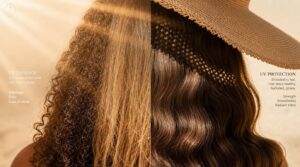
Sun damage affects hair differently depending on individual factors such as hair type, color treatment history, and daily habits. These elements collectively influence the level of risk you face.
Understanding how sun damage shows up in hair — from texture changes to color shifts — helps you connect the dots between your habits and what you’re actually seeing.
Understanding these variables is key to assessing your personal risk and taking proactive steps to protect your hair.
How UVA and UVB Rays Damage Hair
Think of UV rays as two kinds of troublemakers. UVB causes surface-level cuticle lifting and keratin breakdown, weakening hair’s tensile strength. UVA penetrates deeper, triggering melanin oxidation and free radical formation that disrupts color from within. Together, UV-induced oxidative stress drives hair protein degradation, leaving strands structurally compromised.
Here’s what happens beneath the hair cuticle protection:
- UVB damages keratin near the surface
- UVA oxidizes melanin deep inside the shaft
- Free radicals break down proteins and lipids
- Cuticle cells lift, exposing the inner cortex
- Tensile strength drops, making hair prone to snapping
The process also generates reactive oxygen species that further degrade hair lipids and proteins.
Dryness, Brittleness, Frizz, and Split Ends
UV rays lift the cuticle, causing moisture to escape rapidly and leaving hair dry and prone to snapping. This breakdown in cuticle sealing occurs in real time, compromising the hair’s structural integrity.
Poor porosity balancing leads to frizzy hair swelling unevenly in humid conditions, while weakened protein structures turn strands brittle. These issues exacerbate vulnerability to environmental stressors.
Without proper protection at the ends, split ends creep upward, accelerating damage. UV protection isn’t just about color—it’s critical for maintaining the structural soundness of every strand.
Color Fading and Brassiness
UV damage doesn’t stop at structure — it hits color hard too. Sun-induced lightening triggers oxidative color shift, breaking down blue pigments first. That’s when warm undertone reveals kicks in, pulling your blonde or brunette toward yellow and orange.
Mineral buildup can worsen the effect, accelerating unwanted tonal changes. Managing color-treated hair in sunlight requires understanding these chemical reactions.
Brassy or dull results aren’t accidental — they’re chemistry.
Brassy, dull hair isn’t a styling accident — it’s an inevitable chemical reaction to sun exposure
Premature Graying From UV Stress
Color isn’t the only thing UV radiation steals — it can also speed up graying. Here’s what’s actually happening inside your follicles:
- UV-induced oxidative stress triggers oxidative melanocyte injury, damaging the pigment cells responsible for hair color
- Catalase suppression in gray follicles reduces your hair’s natural antioxidant defense
- Melanogenesis gene downshift — including reduced MITF and TYR activity — quietly shuts down melanin production
- Follicle pigment uncoupling separates hair growth from color synthesis, so strands grow in without pigment
- The melanin UV feedback loop means less melanin leads to even greater UV vulnerability, accelerating the cycle
Preventing premature graying due to sun starts with understanding this chain reaction. UV radiation doesn’t just fade color — it dismantles the system that makes it.
Hair Types Most Vulnerable to Sun Damage
Not all hair takes the same hit from the sun. Fine Blonde Strands and Light Fine Hair lack enough pigment to absorb UV rays, leaving them wide open to bleaching and brittleness. Thin Straight Hair provides little physical barrier, making it susceptible to damage.
Tightly Coiled Locks and Porous Curly Hair lose moisture faster, worsening frizz and curl definition. Consequently, thin hair and light-colored hair are simply among the most vulnerable hair types to sun damage.
Chemically Treated, Lightened, and Fine Hair Risks
If your hair has been bleached, colored, or chemically processed, sun exposure hits harder. These treatments trigger oxidative breakdown and porosity amplification, leaving the cuticle fragile and thirsty for moisture it can’t retain.
Fine hair and light-colored hair face heightened breakage propensity, while color-treated hair suffers uneven lightening under UV stress. Cuticle fragility accelerates fading fast — protecting hair from UV radiation with a UV-protective hair product isn’t optional here.
Use UV-Protective Hair Products
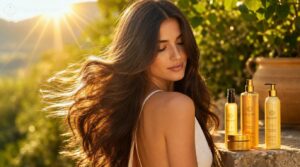
The right products can make a real difference for shielding your hair from UV damage. Just like your skin, your hair needs targeted ingredients to stay protected outdoors.
Here’s what to look for and how each option works.
If you’re letting your silver shine through, our guide on how to enhance natural grey hair covers toning, shine, and styling tips that pair perfectly with a gloss routine.
What to Put in Hair for Sun Protection
Your first line of defense starts in a bottle. Look for a UV protection spray with SPF-like filters — these SPF spray formulas deposit a mineral UV shield directly on each strand.
Oil-based barriers like coconut or argan function as protective hair oils, while protein fortifiers rebuild structure.
Adding an herbal extract boost — think green tea — gives your UV-protective hair product extra antioxidant power.
How Hair Sunscreen Works
UV filters in hair sunscreen work by forming a barrier film over each strand — coating the cuticle so UVA and UVB radiation cannot reach the proteins beneath. Chemical filters absorb UV energy before it causes harm, while mineral filters reflect it.
That broad-spectrum UV filtering also activates antioxidants like vitamin E, which neutralize free radicals before they fade your color or dry out the cortex.
Hair Sunscreen Vs. Skin Sunscreen
Skin sunscreen and hair sunscreen aren’t the same product in different packaging. Regulatory classification sets them apart — the FDA treats skin sunscreen as a drug, while hair UV products fall under cosmetics.
This distinction shapes everything from SPF labeling to ingredient differences in texture and feel. Skin formulas prioritize protecting living tissue, whereas hair formulas focus on shielding nonliving strands.
Skin formulas protect living tissue; hair formulas shield nonliving strands. For scalp vs. strand protection, you often need both.
UV Filters to Look For
Not all UV filters are created equal — and the label tells you everything. Look for these four UV filters ingredients that actually work for hair:
- Zinc oxide – a broad-spectrum mineral that blocks both UVA and UVB
- Avobenzone – a reliable UVA filter option for chemical formulas
- Octocrylene – a UVB stabilizer that boosts photostable filter combos
- Titanium dioxide – another broad-spectrum mineral sunscreen option
Together, these cosmetic UV filters deliver real protection.
Leave-in Conditioner With UV Protection
Once you’ve nailed down the right UV filter ingredients, putting them to work is simple — a leave-in conditioner with UV protection does double duty. It conditions while acting as sunscreen for hair.
Look for UV-protective hair products listing ethylhexyl methoxycinnamate among UV filter ingredients. These leave-ins enhance texture, reduce frizz, and shield color-treated strands without weighing hair down.
Antioxidants Like Vitamin E and Panthenol
UV filters block radiation, but antioxidants fight what slips through.
Vitamin E and panthenol work together to counter oxidative stress on hair — here’s what they actually do:
- Vitamin E delivers antioxidant protection through free radical scavenging
- Panthenol provides a moisture retention boost by converting to B5 inside the shaft
- Together, they offer synergistic antioxidant pairing for stronger cuticle defense
- Both support lipid barrier restoration along the hair surface
- This duo reduces UV protection gaps left by filters alone
Choosing Products for Your Hair Type
Not every SPF hair product works the same for everyone. Your chemical history, scalp sensitivity, and strand thickness all shape what your hair actually needs.
Fine, vulnerable hair types do best with lightweight UV-protective hair products, while coily or chemically treated strands need richer, porosity-compatible formulas.
Choosing texture-specific, thickness-tailored options means sun protection that works with your hair — not against it.
Apply Hair Sunscreen Correctly
Having the right product is only half the battle — how you use it matters just as much. A few small habits can make the difference between hair that’s truly protected and hair that just smells like sunscreen.
Here’s what to do to get the most out of every application.
When to Apply Before Sun Exposure

Timing is everything. Apply your SPF hair product at least 15 minutes before heading out — that is your product setting interval, giving the protective barrier time to form across each strand. For morning sun prep or a travel timing plan, factor this into your routine early.
Pre-swim timing matters too: apply before water contact, not after you’re already poolside.
How Much Product to Use
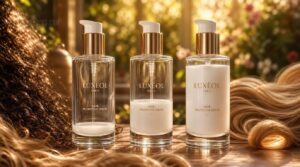
There’s no single right amount — it depends on your hair. Length-based measurement is your starting point: a palm-sized amount for medium hair, less for short, more for long.
Density-adjusted volume matters too — thick or curly hair needs more UV-protective product to build a consistent protective barrier. Fine-hair dosage should stay minimal; too much weighs strands down.
Porosity-driven application guides how much your hair actually holds.
Spraying and Combing for Even Coverage
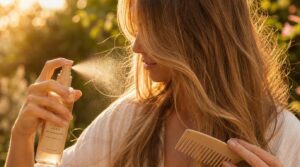
Hold your spray bottle about six inches from your hair and sweep across in smooth, steady passes — overlap each one by roughly half to avoid thin spots. Then comb through immediately to spread the product evenly.
For fuller coverage, try a crosshatch pattern: one set of horizontal passes, then vertical. This layered application builds a consistent protective barrier without weighing strands down.
Reapplying After Swimming or Sweating
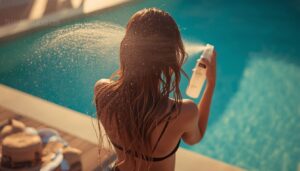
Once you’re out of the water, post-swim reapply is non-negotiable — sweat-triggered washout and chlorine exposure strip away your UV-protective hair product fast. Don’t wait for the two-hour mark if you’ve been swimming.
Reapply timing matters most in these moments:
- Immediately after towel-drying
- After heavy sweating
- After each water rinse
- Before your next long stretch in the sun
- When hair feels dry or uneven
A quick mist refresh with focused strand coverage rebuilds your protection in seconds.
Protecting The Hairline and Part Line
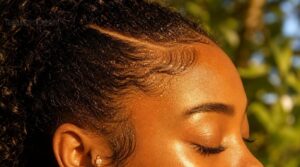
Your hairline and part line are the most exposed strips on your head. Apply hair sunscreen there first, using small-section application to coat every strand. A low-grease coating keeps friction-free styling intact without buildup.
For edge scalp hydration, work the product right to the root. This ensures thorough coverage while maintaining a lightweight feel.
Rotating your part direction daily also prevents repeated UV stress on the same spot, promoting even protection and scalp health.
Using SPF on Exposed Scalp
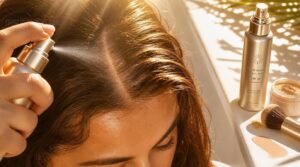
Your scalp needs SPF just as much as your skin does. For exposed areas—like thinning spots or a visible part—opt for SPF 50, broad-spectrum coverage.
Spray formulas work well with hair in place; powder options are low-mess alternatives. Whichever you choose, massage it in gently for full coverage.
If you’re new to scalp sun protection strategies, do a quick patch test first.
Common Hair Sunscreen Mistakes
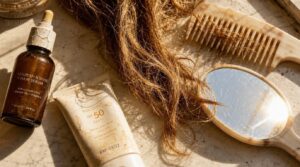
Even small habits can quietly undermine your protection. Watch out for these common missteps:
- Using an alcohol-heavy formula that dries out already sun-stressed strands
- Skipping proper sectioning, which leaves roots and the part line exposed
- Rushing outdoors before insufficient drying means the UV filter film hasn’t set
- Relying on expired sunscreen or missing scalp coverage on thinning areas
Fix these, and your routine actually works.
Cover Hair With Physical Protection

Sunscreen sprays do a lot of heavy lifting, but they’re not the whole story. Physical barriers—things you wear or how you style your hair—can cut UV exposure dramatically before any product even comes into play.
Here are some practical ways to shield your hair from the outside in.
Wide-Brimmed Hats for Maximum Shade
A wide-brimmed hat is honestly one of the smartest tools in your sun-safe hair arsenal. Look for a sun-safe hat with a UPF rating of 50+ — that blocks up to 98% of UV rays.
Prioritize UPF fabric types like nylon-polyester blends, a brim width of at least four inches, ventilation features for breathability, and adjustable fit options so it actually stays on.
UPF Scarves and Wraps
Not everyone loves hats — and that’s fine. A UPF-rated scarf offers the same UV protection for hair with greater flexibility.
Look for a fabric UPF rating of 50+, as weave density impacts matter: tighter fiber blend choices block more radiation.
Wrapping techniques and scarf style compatibility affect coverage. Double-wrap loosely around your hairline for consistent protection, ensuring it functions as a practical UV-blocking accessory.
Protective Hairstyles Like Buns and Braids
Styling your hair into a bun or braid does more than look polished — it provides real UV protection for hair. Tucking ends away limits exposed surface area, supporting moisture locking naturally.
Focus on tension management and edge safeguarding by keeping roots loose. This approach preserves scalp health while maintaining style integrity.
Protective hairstyles for sunny weather also reduce friction against clothing, minimizing damage from repetitive contact.
Extension integration adds coverage, effectively shading more of your scalp and enhancing overall protection.
Avoiding Peak Sun Hours
Protective styles buy you time, but midday timing matters just as much. UV rays are brightest between 10 am and 4 pm, so shade scheduling around that window cuts your sun exposure greatly.
Run quick UV index checks each morning—they take seconds. Pair that with heat stress coordination and flexible outdoor plans, and your hair stays safer without sacrificing your day.
Choosing Gentle Hair Ties
Hair ties matter more than most people think, especially when you’re already working to shield your hair from sun damage. Metal connectors snag and tear the hair cuticle, undoing the protective hairstyles for hot weather you’ve carefully arranged.
Instead, choose low-friction fabrics, wide padded bands, or coil-style release ties with silky texture. These protective accessories for hair reduce hair breakage prevention concerns without sacrificing hold.
Using Wide-Tooth Combs Outdoors
When the wind picks up and tangles set in, reaching for a wide-tooth comb with a light grip makes all the difference. Work in sections from ends to roots for knot release without stressing the hair cuticle.
Dryness management matters here — mist hair lightly if it feels parched. Clean your comb after each use to support moisture retention and prevent breakage, ensuring efforts aren’t wasted.
Protecting Thin or Flat Hair
Thin and flat hair is more susceptible to UV damage because there’s less hair shielding the scalp from the sun. A lightweight, UV-protective hair product—such as a weightless volumizing spray with built-in filters—safeguards strands without weighing down roots.
To enhance protection, incorporate UV-reflective hair clips, rinse hair with cold water after sun exposure, and apply weekly protein treatments. Even a quality hair sunscreen can make a significant difference in maintaining scalp and hair health.
Prevent Pool and Beach Damage
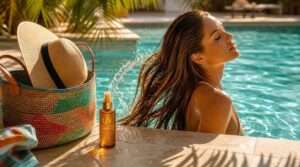
Sun and water make a tough combination for your hair. Chlorine, salt water, and UV exposure all hit at once, stripping moisture and weakening the cuticle faster than sun alone.
Here’s what you can do before, during, and after a swim to keep your hair protected.
Rinsing right after you get out is a great start, but pairing that with a conditioner made for chlorine-damaged hair makes a real difference in keeping strands soft and manageable.
Rinsing Hair Before Swimming
Before you jump in, give your hair a proper drink first. Saturating strands with lukewarm water right before you enter the pool greatly reduces chlorine or salt absorption — dry hair acts like a sponge.
- Time your pre-rinse just before entry
- Use lukewarm water for scalp saturation technique
- Apply even coverage method from roots to ends
- Avoid tangling by skipping harsh scrubbing
- Rinse promptly so hair stays saturated
Using Leave-in Conditioner Before Water Exposure
Think of leave-in conditioner as your hair’s personal shield. Applied to damp strands before entering chlorinated water, it creates a barrier film formation that slows moisture loss and limits chemical absorption.
This damp application technique maximizes the pre-wet slip boost, reducing friction between strands and safeguarding the cuticle — your hair’s protective outer layer.
By forming this barrier, the conditioner defends against UV rays and prevents the breakdown of water-resistant conditioning agents, ensuring prolonged protection.
Swim Caps for Chlorine and Saltwater
A good swim cap does more than keep your hair dry—it’s a physical barrier between your strands and chlorinated water or saltwater damage. Look for silicone fit designs with seal stretch and a non-slip edge; they stay put through every lap.
UV-resistant materials add outdoor protection, while an anti-friction lining reduces breakage. Swim caps are simple, effective protective accessories for hair.
High Buns to Limit Water Contact
Not everyone reaches for a swim cap, and that’s fine—a well-secured high bun is a surprisingly effective alternative. Gathering your hair into a top knot insulation style keeps strands above the waterline, reduces splash contact, and assists in water-shedding styling throughout your swim.
Bun anchor stability matters here: secure it tightly with pins to maintain hairline seal technique, and protect your scalp airflow design from prolonged moisture exposure.
Rinsing Hair Immediately After Swimming
Once you’re out of the water, don’t wait. A lukewarm rinse right away is your first line of defense — it starts quick residue dilution, washing away chlorine and salt before they dry into your strands. Massage your scalp gently to clear buildup near the roots.
Blot with a towel rather than rubbing, then do gentle detangling to minimize breakage on vulnerable, water-softened hair.
Gentle Shampooing After Chlorine Exposure
Once you’ve rinsed, follow up with a gentle, sulfate-free chlorine removal shampoo — ideally within 30–60 minutes. Low-foam formulas clean without stripping your already-vulnerable cuticle further.
For stubborn buildup, chelating shampoo benefits come from ingredients like EDTA, which binds mineral deposits, while sodium thiosulfate neutralizes residual chlorine. Don’t over-clarify, though — once is enough. Finish with conditioner for moisture barrier restoration.
- Choose a sulfate-free shampoo to support hair moisture retention post-swim
- Look for EDTA vs thiosulfate options depending on your buildup type
- Prioritize post-swim hair care and chlorine removal within the hour
- Treat chlorine damage to hair with a follow-up conditioner, not shampoo alone
Avoiding Harsh Chemical Treatments in Summer
Summer is the worst time to stack chemical services. Bleach timing matters — spacing sessions farther apart keeps your hair out of that fragile, overprocessed state during peak UV months.
Prioritize pH balance by rotating to gentler, sulfate-free shampoos that preserve natural oils.
Swap alcohol-heavy stylers for alcohol-free styling products, and rely on UV-protective hair products to complete your summer hair care routine.
Repair Sun-Damaged Hair
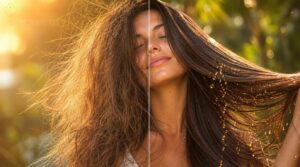
Sun-damaged hair isn’t a lost cause — it just needs the right kind of attention. The good news is your hair can bounce back with a few targeted steps.
Before reaching for stronger fixes, it’s worth understanding whether toning your hair twice is actually safe, since repeated toning can quietly worsen existing sun damage.
Here’s what actually works.
Can Sun-Damaged Hair Be Repaired?
Sun-damaged hair can’t fully reverse itself — but it can look and feel dramatically better. Think of it like a cracked wall: you can patch and smooth it, even if the original structure has shifted.
Here’s what actually helps:
- Deep conditioning treatments rebuild Moisture Retention
- Protein Reconstruction targets internal protein loss
- Hydrating masks with natural oils support Long-Term Maintenance
Consistent post-sun hair treatment methods make the real difference.
Fixing Straw-Like Hair
Straw-like texture signals protein imbalance and serious moisture loss in your hair, often caused by UV-induced oxidative stress stripping lipids and keratin. This damage results in brittle strands prone to snapping.
To address this, begin with a bond-repair treatment to restore protein balance, followed by silicone-free conditioning to seal moisture. Always finish with a Cold Water Rinse to smooth the cuticle and practice Gentle Detangling using a wide-tooth comb on wet hair only.
| Problem | Cause | Fix |
|---|---|---|
| Dry hair texture | Hair moisture loss from UV | Silicone-Free Conditioning |
| Brittle strands | Keratin protein breakdown | Bond-repair treatment |
| Rough, tangled feel | Lifted cuticles | Cold Water Rinse + Gentle Detangling |
Deep-Conditioning Masks for Dryness
When your hair feels parched after too much sun, deep conditioning treatments are your best recovery tool. Look for masks that combine:
- Glycerin Attraction and aloe to pull moisture back into the shaft
- Shea Butter Softending with ceramide barrier ingredients to lock hydration in
- Protein Fortification to rebuild structure lost to UV stress
Apply hydrating masks to damp hair, leave for 20 minutes, then finish with a cool rinse to seal the cuticle.
Bond-Repair Treatments for Weak Hair
When UV radiation chips away at your hair’s protein bonds, deep conditioning treatments alone can’t always fix the damage. That’s where bond-repair steps in.
| Treatment Type | Key Technology | Best For |
|---|---|---|
| Disulfide Bond Restoration | Crosslinking Technology | Bleached or chemically treated hair |
| Biomimetic Protein Repair | Keratin analogs | Protein loss in hair |
| Cationic Bond Builders | Multi-Step Protocol | Fine, UV-weakened strands |
Use these treatments consistently — not just once.
Coconut, Avocado, and Raspberry Seed Oil Treatments
Nature’s own oils can be surprisingly powerful allies for sun-damaged strands. Think of them as a liquid film barrier sealing each shaft against further stress.
- Coconut oil delivers lauric acid for deep fatty acid synergy, reducing moisture loss before and after UV exposure.
- Avocado oil offers rich oleic acid, softening brittle ends and restoring pliability.
- Raspberry seed oil provides an antioxidant boost with natural photoprotective compounds.
Master your application timing — apply oils to towel-dried hair, blending both for ideal blend stability.
Avoiding Heat Styling After Sun Exposure
After a long sunny day, your hair is already fighting to hold onto moisture — don’t add more heat to that battle. The Moisture-First Approach means conditioning before anything else. Thermal Recovery Timing matters: wait at least 24 hours before reaching for hot styling tools.
| Strategy | Why It Helps | Alternative |
|---|---|---|
| Cooling Lock-In | Stabilizes the cuticle | Air-dry naturally |
| Post-Sun Detangling | Reduces breakage risk | Wide-tooth comb |
| Heat-Free Styling | Prevents added protein loss | Braids or loose buns |
Avoiding heat styling in summer protects already-stressed strands from compounding heat damage.
Trimming Split Ends and Breakage
Once heat styling is off the table, your next move is the trim. Sun damage weakens hair cuticles, so split ends spread fast if left alone. Sectional cutting with sharp scissors gives you clean, precise results.
Gentle detangling prevents breakage during the process. Trim timing matters — don’t wait too long.
End protection starts with removal.
Building a Daily Recovery Routine
Think of recovery as a rhythm, not a rescue mission. Once trimming clears the damage, consistency does the real work.
- Morning Scalp Refresh — Apply a leave-in conditioner to damp hair before stepping out.
- Midday Moisture Mist — Spritz a UV-protective hair product between 10 a.m.–4 p.m.
- Post-Sun Detangling — Use a wide-tooth comb gently after rinsing with cool water.
- Evening Oil Seal — Finish with a light hair oil protection on your ends, locking in Sun Recovery Hydration overnight.
Rotate a hydrating hair mask and deep conditioners weekly to keep cuticles resilient.
Frequently Asked Questions (FAQs)
What can I put in my hair to protect from sun damage?
Start with a UV-protective hair product or leave-in conditioner — these create a silicone coating that shields each strand.
Hydrating oils, such as coconut oil and argan oil, add another layer of natural botanical SPF defense.
Can sun damaged hair be repaired?
Yes, but partly. Sun damage can’t be fully reversed — split ends need trimming, not fixing.
With consistent deep conditioners and bond-repair treatments, though, your hair can feel noticeably stronger and smoother over time.
How can I fix straw-like hair?
Straw-like hair needs moisture balance restored fast. Focus on deep conditioning masks for cuticle coating, protein replenishment, and gentle detangling.
Consistent hair hydration treatments rebuild what sun damage strips away from hair.
How to protect your hair from sun damage?
Protecting your hair from sun damage starts with understanding the risk. Use hair sunscreen, UV-protective hair products, and physical barriers like hats to keep strands strong and color intact.
How do I protect my hair from direct sunlight?
The sun that makes your hair glow can quietly destroy it. Use a UV-protective hair product, layer hair sunscreen, wear a wide-brimmed hat, and reapply after swimming.
How does sun damage your hair?
UV radiation hits your hair cuticle first, lifting its protective scales.
This triggers protein breakdown, lipid oxidation, and moisture evaporation deep inside the shaft.
The result is dry, brittle strands and increased vulnerability to scalp sunburn.
Does your hair protect your scalp from the Sun?
Your hair shields your scalp — but only partially. Think of it as a screen door, not a solid wall.
Hair density shielding and melanin absorption help, yet UV still slips through.
How to repair damaged hair after sun exposure?
Yes, sun-damaged hair can recover.
Start with a Protein Restoration Mask to rebuild weakened strands, followed by a Cold Water Rinse to seal the cuticle, and skip heat styling for at least 24 hours.
How do you protect your hair from UV rays?
Think of your hair as a fabric left in a window — UV rays slowly bleach and weaken it.
Hair sunscreen, UV-protective hair products, and protective accessories for hair are your first real defense.
How can I prevent my hair from getting sun damage?
Preventing sun damage starts with layering protection: apply a UV-protective hair product, use hair sunscreen, wear UV-reflective accessories, and embrace mindful sun exposure.
Natural oils add extra defense during seasonal hair care routines.
Conclusion
An ounce of prevention is worth a pound of cure—and your hair proves that every August. Learning how to protect hair from sun damage isn’t about overhauling your routine; it’s about adding a few deliberate steps before you head out the door. UV filters, physical coverage, and consistent post-sun care work together to keep your strands strong all season.
Start small, stay consistent, and your hair will carry the summer well.