
This site is supported by our readers. We may earn a commission, at no cost to you, if you purchase through links.
Growing a handlebar mustache takes weeks of patience and restraint. Shaving it into that perfect, symmetrical curl? That takes precision, the right tools, and a steady hand. One wrong snip can send you back to square one, watching your carefully cultivated lip curtain lose its iconic shape.
The difference between a sharp, distinguished handlebar and a lopsided disaster often comes down to technique. You don’t need a professional barber to nail the look—just a clear plan and the confidence to shape those ends without second-guessing every cut.
Master the fundamentals of trimming, mapping symmetry, and styling with wax, and you’ll transform your mustache from wild growth into a statement piece worth showing off.
Table Of Contents
- Key Takeaways
- What is a Handlebar Mustache?
- Is Your Mustache Ready to Be Shaved?
- Essential Tools for Shaving a Handlebar Mustache
- Preparing Your Mustache for Shaving
- Mapping Out Your Handlebar Shape
- Step-by-Step Guide to Shaving a Handlebar Mustache
- How to Avoid Common Shaving Mistakes
- Styling Your Handlebar After Shaving
- Daily Maintenance for a Sharp Handlebar Look
- When to Trim or Reshape Your Handlebar Mustache
- Frequently Asked Questions (FAQs)
- Should you trim a handlebar mustache?
- What are common handlebar mustache mistakes?
- How to sculpt a handlebar mustache?
- How long does it take to grow a handlebar mustache?
- What is the difference between a handlebar and an imperial mustache?
- What type of wax is best for styling a handlebar mustache?
- What are the benefits of having a handlebar mustache?
- What is the proper technique for curling a handlebar mustache?
- Can handlebar mustaches work for patchy facial hair?
- How do you eat soup with a handlebar?
- Conclusion
Key Takeaways
- Your handlebar mustache needs one and a half to two inches of growth beyond your mouth corners before you can shape those signature upward curls with wax and proper trimming technique.
- Trim conservatively in small passes using scissors or trimmers at a 10-degree angle along your upper lip line, checking symmetry constantly to avoid over-cutting mistakes you can’t undo.
- Apply mustache wax from center to tips, then twist each end upward at a 45 to 60-degree angle while warming the curl with a blow dryer set between 300 and 350 degrees for lasting hold.
- Maintain your handlebar with daily cleansing using mild shampoo, reapply wax every 8 to 12 hours, and schedule maintenance trims every two to four weeks depending on your growth rate.
What is a Handlebar Mustache?
Before you can shape and shave a handlebar mustache, you need to know exactly what you’re working with. The handlebar is one of the most recognizable styles out there, but it’s also one of the most misunderstood.
Let’s break down what makes this mustache stand out and how it stacks up against other popular styles.
If you’re curious about how different styles are perceived overall, this guide explores whether mustaches are attractive and what influences those opinions.
Defining Handlebar Mustache Shape
A handlebar mustache features upward-curling ends that extend beyond the mouth corners, creating a bold signature look. Facial structure and hair texture influence curl direction and symmetry, while mustache wax holds those iconic tips in place. Trimming maintains clean lines, and style variations range from tight compact curls to dramatic sweeping shapes.
- Upward curl — Ends angle 25 to 45 degrees from your lip line
- Extended tips — Curls reach 1.5 to 2.5 inches past mouth corners
- Symmetrical balance — Both sides mirror each other within 1/8 inch
- Clean lip line — Upper edge stays near your natural lip edge
- Customizable length — Total width spans 6 to 8 inches tip to tip
Handlebar Vs. Other Mustache Styles
Unlike chevron or pencil mustache styles that hug your lip line, the handlebar sends those ends outward and upward into dramatic curls. Most facial hair trends keep growth tight above your mouth, but handlebar mustache styles demand width and length for that signature twist.
Curl techniques with wax transform longer growth into shape, while beard variations like goatees often complement this bold mustache choice perfectly.
Is Your Mustache Ready to Be Shaved?
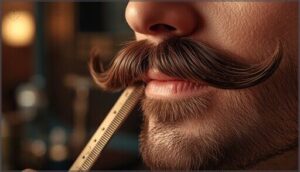
You can’t sculpt a masterpiece out of thin air, and the same goes for your handlebar mustache. Before you reach for the scissors or trimmer, you need to know if your facial hair has what it takes.
Let’s look at the growth benchmarks that’ll tell you whether it’s time to start shaping or if you should keep waiting.
Ideal Length for Shaping
Your mustache needs about one and a half to two inches beyond the mouth corners before you can shape those signature curls. Shorter lengths won’t hold the twist, and longer growth can get unruly fast.
Check both sides for symmetry—uneven facial hair ruins the handlebar look.
The upper lip line should stay clean at one-eighth inch above your lip for precise shaping and better mustache maintenance.
Assessing Growth and Thickness
Length matters, but thickness tells the real story. Your follicle health and genetic factors determine facial hair density—some guys pack 100 follicles per square centimeter while others hit half that.
Check these markers before you shape:
- Hair growth rates average 0.27 to 0.5 millimeters daily, so track weekly progress
- Mustache thickness increases as terminations produce multiple shafts per follicle
- Uneven mustache growth means waiting another week or two
Patience beats rushing every time.
Essential Tools for Shaving a Handlebar Mustache
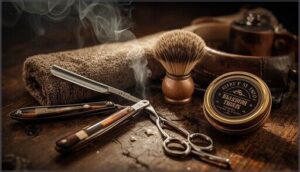
You can’t wrangle a handlebar mustache into shape with just your bare hands and hope. The right tools make the difference between a sharp, controlled look and a wild mess that fights you every morning.
Once you’ve got the shape locked in, finishing with proper aftershave application keeps your skin smooth and irritation-free.
Here’s what you need in your grooming arsenal to get it done right.
Scissors Vs. Trimmers
You’ve got two main trimming tools to choose from—scissors and trimmers—and each brings distinct advantages. Scissors give you precise control over blade sharpness and edge quality, perfect for handlebar mustache care when shaping those signature curls.
Trimmers handle quick beard trimming with guarded consistency, but they can flatten hair texture if you’re not careful with your cutting techniques.
Choosing Mustache Combs and Brushes
The right grooming tools make styling your handlebars a breeze instead of a battle.
Wooden or metal comb materials offer durability, while fine tooth comb designs tame flyaways along your lip line. Boar bristle brush types distribute natural oils for shine, and ergonomic handle designs give you solid grip options when working with mustache wax.
Choose tools that match your mustache care routine and hair thickness. For the best results, consider exploring these high quality mustache comb options to find the perfect tool for your needs.
Selecting The Right Mustache Wax
Your hair type determines the hold level you need—thick mustaches demand extra strong formulas, while thinner hair reacts to light or medium hold. Check wax ingredients like beeswax for stiffness and shea butter for moisture, then explore these application tips:
- Warm a pea-sized amount between fingers until pliable
- Choose natural formulas to minimize skin irritation
- Test scent options before committing to daily wear
- Reapply during the day for consistent mustache styling tips
For lasting results, it’s important to understand the role of in maintaining your style throughout the day.
Preparing Your Mustache for Shaving

You can’t shape a handlebar mustache if it’s a tangled, waxy mess. Proper prep work makes the difference between a clean trim and a crooked disaster.
Let’s walk through the washing and conditioning steps that set you up for success.
Washing and Drying Techniques
A clean handlebar starts with proper mustache cleaning using lukewarm water and mild shampoo. Warm water temperature opens follicles without drying your skin.
Massage cleanser for 20 to 30 seconds, rinse thoroughly, then blot with a microfiber towel. Air drying preserves natural curl and prevents frizz.
Leave your facial hair slightly damp for easier styling—excess hair moisture weakens wax hold.
Detangling and Pre-Shave Conditioning
Detangling Tips start with a wide-tooth comb gliding through damp facial hair from roots to tips. A leave-in conditioner makes hair conditioning easier and reduces breakage during shave preparation.
Apply 2 to 4 drops of pre-shave oils evenly across your handlebar mustache for smoother blade contact. Let the oil absorb for 1 to 2 minutes before lathering—this protects skin during grooming.
Mapping Out Your Handlebar Shape
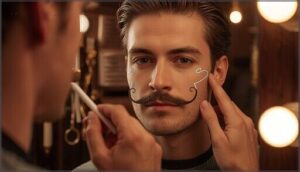
Before you start cutting, you need a clear game plan for where to trim and where to leave things alone. Think of this step as drawing a roadmap on your face—it keeps you from making cuts you’ll regret later.
Here’s how to mark out your handlebar shape with confidence and precision.
Identifying Key Shaving Areas
Think of your handlebar mustache like a sculptor’s block of marble—you need to know exactly where to carve before you make the first cut. Identifying key shaving areas prevents disastrous over-trimming and keeps your facial mapping sharp.
- Upper lip line: Trim from nose to mouth, keeping width roughly matching your nose for proper handlebar shape
- Cheek edges: Clean stray hairs above mustache using precise shaving techniques and edge control
- Mouth corners: Avoid trimming here—these anchor your handlebar’s signature curl and maintain hair texture
- Center part: Mark the middle point for symmetry checks before any beard trimming begins
Marking Symmetry and Evenness
Once your key areas are identified, you need to make sure both sides match. Use your center part as the anchor point and measure outward with a ruler or straight edge—each curl endpoint should sit at equal distance from your nose. Check curl heights in a mirror under neutral light; they should rise to the same level within two millimeters. Mark any uneven spots with a washable pen before you start trimming.
| Check Point | What to Measure | Target Result |
|---|---|---|
| Curl endpoints | Horizontal distance from center | Equal spacing both sides |
| Curl height | Rise above lip line | Within 2mm difference |
| Arc length | Center to outer tip | Matching curvature radius |
Step-by-Step Guide to Shaving a Handlebar Mustache
Now it’s time to get your hands dirty and actually shape that handlebar. You’ve got your tools ready and your outline mapped—the fun part starts here.
Follow these three key steps to carve out a classic handlebar that’ll turn heads.
Trimming The Upper Lip Line
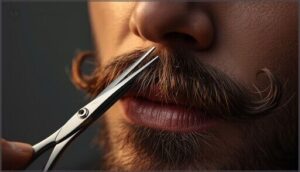
A steady hand transforms your upper lip line from shaggy to sharp. Focus on edge definition by holding your scissors or beard trimming tool at a shallow blade angle—about 10 degrees keeps the cut clean without tugging.
Proper upper lip care prevents irritation and sets the stage for mustache wax application later.
- Pull skin taut above your lip to create a smooth canvas for precision microtrimming.
- Trim conservatively along the natural curve, following your mouth’s contour.
- Check symmetry by relaxing your face between passes.
Shaping The Ends for Curl
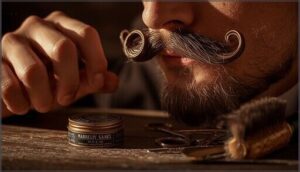
Once your upper lip line is clean, shift focus to the signature curl at each end. Aim for a 45 to 60 degree angle from your lip line—this classic arc gives your handlebar mustache its rebellious swagger.
Trim tiny amounts to taper the tips, then apply a dab of mustache wax from base to curl. Twist outward to lock in curl formation and seal the shape.
Cleaning Up Cheek and Mouth Edges
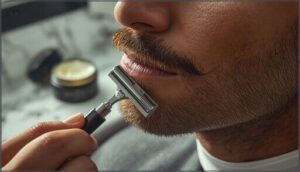
Now it’s time for facial contour cleanup to frame your handlebar mustache like a champion. Use light strokes along the cheek cleanup zone to remove stray hairs above your jawline, following a natural upward curve.
Focus on the mouth edge for symmetry, trimming 0.5 to 1.5 millimeters above your lip line. Rinse with cold water and apply alcohol-free balm for skin safety.
How to Avoid Common Shaving Mistakes
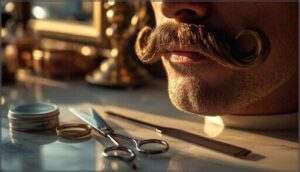
Even experienced groomers can slip up when shaping a handlebar mustache, and those mistakes are tough to undo. The good news is that most errors come down to two things: cutting too much and misjudging balance.
Here’s how to keep your mustache looking sharp without any regrets.
Preventing Over-Trimming
One wrong snip can turn your handlebar masterpiece into a handlebar disaster. Always work in small passes with scissors or shaping tools, removing just a few hairs at a time. Step back and check your work after every trim.
Remember, hair texture affects how much you can safely cut—thicker mustaches hide mistakes better than thin ones. You can’t glue it back on, so go slow.
Thicker mustaches forgive trimming errors better than thin ones, but you can’t glue hair back on—so trim conservatively
Ensuring Both Sides Are Even
Perfect symmetry is the hallmark of a polished handlebar mustache. Use mirror techniques to compare both sides at the lip line—check that each end curls to within 1 to 2 centimeters of the other. Apply equal mustache wax on each side for balanced style.
Trim light passes, alternating sides to maintain facial alignment. Step back frequently during beard trimming techniques to catch imbalance before it’s too late.
Styling Your Handlebar After Shaving
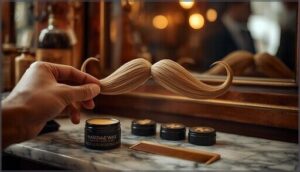
Now that you’ve shaped your mustache, it’s time to bring that handlebar to life. Styling isn’t just about slapping on some wax and calling it a day—it’s about locking in your hard work with the right technique.
Here’s how to apply wax, twist those ends, and use heat tools without torching your masterpiece.
Applying and Distributing Mustache Wax
Wax application sets the stage for a great handlebar mustache. Warm a small amount between your fingertips for five to ten seconds until it softens. Start at the center of your lip line, then push outward with light, feathering strokes. This wax distribution technique coats each hair without clumping.
Match your mustache wax to hair texture—lighter for fine mustaches, firmer for dense growth.
Twisting and Curling The Ends
Your handlebar mustache styling hinges on mastering the twist. After wax application, pinch the very tip of each end and roll it gently between your thumb and forefinger. This twist technique trains the curl formation while the wax sets.
Work outward from the mouth corner, applying light pressure until the ends hold a visible upward curve. Let them cool for ninety seconds to lock in that classic shape.
Using Heat Tools Safely
A blow dryer locks in your twist, but heat protection comes first. Set your tool between 300 and 350 degrees to avoid singeing delicate facial hair during styling.
- Apply heat protectant spray before wax application to shield strands
- Keep the dryer moving and never hold it closer than four inches from skin
- Clean the barrel after each session to prevent product buildup
These safety guidelines and tool maintenance habits prevent burn injuries while you master barbering techniques. Proper mens grooming means respecting both hair products and your face.
Daily Maintenance for a Sharp Handlebar Look

You’ve nailed the shave and the style, but your handlebar won’t keep that sharp look on autopilot. Daily upkeep is what separates a dignified ‘stache from a scraggly mess.
Here’s how to keep your handlebar clean, conditioned, and camera-ready every single day.
Cleaning and Conditioning Tips
Your handlebar deserves daily facial care to look sharp and feel healthy.
Cleanse with mild shampoo and lukewarm water to remove wax buildup and debris without stripping natural oils. Pat dry gently, then work a few drops of lightweight conditioner through the hair to soften strands and prevent breakage.
Follow with a non-comedogenic moisturizer on the skin beneath to lock in hydration and support mustache hygiene.
Reapplying Wax and Restyling
After cleansing, you’ll need to reapply mustache wax when the hold loosens—usually every 8 to 12 hours. Warm a pea-sized amount between your fingers until clear, then distribute from center outward for curl maintenance and even handlebar care.
- Twist the ends around your finger to encourage upward curl
- Allow 2 to 5 minutes for wax to set before final adjustments
- Carry a small travel tin for on-the-go restyling tips
When to Trim or Reshape Your Handlebar Mustache
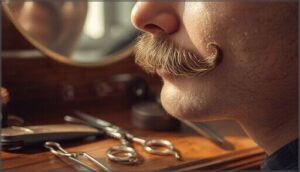
Your handlebar won’t stay perfect forever, no matter how much wax you slap on it. Over time, you’ll notice stray hairs sneaking past your lip line or uneven ends throwing off your whole look.
Knowing when to grab the scissors and how often to clean things up keeps your mustache looking sharp without overdoing it.
Recognizing Signs for a Touch-Up
Your mustache tells you exactly when it’s time for a touch-up. Watch for these telltale signs that demand attention:
| Visual Cue | What to Check | Action Needed |
|---|---|---|
| Beard Line | Uneven or blurred upper lip edge | Reshape for crisp silhouette |
| Curl Definition | Ends pointing inward or losing hook | Restore outward bend symmetry |
| Side Alignment | Uneven height between panels | Equalize contour and length |
| Lip Sharpness | Blended boundary at lip line | Light trim for clean edge |
Density balance and consistent thickness signal you’re ready for mustache maintenance with your beard trimming tools and mustache wax.
Frequency of Maintenance Trims
Once you’ve spotted those signs, lock in your trim schedules to keep that handlebar mustache sharp. Most men hit the barber chair every two to four weeks, balancing growth rates with curl maintenance. Here’s your roadmap:
- Schedule trims every three weeks if you’re refining your first handlebar
- Adjust to two-week intervals for thick, fast-growing facial hair
- Extend to four weeks when slower growth keeps symmetry intact
- Align trimming with wax applications and beard trimming days for efficiency
Consistent mustache maintenance and smart shaping techniques protect your investment.
Frequently Asked Questions (FAQs)
Should you trim a handlebar mustache?
A vintage bartender with an impressive handlebar found that regular snips kept his signature curls symmetrical and sharp.
Yes, you should trim your handlebar mustache—small cuts preserve shape, prevent split ends, and maintain balanced sides.
What are common handlebar mustache mistakes?
You’ll run into lip line errors if your upper edge is uneven or too close. Curl mistakes happen when ends are overly short.
Trimming issues, wax application blunders, and poor handlebar maintenance ruin your look.
How to sculpt a handlebar mustache?
Think you can wing handlebar styling without wax? You’ll just look disheveled.
Sculpting a Handlebar Mustache demands applying quality wax from center outward, twisting ends upward with fingers, and using heat tools to lock your curl.
How long does it take to grow a handlebar mustache?
Most men reach handlebar-worthy length in eight to twelve weeks, though full density and curl potential often take four to six months. This timeline depends on genetic factors and facial hair growth patterns.
What is the difference between a handlebar and an imperial mustache?
A handlebar mustache features long, dramatic ends that curl upward with wax, while an imperial spreads thick and full across your upper lip with minimal curling—both iconic mustache styles demanding different facial hair grooming approaches.
What type of wax is best for styling a handlebar mustache?
You want a beeswax-based mustache wax for the strongest hold and best curl retention.
Hybrid waxes with carnauba offer great rigidity while staying reworkable, balancing firm styling with natural-looking mustache maintenance throughout your day.
What are the benefits of having a handlebar mustache?
A well-groomed handlebar mustache creates powerful facial framing, enhances your expressions, and builds memorable personal branding.
The distinctive style signals confidence, versatility, and careful grooming that sets you apart in any social setting.
What is the proper technique for curling a handlebar mustache?
Start with quality mustache wax warmed between your fingers. Apply from center to tips, comb through, then lift and twist each end upward and outward. Use your finger to shape a smooth, tight curl.
Can handlebar mustaches work for patchy facial hair?
Even if your cheeks look sparse, the mustache zone usually grows denser than other areas. Strategic waxing and upward curling create fullness, masking patchiness while drawing attention to your handlebar’s bold, sculpted ends.
How do you eat soup with a handlebar?
Tilt your bowl away from your mustache and take small, controlled spoonfuls to keep soup off your facial hair.
Apply light wax beforehand so the ends stay curled, and keep a napkin handy for quick cleanups.
Conclusion
Your handlebar mustache is more than facial hair—it’s a flag you plant in the ground, declaring you’ve mastered something most men won’t attempt.
Learning how to shave a handlebar mustache transforms raw growth into a sculpted signature, one precise cut and waxed curl at a time.
Keep your tools sharp, your symmetry checked, and your styling game consistent. That mirror doesn’t lie, and neither will the double-takes you earn.