This site is supported by our readers. We may earn a commission, at no cost to you, if you purchase through links. This content is for general informational and educational purposes only and is not a substitute for professional medical, dermatological, or nutritional advice.
One side always grows faster. You trim a little off the left, check the mirror, then chase that same edge on the right for ten minutes straight, and somehow it still looks crooked. Sound familiar?
That lopsided chase happens because most guys trim up close, under bad light, without a centerline to work from. Your eyes trick you at three inches away — distance and proper anchoring fix that fast.
Get your prep right, your tools right, and your reference points right, and how to trim mustache evenly stops being a guessing game. Here’s the sequence that actually holds up under a mirror.
Table Of Contents
- Key Takeaways
- How to Prep Your Mustache Before Trimming
- How to Trim a Mustache Evenly Step-by-Step
- Top Tools for a Precise Mustache Trim
- Fixing Common Mustache Trimming Mistakes
- Frequently Asked Questions (FAQs)
- How far down should you trim your mustache?
- What to do if the mustache is uneven?
- How to trim a mustache with a gap?
- Are you supposed to trim your mustache above your lip?
- How often should you trim your mustache?
- Can you trim a mustache without scissors?
- What mustache style suits your face shape?
- How long should you let it grow first?
- Does mustache wax help maintain a trimmed shape?
- Conclusion
Key Takeaways
- Prep your mustache by washing, conditioning, and drying it completely before trimming, since damp hair stretches and leads to cutting it too short.
- Always trim from the centerline outward using a longer guard first, taking off small amounts and comparing both sides constantly to keep symmetry.
- Step back a few feet to check your work from a distance, since close-up viewing tricks your eyes and causes unnecessary over-correction.
- Fix uneven mustaches by debulking the fuller side with scissors in small snips rather than reaching for the trimmer or overcorrecting all at once.
How to Prep Your Mustache Before Trimming

Before you touch a trimmer to your mustache, you’ve got some groundwork to cover. Skip the prep and even the steadiest hand will end up with uneven results. Here’s what you need to do first.
If you want the full rundown on getting your setup right, this guide to beard trimming prep for men walks through the basics before you start on your mustache.
Wash and Soften Facial Hair
Grab your beard wash first and work it in with your fingertips using small circles, so the cleanser reaches down to the skin and lifts dirt out of the follicles.
Rinse with warm water, then follow with conditioner, leaving it on for a minute or two. This softens hair fibers, making them easier to trim without tugging or resistance.
Dry Completely Before Cutting
Once you’ve rinsed out the conditioner, towel dry the mustache completely, don’t rush this part. Wet hair stretches, so it looks longer than it really is, and you’ll end up cutting too short once it dries and shrinks back. Damp strands also snag on scissors and clippers. Let it dry fully, no cool or tacky spots, before you trim.
For safer shaping, follow this mustache trimming with clippers guide and start with a longer guard.
Learning dry cutting techniques can help you achieve much more precision.
Comb Hair Into One Direction
Once dry, take your fine-tooth comb and comb through the mustache, working with the natural grain rather than against it. Hair on the left, right, and center often grows in slightly different directions, so check each section separately.
Keep tension light to avoid tugging, and repeat the strokes until every strand lies flat in one direction — that’s your even cutting line.
Set Up Proper Lighting and Mirror
Bad lighting ruins even the best combing job. Set up lights at face height, not just overhead, since downward shadows exaggerate uneven length. Angle a second light source to fill in shadowed corners.
- Face-height lighting from both sides
- Clean, non-glare mirror surface
- Mirror centered at nose and lip level
- Steady, untilted mirror position
- Magnifying mirror checked against a standard one
Symmetry starts with what you actually see.
How to Trim a Mustache Evenly Step-by-Step
Once your mustache is prepped and dry, it’s time to pick up the tools. Trimming evenly isn’t about rushing through it, it’s about following the right order every single time. Here’s exactly how to work through it, step by step.
Start With a Longer Guard
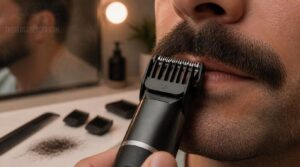
Never start with your shortest guard, that’s how holes happen. Pick a longer guard first, since it leaves extra length as a safety margin while you map the mustache shape and gauge thickness across both sides.
Once you’ve settled on a starting guard, this step-by-step short beard trimming guide can help you fine-tune the mustache edges without overcorrecting too soon.
This prevents over-cutting before you’ve even checked symmetry. Once you’re confident, switch to shorter adjustable guards for precision trimming and tighter cleanup.
Trim From Center Outward
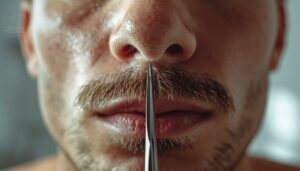
Anchor everything to the middle first. Line up your comb’s edge with the middle of the nostrils, that’s your centerline anchor point, and trim only what pokes past it.
Work outward in short snips, checking each side against the other as you go:
- Comb hairs down before each pass
- Trim tiny sections, not big swipes
- Compare left to right constantly
- Leave the center fuller than the edges
That’s how you keep symmetry while managing central fullness.
Define The Lip Line
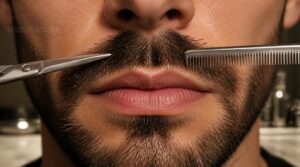
Look for the vermilion border, that thin line where your lip color starts, and trim any hair crossing onto it. Follow your natural lip curvature instead of a straight edge.
Keep the philtrum crease visible at center, don’t bury it under overhanging hair. Match corner lip symmetry on both sides, and leave a hair’s width margin above the lip for a clean, defined line.
Check Symmetry From a Distance

Step back a few feet and take a real look, since up close you’ll fixate on tiny snips that don’t matter from normal distance. This avoids near-detail bias and reveals true silhouette symmetry.
Hold your mirror steady at eye level, keep your face centered, and compare both sides against the same reference points, your nose center and mouth corners, every single check.
Detail Edges and Nostril Hairs
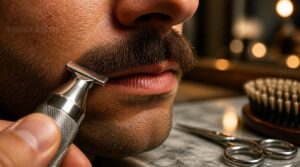
This is where a mustache goes from "decent" to sharp. Switch to your detailing head or T-blade and clean up the perimeter, working small strokes at the corners so you don’t over-shorten the center.
For stray hairs, grab your mustache scissors for precision snips instead of the trimmer.
Nostril safety matters here: trim only what pokes out, since inner hairs filter dust and shouldn’t be removed.
Top Tools for a Precise Mustache Trim
Good technique only gets you so far without the right gear in your hand. A dull trimmer or flimsy scissors will fight you every step of the way, no matter how careful you are. Here’s what actually belongs in your kit.
Investing in a quality diffuser matters just as much as your cutting tools, since the right attachment shapes how evenly your curls dry—check out this step-by-step guide to diffusing curly hair for technique tips that pair perfectly with your gear.
1. Philips Norelco Multigroom Series 7000
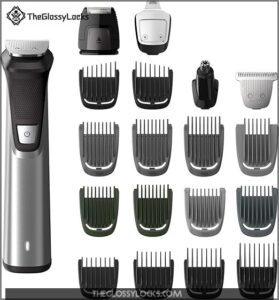
Grab this one if you want a whole grooming kit, not just a mustache tool.
The DualCut self-sharpening blades run up to five years without oil, and the 23-piece attachment set covers beard, head, and body too.
It’s powered by lithium-ion, giving you roughly 5 hours of runtime per charge, and the fiberglass guards resist bending under regular use.
At 14.96 ounces, it’s solid but manageable, great for guys who want one trimmer that does it all reliably.
| Best For | Guys who want one reliable trimmer for beard, head, body, and face instead of juggling several separate tools. |
|---|---|
| Material | Metal/Steel |
| Weight | 14.96 oz |
| Power Source | Lithium-ion Rechargeable |
| Primary Use | All-in-One Grooming |
| Precision Level | High-Torque General |
| Maintenance | Maintenance-Free |
| Additional Features |
|
- Self-sharpening DualCut blades last up to 5 years with no oiling required
- 23-piece attachment set covers nearly every grooming need
- Steel frame and rubber grips give solid, comfortable control during use
- Battery must be periodically recharged, so runtime is capped at about 5 hours
- Large attachment set can be tricky to store neatly
- Full metal motor and reinforced drivetrain add some heft compared to lighter trimmers
2. Wahl Lithium Pen Detail Trimmer
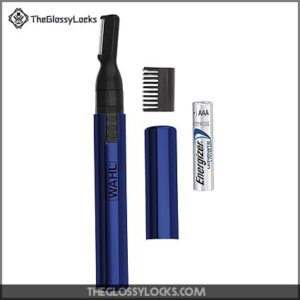
If the Norelco is your all-in-one kit, the Wahl Lithium Pen is your precision backup for the lip line itself. It’s a 2-in-1 detail trimmer with snap-off heads, one for close outlines, one rotary head for nose and ear hair.
The lithium battery gives you solid runtime for touch-ups, and blades rinse clean under the tap. The anodized aluminum body feels sturdy but light, perfect for one-handed shaping right along the edge of your mustache.
| Best For | Anyone who wants a compact, precision tool for detailed touch-ups like mustache edges, nose hair, and ear hair between full grooming sessions. |
|---|---|
| Material | Anodized Aluminum |
| Weight | 2 oz |
| Power Source | 1 AAA Lithium Battery |
| Primary Use | Nose/Ear/Brow Detailing |
| Precision Level | Detail Precision |
| Maintenance | Battery Replacement |
| Additional Features |
|
- Interchangeable snap-off heads make it easy to switch between detail outlining and nose/ear trimming
- Lithium battery offers reliable runtime for quick touch-ups on the go
- Detachable heads rinse clean under the tap for simple, hygienic maintenance
- Runs on a single AAA battery, so you’ll need to keep replacements on hand
- Compact size makes it better suited for detail work than full grooming coverage
- May include minor testing particles from factory quality checks
3. Tweezerman precision moustache grooming scissors
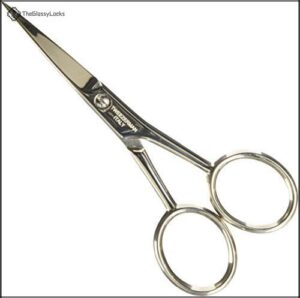
Once your edges are outlined, precision scissors take over for the fine work. Tweezerman’s scissors use sharp, straight stainless steel blades honed for snag-free cuts on individual hairs, with a fixed pivot that keeps tension consistent every snip.
The large finger loops give you real control, so you can work corner-to-center without wrist strain. Many models pair with a built-in comb for guided, symmetrical shaping. Clean blades with alcohol after each session, and only cut small amounts at a time.
| Best For | Anyone who wants sharp, precise control for trimming and shaping moustache or beard hair in small, careful amounts. |
|---|---|
| Material | Stainless Steel |
| Weight | 1.44 oz |
| Power Source | Manual |
| Primary Use | Mustache/Beard Trimming |
| Precision Level | Fine Detail Precision |
| Maintenance | Alcohol Cleaning |
| Additional Features |
|
- Precision straight stainless steel blades deliver clean, snag-free cuts
- Ergonomic design with large finger loops offers excellent control and reduces wrist strain
- Durable stainless steel construction built to last
- Requires cleaning with alcohol after every use
- Best suited to cutting small amounts of hair at a time, so it’s slower for bigger jobs
- Precision-focused design isn’t ideal for trimming large areas quickly
4. Jason professional beard trimming scissors
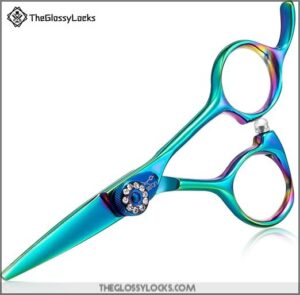
If you want a workhorse pair for everyday shaping, these are built with Japanese 440C steel, so the edge stays sharp longer between sharpenings. The hollow-ground, convex blades cut clean without snagging or tugging stray hairs.
The offset handle drops your thumb below your index finger, cutting wrist strain on long sessions. A tension screw lets you dial in blade tightness to taste.
Wipe blades dry after each use and oil the pivot point to stop rust from creeping in.
| Best For | Anyone who wants precise, detailed grooming for beards, mustaches, bangs, and stray nose or ear hairs rather than bulk hair removal. |
|---|---|
| Material | Stainless Steel |
| Weight | N/A |
| Power Source | Manual |
| Primary Use | Facial Hair Trimming |
| Precision Level | Detail Work |
| Maintenance | Manual Care |
| Additional Features |
|
- Stainless steel blades offer precise, detailed cutting control
- Specialized shear design makes quick work of facial hair and fine detail trimming
- Compact 4.5-inch blade length is easy to maneuver in tight spots
- Not suited for bulk hair removal or larger grooming jobs
- Manual operation demands a steady hand for clean results
- Detail-focused design means slower going compared to powered trimmers
5. Kent Cellulose Acetate Mini Pocket Comb
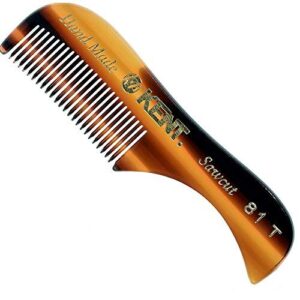
Once your scissors are clean, you’ll need a comb that can keep up with them between cuts. Kent’s mini pocket comb is saw-cut from cellulose acetate and hand-polished, so the rounded teeth glide without snagging skin or hair.
At 112 mm, it tucks into a pocket for quick touch-ups on the road. Fine teeth suit light-to-medium mustaches best, straightening fibers before every snip and spreading natural oils for a healthier finish.
| Best For | Anyone who wants a portable, precise comb for mustache and beard grooming between trims. |
|---|---|
| Material | Cellulose Acetate |
| Weight | 0.3 oz |
| Power Source | Manual |
| Primary Use | Mustache/Beard Styling |
| Precision Level | Fine-Tooth Precision |
| Maintenance | Wipe Clean |
| Additional Features |
|
- Rounded, hand-polished teeth glide smoothly without snagging skin or hair
- Compact, pocket-friendly size makes it easy to carry for travel, car, or office touch-ups
- Cellulose acetate construction reduces static and stimulates natural oils for a healthier finish
- Fine teeth are best suited to light-to-medium facial hair, not thick or coarse detangling
- Extra-small size may feel limiting for those who prefer a larger, full-size comb
- Delicate build means it’s not ideal for heavy daily use compared to sturdier combs
Fixing Common Mustache Trimming Mistakes

Even with a steady hand, mistakes happen, and that’s fine. A crooked line or a bald patch doesn’t mean starting over from scratch. Here’s how to fix the most common slip-ups without ruining the whole mustache.
A crooked line or a bald patch doesn’t mean starting over—every mustache mistake can be fixed
Correcting an Uneven Mustache
One side higher than the other? That’s the most common uneven mustache problem, and it’s fixable.
- Brush hair down first for true symmetry
- Identify the fuller side
- Debulk the heavy side with scissors, not the trimmer
- Trim in small snips, checking often
- Step back for distance viewing before cutting more
Growth rate varies naturally—don’t over-correct. Targeted scissor work beats guesswork every time.
Trimming Around a Gap
Going for a soul patch gap or a clean split under the nose? Comb hairs down first, then trim to the lip line, leaving that intentional gap. Gap edge consistency matters most, so keep blades parallel and cut small amounts.
Watch for hair spring afterward, hairs rise once released. Match both sides using the comb as your measuring stick, keeping the boundary symmetrical before blending edges outward.
Avoiding Over-Trimming The Center
Ever notice the center always ends up shorter than you planned? That’s because it’s the spot barbers hit repeatedly. Trim your mustache from center outward, taking off 1-2mm at a time. Let cut hair settle before judging length, since fresh trims look shorter than they’re. Check symmetry from arm’s length, and keep tool pressure even to avoid trimming mistakes.
Blending Mustache Into Beard
A sharp line where mustache meets beard looks unfinished, so fade it into your beard using gradient guard staging: start long, drop shorter near the join. Comb hair toward natural growth alignment first.
- Comb both areas same direction
- Trim guard-length gradually downward
- Detail the boundary with scissors
- Check symmetry join on both sides
- Apply wax for lasting hold
Frequently Asked Questions (FAQs)
How far down should you trim your mustache?
Picture a clean line hugging your upper lip, not swallowing it. Trim to the lip line, leaving hair just above it, though horseshoe styles hang lower toward the jaw for that framed, rugged look with intention.
What to do if the mustache is uneven?
Match the longer side down gradually with small, deliberate snips—never one big cut. Trim in small increments, rechecking often. This gradual length adjustment restores facial symmetry without over-trimming.
Blending uneven patches this way keeps hair symmetry intact and trims with intention, not guesswork.
How to trim a mustache with a gap?
Since philtrum hair density runs thin naturally, trim with intention: comb hair away from the gap, use wax for styling, darken hair for contrast, and keep cuts even to prevent a center dip while maintaining symmetry.
Are you supposed to trim your mustache above your lip?
Here’s the trick: you don’t trim above your lip, you trim at it. Cut hairs that hang below the lip line so your mouth stays visible, keeping the mustache clean without touching skin above.
How often should you trim your mustache?
Most guys need a trim every three to five days to stay sharp, but it depends on growth rate, hair texture, and style. Growing out? Stretch to once a week. Trimming with intention beats a rigid schedule every time.
Can you trim a mustache without scissors?
Definitely, doable. Use an electric trimmer with adjustable guards for bulk reduction, starting long and going shorter gradually. A beard trimmer works too—just avoid over-trimming, comb often, and manage stray hairs while trimming with intention.
What mustache style suits your face shape?
Match the cut to your bone structure: Oval face styles wear almost anything, square jaw balancing calls for a Chevron, round face length needs a Horseshoe or Handlebar, oblong width strategies favor a Walrus, and heart shapes benefit from fullness near the mouth.
How long should you let it grow first?
Patience isn’t exactly a barber’s favorite virtue, yet it’s the first tool you’ll need. Give stubble growth cycles 2 to 4 weeks (longer if patchy) before trimming—rushing it only makes uneven coverage harder to fix later.
Does mustache wax help maintain a trimmed shape?
Yes. Wax locks your lip line definition in place, tames flyaways, and holds shape through meals or wind. Pick a hold level that suits your style, and you’ll get better mustache maintenance with less midday touch-up work.
Conclusion
A carpenter never measures once and cuts twice; he checks his line, then checks it again. Your mustache deserves that same respect. Trim from the center outward, breathe, and step back before every pass, since that distance is what saves you from ten more minutes chasing a crooked edge.
Master how to trim mustache evenly, and you’ll stop fighting the mirror altogether. Steady hands, good light, one centerline. That’s the whole trick.