This site is supported by our readers. We may earn a commission, at no cost to you, if you purchase through links. This content is for general informational and educational purposes only and is not a substitute for professional medical, dermatological, or nutritional advice.
You lost the scissors. Or your dog buried them. Doesn’t matter — your mustache still looks like a caterpillar had a bad day, and you’ve got a Zoom call in twenty minutes.
Here’s the good news: scissors were never the secret weapon you thought they were. Barbers reach for a trimmer and steady hands way more often, because guards give you control scissors can’t touch. One wrong snip with scissors and you’re stuck explaining a bald patch for a week.
So grab what you’ve got — trimmer, comb, decent light — and let’s get that lip line sharp before your call starts.
Table Of Contents
- Key Takeaways
- Tools for Trimming Without Scissors
- Prepare Your Mustache Before Trimming
- Choose The Right Trimmer Guard
- Reduce Mustache Length and Bulk
- Define a Clean Upper Lip Line
- Blend Edges and Refine Shape
- Maintain Your Mustache Between Trims
- Frequently Asked Questions (FAQs)
- How to trim a mustache with only scissors?
- How to trim a mustache without ruining it?
- Should you trim your mustache with scissors or clippers?
- What is the best tool to trim a mustache?
- How often should you replace trimmer guard blades?
- Can mustache wax substitute for trimming altogether?
- What face shapes suit a thicker mustache style?
- Is an alum block necessary after edge trimming?
- How long should hair grow before first trim?
- Conclusion
Key Takeaways
- A trimmer with adjustable guards beats scissors for control, letting you go gradual instead of risking a bald patch you can’t undo.
- Always trim dry hair, not wet — wet strands lie flat, hide their true length, and spring back shorter than you meant after they dry.
- Start with longer guards and work your way down step by step, testing a small patch first so mistakes stay small instead of ruining the whole mustache.
- Nail the shape once, then keep it with daily combing, weekly checkups, and quick touch-ups on stray hairs before they turn into a full re-trim.
Tools for Trimming Without Scissors

No scissors? No problem. You just need the right gear to get sharp, clean results without them. Here’s what you’ll want within arm’s reach before you start.
A sharp thinning shears and a good spray bottle can go a long way, and this step-by-step guide to cutting your own hair walks through exactly what belongs in your kit.
Adjustable Beard Trimmer
Your beard trimmer with adjustable guards does the heavy lifting here — no scissors needed. Play it safe: Start with a longer guard, then work center-outward, shorter guards at the edges (optional), and fade into your beard.
Look for:
- Guard length adjustment (1-20mm)
- Solid cordless battery life
- Ergonomic grip comfort
- Waterproof housing
- Easy blade maintenance routine
Many models offer precision wheel dials for fine-tuned length adjustments, making it easier to achieve consistent results. precision wheel dial is a key feature in several top-rated trimmers for accurate guard positioning.
Fine-tooth Mustache Comb
Once your trimmer sets the length, grab a fine-tooth beard comb with 1-2mm tooth spacing. Tight teeth straighten stubborn hairs and expose uneven patches your trimmer might’ve missed.
Go for cellulose acetate — anti-static, smooth-gliding, kind to skin. It’s pocket-sized too, so touch-ups happen anywhere. Bonus: it distributes wax evenly for all-day hold and shape control.
Bright Mirror Lighting
Good comb work means nothing if you can’t see what you’re doing. Grab a mirror with good lighting — 1200 lumens, 4000 kelvin color temperature nails true skin tone, no shadows over your lip line.
Installation’s a five-minute job, no drilling. And under 10 watts means pennies added to your bill, with LEDs lasting 25,000+ hours.
Precision Razor for Edges
Once your mirror’s set, grab a precision razor for edge definition. It controls what trimmers can’t — a crisp lip line.
- Floating head follows lip contour
- Glide at 15-20° angle
- Light pressure only
- Clear blade after each pass
- Rinse after — post-edge skin care matters
Symmetry check both sides. That’s beard blending done right.
Prepare Your Mustache Before Trimming

Before you touch that trimmer, slow down for a second. Prep work is where a good trim starts — skip it and you’re just guessing. Here’s what you need to do first.
Wash Away Product Buildup
Wax and old oil don’t just sit there — they cake onto hair, hiding your true length. Use clarifying shampoo, massage 20 seconds, warm water rinse. Pre-trim oil (2 drops, 5 minutes prior) lifts residue further.
| Step | Product | Time |
|---|---|---|
| Oil | Pre-trim oil | 5 min |
| Wash | Clarifying shampoo | 20 sec |
| Rinse | Warm water | 15 sec |
Dry Mustache Completely
Skip the blow-dry rush. Let your mustache air-dry 10-15 minutes at room temp, or speed things up with a microfiber towel pat — one downward stroke, no rubbing. Low dryer heat (30°C, 10cm away) works too.
Wet hair lies flat and tricks you on length. Dry trimming only — always.
Comb Hairs Straight Downward
Once your mustache is dry, grab your fine-tooth beard comb and stroke straight down, teeth at a 90-degree angle. This reveals true length — no guessing. A 0.5mm spacing catches every stray hair.
Quick checklist:
- Comb for 30 seconds
- Clean debris between teeth first
- Rinse the comb after — 10 seconds, warm water
Precision trimming starts here.
Keep Your Mouth Relaxed
Ever snag a hair just because you were talking mid-trim? That’s tension, not bad luck.
Keep your jaw still and let the blade do the work—a top-rated mustache trimmer with steady guard control makes those snag-free, even lines much easier to hit.
Keep your jaw loose, lips flat, breathing slow — four in, six out. Neutral lip alignment matters more than guard size.
| Do This | Not That |
|---|---|
| Relaxed jaw | Clenched teeth |
| Steady breathing | Held breath |
| Gentle support | White-knuckle grip |
Choose The Right Trimmer Guard
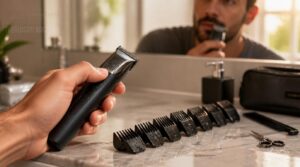
Picking the right guard makes or breaks this whole process. Go too short too fast, and there’s no fixing it — that hair’s gone for weeks. Here’s how to pick smart and trim smarter.
Start With Longer Guards
Play it safe. Attach a longer guard first — a 4 or 5mm — before your trimmer touches a single hair.
Why? Gradual length reduction beats guessing every time. You can always go shorter.
- Preserves center fullness
- Protects outer edge shaping
- Sets up smooth flow blending
Cutting too much too fast? No electric trimmer undoes that mistake.
Cut too much too fast, and no trimmer on earth can give those hairs back
Test One Small Section
Don’t just jump in blind. Run your trimmer over one small patch first — center, under the nose works great.
| Check | Why It Matters |
|---|---|
| Test patch area | Confirms guard length |
| Check for sensitivity | Avoids irritation |
| Assess trim accuracy | Verify tool performance |
Comb it down and let it settle before judging the result.
Reduce Length Gradually
Test patch looking good? Now don’t rush the rest.
Go 6mm first, then step down to 5mm, 4mm, then 3mm — one guard at a time. Comb it down and let it settle between each pass so you actually see the change.
- Clean blades before each swap
- Test one whisker per guard
- Track length in millimeters
Slow and steady wins here. Rushing it just means fixing mistakes later.
Avoid One-guard Trimming
One guard, start to finish? Rookie move.
Your mustache isn’t flat — it’s got dense spots and thin ones. Guard layering fixes that: longer where it’s thick, shorter where it’s not. Mix sizes and you get gradient trimming — natural, not blunt.
Skipping this means uneven length and a weird, chopped-off look. Nobody wants that.
Reduce Mustache Length and Bulk

Guard’s picked, so now it’s time to actually cut. This part’s all about technique — how you move the trimmer matters just as much as what setting it’s on. Here’s exactly how to do it right.
Trim With The Grain
Here’s the thing about mustache hairs — they grow outward from your nose toward the corners, not straight down. So grain direction matters.
Comb dry hair with a fine-tooth comb to spot it. Run your electric trimmer with the grain, blade flat against skin. Fighting it means split ends and razor burn.
Never trim wet — you’ll butcher the length.
Work From Center Outward
Grain sorted, now think zones. Split your mustache into three: center strip, left side, right side.
Trim the center first — keep it 1-2mm longer, comb separates zones cleanly. Then work outward, matching sides for mustache symmetry.
- Comb center strip up
- Trim lightly, check length
- Move to left zone
- Match right zone exactly
Make Slow Overlapping Passes
Slow down — rushing the trimmer skips hairs. Move it at 1 to 2 centimeters per second, overlapping each pass by 2 to 3 millimeters.
Keep pass direction consistent with hair growth, pause briefly between passes, and let the blade settle. Steady pressure, steady speed. Check the mirror often — even coverage beats a fast, sloppy job every time.
Try Comb-over-trimmer Technique
Want barbershop-level control? Use the comb-over-trimmer technique — place the comb between skin and blade, adjust comb guard spacing, then glide the trimmer over it.
This trick:
- Locks in uniform length
- Sharpens blade angle control
- Uses the hair lift method for flat cutting
- Protects your lip line while blending toward the beard
Nice mustache shaping, minimal risk.
Check Symmetry Frequently
Rarely does a lopsided mustache look intentional. So stop every few passes for a Mirror Angle Check — 45 degrees catches what a flat view misses.
| Check | Fix |
|---|---|
| Uneven tips | Trim 1-2mm off longer side |
| Shadowed spot | Adjust lighting angle |
Comb it down and let it settle before judging. Real-time feedback beats guessing every time.
Define a Clean Upper Lip Line
This is where your mustache actually starts looking sharp instead of just short. The upper lip line makes or breaks the whole shape, so you can’t rush it. Here’s exactly how to get that edge crisp and clean.
Remove The Trimmer Guard
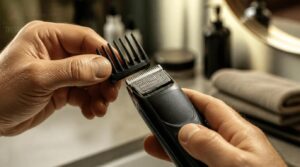
Time to bare the blade. Turn the trimmer off first — safety isn’t optional here.
- Hit the release button
- Slide the guard forward
- Lift it straight up
- Check the blade’s fully exposed
Store the guard somewhere dry so it won’t rust. That bare blade gives you the precision trimming your upper lip line actually needs.
Relax Your Facial Muscles

A tight lip zone ruins straight lines. So loosen up first: let your jaw hang, breathe slow through your nose, soften those cheeks.
| Move | How | Why |
|---|---|---|
| Jaw hang | Drop it open | Loosens mouth corners |
| Nose breathing | Slow, steady | Calms facial tension |
| Cheek soften | Light spread | Keeps skin smooth |
| Tongue up | Roof of mouth | Relaxes jaw posture |
Trace Above The Lip
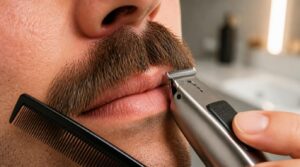
This is where a shaky hand ruins the whole mustache. Pop the guard off, comb hairs down, and trace the lip line in short strokes, center to edge.
- Use the comb guide method for a straight reference.
- Keep pressure light — smartphone weight, nothing heavier.
- Check your mirror angle for shadow-free precision.
Go slow. This trimming technique rewards patience, not speed.
Edge From Center Outward

Now start dead center and work outward — same rule as before, just with more control. This is your Center Outward Technique: short strokes, guard off, moving toward each corner.
| Side | Check |
|---|---|
| Left | Match right |
| Right | Match left |
| Center | No dip |
Use the Symmetry Check Method — pause, compare both sides in the mirror before finishing your edge.
Remove Stray Hairs Carefully

Symmetry looks good? Good. Now hunt the stragglers.
- Grab a magnification mirror — 5x, angled — for a true view.
- Do a lighting check, both sides, to catch shadowed hairs.
- Use tweezing technique — pluck with the grain, no yanking.
- Try a powder pass method to lift sneaky hairs first.
- Finish with a cold compress to soothe the skin.
Blend Edges and Refine Shape

Straight lines are great, but a mustache still needs to look like one piece, not two separate patches. That means smoothing out where the ends meet your beard and fixing any spots that don’t quite match. Here’s how to pull it all together.
Shorten Guards Near Corners
Once the center’s set, drop your trimmer guard down near the corners — this is where gradual length reduction matters most. That 30-degree corner angle isn’t random; it follows your lip’s natural curve.
| Guard Position | Length |
|---|---|
| Center | 12mm |
| Corners | 8-10mm |
| Edge | 6mm |
Blend Ends Into Beard
Now merge those corners into the beard mass — this is where the mustache stops being its own thing. Comb hairs downward for hair direction consistency, then work the trimmer toward the neckline area. Use light razor edge refinement to soften the meeting point.
A dab of styling product helps everything lay flat during this gradual blending pass.
Preserve Center Fullness
Here’s the trap guys fall into: they work so hard the middle goes thin too. Don’t. Use a center guard selection 2mm longer than your edge guard — think 5mm center, 3mm sides. Trim from the center outward, light overlapping passes only. Lift with a comb for volume, then run a quick symmetry verification check before moving on.
Correct Uneven Areas Gradually
Found a rough patch? Mark the longest hair with grooming chalk, then drop your guard 1mm and pass again — check every 15 seconds.
- Patience beats speed every time
- Small corrections avoid big mistakes
- Chalk marks keep you honest
- Gradual fixes protect your shape
Never chase it with one aggressive pass. That’s how mustaches get ruined.
Apply Wax for Control
Once your shape’s locked in, wax if it starts getting unruly. Pick one with a 4-5 hold rating and beeswax for flexibility.
Warm a pea-sized bit between fingers for 10 seconds, then work it base to tip with a comb. Press for 5 seconds, let it set 30 — that’s real control, all day.
Maintain Your Mustache Between Trims

Getting the shape right is one thing — keeping it right is another game entirely. A great mustache isn’t a one-and-done deal, it’s a daily habit. Here’s how to stay sharp between trims.
Comb Hairs Every Day
A trimmed mustache doesn’t stay perfect on its own — that’s on you now.
Comb twice daily: once after your morning wash to knock down overnight oil, once before bed to align hairs for sleep. Skip a day and tangling risk jumps fast. Always comb downward, with the grain.
It’s a small habit that keeps your whole shape looking sharp.
Inspect The Shape Weekly
Once a week, give your mustache a real once-over — not just a glance in the mirror while brushing your teeth. Grab bright light and check for symmetry, gaps over 3mm, or strays past the lip line.
This weekly shape check catches uneven patches early, before they turn into a full re-trim. Five minutes now saves you a headache later.
Touch Up Visible Strays
That one rogue hair sticking out like it’s waving at strangers? Handle it now, not later.
Grab your trimmer, shortest guard, and go spot trimming one hair at a time. Comb down, let it settle, snip only what’s proud.
- Spot trim with the shortest guard
- Comb it down, let it settle
- Use precision razor for stubborn ones
- Check under bright mirror lighting
- Confirm guard size before cutting
Reclean The Lip Line
Stray hairs handled? Good. Now hit the lip line itself — it fades fast.
| Tool | Job |
|---|---|
| Bare blade | Precision trimming |
| Safety razor | Lip edge refinement |
| Alum block | Reveal missed spots |
| Mirror | Confirm lip contour shaping |
Weekly lip line maintenance keeps facial hair grooming sharp. Retrace the border — don’t let upper lip cleanup slide.
Avoid Trimming Wet Hair
Fresh out the shower? Let it dry first. Trimming it wet causes hair swelling — strands puff up, hide true length, and spring back after drying, leaving patches uneven.
Wet blades slip too, risking rust and jagged snags. Dry hair trims cleaner, period.
Comb it down, let it settle, then check length. Merge the edges into your beard once you’re sure it’s dry.
Frequently Asked Questions (FAQs)
How to trim a mustache with only scissors?
Think of scissors as your sculptor’s chisel — precision over power. Grip with thumb and index finger steady, comb to 3mm, snip in 1-2mm increments along the lip line, then edge outward for clean, symmetrical mustache grooming.
How to trim a mustache without ruining it?
Go slow and dry. Use gradual guard length adjustment, good mirror lighting, and the comb-over-trimmer method for even cuts. Never trim wet hair. Define your lip line last, with a steady hand.
Should you trim your mustache with scissors or clippers?
Barbers say 80% of mustache mistakes come from rushing scissor cuts. So use clippers with guard length adjustment for bulk reduction and speed, then switch to scissors only for edge detailing near the lip line.
What is the best tool to trim a mustache?
Your electric trimmer wins, hands down. Pick one with solid guard length adjustment, pair it with a beard comb for alignment, work under bright light, and finish the lip line with a precision razor.
How often should you replace trimmer guard blades?
Daily trimmers usually swap guard blades every 12 months. But if you’re only trimming weekly, stretch that to 18 months — check for nicks or rust first, since visible wear always beats the calendar.
Can mustache wax substitute for trimming altogether?
Nope. Wax only shapes what’s already there — it can’t shorten hair or fix split ends. For real length control and a sharp edge, you need a trimmer. Wax is styling’s finishing touch, not a substitute.
What face shapes suit a thicker mustache style?
Round and diamond faces gain the most from mustache thickness—think Walrus or Chevron styles for Round Face Balance and Diamond Face Definition.
Square, oval, and oval and heart shapes handlebars since face shape suitability really drives the final call.
Is an alum block necessary after edge trimming?
Not always. Skip it if edge trimming leaves skin clean and intact. But if you nick yourself or get razor burn, alum’s your best friend — it stops bleeding fast and calms irritated skin right down.
How long should hair grow before first trim?
Give it at least 5 centimeters — coarse or curly hair wants closer to Fine or straight hair? You can go earlier, around 1 centimeter. Watch for hair standing upright and filling in evenly. That’s your green light.
Conclusion
A trimmer is just a compass — it points you straight, but you steer the ship. That’s the real secret behind how to trim a mustache without scissors: patience beats panic, every single time.
Guards give control. Steady hands give confidence. Check your work in good light, comb daily, and catch strays before they turn into a bad Zoom story.
Master this routine once, and every trim after feels like muscle memory — sharp, simple, yours.