This site is supported by our readers. We may earn a commission, at no cost to you, if you purchase through links. This content is for general informational and educational purposes only and is not a substitute for professional medical, dermatological, or nutritional advice.

Most people layer their skincare products without a second thought—cleanser, treatment, moisturizer, done. But benzoyl peroxide and retinol are a pair that punishes casualness. Used together without care, benzoyl peroxide can degrade up to 70% of unstable retinol within 24 hours, leaving you with two half-strength products and a face that’s drier than it should be.
The consequence? Two half-strength products and skin that suffers. This interaction isn’t just inconvenient—it undermines your entire routine, forcing a false choice between combating acne and pursuing smoother, healthier skin.
However, timing, order, and formulation all matter. Knowing how to use these ingredients correctly means you don’t have to choose between fighting breakouts and building better skin. Master the method, and both can work in harmony.
Table Of Contents
- Key Takeaways
- Yes—Use Them at Different Times
- How Benzoyl Peroxide Works
- How Retinol Works
- Why Combining Them is Tricky
- Morning Benzoyl Peroxide Routine
- Night Retinol Routine
- Build Tolerance Slowly
- Prevent Irritation and Mistakes
- Use Ceramide or Hyaluronic Acid Moisturizers Daily
- Do Not Apply Benzoyl Peroxide Directly Over Retinol
- Avoid Scrubs, AHAs, and BHAs When Irritated
- Do Not Skip Sunscreen During The Routine
- Stop or Scale Back if Your Skin Barrier Feels Damaged
- See a Dermatologist for Severe Acne, Pregnancy, or Persistent Irritation
- Frequently Asked Questions (FAQs)
- What is the 1 2 3 rule for retinol?
- What works 11 times faster than retinol?
- Can you use retinol and benzoyl peroxide together?
- Are retinoids better than benzoyl peroxide?
- Does benzoyl peroxide break down retinol?
- Can you use benzoyl peroxide with retinol acne treatment?
- Should I use benzoyl peroxide or retinol at night?
- How often should I use retinol & benzoyl peroxide?
- Can I use retinol and benzoyl peroxide at the same time?
- Does retinol deactivate benzoyl peroxide?
- Conclusion
Key Takeaways
- Benzoyl peroxide can destroy up to 70% of unstable retinol within 24 hours, so using them at the same time quickly kills both products before they can do their job.
- The fix is simple: use benzoyl peroxide in the morning and retinol at night, keeping them on opposite ends of your day so each one works at full strength.
- Both actives dry out your skin on their own, so sealing in a moisturizer isn’t optional — it’s what keeps your barrier from breaking down.
- Start slowly with 1–2 applications per week for each product, then gradually increase frequency every 2–4 weeks based on how your skin actually responds.
Yes—Use Them at Different Times
Yes, you can use both — just not at the same time.
Keeping them on opposite ends of your day is the simplest way to get results without the irritation. Here’s how to make that split routine actually work.
Best Approach: Benzoyl Peroxide in The Morning, Retinol at Night
Think of it like clockwork scheduling for your skin: use benzoyl peroxide in the morning and retinol at night. This split works with your circadian skin cycle naturally.
If you’re prone to irritation, try an alternating night skincare routine instead—rotating retinol and benzoyl peroxide on separate evenings gives your skin breathing room.
Morning UV exposure makes sunscreen essential anyway, protecting your actives.
At night, retinol does its renewal work undisturbed.
Separating them this way is the foundation of safe, effective application timing for acne and anti-aging products.
Why Layering Them Together Can Reduce Effectiveness
Layering them together sounds efficient, but it can work against you. Benzoyl peroxide is an oxidizing agent, and retinol is oxidation-sensitive — reactive interference between the two causes retinoid oxidation and penetration loss before retinol even reaches deeper skin layers. Understanding this oxidation conflict is exactly why timing matters.
Dose dilution, combined with barrier disruption from doubled dryness, means both actives underperform. Following the proper layering sequence can help preserve each ingredient’s efficacy.
Who Should Avoid Combining Them Without Dermatologist Guidance
Not everyone should combine these two actives without professional input. Certain skin conditions and life circumstances make the stakes higher.
- Pregnancy safety: Retinol poses risks to an unborn baby, so avoid it unless a clinician directs otherwise.
- Eczema risk: A fragile skin barrier can’t always handle the skin irritation management demands of both actives.
- Rosacea flare: Sensitive skin reacts quickly to irritants, and introducing both together makes identifying the trigger harder.
- Post-procedure sensitivity: After peels or laser treatments, skin needs time before tolerating strong actives again.
- Severe acne prescriptions: If you’re already on prescription medication, adding OTC retinol and benzoyl peroxide without dermatologist consultation can complicate your regimen and worsen potential side effects of combined acne treatments.
Skin patch testing before committing to any routine is always a smart first step.
Quick Safety Rule: Separate Actives and Support The Skin Barrier
Keep these actives apart in time, and seal your barrier after each one. Apply benzoyl peroxide in the morning with a timing buffer before moisturizing with a ceramide moisturizer, then use retinol at night with proper ingredient spacing.
Alternating day usage of potent acne treatments suits sensitive skin especially well.
How Benzoyl Peroxide Works

Benzoyl peroxide is one of the most well-studied ingredients in acne treatment, and understanding what it actually does helps you use it more effectively.
It works on a few different levels — from targeting bacteria deep in your pores to calming the redness that comes with a breakout. Here’s what makes it such a reliable tool for clearing skin.
Kills Acne-causing Bacteria Inside Pores
Acne bacteria thrive in low-oxygen environments deep inside your pores — and that’s exactly where benzoyl peroxide strikes.
Its oxygen release and free radical action create follicular oxidation, disrupting bacterial biofilms and eliminating anaerobic conditions Cutibacterium acnes depends on to survive. These powerful antibacterial properties target active bacterial activity directly at the source, without triggering antibiotic resistance.
Helps Unclog Oil-filled Follicles
Beyond killing bacteria, benzoyl peroxide also works as a keratolytic — meaning it helps loosen and shed dead skin cells and excess sebum that clog follicles. This dual action enables pore cleaning from the inside out.
The keratolytic effect is particularly effective for microcomedone prevention, as it disrupts early buildup before a full breakout forms. Over time, this process also improves overall skin barrier protection.
Reduces Redness and Inflammatory Acne
When inflammatory acne flares, you’re not just dealing with bumps — redness and swelling are part of the picture too. Benzoyl peroxide helps calm that response by reducing the cytokines driving inflammation.
Pairing it with niacinamide’s calming support or azelaic acid can further ease visible redness.
For persistent cases, light therapy offers additional relief alongside thoughtfully combining benzoyl peroxide and retinol.
Best Concentrations: 2.5% to 5%
Starting low is the smartest move when combining benzoyl peroxide and retinol. A mild strength choice like 2.5% controls bacteria without overwhelming your skin, while 5% offers moderate potency guidance for faster results if tolerated well.
Skin type suitability matters. Oily skin often tolerates higher concentrations better than dry or sensitive types.
Best For: Pimples, Whiteheads, and Inflamed Breakouts
Benzoyl peroxide is your go-to for active, inflamed breakouts—pimples, whiteheads, and red pustules that need fast inflammation control tactics. Use it as a spot treatment focused on troubled areas, or across broader zones when flares are widespread.
It won’t replace retinol’s whitehead prevention plan, but it treats what’s already angry on your skin right now.
How Retinol Works

Retinol does a lot more than fight acne — it works at a cellular level to keep your skin renewing itself the way it’s supposed to. Think of it as a reset button your skin has been waiting for.
Here’s what it actually does when you use it consistently.
Speeds Up Skin Cell Turnover
Think of retinol as a reset button for your skin. Once absorbed, it triggers retinoid gene activation deep in skin cells, accelerating keratinocyte turnover so fresh cells rise to the surface faster.
This epidermal renewal boost clears away dull, dead cells more quickly than your skin would manage alone — usually delivering noticeable texture improvements within 8–12 weeks of consistent nightly use.
Helps Prevent Clogged Pores
Retinol’s faster cell turnover prevents pores from becoming congested in the first place. By loosening dead cells before they can accumulate in follicles, it promotes clearer skin long-term. This process directly combats buildup, ensuring pores remain unobstructed.
Pairing retinol with a gentle cleansing routine and non-comedogenic, oil-free moisturizers reinforces its pore-unclogging effect from every angle. This combined approach maximizes skin clarity while maintaining balance.
Fades Post-acne Marks Over Time
Once pores are clearer, retinol keeps working beneath the surface. It accelerates skin turnover, gradually pushing post-inflammatory hyperpigmentation—those stubborn dark spots left after breakouts—toward the surface where it can shed. Pigment depth matters: superficial marks may fade within weeks, while deeper discoloration takes months.
Sun protection is non-negotiable, as UV exposure darkens existing hyperpigmentation and stalls progress substantially.
Supports Collagen for Smoother-looking Skin
Beyond fading marks, retinol stimulates fibroblasts—the cells responsible for collagen production—which gradually firms and smooths skin texture. This protein synthesis boost is why retinol pairs well with peptide boosters and Vitamin C synergy in your routine.
Adding hydration layers after application protects your barrier, and consistent sun protection keeps that new collagen intact.
Microneedling boost treatments can enhance these results further.
Best Beginner Strengths: 0.25% to 0.5%
Starting low is the smartest move with retinol. A Starter Retinol Dose between 0.25% and 0.5% gives your skin time to adjust without overwhelming it.
Here’s what a safe beginner plan looks like:
- Choose Low Strength Options like 0.25% for your first few weeks
- Follow a Gradual Application Schedule: 1–2 nights per week to start
- Use an Initial Moisturizer Strategy—apply moisturizer right after retinol to cushion dryness
- Always follow a Patch Test Protocol on a small area before full-face use
- Practice concentration adjustment only after 4–6 weeks of tolerance
This approach keeps irritation manageable while your skin builds resilience.
Why Combining Them is Tricky

Both of these ingredients work well on their own, but mixing them carelessly can actually work against you. The chemistry between them creates some real friction that’s worth understanding before you start.
Here’s what makes combining benzoyl peroxide and retinol more complicated than it first appears.
Benzoyl Peroxide Can Oxidize Unstable Retinol
Think of benzoyl peroxide as a free-radical machine — and free radicals are retinol’s worst enemy. Research shows unstable, non-encapsulated retinol can degrade up to 70% within 24 hours when exposed to benzoyl peroxide. Photostability concerns and formulation pH impact how quickly this occurs.
Benzoyl peroxide destroys unstable retinol fast — degrading up to 70% of it within just 24 hours
Microencapsulation benefits retinol by shielding it from this oxidation conflict, preserving its potency where basic formulas cannot.
| Factor | Unencapsulated Retinol | Encapsulated Retinol |
|---|---|---|
| Oxidation risk | High | Low |
| Shelf-life stability | Poor | Strong |
| Interaction with benzoyl peroxide | Significant degradation | Minimal impact |
Using Both Together May Increase Dryness and Peeling
Both actives are drying on their own — stack them carelessly, and your irritation load doubles fast. Benzoyl peroxide strips surface oils while retinol accelerates cell turnover, leaving your barrier less resilient.
Cold weather, heated indoor air, and harsh formulation vehicles make redness and peeling worse.
Moisturizer timing matters here: apply it right after each active to support skin dryness prevention before irritation takes hold.
Simultaneous Layering Can Weaken Results
When you layer both actives at once, oxidation loss kicks in almost immediately — benzoyl peroxide’s free radicals degrade unstable retinol before it can do its job. That’s absorption competition and dose dilution happening in real time.
Here’s what simultaneous use actually costs you:
- Oxidation conflict neutralizes retinol’s skin-renewing action
- Barrier compromise from combined drying effects weakens skin resilience
- Irritation amplification disrupts consistent combination therapy skincare
- Uneven absorption makes results look slower than they should
Irritation Risk is Higher for Sensitive or Rosacea-prone Skin
Sensitive or rosacea-prone skin is already walking a tightrope. Barrier disruption from either active can trigger microinflammation confusion — bumps and redness that look like acne but aren’t.
Add heat sensitivity, fragrance flare, or alcohol irritation from your formulas, and the reaction compounds fast.
Managing skin dryness and irritation starts with skin patch testing before introducing new skincare products and following guidelines for sensitive skin closely.
Encapsulated Retinol May Be More Stable
Microencapsulated retinol uses encapsulation technologies to protect retinoids inside a lipid shell, creating an oxygen barrier that dramatically slows oxidation.
With controlled release and nanoparticle size optimized for shelf-life retention, oxidation stability improves greatly — some formulas retain over 95% potency alongside benzoyl peroxide.
Following safety guidelines for combining benzoyl peroxide and retinol means choosing encapsulated forms when possible.
Morning Benzoyl Peroxide Routine
Your morning routine doesn’t need to be complicated—it just needs to be consistent.
A few simple steps will let benzoyl peroxide do its job without setting your skin up for irritation later in the day. Here’s how to build that routine from start to finish.
Step 1: Cleanse With a Gentle Face Wash

Before you apply anything to your skin, start with a clean slate. Use a gentle face wash with non-stripping surfactants and soothing additives like glycerin or ceramides, massaging in a gentle circular motion for about 20–30 seconds. Rinse with lukewarm water and pat dry.
- Keeps your skin barrier intact
- Suits every skin type, including sensitive skin
- Short rinse time prevents over-drying
- Works well alongside a benzoyl peroxide wash like PanOxyl
Step 2: Apply Benzoyl Peroxide to Acne-prone Areas
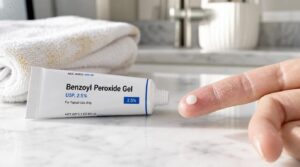
Once your skin is fully dry, squeeze out a thin layer of benzoyl peroxide — a pea-sized amount covers most acne-prone zones comfortably. For spot-only concerns, treat just the active breakout. Stick to dry skin application to reduce stinging.
Remember bleach precautions: this acne treatment can lighten towels and pillowcases on contact, so handle it carefully.
Step 3: Wait 5–10 Minutes Before Moisturizing
After applying benzoyl peroxide, resist the urge to layer anything immediately. That 5–10 minute absorption window matters more than it sounds:
- Tackiness reduction signals the formula has settled
- Irritation mitigation improves when moisturizer isn’t applied too soon
- Barrier recovery timing works best with a clear gap between actives and facial moisturizer
Best practices for timing active ingredients mean letting skin dryness stabilize first.
Step 4: Apply a Barrier-supporting Moisturizer
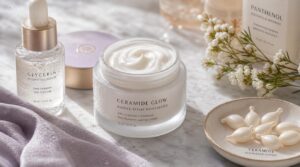
Once that absorption window closes, reach for your moisturizer. Start with humectant layering — a glycerin-rich formula applied to slightly damp skin draws water in and eases skin dryness fast.
Follow with ceramide support to handle lipid replenishment in the stratum corneum, rebuilding your skin barrier from the inside out.
Add anti-irritant boosters like niacinamide or panthenol, then finish with a gentle occlusive seal to lock everything in.
Step 5: Finish With Broad-spectrum SPF 30+
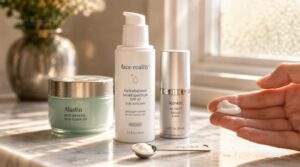
Your moisturizer is down — now seal the whole routine with broad-spectrum SPF 30+. This final step manages sun protection post-active care, since benzoyl peroxide and retinol increase UV sensitivity.
Use about a quarter teaspoon for your face, spread evenly for real SPF shield maintenance.
Reapply every two hours outdoors — reapplication timing is also crucial.
Daily sun protection isn’t optional here; it’s what keeps your results intact.
Option: Use a Benzoyl Peroxide Wash to Reduce Irritation
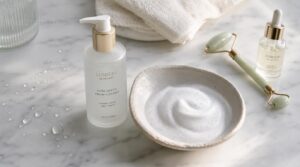
If your skin is sensitive, a benzoyl peroxide wash is worth considering. Its short contact exposure—lather, wait briefly, rinse—delivers the active ingredient without leaving residue on the skin all day. Gentle surfactants cleanse effectively without stripping the skin’s natural moisture.
The rinse timing is crucial: shorter contact reduces irritation. Begin with gradual frequency, starting a few mornings weekly, to allow your skin to adapt.
Follow the wash with post-wash hydration to strengthen the skin barrier. This step is essential before starting your nighttime routine with retinol, ensuring balanced care.
Night Retinol Routine
Your nighttime routine is where retinol does its best work, so the steps matter. Done right, it’s straightforward and easy to build into any evening schedule.
Here’s exactly how to do it.
Step 1: Cleanse and Dry Your Skin Completely
Before retinol ever touches your face, your skin needs to be genuinely clean and completely dry. Use a gentle cleanser suited to your skin type, rinse until there’s no residual moisture or cleanser film left — especially along the jawline.
Pat your skin dry with a clean towel to keep your skin barrier calm and ensure retinol absorbs evenly rather than diluting on a damp surface.
Step 2: Apply a Pea-sized Amount of Retinol
A precise pea measurement is all you need — no more, no less. Dispense a small amount and follow these steps:
- Warm it between fingertips for a second
- Dot evenly across forehead, cheeks, and chin
- Use a gentle spreading motion outward
- Build a thin even layer across fully dry skin
- Stay consistent — this consistent dosing routine facilitates gradual tolerance building without spiking irritation risk
Step 3: Avoid Eyelids, Corners of Nose, and Lips
Think of these three zones — eyelids, nose corners, and lips — as no-fly zones for retinol. Their skin is thinner, more permeable, and quicker to react with redness or dryness.
| Zone | Why It’s Sensitive |
|---|---|
| Eyelid protection | Thin skin irritates fast |
| Nose corner care | Creases trap and concentrate product |
| Lip border guard | Permeable skin burns easily |
Use fingertip placement with intention — press, don’t swipe. A moisturizer buffer along these borders adds a practical shield for sensitive skin.
Step 4: Follow With a Non-comedogenic Moisturizer
After retinol, your skin needs a buffer — and the right noncomedogenic moisturizer delivers it. Choose gel vs cream based on your skin type: gel formulas with humectant focus ingredients like hyaluronic acid suit oily skin, while ceramide-rich creams offer stronger barrier-repairing support when dryness peaks.
Squalane lightweight options work well for both skin types. Use a pea-size application and massage gently. Your moisturization strategy here is simple skin barrier support when using potent actives.
Option: Use The Moisturizer-retinol-moisturizer Sandwich Method
If your skin tends toward dryness or sensitivity, the moisture sandwich technique offers extra protection. This product layering approach in skincare buffers retinol between two moisturizer layers, reducing skin irritation without sacrificing results.
The same barrier-first thinking applies to other actives too—understanding why vitamin C serum can cause skin irritation can help you build a gentler routine overall.
- First Layer Selection: Apply a thin noncomedogenic moisturizer and wait briefly — your waiting interval — until it’s no longer tacky.
- Retinol Buffering: Smooth a pea-sized amount evenly across treatment areas.
- Pilling Prevention: Keep both layers lightweight to avoid clumping.
- Product Compatibility: Choose fragrance-free formulas on both sides.
- Seal with your second moisturizer immediately after.
Avoid Using Exfoliating Acids on Retinol Nights
On retinol nights, keep exfoliating acids off your face entirely. Combining salicylic acid, glycolic acid, or any BHA with retinol creates real acid-retinol irritation — redness, flaking, and pH imbalance risk that weakens your barrier faster than either ingredient alone. Alternate days instead — your skin needs exfoliant-free recovery nights to rebuild properly.
| Ingredient to Avoid | Why Skip It on Retinol Nights |
|---|---|
| Glycolic acid (AHA) | Doubles resurfacing, damages barrier |
| Salicylic acid (BHA) | Compounds pore-level irritation |
| Lactic acid | Increases sensitivity skin detection risk |
| Physical scrubs | Mechanical stress disrupts recovery |
| Benzoyl peroxide layered over retinol | Oxidizes retinol, reduces efficacy |
Best practices for timing the application of active ingredients mean giving barrier restoration timing the respect it deserves.
Build Tolerance Slowly
Your skin needs time to adjust, and rushing the process is one of the most common mistakes people make with these two actives. Starting slow isn’t a sign of caution — it’s how you actually get results without wrecking your barrier in the first few weeks.
Here’s how to ease both products into your routine without the drama.
Start Benzoyl Peroxide 1–2 Mornings Per Week
If you’re new to benzoyl peroxide, start with a small starting dose just 1–2 mornings per week. Your weekly frequency plan might look like this:
- Apply to acne-prone areas, Monday morning only
- Watch for first-week skin cues like redness or tightness
- Practice targeted spot application rather than full-face coverage
- Use benzoyl peroxide in the morning, use retinol at night
- Prioritize post-application barrier care with a gentle moisturizer
Start Retinol 2–3 Nights Per Week
Begin on 2–3 non-consecutive nights per week — Monday and Thursday work well — using only a pea-sized amount across your whole face.
Gentle skin prep matters here: cleanse, dry completely, then apply.
Monitor irritation closely during the first few weeks. This gradual introduction keeps dose escalation manageable and gives your barrier time to adjust.
Increase Frequency After 2–4 Weeks if Tolerated
After 2–4 weeks of consistent use, it’s time for tolerance assessment. If your skin shows no persistent redness or peeling, add just one extra application day — not several at once. This gradual day addition keeps barrier recovery timing in your favor.
Incremental scheduling, paired with careful irritation threshold monitoring, helps your dose escalation stay manageable without pushing your skin past its limit.
Use Alternate-day Scheduling for Sensitive Skin
If your skin is prone to react quickly, alternate-day scheduling is one of the safest ways to manage a safe combination of benzoyl peroxide and retinol. Alternating versus concurrent use of acne actives keeps irritation manageable.
Try this gradual frequency approach:
- Apply benzoyl peroxide Monday and Thursday mornings
- Use retinol Tuesday and Friday nights
- Practice off-day moisturizing to support barrier recovery
- Keep a symptom diary for tolerance tracking
Reduce Frequency if Redness, Burning, or Peeling Persists
If redness, burning, or peeling don’t settle within a week, that’s your skin signaling it needs an irritation break schedule. Pull back to your last-tolerated frequency—a gradual frequency taper protects your barrier as the first method. Managing irritation from potent ingredients means slowing down, not stopping entirely.
Symptom-trigger scaling and recovery phase guidelines keep sensitive skin users on track without losing progress.
Patch Test Both Products Before Full-face Use
Before applying either active ingredient to your entire face, a skin patch test provides valuable data about how your skin responds. Test each product separately — never together — on a small area like your jawline or behind your ear.
- Test area selection: Choose jawline or behind the ear
- Single product testing: Patch test retinol and benzoyl peroxide on separate days
- Monitoring window: Wait 48 hours before evaluating results
- Irritation signs: Watch for redness, stinging, flaking, or swelling
- Gradual rollout: If clear, expand to full-face use slowly
This patch testing protocol is especially important for managing skin dryness and irritation from active ingredients, adhering to guidelines for sensitive skin.
Prevent Irritation and Mistakes
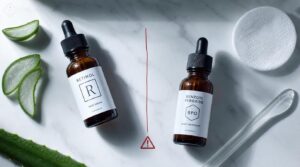
Even with the best routine in place, small mistakes can quietly set your progress back. Knowing what to avoid is just as important as knowing what to do.
For example, confusing similar products is a common slip — understanding the difference between facial toner and astringent can help you choose the right step for your skin.
Here’s what to keep in mind to protect your skin and get the most out of both actives.
Use Ceramide or Hyaluronic Acid Moisturizers Daily
Think of your moisturizer as the safety net that keeps your routine on track. Daily ceramide barrier repair and hyaluronic acid hydration counterbalance the dryness both actives can cause.
Apply your barrier-repairing moisturizer after each active — morning and night. A layered moisturizer strategy using fragrance-free options with ceramides and hyaluronic acid strengthens skin barrier integrity and helps you stay consistent without irritation forcing you to stop.
Do Not Apply Benzoyl Peroxide Directly Over Retinol
Layering benzoyl peroxide directly over retinol is one of the most common mistakes people make — and it quietly undermines both products. Oxidation interaction degrades retinol before it is absorbed, while barrier compromise and peeling amplification make irritation harder to manage. Redness masking then hides whether either active is actually working.
Follow these safety guidelines for combining benzoyl peroxide and retinol:
- Never apply benzoyl peroxide immediately after retinol — absorption conflict reduces the effectiveness of both.
- Use application timing strategies that separate actives by several hours or by morning/night scheduling.
- Avoid overlapping zones on your face to lower localized irritation risk.
- Stick to best practices for timing active ingredients application — consistency matters more than doubling up.
Avoid Scrubs, AHAs, and BHAs When Irritated
When your skin is already irritated, adding AHAs, BHAs, or scrubs is like pouring water on a grease fire — it makes things worse. Overlapping exfoliants overwhelm a compromised barrier, intensifying burning and peeling. Pause exfoliation until irritation settles.
Then rebuild with gentle cleansing, fragrance-free formulas, and barrier-support moisturizers. Incorporate soothing serums packed with healing ingredients like ceramides and hyaluronic acid.
Do Not Skip Sunscreen During The Routine
Retinol makes your skin more sensitive to UV, and benzoyl peroxide doesn’t help either — both raise your phototoxicity risk without proper photoprotection.
That’s why SPF timing matters: apply a barrier-boosting sunscreen with SPF 30+ as your final morning step. Don’t fall for the makeup SPF myth — foundation won’t cut it.
Reapply frequently throughout the day for real photodamage prevention.
Stop or Scale Back if Your Skin Barrier Feels Damaged
Sunscreen protects your skin from the outside, but what about protecting it from the inside out? If burning, tightness, or persistent dryness show up, those are barrier recovery signs telling you to pause.
Pausing actives, switching to a gentle cleanser choice, and focusing on moisturizer layering helps calm skin barrier disruption.
Once irritation settles, gradual reintroduction of one active at a time keeps you in control.
See a Dermatologist for Severe Acne, Pregnancy, or Persistent Irritation
Some situations genuinely call for more than a careful home routine. If you’re dealing with severe cystic acne, pregnancy acne safety becomes a real concern—since topical retinoids are usually avoided, and even benzoyl peroxide needs clinical sign-off.
Persistent irritation signs, medication contraindications, and questions about prescription vs. OTC acne product considerations are exactly what dermatology follow-up is designed for.
Don’t troubleshoot alone.
Frequently Asked Questions (FAQs)
What is the 1 2 3 rule for retinol?
The 1-2-3 rule is a simple weekly ramp:
Use retinol once a week for one week, twice a week for two weeks, then three times a week for three weeks.
What works 11 times faster than retinol?
Retinal. It requires just one conversion step to reach retinoic acid — making it considerably faster-acting than retinol. Some lab data suggest retinal conversion happens up to 11 times more efficiently.
Can you use retinol and benzoyl peroxide together?
Yes, you can — but timing matters.
Apply benzoyl peroxide in the morning and retinol at night to protect oxidative stability, avoid potential interactions, and keep each active working at full strength.
Are retinoids better than benzoyl peroxide?
Neither wins outright. Benzoyl peroxide targets bacteria fast, making it ideal for active breakouts, while retinoids offer long-term benefits by preventing clogged pores.
Your skin type and result timeline determine which fits better.
Does benzoyl peroxide break down retinol?
Benzoyl peroxide’s free radicals can destabilize retinol through an oxidative pathway, like a lit match near a candle.
This interaction degrades up to 70% of unprotected retinol within 24 hours, greatly reducing its effectiveness on your skin.
Can you use benzoyl peroxide with retinol acne treatment?
Both actives can work together safely when you separate them by time of day.
A product compatibility test and smart skin type considerations make combining retinol and benzoyl peroxide in skincare genuinely effective.
Should I use benzoyl peroxide or retinol at night?
Retinol wins the night shift. Keep benzoyl peroxide in your morning routine and save retinol for your nighttime skincare routine — sunlight sensitivity makes evening the smarter, safer choice.
How often should I use retinol & benzoyl peroxide?
Start slow: benzoyl peroxide 1–2 mornings per week, retinol 2–3 nights per week. Increase frequency every 2–4 weeks based on your skin tolerance and sensitivity assessment.
Can I use retinol and benzoyl peroxide at the same time?
Yes, but not at the same time. Use benzoyl peroxide in the morning and retinol at night. Direct contact reduces effectiveness and increases dryness, redness, and irritation risk.
Does retinol deactivate benzoyl peroxide?
It’s actually the reverse. Benzoyl peroxide’s oxidation kinetics can degrade unstabilized retinol, not the other way around. Chemical interaction between these two depends heavily on formulation pH and encapsulation technology.
Conclusion
Take someone who’s been using both products nightly, wondering why their skin stays irritated and their breakouts barely budge. The answer isn’t the ingredients—it’s the timing. Learning how to use retinol with benzoyl peroxide means separating their application by routine: benzoyl peroxide in the morning, retinol at night.
That one shift protects both actives and your skin barrier. Done consistently, it’s not a compromise—it’s a smarter strategy.