This site is supported by our readers. We may earn a commission, at no cost to you, if you purchase through links. This content is for general informational and educational purposes only and is not a substitute for professional medical, dermatological, or nutritional advice.
Most guys ruin their first mustache trim in under sixty seconds, one wrong pass with the trimmer, and three weeks of growth disappears. It happens in barbershops all the time: a nervous first-timer grabs the clippers, guesses at a guard size, and walks out with a patchy mess he has to hide until it grows back.
Here’s the truth nobody tells beginners: mustache trimming for beginners isn’t about steady hands. It’s about sequence. Comb first, trim longer than you think you should, check both sides in the mirror before you commit to anything permanent.
Get the order right, and even a first attempt looks intentional. Get ready to learn exactly where to start, what tools earn a spot on your counter, and how to shape a mustache that actually suits your face.
Table Of Contents
- Key Takeaways
- Choose a Beginner-Friendly Mustache Style
- Gather Mustache Trimming Tools
- Prepare Your Mustache for Trimming
- Trim Your Mustache With a Trimmer
- Trim Your Mustache With Scissors
- Shape, Blend, and Style Your Mustache
- Maintain Your Trim and Avoid Mistakes
- Frequently Asked Questions (FAQs)
- What is the 3 month mustache rule?
- When should I first trim my mustache?
- What are common mustache trimming mistakes?
- Are you supposed to trim your mustache above your lip?
- How often should I exfoliate skin under my mustache?
- Can I use regular kitchen scissors in a pinch?
- Why does my mustache look different wet versus dry?
- How do I fix an uneven growth patch quickly?
- Should I comb my mustache every single day?
- Conclusion
Key Takeaways
- Always trim dry, combed-down hair with a longer guard first, since wet hair swells up to 30% and tricks you into cutting too short.
- Work from the center of your lip outward in small passes, checking both sides in the mirror as you go, so your first attempt looks intentional instead of patchy.
- Pick your mustache style based on your face shape and hair density before you touch a blade, since the right match creates natural symmetry from day one.
- Stick to a maintenance routine, touching up every two to five days and doing a full weekly shape check, so you catch drift before it ruins the line.
Choose a Beginner-Friendly Mustache Style

Before you pick up a single tool, you need a plan, because a great mustache starts with the right style for your face and your patience level. Some shapes take daily upkeep, while others forgive a missed trim or two, and that difference matters when you’re just starting out.
Once you’ve settled on a shape, tools like a trimmer or scissors will help you maintain those crisp lines, and if you’re pairing your mustache with facial hair below, this guide on how to trim a ducktail beard for a sharp, balanced look is worth a look.
Let’s walk through what to think about before you make the first cut.
Match Style to Face Shape
Your mirror holds the first clue. Stand under good grooming lighting conditions and study your jawline before picking a style:
- Round Face – Chevron adds length
- Square Face – Horseshoe softens angles
- Oval Face – Pencil keeps balance
- Heart Face – English suits narrow chins
- Diamond Face – Dali flatters cheekbones
Matching style to shape creates facial symmetry and easy mustache styling from day one.
Choose Your Desired Fullness
Once you’ve picked a style, decide how full you want it. Higher hair density (80–150 hairs/cm²) helps fuller looks at 5–7mm; lower density suits 3–4mm for medium fullness. Light fullness cuts sweat by 25%, great for active guys.
Use a higher guard size first, then adjust length gradually as you build volume control and confidence.
Set The Lower Lip Line
Fullness settled, now nail down where the mustache actually ends. Set your lower lip line 1–2mm above the lip edge, aligned with the philtrum’s center. Comb your mustache down first, then trim from the center outward using a razor’s shallow edge for definition.
- Use a comb guide for straight alignment
- Check guard trimming accuracy after passes
- Sit before a mirror with good lighting
- Maintain line consistency weekly
- Avoid drifting past 0.5mm
Know When to First Trim
So how do you know it’s time? Trim once hair covers your whole upper lip, corner to corner, and reaches 4-6mm in length. Watch for coarseness you can feel, slight pulling on your lip, or catching while you eat. Most guys hit this stage 2-3 weeks in, right after a good wash.
Compare Popular Beginner Styles
Once you’ve got the basics down, pick a shape that flatters you.
Horseshoe suits round faces, trimmed to 5–7mm with a size 3 guard, touched up weekly.
Chevron softens square jaws using a size 2 guard for that crisp 4–6mm V.
Pencil styles stay thin at 2–3mm, guard size 1, needing trims only every 7–10 days.
Gather Mustache Trimming Tools
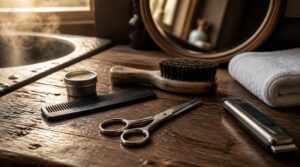
Before you make a single cut, you need the right tools laid out and ready. Good technique only gets you so far if your gear is dull, dirty, or just the wrong tool for the job. Here’s exactly what belongs in your kit.
Fine-Tooth Mustache Comb
A good comb is the quiet workhorse of your kit. Teeth spaced 0.1 to 0.2 millimeters apart glide through hair without snagging, letting you comb your mustache down first to spot stray hairs before you trim from the center outward.
Stainless steel resists rust and sanitizes easily, keeping comb hygiene in check. Its small size makes portability easy, and it distributes wax evenly once you’re ready to style. For precise grooming, a pocket-sized beard comb offers convenient access and durability.
Sharp Blunt-Tip Facial Scissors
Precision starts with your blades, not your trimmer. Look for scissors between 4.5 and 5.5 inches with a blunt tip design that keeps you safe near your nose and lips while you work at a tight cutting angle.
Stainless steel holds an edge through repeated trims, and ergonomic finger holes give you steady control. Skip kitchen shears; they’re too dull for real precision cutting.
If you’re touching up fades weekly, dedicated barber shears make a real difference — here’s a closer look at how often you should trim a fade haircut.
Electric Trimmer With Guards
Your electric trimmer does the heavy lifting, and guard size selection is what keeps results consistent. Start with a longer guard, check battery life indicators before you begin, and confirm wet/dry operation if you trim after a shower.
- Comb your mustache down first
- Trim from the center outward
- Match guard compatibility to your brand
- Brush blades clean for blade maintenance
Magnifying Mirror
Ever tried defining a lip line by feel alone? You’ll miss hairs every time.
A magnifying mirror with 5x to 10x magnification reveals what your naked eye can’t, working best about 6 inches out. Look for adjustable angles, solid LED lighting, and a scratch-resistant surface.
Mount it near your sink, comb your mustache down first, then start precision trimming with confidence.
Blade Brush and Sanitizer
A dull, grimy blade drags instead of cutting, so keep a dedicated blade brush and sanitizer nearby. Soft nylon bristles with rounded tips reach between trimmer teeth, clearing metal shavings without scratching steel.
Rinse under warm water, lather sanitizer for 20 seconds, scrub the blade 15 seconds, then air dry fully before storing. This habit protects both your trimmer and your scissors long-term.
Prepare Your Mustache for Trimming

Before you make a single cut, your mustache needs some prep work. Skipping this step is how beginners end up with uneven lines and choppy results. Here’s exactly how to get your mustache ready for a clean, confident trim.
Shampoo Away Oils and Debris
Your mustache traps more grime than you’d think, so grab a beard shampoo before you touch a blade. Cleansing agents remove oils while surfactants lift impurities, and a clarifying shampoo gives you a deeper clean when buildup’s heavy. This matters because:
- Loose food particles hide in thick hair
- Skin oils cause blades to snag
- Debris redeposits without a solid rinse
Condition to Soften Hairs
Once you’ve rinsed the shampoo out, don’t reach for a towel just yet. Massage in a beard conditioner with panthenol and glycerin for a couple minutes, working it through with your fingers. This softens coarse hairs and cuts breakage, especially with a leave-in formula containing keratin.
A warm towel wrap afterward opens the cuticle further, locking in that moisture before you dry.
Dry Completely Before Trimming
That warm towel wrap feels great, but soggy hair lies to you about its true length. Grab a microfiber towel and pat (don’t rub) for two minutes, pulling moisture down toward 10%.
Let it air dry the rest of the way, room temp, no rush. Damp hair stretches; dry hair cuts clean, within 0.5mm accuracy versus over a millimeter off when wet.
Comb Downward and Outward
Once it’s dry, grab your fine-tooth comb and comb your mustache down first, then sweep outward toward the sideburns. This directional combing exposes true length and stray hairs.
| Comb Direction | Result | Fix |
|---|---|---|
| Upward | Uneven cut | Comb down |
| Outward | Even edge | Keep angle |
| Wide-tooth | Bulk loss | Use fine-tooth |
Skipping this step causes jagged, asymmetrical lines later.
Relax Your Mouth and Face
Before you touch a blade, settle your face. A tense jaw shifts your mouth width and throws off your lip line.
- Clench your jaw 5 seconds, release 10, ten reps
- Massage the masseter in slow circles
- Stretch your upper lip upward, hold 10 seconds
- Breathe in for 4, hold 4, out for 6
Relaxed muscles mean cleaner, steadier upper lip grooming.
Trim Your Mustache With a Trimmer
With your mustache clean, dry, and combed, it’s time to pick up the trimmer and get to work. This tool gives you speed and control, but only if you use it in the right order. Here’s exactly how to move through the process, step by step.
Start With a Longer Guard

Grab a 5mm guard (the red one) before you touch the blade to hair.
Start with a longer guard since it’s much easier to trim more later than to fix a patch you cut too short.
Coarse or curly hair? Size up.
Fine hair? A slightly shorter guard works fine without pulling.
Remove Bulk in Small Passes
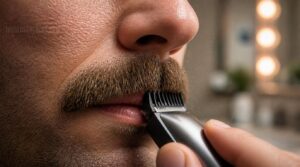
Once your guard’s set, don’t just mow straight through, work in overlapping passes, moving the trimmer back and forth in a steady, continuous motion so you’re never yanking hair. Overlap each pass by 2 to 3mm to catch stray patches.
Check length every 2mm, then swap to a shorter guard and repeat until bulk’s manageable.
Trim From Center Outward
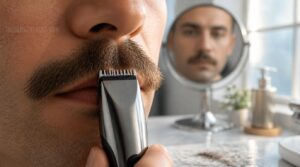
Here’s where symmetry gets built, not fixed later. Line the trimmer up at the midpoint below your nose, guard parallel to the lip line, and work outward in short 5mm strokes toward each corner.
Mirror trimming both sides after every pass keeps them honest, since comparing left and right as you go catches uneven patches before they become obvious mistakes.
Define The Upper Lip Line
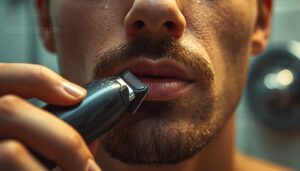
This is the line that makes or breaks the whole mustache. Remove the guard and, with the blade flat, define the lip line 1–2mm above your top lip line, following its natural arch. Check:
- Center alignment
- Even corners
- Relaxed mouth
- Mirror symmetry
Keep muscles relaxed, since smiling shifts the natural edge alignment entirely.
Taper and Blend Outer Edges
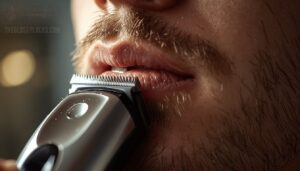
A hard stop-line at the edges looks amateur, so soften it. Set a 3mm guard, trim outward, then drop to 1mm in 0.5mm passes—keeping the trimmer flat against skin, following your lip’s curve.
Lift outer hairs with a comb, snip stray long ones at 45 degrees, then step back 30cm under good light to check the gradual fade before moving to scissor work.
Trim Your Mustache With Scissors
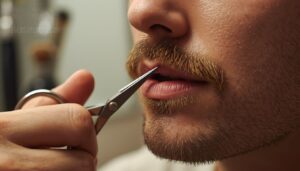
Scissors give you a level of control a trimmer just can’t match, especially when you’re working close to the lip line. This method takes more patience, but it rewards you with precise, natural-looking results. Here’s how to work through it step by step.
Comb Hairs Over Your Lip
Before scissors touch anything, grab your Comb and pull hairs straight down over the Lip Line. Use a 45-degree comb angle, light pressure only, so hairs settle without bending. This detangling method reveals stray or uneven strands under the magnifying Mirror.
Wash and dry your comb after — hygiene matters before your Trimmer or Scissors ever make contact.
Follow The Natural Lip Curve
Now hold your scissors so the blades run parallel to your lip’s natural rise and fall, adjusting the angle slightly for each section. Trace the curve, not a straight line — keep the cutting edge perpendicular to hair growth to avoid split ends.
Thumb on the pivot, fingers steady on the grips, mirror angled at 45 degrees so you actually see what you’re cutting.
Snip From Center Outward
With that curve traced, start your first cut dead center, right below the nose. This is where trim from the center outward really pays off — a fine-tooth comb aligns hairs first, blade at a steady angle, 2mm from skin.
Snip in small increments, rotating slightly outward each time for a natural taper toward the corners.
Thin Excess Volume Carefully
Once your center taper looks even, some spots may still bulk up more than others — that’s just natural hair density at work. Grab your thinning shears and work in light, feathered passes, angled slightly upward, removing small amounts at a time.
Go slow here. Over-thinning creates gaps that are tough to fix, so check volume control after each pass before cutting more.
Cut Missed Hairs Individually
Every mustache has a few rebels that skip the main pattern. Grab your fine-tip scissors and isolate strays by pulling each one taut before cutting at a controlled angle.
Good lighting matters here—position a lamp close, then:
- Lift the stray with your comb
- Align blade tips at its base
- Snip cleanly, leaving 1-2mm
- Smooth edges with a light comb-through
Shape, Blend, and Style Your Mustache

Once the cutting is done, the real polish happens in the details. This stage is about tightening up lines, checking your work, and adding a bit of finish so the mustache looks intentional, not just trimmed. Here’s what to focus on to pull it all together.
Leave 1–2 Millimeters Above Lip
That gap between mustache and lip isn’t just style, it’s function. Set your guard to 1mm, since that leaves hair sitting right where it should.
Comb your mustache down first, then trim from the center outward for even lip line precision. A comb pressed flush against skin confirms you’ve nailed it, no guesswork needed.
Clean The Nose-Mustache Area
Where nose meets lip is where most beginners lose control. Grab your fine-tooth comb, separate nostril hairs, then switch to a 1.5mm precision guard for the junction.
- Trim along the nasal crease
- Move the trimmer slowly
- Angle blunt-tip scissors carefully
- Apply cooling astringent after
- Sanitize tools in alcohol
Check nostril alignment in your mirror before finishing.
Check Symmetry From Every Angle
A lopsided mustache stands out fast, even to strangers. Face the mirror straight on, mouth relaxed, and check tip height on both sides.
Then turn to each profile—one side often flares more from comb direction or growth pattern. Mix guard and scissor work evenly, recheck after hairs settle, and never judge symmetry right after cutting.
Apply Beard Oil or Balm
Trimmed hair still needs care, and that’s where oil and balm come in. Apply beard oil first—3 drops, worked under the mustache into skin. Follow with a fingertip of balm, warmed between fingers, for hold. This oil and balm routine covers:
- Skin hydration
- Root-to-tip coverage
- Softness
- Shape control
- A finished look
Don’t mix them together; apply separately to avoid grease.
Use Wax for Styled Ends
Want curled ends that actually hold? That’s what mustache wax delivers. Warm a pea-sized amount, about 0.5 grams, between your fingers for 10 seconds until pliable.
Spread it over the last 2-3 millimeters of hair, then use a fine-tooth comb to twist ends clockwise. Let it set for 30 seconds before final adjustments—check symmetry, then style with confidence.
Maintain Your Trim and Avoid Mistakes

Getting the perfect trim once is only half the job, keeping it sharp week after week is where real skill shows. A great mustache falls apart fast if you skip upkeep or fall into a few common traps beginners always seem to hit. Here’s what you need to know to keep your look consistent and avoid the mistakes that undo all your hard work.
Touch Up Every Few Days
Hair grows fast, so don’t skip touch-ups. Coarse mustaches push out 1mm a day, needing attention every two days, while finer hair stretches to five or six. Watch for lip line drift and stray hair poking past the edge.
Grab your scissors, comb downward, and snip only what’s crossing the line. Wipe tools with alcohol afterward, every time.
Schedule Weekly Shape Trims
Touch-ups handle the small stuff, but pick one day a week for a full weekly maintenance check. Monday works well, giving 7-10 days growth, usually 2-4mm on beginners. Measure length at the lip line, log the date and amount trimmed. Track your growth rate this way; faster than 1mm daily means shifting to every five days instead.
Never Trim Wet Hair
That weekly log only means something if your measurements are accurate, and wet hair lies to you. Water swells each strand up to 30%, so you’ll cut too short, then watch it shrink as it dries. Dry hair ensures accurate length. Wet strands also slip past your comb, raising nick risk. Always trim bone-dry, combed, and relaxed.
Wet hair lies about its length, swelling up to 30% before shrinking back as it dries
Avoid Over-Trimming The Center
Dry hair sets you up right, but the center still trips up most beginners. Those middle hairs grow denser and 0.8 cm longer, tempting you to cut hard and fast.
Slow down instead:
- Pick a 3 mm guard minimum
- Trim in 2 mm passes, checking under a mirror each time
- Keep a 1 mm buffer so you don’t dig a bald dip that takes weeks to regrow
Clean Tools After Every Use
Skip the cleanup and you’re just growing bacteria for next week’s trim. Wipe scissors with 70% isopropyl alcohol, soak combs in diluted bleach, and spray trimmer heads with medical-grade disinfectant.
Clean the blade brush after every use, lubricate pivot points with lightweight oil, then store tools dry to stop rust before it starts.
Frequently Asked Questions (FAQs)
What is the 3 month mustache rule?
It’s simple growth patience: let your mustache grow untouched for 90 days before trimming. This natural pattern observation reveals true length and density, letting you avoid early trimming mistakes and time your style decision correctly.
When should I first trim my mustache?
Once your upper lip forest reaches 4 to 5 millimeters, roughly 14 to 21 days into the hair growth cycle, grab your scissors or beard trimmer. Anything shorter risks a patchy, uneven line.
What are common mustache trimming mistakes?
Most trouble starts with wet trimming, wrong guard sizes, or over-trimming the center. Add tool sanitization neglect, sloppy lip lines, poor blending, and cutting while smiling, and you’ve got the full mistake list worth avoiding.
Are you supposed to trim your mustache above your lip?
Yes, always trim the lip line. Comb your mustache down first, then trim from the center outward, following growth direction. Leave 1–2 millimeters above the lip, checking every 3–4 days for stray hairs.
How often should I exfoliate skin under my mustache?
Twice a week works for most guys, with oily or normal skin tolerating up to three. Sensitive or dry skin needs just once weekly. Watch for redness or tightness, that’s over-exfoliation, and always adjust with the seasons.
Can I use regular kitchen scissors in a pinch?
Picture reaching for kitchen shears mid-trim: their pointed tips risk nicks, wider 30–45° opening slips off your lip curve, and daily food contact means real hygiene risk.
Better to grab blunt-tip facial scissors built for precision and safety.
Why does my mustache look different wet versus dry?
Water stretches and clumps hair, hiding true length while smoothing light reflection. Comb your mustache down first, then check in a mirror once fully dry, so your precision cutting matches how it actually sits.
How do I fix an uneven growth patch quickly?
Funny how the same fine-tooth comb that reveals a tangle also exposes a quick patch fix: spot the uneven area under bright light, then use a guarded trimmer approach, 3 mm setting, blending center outward for even stray hair removal.
Should I comb my mustache every single day?
Yes, daily combing trains growth direction and spreads product evenly. Use a gentle detangling method each morning, and if your skin feels sore, ease up, that’s a sensitivity check worth listening to.
Conclusion
Comb first, trim slow, check twice—that’s the rhythm that separates a clean line from a hack job. Mustache trimming for beginners isn’t about fancy tools or steady hands; it’s about respecting the sequence every single time.
Build the habit, protect the length you’ve got, and let small, patient passes do the work. Master the process, and the mustache takes care of itself.
Your trimmer won’t forgive rushing, and neither will your mirror.