
This site is supported by our readers. We may earn a commission, at no cost to you, if you purchase through links. This content is for general informational and educational purposes only and is not a substitute for professional medical, dermatological, or nutritional advice.

Your hair has been growing for years, yet it stalls at the same spot every time. The ends split, snap, and quietly cancel out months of progress.
Hair grows about half an inch a month, so length is rarely the problem. Breakage is. A rough towel, a tight ponytail, or a night on a cotton pillowcase can shear off what your scalp worked to produce.
For tightly coiled strands, this guide to what 4c hair is shows why gentle handling matters most for keeping your length.
A solid hair care routine for long hair fixes that by cutting friction at every step. From the way you wash to how you sleep, small changes protect your ends and let your length finally stick.
Table Of Contents
- Key Takeaways
- Build a Long Hair Wash Routine for Your Scalp and Hair Type
- Condition and Hydrate Long Hair From Mid-Lengths to Ends
- Detangle, Dry, and Brush Long Hair Without Breakage
- Protect Long Hair During Styling and Sleep
- Plan Weekly and Monthly Long Hair Maintenance
- Frequently Asked Questions (FAQs)
- What is the best hair care routine for long hair?
- What is the 3 rule for hair length?
- At what age is hair thickest?
- What is the Japanese hair washing method?
- What is a good hair care routine for long hair?
- What is the 25 rule for hair length?
- How to fix frizzy menopause hair?
- Is Paul Mitchell good for dry hair?
- What is a good hair routine for long hair?
- How to take care if you have long hair?
- Conclusion
Key Takeaways
- Your hair grows about half an inch a month, so the real obstacle to length is breakage, which you prevent by cutting friction and tension in every step of your routine.
- Wash according to how quickly your scalp gets oily, focusing shampoo on your scalp and conditioner from mid-lengths to ends, and add a weekly deep conditioning mask to keep your oldest hair strong.
- Detangle gently from the bottom up on damp hair, dry with a microfiber towel or soft tee, and always use heat protectant while keeping iron temperatures low.
- Protect your hair at night with a silk pillowcase and a loose braid, then support your length with a daily scalp massage and trims about every 12 weeks to stop split ends from traveling upward.
Build a Long Hair Wash Routine for Your Scalp and Hair Type

You can’t build a good routine until you know how fast your scalp makes oil, so start there. If your roots look greasy after one or two days, plan on washing that often. If they hold up for three or four days, stretch it out. Curly and coily hair (types 3 and 4) usually does best with hair washing frequency of once or twice a week, since oil travels slowly down those strands.
Since sweat, humidity, and the seasons can nudge your schedule either way, these practical hair care tips for women can help you fine-tune your wash days as conditions change.
Match your shampoo to your texture. Fine hair likes a lightweight, volumizing formula, while coarse hair can handle something richer. Straight hair usually is oilier, so a lightweight clarifying shampoo helps avoid residue buildup, while curly hair benefits from gentler, moisturizing formulas.
Focus shampoo on your scalp only. The suds will rinse down and clean your lengths without drying out your ends.
Save your moisturizing conditioner for the next step, and fit in weekly deep conditioning when your hair needs it.
Condition and Hydrate Long Hair From Mid-Lengths to Ends

Once you’ve rinsed out your shampoo, it’s time to give your lengths some care. Condition from midlengths to ends, since your roots make their own oil and get weighed down. Your ends are the oldest part of your hair and have taken the most friction, so they need the most help.
Smooth a moisturizing conditioner through, leave it for two to three minutes, then rinse. Fine hair does best with a lightweight formula, while coarse or curly hair can take something richer.
If your curls still feel dry after rinsing, this guide on how to use leave-in conditioner for curly hair shows how to lock in extra moisture between washes.
Then work a little leavein conditioner into damp lengths for slip. Once a week, swap in a deep conditioning mask. If your hair feels stiff, ease off protein; if it feels limp and stretchy, check your moistureprotein balance.
Detangle, Dry, and Brush Long Hair Without Breakage
Now that your lengths are conditioned, keep that slip working for you while you detangle. Start with gentle detangling on damp hair, never soaking wet or bone dry.
Split your hair into four to six sections and clip them apart. Use bottom-up detangling: work your fingers through the last few inches first, then move upward in small steps. Once fingers have loosened the knots, follow with a wide-tooth comb. Re-spritz any section that dries out.
Skip the rough rubbing. Squeeze water out with a microfiber towel or soft cotton tee, since terry cloth roughs up the cuticle.
If you air-dry, loosely twist hair into a silk scrunchie bun once it’s mostly dry. If you blow-dry, always apply heat protectant first.
Protect Long Hair During Styling and Sleep

Your long hair faces its biggest risks when you style it and when you sleep, and both are easy to fix. Below, you’ll find two habits that cover heat and tension by day and friction by night. Start with the first one, since it shapes everything else you do to your hair.
Heat Protection and Low-Tension Styling
Picture Maya, who blow-dries her waist-length hair on high, then flat irons each section four times. Her ends split within weeks.
Spray heat protectant on damp hair, then rough-dry on medium heat, keeping the dryer moving. Set your iron below 350°F if your hair is fine, and make one slow pass through inch-wide sections. Try banding or loose twists for heat-free low-tension hairstyles.
Nighttime Hairstyles and Friction Protection
Why do you wake up with knots after a night of tossing and turning? Friction. Your hair drags against cotton for hours. Fix it with these steps: Cotton grabs strands as you shift, while a silk pillowcase for hair lets them glide, cutting down on tangles and frizz by morning.
- Pick protective hairstyles like a loose braid.
- Use gentle hair ties or a silk scrunchie.
- Swap in a silk pillowcase.
- Tuck your ends away from the pillow.
That’s smart nighttime hair care.
Plan Weekly and Monthly Long Hair Maintenance
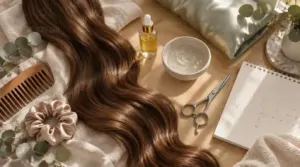
Healthy long hair doesn’t happen by accident, and a simple schedule keeps you in control of it. Once your washing, styling, and nighttime habits are set, a few recurring tasks protect the length you’ve worked hard to grow. Here are the two maintenance pillars to build into your weekly and monthly routine.
Weekly Masks and Targeted Repair Treatments
Think of weekly deep conditioning as a reset for your oldest hair. Apply a deep conditioning mask from mid-lengths to ends, and leave it on only as long as the label says. Longer won’t help and can leave residue.
Alternate it with a protein treatment or bondbuilding treatments if you bleach or color. Use those less often, since overdoing them can make hair stiff.
Scalp Care and Length-Retaining Trims
Think of your scalp as soil and your ends as the oldest leaves on the plant. Tend both well.
Treat your scalp like soil and your ends like the oldest leaves, and tend both with equal care
Scalp care and length-retaining trims work together, and they matter for long hair care for men too. Massage your scalp for four minutes daily, and exfoliate weekly. Book regular trims every 12 weeks for split end prevention and hair growth retention.
Frequently Asked Questions (FAQs)
What is the best hair care routine for long hair?
You might think long hair needs a complicated routine, but it doesn’t. Your hair care routine for long hair comes down to this: wash gently, condition the ends, protect your strands, and book regular trims.
What is the 3 rule for hair length?
The 3-inch rule is a quick guideline that uses your facial proportions to help you choose short or long hair. It’s flexible, so texture and style still matter.
Either way, hair length retention still counts.
At what age is hair thickest?
Your hair is usually thickest between your mid-30s and mid-40s. Strand width keeps growing until about 40 to 45, while density peaks in your twenties. Together, they make your hair thickness feel fullest around
What is the Japanese hair washing method?
Ask ten people in Tokyo how they wash their hair and you’ll get ten answers. The Japanese hair washing method isn’t one fixed technique. It’s a scalp-first routine: brush, wet thoroughly, lather at the roots, massage with fingertips, then rinse well.
What is a good hair care routine for long hair?
Think of long hair as a thread that’s been rewound for years; every tug shows. Wash two to three times weekly, condition mid-lengths down, add weekly deep conditioning, and use detangling spray. A silk pillowcase helps.
What is the 25 rule for hair length?
Grab a ruler and measure from your earlobe to your chin. Under 25 inches (about 5 cm)? Shorter cuts like bobs or crops tend to flatter you. Over it, longer hair balances your face better.
How to fix frizzy menopause hair?
Menopause frizz can feel like your hair staged a full rebellion overnight. Fix it with a weekly deep conditioning mask and a leave-in to seal in moisture. Add a gentle scalp massage with diluted rosemary oil.
Is Paul Mitchell good for dry hair?
Dry hair is a parched garden; Paul Mitchell is rain.
Yes, Sheer Hydration and Instant Moisture help.
Build a moisturizing hair routine with sulfatefree shampoo, deep conditioning mask, and heat protectant for hair moisture retention.
What is a good hair routine for long hair?
A solid hair care routine for long hair starts with washing 2–3 times weekly using sulfate-free shampoo and lukewarm water. Add weekly deep conditioning, practice bottomup detangling, seal your ends, use heat protectant, and sleep on silk.
How to take care if you have long hair?
Long hair is a delicate silk scarf. Your hair care routine for long hair: wash 2-3 times weekly, detangling from ends upward, weekly deep conditioning, protect hair at night in a silk or satin bonnet.
Conclusion
Think of your hair as a rope that frays wherever it rubs. Every gentle habit you’ve just learned stops one more fray before it starts.
A steady hair care routine for long hair doesn’t demand flawlessness. It asks for kindness at each step: cleanse the scalp, feed the ends, detangle slowly, shield strands from heat and cotton, and trim on schedule.
Stick with it for three months, and your tired ends will finally stay put.