This site is supported by our readers. We may earn a commission, at no cost to you, if you purchase through links. This content is for general informational and educational purposes only and is not a substitute for professional medical, dermatological, or nutritional advice.
Two thin lines dropping past the corners of your mouth, bare skin under your nose, nothing touching the chin. That gap is the whole point. Get it right and you’ve got one of the most recognizable mustache styles out there, worn everywhere from martial arts flicks to your uncle’s barbershop chair.
Most guys who try growing a fu manchu mustache run into the same wall: uneven tendrils, patchy philtrum growth, or hair that just won’t hang straight no matter how much wax they use. It’s a style that rewards patience and punishes shortcuts.
Here’s what separates a sharp fu manchu from a scraggly mess, and how to build one that actually holds its shape.
Table Of Contents
- Key Takeaways
- What is a Fu Manchu Mustache?
- Fu Manchu History and Cultural Impact
- Popular Fu Manchu Mustache Variations
- How to Grow a Fu Manchu
- Grooming and Styling Your Fu Manchu
- Frequently Asked Questions (FAQs)
- Why is it called a fu manchu mustache?
- What is the difference between a horseshoe mustache and a Fu Manchu?
- What mustache style is most attractive?
- What is Hulk Hogan’s mustache called?
- What is a Fu Manchu moustache?
- What is a fu manchu beard?
- How to wear a Chu Man fu mustache?
- What is a Fu Manchu?
- How do you grow a Fu Manchu mustache?
- How do you style a Fu Manchu moustache?
- Conclusion
Key Takeaways
- A true Fu Manchu is all about that bare gap under your nose and past the mouth corners, with two thin tendrils hanging free instead of connecting down to your chin like a horseshoe does.
- Growing one takes real patience, since you’re looking at four to six weeks just for corner fuzz, and a full three months before those tendrils are long enough to sculpt properly.
- The style’s got a rough history worth knowing, born from a 1930s Hollywood villain trope that leaned hard on ugly Asian stereotypes, though plenty of guys today wear it as a way to reclaim it as pure personal style.
- Keeping it sharp comes down to a few daily habits: shaving that philtrum gap clean, training tendrils downward, and going easy on the wax until you’ve actually got length to work with.
What is a Fu Manchu Mustache?
The Fu Manchu gets tossed around a lot, but most folks couldn’t pick one out of a lineup with other big ‘staches. It’s got a specific shape, specific rules, and a few cousins that get mixed up with it constantly. Let’s break down exactly what makes this one stand apart from the rest.
For a closer look at those long, flared tips and the clean chin that separates it from a horseshoe or handlebar, check out this full breakdown of mustache styles.
Defining Shape and Features
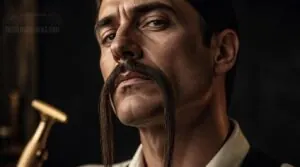
Picture two thin ropes of hair hanging off your top lip, nowhere near your chin. That’s the Fu Manchu mustache: trim the center short, train ends downward, keep things aligned with your mouth’s corners.
What makes it work:
- Philtrum separation stays bare
- Symmetry balance on both sides
- Long narrow ends, not curls
Tendril Length and Separation
So how long should those tendrils actually get? Ideal tendril span runs anywhere from a couple centimeters to a few inches, hanging 1-2 centimeters past your chin once fully grown.
Keep the philtrum gap width around 2-6 millimeters, no spiral or crossover. Guide growth parallel to your lip edge for clean tendril separation.
Fu Manchu Versus Horseshoe
Get those tendrils dialed in, and it’s worth knowing what they’re not: a horseshoe. Horseshoe pipes run down from the mustache to the chin, connected the whole way. Fu Manchu stays separate, hanging free above the jaw. Three real differences:
- Shape – Fu Manchu floats; horseshoe connects.
- Culture – biker rugged vs. villain trope.
- Upkeep – cheek growth versus lip-only training.
The cultural portrayal of Fu Manchu in media has been critiqued for reinforcing harmful Asian women stereotypes.
Fu Manchu Versus Handlebar
Now, the handlebar’s a whole different animal. Those edges curl upward, waxed into a bike-handle arc above the lip, where Fu Manchu drops downward past the corners. One fights gravity with wax, the other trains hair to hang.
Grooming tools barely overlap either: waxing kit versus daily lip-gap shaving. Styling time commitment differs too — handlebar’s quick touch-ups versus Fu Manchu’s longer sessions.
Why Hogan’s is Different
Since we’re on the subject of contrast, importantly: good grooming gear matters as much as good technique. Think craftsmanship and heritage the way Hogan builds shoes—premium materials, hand finishing, built for the long haul.
Apply that same mindset to your grooming routine. Quality trimmers, real balm, patience. Your Fu Manchu mustache deserves the same care as anything worth keeping around.
Fu Manchu History and Cultural Impact

Before you grow one, it helps to know where this mustache actually came from. It’s got a backstory that runs through old pulp novels, classic film, and some real cultural baggage worth understanding. Here’s the timeline, from page to screen to your bathroom mirror.
That same tradition of facial hair in the fire service raises a practical question today, one worth exploring in this guide on firefighter grooming standards and beard policies.
Literary Origins of Fu Manchu
Before Fu Manchu ever hit a movie screen, he crawled out of the pages of a 1912 story called The Zayat Kiss. That’s the character’s first appearance, courtesy of author Sax Rohmer, and it stuck:
- A mastermind spanning continents
- Secret schemes decades deep
- The blueprint for pop culture villains
- A legacy tangled in cultural sensitivity concerns
Early Film Portrayals
Page didn’t give Fu Manchu his mustache—film did. The look debuted in 1929’s The Mystery of Dr. Fu Manchu, then Boris Karloff cemented it in 1932, planting silent film mustaches as villain shorthand.
That’s classic early cinema stereotypes: sharp facial hair signaling danger before dialogue existed. Facial hair symbolism did the heavy lifting, turning Sax Rohmer’s character into cinema’s blueprint for pop culture villains.
Villain Imagery in Pop Culture
Once Karloff wore it on screen, that mustache became shorthand for evil itself. Villain imagery leans hard on silhouette-based menace—sharp shadows, sinister shapes—paired with architectural villain settings and exotic villain attire to sell danger fast.
Across villain evolution eras, the Fu Manchu mustache stayed pop culture’s laziest, most enduring sinister signal.
Moral ambiguity visuals came later.
Racial Stereotypes and Controversy
Here’s the uncomfortable truth behind the style: a Chinese supervillain built by Western culture to look dangerous. It fueled anti-Asian stereotypes and exclusion laws for decades.
A Chinese supervillain built by Western culture to look dangerous fueled anti-Asian stereotypes for decades
- Chevrolet’s 2023 ad, pulled after backlash
- Yellowface casting choices in old Hollywood
- COVID-era "China virus" rhetoric
That’s cultural appropriation debate territory, and competitive mustache ethics now demand context statements at championships.
Modern Reinterpretations and Personal Expression
So where does that leave guys who just like the look? Plenty of wearers now treat it as personal reclamation, not tribute.
Mixing tendrils with stubble, silver dye, or matte pomade turns an old caricature into genuine facial hair creativity, part of a modern revival built on self-expression rather than stereotype.
Your mustache, your story.
Popular Fu Manchu Mustache Variations

Not every Fu Manchu has to look the same off a movie poster. Once you’ve got the basic shape down, there’s real room to make it your own, with hair texture and personal style pulling a lot of weight. Here’s a rundown of the variations you’ll see most in the chair.
Classic Thin Tendrils
Two thin strands, hanging like tiny pendulums past the corners of your mouth, no bulk, no mess. Think 2 to 4 millimeters wide, straight, uncurled, dropping 20-40mm down.
The trick’s clean separation maintenance: keep the center trimmed flat, train growth downward daily, and shape each tip so it stops short of your jaw. Precision over volume, every time.
Thick and Rugged Versions
Now flip the script: forget dainty, go rope-thick. Thick Fu Manchu tendrils run 1.5 to 2.5 inches, denser at the ends for that chunky, weathered look.
Sharpen the outer edges for real jawline shaping techniques, keep a 2-4mm gap for structure, and lock it down with strong-hold wax. Coarse, wavy hair holds shape best.
Short Fu Manchu Styles
Not everyone wants rope-thick tendrils hanging past the jaw, and that’s fine. The short Fu Manchu keeps tips above the mouth, just a few millimeters past the corners, with clean tendril length control and sharp gaps.
Pair it with shaved cheeks for jawline minimization, and stick to a quick weekly trim, this one’s low-fuss, low-drama grooming.
Silver, Ginger, and Coily Hair
Length’s one thing, but hair type changes the whole game. Silver strands run finer and cooler-toned, so light UV-protectant balm keeps them shiny, not dull.
Ginger tendrils fade at the tips first, think strawberry-blonde drift, so color-safe products matter.
Coily Fu Manchus need heavy moisture and gentle detangling daily, tight curls tangle fast, so keep sealants on hand.
Competition-Level Sculpted Designs
When you’re chasing trophies, casual grooming won’t cut it. Competition Fu Manchus demand tendril symmetry techniques, precise edge sculpting, and strict proportion measurement, tendrils matched within 0.1 inch, angled 15-25 degrees outward.
What separates winners:
- Mirror-perfect tendril length
- Crisp, waxed edge definition
- Daily maintenance rehearsal routines
Mustache wax and conditioning keep hair strong, shiny, stage-ready.
How to Grow a Fu Manchu
Growing a Fu Manchu isn’t hard, but it does take patience and a little know-how. You’re basically training your face to grow in a very specific direction, and that means a real plan, not just letting things go wild for a month. Here’s what you need to know before you start.
Preparing Your Facial Hair

Before those tendrils even think about hanging low, your skin and hair need a clean slate. Cleansing skin and washing hair strips oil, then dry fully, wet hair stretches and tricks you into cutting short. Pat dry, don’t rub. Comb through gently, detangling strands so nothing snags once training starts. Sharp, clean tools finish the prep job right.
Creating Clean Tendril Separation
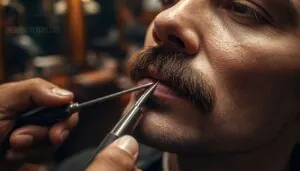
Grab a trimmer and carve out real space between your center mustache and each hanging strand, that gap is what makes a Fu Manchu read as sharp instead of scraggly.
- Taper the inner edge of each tendril
- Check symmetry checks both sides in the mirror
- Work wax lightly so the gap stays visible, not glossy
Training Hair to Hang Downward
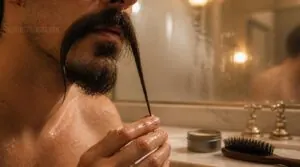
Hair doesn’t just hang downward on its own, you’ve got to teach it. Twice a day, pinch each tendril near the base and pull straight down for a slow count of 30, ten reps per side, right after a shower when hair’s damp and cooperative.
Follow up with a light wax set and a downward brush daily, that’s how you build real muscle memory into the follicle.
Expected Growth Timeline
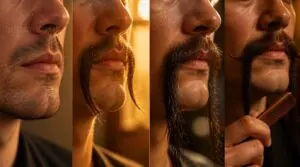
Patience is the real trick here, not skill. Corners show fuzz by week four, tendrils start reaching past the lip by week six to eight, then thicken up nicely through week twelve.
By month three, expect tendrils sitting around 1 to 2 inches, ready for real sculpting. After month four, you’re just maintaining, weekly mustache trimming and daily brushing keep it sharp.
Common Growing Mistakes
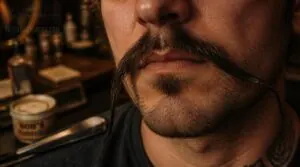
Most guys wreck a good Fu Manchu before it even gets going. Trimming too early flattens tendrils before they hang right, and wax overuse turns them into greasy toothpicks.
Skip daily philtrum shaves and tendril separation disappears into horseshoe territory. Watch growth imbalance too—long center, short sides looks sloppy.
Save products until there’s actual length to work with.
Grooming and Styling Your Fu Manchu
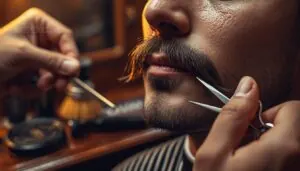
Growing it out is half the battle, but keeping it sharp is where the real work starts. A Fu Manchu lives or dies on the details, so you can’t just set it and forget it. Here’s what you need to know to keep yours looking clean and pulled together.
Trimming Long Mustache Tendrils
Once tendrils hit chin length, trimming stops being optional. Comb them straight, then cut the baseline first before shaping the outer edges — scissors give you that soft, organic taper a trimmer just can’t match. Work weekly, conservatively; you can’t glue hair back on.
A fine-toothed mustache comb reveals true length before every cut, saving you from lopsided tendrils.
Waxing and Sculpting Techniques
Scissors get the shape close, but wax locks it in.
For lasting definition, follow this handlebar mustache trimming and waxing guide for precise shaping techniques.
Blow-dry and comb first, then work medium hold wax center-out in three passes — heavy hold looks stiff, light won’t hold the point.
Keep the center trimmed clean for two separate pieces, not one strand.
Sculpt straight down, never curled.
Let it set five minutes before final shaping.
Cleaning and Moisturizing Products
Wax builds structure, but skin underneath still needs care. Wash with a gentle, soap-free cleanser so you’re not stripping oils the wax already fights.
Follow with a lightweight moisturizer carrying humectants like glycerin or hyaluronic acid, plus ceramides for barrier support. Beard oil after washing keeps skin and hair pliable — bonus if your daytime formula packs SPF.
Pairing With Beards and Soul Patches
Skin’s squared away, so let’s talk framing. A slim Fu Manchu with a short beard gives your jawline definition and draws the eye downward on purpose.
Soul patch guys get soul patch balance for free, the patch anchoring each tendril so lower facial width stays even.
Full beards work too, just keep that tendril separation care sharp so nothing fuses into one furry blob.
Matching Hairstyles and Face Shapes
Face shape decides how your tendrils should hang, and hair on top matters too. Oval face shapes handle most looks fine.
Round face shapes need higher starts for length. Square jawlines soften with narrow, separated tendrils.
Heart faces balance with longer lower growth. Diamond faces pair softness with cheek width.
Slick backs and undercuts keep focus downward, right where your Fu Manchu lives.
Frequently Asked Questions (FAQs)
Why is it called a fu manchu mustache?
Picture Boris Karloff on a 1932 movie set, tendrils waxed past his chin. That look stuck. The name comes straight from Sax Rohmer’s villain, whose screen version made this drooping mustache style famous worldwide.
What is the difference between a horseshoe mustache and a Fu Manchu?
Think jawline versus corners. The horseshoe hugs your jaw in one connected U, while a Fu Manchu keeps upper lip separation with two hanging tendrils. One frames the mouth, the other dangles past it.
What mustache style is most attractive?
Truth is, "most attractive" is really code for whatever suits your face. Symmetry, jawline enhancement, skin tone contrast — a well-groomed Fu Manchu mustache checks those boxes and delivers a solid confidence boost when it fits your look.
What is Hulk Hogan’s mustache called?
That’s your horseshoe mustache, arching down past the corners of his mouth to the jawline, full and thick throughout. It’s a different animal from the Fu Manchu, no thin tendrils here, just bold, connected growth framing his signature wrestling look.
What is a Fu Manchu moustache?
Two ropes of hair could dangle off your lip and swing when you talk, that’s basically the deal here. Clean upper lip, shaved cheeks, and two tapered tendrils running downward — vintage villain energy, way cooler than any handlebar mustache.
What is a fu manchu beard?
Take those two dangling tendrils past the chin, add a small chin tendril variant, and you’ve got the beard version. Same clean beard separation technique, longer reach, more commitment to the maintenance routine.
How to wear a Chu Man fu mustache?
Wearing it right is basically wielding a facial samurai sword: shave a clean philtrum gap, trim the center short, keep tendrils long and straight, wax lightly, comb daily, pair with minimal beard growth.
What is a Fu Manchu?
Picture two long, thin tendrils hanging past the mouth, mouth itself clean shaven. That’s the defining shape — full tendril length, clear separation from cheeks and chin, no connecting hair. Simple to spot once you know what you’re looking for.
How do you grow a Fu Manchu mustache?
Shave a clean philtrum gap, let corners grow 4-6 weeks, comb tendrils downward daily, trim the center often, and skip heavy wax early on — patience beats rushing the hang.
How do you style a Fu Manchu moustache?
One barber let a client’s tendrils grow six weeks untouched, then trimmed weekly and waxed for hold. Comb downward daily, clean the philtrum, and match your hairstyle for a sharp, balanced look.
Conclusion
Funny thing: the same two tendrils that mark a movie villain also mark the guy at the DMV who just likes bold facial hair. That’s the trick of a fu manchu mustache, it carries menace and mischief in equal measure, depending on who’s wearing it.
Grow the gap clean, train the tendrils down, keep the wax light. Do that, and you’ve got a style with real staying power, one that’s outlasted a century of trends.