This site is supported by our readers. We may earn a commission, at no cost to you, if you purchase through links. This content is for general informational and educational purposes only and is not a substitute for professional medical, dermatological, or nutritional advice.

One crooked snip near the corner of your mouth, and you’re stuck hiding behind a coffee mug for two weeks straight. Every barber’s seen it walk through the door.
Here’s the thing most guys get wrong: they grab the trimmer first and skip everything that actually makes a clean line possible. Wash, dry, comb, then cut, in that order, or you’re just guessing at where the hair actually falls.
The best mustache trimming techniques come down to prep work and patience, not fancy gear. Get the angles right, know when scissors beat electric, and pick tools built for the job, and you’ll walk out looking sharp instead of lopsided.
Table Of Contents
- Key Takeaways
- Prepare Your Mustache for Trimming
- Trim With an Electric Trimmer
- Trim Your Mustache With Scissors
- Top 5 Mustache Trimming Tools
- Frequently Asked Questions (FAQs)
- What are common mustache trimming mistakes?
- Is it better to trim your mustache wet or dry?
- Should I trim my mustache upwards or downwards?
- Should the mustache go past the corner of the mouth?
- How often should you trim your mustache weekly?
- What products help keep facial hair soft?
- Can beard oil prevent skin irritation and acne?
- Which mustache style suits a round face?
- How do you curl a handlebar mustache?
- Conclusion
Key Takeaways
- Always wash, dry, and comb your mustache before cutting, since guessing at wet or messy hair throws off your whole line.
- Trim dry hair for accuracy, working from the longest trimmer guard down and cutting outer edges inward toward the center for symmetry.
- Use scissors at a 45-degree angle for precise spots like the lip line and nostrils, snipping no more than 1mm at a time.
- Keep your mustache even with your lip corners, since going past them by even a few millimeters reads as too long to most people.
Prepare Your Mustache for Trimming

A great trim starts long before the scissors come out. Your mustache needs to be clean, dry, and combed just right so you can actually see what you’re working with. Here’s how to get it ready, step by step.
If you want the full rundown, this beginner’s guide to mustache trimming walks through washing, drying, and combing so nothing gets missed before you pick up the scissors.
Wash and Condition Mustache Hair
Before you touch a blade, wash up. Use a sulfate-free shampoo, massage it in for 30 seconds, then rinse with lukewarm water.
Follow with conditioner for 2-3 minutes, rinsed cool to seal the cuticle.
- Softer hair cuts cleaner
- Less irritation on skin
- Better product absorption
- Easier comb control
Brush in circles to spread oils, then finish with beard oil. Wash 2-3 times weekly.
Dry The Mustache Completely
Wet hair hides split ends and throws off your line, so get it bone dry before any trimmer or scissors touch it.
| Method | Time | Best For |
|---|---|---|
| Towel pat | 20-30 sec | Quick removal |
| Air dry | 5-10 min | Gentle finish |
| Low-heat dryer | 2-3 min | Full dry control |
Finish damp hair with beard oil, then comb.
Comb Hairs Straight Downward
Once dry, grab your comb and pull hairs straight down at a 90-degree angle to the skin. This aligns every strand with its natural growth path.
Here’s what proper downward combing does for you:
- Applies light tension so hairs sit taut and even
- Aligns the comb’s straight edge with your lip line
- Reveals stray hairs before you make a single cut
That’s your true starting line for trimming.
Keep Your Face Expressionless
Before you cut a single hair, relax your jaw and let your lips fall neutral. A tense face shifts your lip line and throws off symmetry.
Soften your eyebrows, steady your gaze in a well-lit mirror, and hold calm posture.
| Tense Face | Relaxed Face |
|---|---|
| Jaw juts forward | Jaw stays level |
| Uneven lip line | True symmetry |
| Rushed snips | Controlled cuts |
Choose Your Desired Shape
Every great mustache starts with a decision: what shape fits your face?
If you’re working with sparse or uneven growth, this guide on styling tips for a patchy beard can help you choose a mustache shape that still looks intentional.
Handlebar suits square jaws with curled, waxed ends. Chevron favors rounder faces, staying close to the nose with a bold lip line definition.
Think end style selection now, before you cut. Straight, curled, or extended, your choice guides every trim, and locks in the symmetry checking method you’ll use later.
Trim With an Electric Trimmer
An electric trimmer gives you speed and control once your mustache is clean and dry. It takes a bit of technique to get sharp lines without taking off too much. Here’s how to run through it step by step.
Start With The Longest Guard
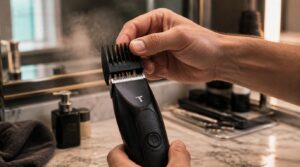
Grab your trimmer and start with a longer guard first, never the shortest. On a Multigroom 7000, that’s the 10mm Guard 6, snap it onto the base until it clicks, rotate a quarter turn to lock.
- Stainless steel edge stays sharp for hours
- Snap-fit attachment, no tools needed
- Rinse and dry after each session
- Prevents lopsided, uneven results
Define The Upper Lip Line

Your philtrum is the groove between nose and lip, and it’s your best guide here. Follow its natural curve, staying 1mm above the vermilion border, slightly higher at center than the corners of your mouth.
Check facial symmetry by comparing nose-to-mustache distance on each side, 8-10mm is standard. A fine comb helps trace the line before you trim.
Trim Outside Edges Inward

Think of the outer edges as your frame, work them first and the center falls into place. Set your trimmer to a 45 degree angle against the skin, then use short, overlapping strokes moving corner-to-center.
- Cover no more than 5mm per stroke
- Follow the mustache’s natural curve
- Switch to a shorter guard for tapering
This inward cutting motion keeps edges sharp and symmetrical.
Reduce Bulk With Upward Combing
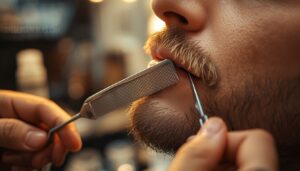
Bulky mustache? Comb hair upward at a 45-degree angle, tilting 10-15 degrees to lift it off the skin. Pick a 2mm-spaced comb for medium hair, keep gentle tension with your other hand, then trim just the top 2-3mm. Finish with a fine-tooth comb pass to smooth stray hairs before styling.
Blend Edges Into Facial Hair

Where mustache meets beard shouldn’t look like a cliff edge. Drop your guard to 1.5mm along that seam, then feather in short strokes toward the center.
Comb hairs downward, matching natural growth direction, and join the areas with light circular passes. Finish with beard oil for edge softening, so the line disappears and your whole face reads as one connected, groomed look.
Trim Your Mustache With Scissors
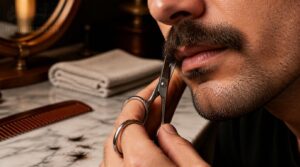
Scissors give you more control than trimmers, especially around tricky spots like the lip line and nostrils. It takes a steady hand and the right order of steps, but the payoff is a cleaner, more precise shape. Here’s how to work through it, step by step.
Comb Hairs Down Naturally
Comb your mustache down first, using a stainless-steel comb with 0.5mm to 1mm spacing. Hold it at a 15-degree angle, light pressure, one smooth downward stroke from nose to lip edge.
This reveals true hair length, exposes strays, and cuts trimming errors by up to 30%, so every snip lands exactly where it should.
Snip Along The Lip Line
Now grab your scissors and hold them at a 45-degree angle to the skin along the lip line. Snip in small segments, no more than 1mm at a time, following the hair’s natural growth direction.
- One wrong snip can wreck weeks of growth
- A crooked lip line throws off your whole look
- Precision now saves frustration later
- Small cuts protect your confidence
- A clean line makes you look sharp
Check symmetry in a mirror with good lighting.
Trim Near Nostrils Carefully
The lip line’s done, but the nose area needs extra care. Angle your scissors at 45 degrees, blades parallel to the nostril rim, tension pulled taut with your finger. Follow the hair’s natural curve, snip small, check symmetry under bright light.
| Step | Why It Matters |
|---|---|
| Skin tension | Prevents nicks |
| Good lighting | Reveals stray hairs |
Sanitize scissors after.
Remove Individual Overgrown Hairs
Even a clean line hides a few strays. Run a fine comb through and check from the side under bright light, that’s texture testing.
For tweezing precision hairs, sterilize tips first, grip close to skin, pull with growth. Prefer micro snip trimming? Tweezerman mustache scissors snip the strays cleanly.
Practice skin safety, avoid irritated spots, then apply light moisturizer for aftercare blending. A patch test is recommended before trying new facial hair removal methods to prevent irritation or allergic reactions. patch test recommended
Check for Uneven Sections
Since one crooked patch can undo a clean trim, step back and check before you call it done.
One crooked patch is all it takes to undo an otherwise clean trim
Turn your head under natural daylight, then switch to indoor light, that lighting assessment catches color and length gaps single-light checks miss.
- Compare left and right sides for a symmetry comparison
- Angle a mirror under your chin for a mirror angle check
- Measure with a ruler for length measurement
- Rotate slowly for full visual inspection
Top 5 Mustache Trimming Tools
Good technique only gets you so far without the right gear in hand. The tools you pick decide how clean, safe, and precise your cuts turn out. Here are five that earn a permanent spot in your grooming kit.
Pairing quality tools with proper chest shaving cream application techniques makes a real difference in how smooth and irritation-free the result feels.
1. Philips Norelco Multigroom Series 7000
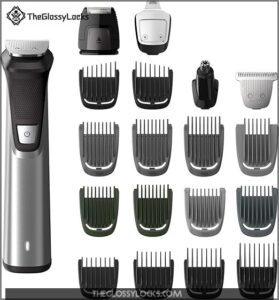
This trimmer earns its spot for one reason: DualCut self-sharpening blades that cut twice as fast and stay sharp for years, no oil needed.
The 23-piece attachment set controls beard, head, body, and nose in one kit, and the full metal motor pushes through thick growth without bogging down. Fiberglass guards resist bending, so your line stays true.
At 14.96 ounces with a 5-hour lithium-ion charge, it’s built for regular use, not just occasional touch-ups. Model MG7750/49 is the one to look for.
| Best For | Anyone who wants one tool to handle beard, head, body, and face grooming without buying separate trimmers for each job. |
|---|---|
| Material | Full metal motor |
| Primary Use | Full-body grooming |
| Portability | Cordless rechargeable |
| Precision Level | High-torque cutting |
| Maintenance | No oil needed |
| Design Focus | Versatile attachment set |
| Additional Features |
|
- Self-sharpening DualCut blades last up to 5 years with zero oil or maintenance
- Full metal motor and steel drive train power through thick, dense hair with ease
- 23-piece attachment set covers nearly every grooming need in a single kit
- Battery runtime tops out at 5 hours, so heavy users will need to recharge often
- Such a large attachment set can be tricky to store and keep organized
- No cordless quick-charge option mentioned, so a dead battery means waiting it out
2. Wahl Lithium Pen Detail Trimmer
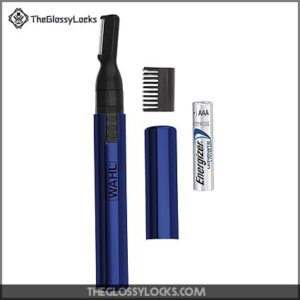
When precision matters more than power, grab the Wahl Lithium Pen Detail Trimmer. Its rinseable blade controls fine outlining along the lip line, and the snap-in detail head swaps fast for touch-ups.
The blue anodized aluminum body stays lightweight through long sessions, and one AAA lithium battery outlasts old NiMH models. A battery indicator light warns before it dies mid-trim.
Perfect for cleanup work between full trims, this pocket tool keeps your edges sharp without dragging out the big gear.
| Best For | This trimmer is best for anyone who wants a portable, multipurpose grooming tool for trimming nose, ear, eyebrow, and facial hair with salon-level precision. |
|---|---|
| Material | Anodized aluminum |
| Primary Use | Nose, ear, brow detailing |
| Portability | Portable travel size |
| Precision Level | Detail precision heads |
| Maintenance | Battery replacement needed |
| Design Focus | Interchangeable heads |
| Additional Features |
|
- Interchangeable, detachable heads make it easy to switch between nose, ear, brow, and facial detailing while staying hygienic
- Self-sharpening precision blades and a rugged anodized aluminum housing offer smooth, durable performance
- Lightweight, lithium-powered design makes it simple to toss in a bag for travel or quick touch-ups on the go
- Relies on a single AAA lithium battery, so you’ll need to keep replacements on hand
- May contain minor leftover particles from factory testing right out of the box
- Product appearance can shift slightly over time due to ongoing design updates
3. Tweezerman precision moustache grooming scissors
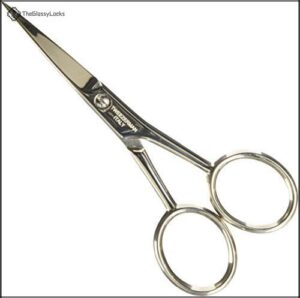
Some jobs call for a scalpel, not an axe. That’s where Tweezerman’s moustache scissors shine, with straight stainless steel blades built for clean snips right along the lip line.
The compact 2 to 2.5 inch blades and micro serrations grip stray hairs so they don’t slip during the cut. Large finger loops give you steady control, which matters when you’re working millimeters from your skin.
Wipe blades with alcohol after each use, and they’ll hold their edge for years.
| Best For | Anyone who wants precise, controlled trimming of moustache and beard hair without accidentally taking off more than intended. |
|---|---|
| Material | Stainless steel |
| Primary Use | Moustache and beard trimming |
| Portability | Compact handheld |
| Precision Level | Fine detail blades |
| Maintenance | Alcohol cleaning required |
| Design Focus | Ergonomic finger loops |
| Additional Features |
|
- Straight stainless steel blades allow precise, detailed trimming right along the lip line
- Ergonomic design with large finger loops gives steady, reliable control
- Durable stainless steel construction holds its edge over time
- Requires cleaning with alcohol after every use
- Best suited for small amounts of hair at a time, so it’s not ideal for quick, large trims
- Compact size means it’s not built for cutting or shaping larger areas of hair
4. Jason professional beard trimming scissors
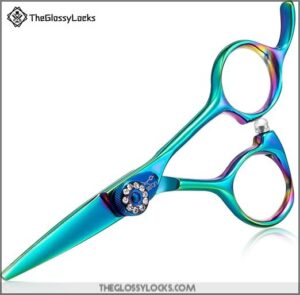
Want scissors that feel like an extension of your hand? Jason’s beard trimming scissors are built from Japanese 440C steel, convex ground for a smooth, snag-free cut.
The adjustable tension screw lets you dial in blade tightness to your liking, and offset grips keep your wrist relaxed through long sessions.
That razor-sharp edge minimizes pulling on coarse hairs, so your mustache line stays crisp. Clean and oil the pivot regularly, and these blades will keep their edge for the long haul.
| Best For | Anyone who wants precise, detailed grooming—like shaping beards, trimming mustaches, or cleaning up nose and ear hair—rather than tackling bulk hair removal. |
|---|---|
| Material | Stainless steel |
| Primary Use | Beard and moustache trimming |
| Portability | Compact handheld |
| Precision Level | Detail shear work |
| Maintenance | Manual care required |
| Design Focus | Specialized shear blades |
| Additional Features |
|
- Stainless steel blades deliver precise, detail-focused cuts
- Specialized shear design excels at fine work like bangs and facial hair
- Versatile enough for beards, mustaches, and nose/ear grooming
- Not suited for bulk hair removal or heavy-duty trimming
- Manual operation demands a steady, practiced hand
- Requires care and attention to maintain cutting precision
5. Kent Cellulose Acetate Mini Pocket Comb
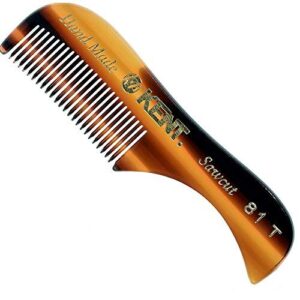
Every toolkit needs a good comb, and this Kent pocket comb earns its spot. Hand-cut from a single sheet of cellulose acetate, saw-cut and polished so the teeth glide instead of snag.
Rounded tips mean no scratching, even on sensitive upper-lip skin. At 6 x 1.7 inches, it slides into a pocket for touch-ups on the go.
Fine teeth suit mustache work perfectly, though thick beards might want something wider.
| Best For | Anyone who wants a compact, travel-friendly comb for precise mustache and beard grooming, especially those with sensitive skin. |
|---|---|
| Material | Cellulose acetate |
| Primary Use | Moustache and beard maintenance |
| Portability | Pocket-sized |
| Precision Level | Fine-tooth precision |
| Maintenance | Simple wipe clean |
| Design Focus | Hand-polished teeth |
| Additional Features |
|
- Smooth, hand-polished teeth glide through facial hair without snagging or scratching
- Compact 6 x 1.7 inch size fits easily in a pocket, bag, or car for quick touch-ups
- Durable, waterproof cellulose acetate resists static better than plastic combs
- Fine teeth aren’t built for detangling thick or coarse beards
- Extra-small size may feel flimsy to those who prefer a larger, sturdier comb
- Limited to grooming touch-ups rather than everyday full-head use
Frequently Asked Questions (FAQs)
What are common mustache trimming mistakes?
Skipping the pre-trim wash, using the wrong guard size, and cutting against natural growth top the list. Over-trimming edges and neglecting to mix into surrounding hair also cause uneven, patchy results that take extra time to fix.
Is it better to trim your mustache wet or dry?
Wet hair lies like grass after rain, flat and deceiving. Go dry for accuracy: dry strands settle at true length, so you trim what you’ll actually see, avoiding that shrink-back surprise once damp hair dries shorter than planned.
Should I trim my mustache upwards or downwards?
Both, depending on your goal. Go upward to cut bulk and ease irritation; go downward for a crisp, defined edge along the lip line. Combine them: upward first for volume, downward last for a clean finish.
Should the mustache go past the corner of the mouth?
Nope, keep it right at the corner. Studies show a 1:1 ratio with your lip width reads as balanced, while extending even 2-3mm past it gets rated too long by most people.
How often should you trim your mustache weekly?
Think of a guy growing a handlebar for a wedding in three months. He’ll want weekly trims to hold shape. Aim for once a week, adding quick top-ups if hairs grow fast or look sporadic.
What products help keep facial hair soft?
Beard oil locks in moisture after washing, while a leave-in conditioner fights frizz all day. Add a non-sulfate shampoo weekly, and a boar bristle brush to spread oils evenly through every strand.
Can beard oil prevent skin irritation and acne?
Good beard oil works like an umbrella for your skin, blocking moisture loss. It can calm dryness and friction with light oils like jojoba, but heavy or fragranced blends may clog pores or trigger irritation instead.
Which mustache style suits a round face?
For round faces, go with a pencil or handlebar style. Keep width to 2-3mm and let the ends extend past your lip corners, curling upward. This builds vertical lines that slim and elongate your face shape.
How do you curl a handlebar mustache?
Wash and dry the mustache first, then apply warm wax to the ends and pinch, roll, and twist with your fingers. Curl upward and in—or wind ends around a pen for tighter, cleaner curls.
Conclusion
Test the theory yourself: a sharp mustache line isn’t luck, it’s power. Every guy who walks out looking clean followed the same sequence: prep, angle, tool choice, patience. Skip a step, and you’ll see it in the mirror by Wednesday.
The best mustache trimming techniques aren’t about owning fancy gear; they’re about respecting the process. Master the basics, trust your hands, and that crooked snip becomes a memory, not a monthly habit.