This site is supported by our readers. We may earn a commission, at no cost to you, if you purchase through links. This content is for general informational and educational purposes only and is not a substitute for professional medical, dermatological, or nutritional advice.

A knife at HRC 62 will chip on the wrong stone before you finish the first pass. Thin Japanese edges punish soft abrasives and sloppy angles, and one rolled edge can cost you a week of clean cuts.
Most honing stones for chefs fail on three counts: wrong hardness for the steel, wrong grit for the damage, or a base that slides mid-stroke. A 1000 grit stone won’t fix a chip, and a 240 grit stone will scar a finished bevel.
Below, ten stones get sorted by material, grit range, size, and upkeep, so your next purchase matches your blades.
Table Of Contents
- Key Takeaways
- 10 Best Honing Stones for Chefs
- 1. SUWAJUME 3pc Diamond Sharpening Stone Set
- 2. Suwajume Natural Green Whetstone 10000 Grit
- 3. 5-Piece Diamond Sharpening Stone Set
- 4. HiramWare 400/1000 Grit Whetstone
- 5. Sharp Pebble Whetstone Sharpener Kit
- 6. KEENBEST Dual Grit Whetstone Sharpener
- 7. MIDO 400/1000 Whetstone Sharpening Kit
- 8. BABOSTOW Dual Grit Knife Sharpening Stone
- 9. Messermeister 12 Ceramic Sharpening Rod
- 10. Intelitopia Dual Grit Knife Sharpening Set
- Honing Stone Materials and Blade Compatibility
- Grit Selection for Restoring and Refining Edges
- Honing Stone Size, Stability, and Kitchen Storage
- Using, Cleaning, and Flattening Chef Honing Stones
- Frequently Asked Questions (FAQs)
- Conclusion
Key Takeaways
- Match the abrasive to your steel: ceramic or bonded diamond for hard Japanese blades (HRC 60 and up), and oil or water stones for softer Western knives.
- Pick your starting grit by the damage, using 200 to 300 for chips and rolled edges, 800 to 1200 for a dull but intact edge, and 4000 to 6000 for a finish that suits most kitchen knives.
- Choose a stone that’s long enough for your longest blade and sits on a non-slip base, because a shifting or undersized stone ruins your angle.
- Keep a steady 15 to 20 degree angle, flatten waterstones every 2 to 3 sessions, and air dry every stone to keep your edges accurate.
10 Best Honing Stones for Chefs
The ten products below cover diamond plates, dual-grit water stones, a natural finishing stone, and one ceramic rod. You’ll see grit range, size, and material noted for each, so you can match a pick to your steel and your workload. Start with the option closest to the knives you sharpen most.
For razor-fine edges, this guide to sharpening razor blades with a stone shows how grit progression and light pressure work on delicate steel.
1. SUWAJUME 3pc Diamond Sharpening Stone Set
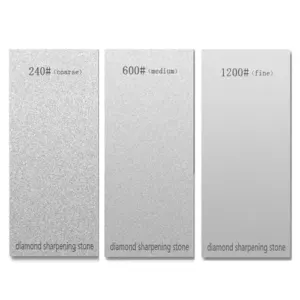
A three-stone diamond set covers repair, bevel setting, and finishing. The 240 grit stone reprofiles dull or chipped edges, the 600 grit sets a bevel, and the 1200 grit refines it. Diamond cuts fast and never needs flattening, so it suits hard steels above 60 HRC.
A silicone anti-slip pad keeps each stone planted. Use water or oil, then dry the cast iron backing to prevent rust. Heavy use wears the stones quickly, and user reports flag inaccurate grit markings.
| Best For | Home cooks and outdoor enthusiasts who want a portable, fast-cutting set to repair, sharpen, and finish household, chef’s, and outdoor knives, including those made of hard steel. |
|---|---|
| Grit | 240/600/1200 |
| Material | Diamond, cast iron backing |
| Weight | 4.8 oz |
| Dimensions | 0.2″ x 0.1″ x 0.1″ |
| Lubrication | Water or oil |
| Stability Base | Silicone anti-slip pad |
| Additional Features |
|
- Three grits (240, 600, and 1200) cover repairing chipped edges, setting a bevel, and finishing the edge.
- A silicone anti-slip pad on the back keeps each stone steady while you sharpen.
- Diamond cuts quickly, never needs flattening, and handles hard steels above 60 HRC.
- The stones can wear out quickly with heavy use.
- The cast iron backing can rust if you don’t dry it after use.
- Users report that the grit markings may be inaccurate or inconsistent.
2. Suwajume Natural Green Whetstone 10000 Grit
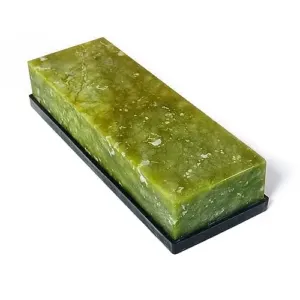
Once the 1200 grit diamond stone has refined your edge, this natural green stone finishes it. At 10000 grit, the MANAO18 polishes a bevel to a mirror finish on household, chef, outdoor, and carving knives. Soak it in water or use sharpening oil.
It’s a finisher only. Don’t use it for rough grinding. At 7.09" long, it’s shorter than an 8-inch blade, so overlap your passes and hold your angle steady. Expect color variations, and some buyers report surface fissures.
| Best For | Home cooks, chefs, and knife hobbyists who already have a sharp, refined edge and want a final polish that leaves a mirror finish on household, chef, outdoor, or carving knives. |
|---|---|
| Grit | 10000 |
| Material | Natural stone |
| Weight | 2 lb |
| Dimensions | 7.09″ x 2.36″ x 1.18″ |
| Lubrication | Water or oil |
| Stability Base | N/A |
| Additional Features |
|
- Polishes the edge to a mirror-like finish at 10000 grit
- Works on a wide range of knives, including household, professional chef, outdoor, and carving blades
- Performs well when soaked in water or used with sharpening oil
- Not suitable for rough grinding, so it only works as a finishing stone after a coarser one
- At 7.09" long, it is shorter than an 8-inch blade, so you need to overlap your passes and hold a steady angle
- Natural stone can vary in color, and some buyers report surface gaps and fissures that affect durability
3. 5-Piece Diamond Sharpening Stone Set
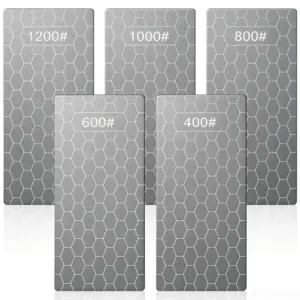
Where the previous stone finishes, this set starts you at the bottom of the ladder. It gives you five diamond-coated grits: 400, 600, 800, 1000, and 1200. Start coarse to set the bevel, then step up one stone at a time.
The honeycomb layout channels debris away so the surface stays clean, and the non-slip base keeps things steady. Add water or honing oil to extend stone life.
At 6" long, it’s compact, but buyers report slipping and durability issues.
| Best For | Home cooks and hobbyists who want an affordable, compact set that lets them start with a coarse grit to repair a dull edge and then work up to a fine finish. |
|---|---|
| Grit | 400/600/800/1000/1200 |
| Material | Diamond-coated stone |
| Weight | N/A |
| Dimensions | 3.93″ x 0.66″ x 6.29″ |
| Lubrication | Water or honing oil |
| Stability Base | Non-slip base |
| Additional Features |
|
- Five diamond-coated grits (400, 600, 800, 1000, and 1200) let you set the bevel and then refine the edge step by step.
- The honeycomb layout channels grinding debris away so the surface stays clean.
- Its compact size makes it easy to store and carry, and it works on kitchen knives, tool steel, carving tools, ceramics, and more.
- Some users report durability problems with long-term use.
- Certain customers have reported slipping during operation, despite the non-slip base.
- Results vary, and not every knife reaches the desired sharpness.
4. HiramWare 400/1000 Grit Whetstone
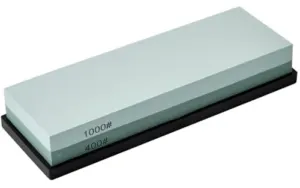
If you’d rather learn on two grits than five, this one makes sense. It pairs a 400 side for setting the bevel with a 1000 side for refining, which covers most kitchen touch-ups.
The white corundum block measures 7" x 2.3" x 1.1" and weighs 1.4 pounds. A silicone base keeps it from shifting. Soak it in water, no oil needed.
It works with chef’s knives, pocket knives, chisels, plane blades, and axes. Skip serrated or curved edges. It’s straight blades only.
| Best For | Beginners and home cooks who want one simple, two-grit stone to learn on and keep their kitchen knives, pocket knives, and basic woodworking tools sharp. |
|---|---|
| Grit | 400/1000 |
| Material | White corundum |
| Weight | 1.4 lb |
| Dimensions | 7″ x 2.3″ x 1.1″ |
| Lubrication | Water |
| Stability Base | Non-slip silicone base |
| Additional Features |
|
- Dual-sided 400/1000 grit covers both setting the bevel and refining the edge
- Non-slip silicone base keeps the stone steady while you work
- Uses water only, so there’s no oil to buy or clean up
- Works on straight-edged blades only, so no serrated or curved edges
- Needs water lubrication throughout use
- Manual tool that takes practice and effort, with no electric option
5. Sharp Pebble Whetstone Sharpener Kit
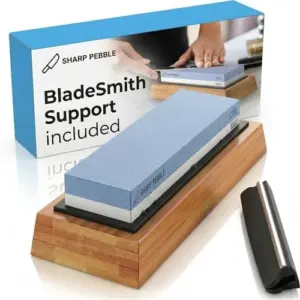
A dual-grit 1000/6000 stone covers both edge repair and polishing, so you don’t need a second purchase to get a finished edge. It measures 7.25" x 2.25" x 1" and weighs 2.1 pounds, which is enough mass to stay put. The non-slip bamboo base locks it down, and the included angle guide keeps your blade position consistent.
Soak it in water before use. No honing oil is needed. Skip it for ceramic knives and extremely hard alloys, and check that the guide clears wide bolsters.
| Best For | Home cooks and beginners who want a single stone that handles both repairing and polishing kitchen knives, pocket knives, scissors, and chisels without buying extra gear. |
|---|---|
| Grit | 1000/6000 |
| Material | Corundum |
| Weight | 2.1 lb |
| Dimensions | 7.25″ x 2.25″ x 1″ |
| Lubrication | Water |
| Stability Base | Non-slip bamboo base |
| Additional Features |
|
- Dual-grit 1000/6000 stone covers both edge repair and polishing in one purchase
- Included angle guide keeps blade positioning consistent, and the non-slip bamboo base holds the stone steady
- Water-based sharpening means no honing oil, and beginners can get a razor-sharp edge in about 10 minutes
- Must be soaked in water before each use
- Not suitable for ceramic knives or extremely hard alloys
- Angle guide may not fit blades with very wide bolsters or unusual profiles
6. KEENBEST Dual Grit Whetstone Sharpener
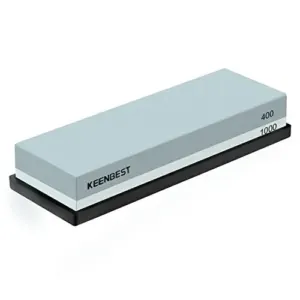
A 400/1000 dual-grit stone gives you repair and polish in one block, and this one does both without oil. Soak it in water for 10 to 15 minutes before each session, then use the 400 grit side to rebuild nicked or heavily dulled edges. Flip to the 1000 grit side for a smooth finish.
The stone measures 7 x 2.2 x 1.1 inches and weighs 16 ounces. Its non-slip rubber base keeps it steady. It sharpens scissors, chisels, and axes.
| Best For | Home cooks and DIY users who want one affordable, oil-free stone to both repair dull or nicked blades and finish them to a smooth edge. |
|---|---|
| Grit | 400/1000 |
| Material | White corundum, silicon carbide |
| Weight | 16 oz |
| Dimensions | 7″ x 2.2″ x 1.1″ |
| Lubrication | Water |
| Stability Base | Non-slip rubber base |
| Additional Features |
|
- Two grits in one block: 400 grit repairs nicked or heavily dulled edges, and 1000 grit polishes
- No oil needed, just a 10 to 15 minute water soak before use
- Non-slip rubber base keeps the stone steady while sharpening
- Needs to be soaked in water before every session for best results
- Results vary with steel type, pressure applied, and how well the stone is maintained
- Grit numbers are approximate, so the 1000 side may not give a true mirror-fine finish
7. MIDO 400/1000 Whetstone Sharpening Kit
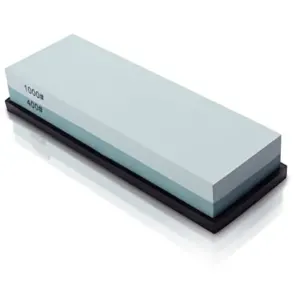
Say you’ve got a dull santoku and a Sunday afternoon. This kit gets you through it with one stone and no honing oil.
The silicon carbide block measures 7.67" L x 2.75" W x 1.41" H and weighs 1.5 pounds. Use the 400-grit side to set a fresh bevel, then flip to 1000 to smooth it out. Soak it in water for 5 to 10 minutes first. A silicone base and acacia holder keep it from shifting.
Some buyers report cracking on first use, and durability reviews are mixed. Handle it gently.
| Best For | Home cooks and outdoor enthusiasts who want one affordable stone to restore dull kitchen knives, hunting knives, scissors, and axes using only water. |
|---|---|
| Grit | 400/1000 |
| Material | Green silicon carbide |
| Weight | 1.5 lb |
| Dimensions | 7.67″ x 2.75″ x 1.41″ |
| Lubrication | Water |
| Stability Base | Silicone base, acacia holder |
| Additional Features |
|
- Two grits in one stone: 400 to set a fresh bevel, 1000 to smooth it out
- Silicone base and acacia wood holder keep the stone steady while you work
- Works with water only, so there is no honing oil to buy or clean up
- Some customers report the stone cracking during first use
- Durability gets mixed feedback in customer reviews
- Needs a 5 to 10 minute soak in water before each use
8. BABOSTOW Dual Grit Knife Sharpening Stone
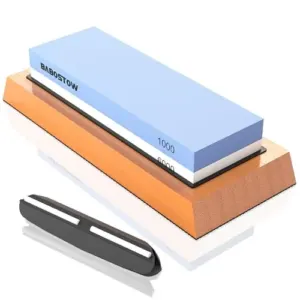
A 1000/6000 combination covers roughly 90 percent of what a home kitchen needs, and this stone delivers it in one slab. The 1000 side restores a dull edge. The 6000 side polishes it.
You’re working with an aluminum oxide stone measuring 7.1 x 2.4 x 1.2 inches, so an 8-inch chef’s knife will overhang slightly. Plan short, deliberate passes.
The bamboo base and silicone holder keep it from shifting, and the angle guide helps beginners hold a steady bevel. Soak it in water first. Skip serrated and ceramic blades.
| Best For | Home cooks and beginners who want one affordable whetstone to restore and polish kitchen knives, scissors, and other tools without using honing oil. |
|---|---|
| Grit | 1000/6000 |
| Material | Aluminum oxide |
| Weight | N/A |
| Dimensions | 7.1″ x 2.4″ x 1.2″ |
| Lubrication | Water |
| Stability Base | Bamboo base, silicone holder |
| Additional Features |
|
- Dual-sided 1000/6000 grit lets you restore a dull edge and then polish it with a single stone
- Non-slip bamboo base and silicone holder keep the stone steady while you work
- Built-in angle guide helps beginners hold a consistent sharpening angle
- Not suitable for serrated or ceramic blades
- Must be soaked in water before each use
- At 7.1 inches long, it is slightly shorter than an 8-inch chef’s knife, so you need short, deliberate passes
9. Messermeister 12 Ceramic Sharpening Rod
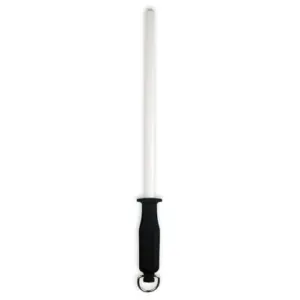
A 1200 grit ceramic rod won’t reshape a ruined edge, and it doesn’t pretend to. It’s built for the daily touch-up that keeps a chef’s knife cutting cleanly between full sharpenings.
The solid ceramic center and soft-grip handle with hang ring make it easy to store and control. At 18.5 inches long, it suits long slicers and chef’s knives without blade overhang.
Handle it carefully. Some users report breakage, and ceramic can chip if dropped. Skip it for nicked blades.
| Best For | Home cooks and pros who want a quick daily touch-up to keep long slicers and chef’s knives cutting cleanly between full sharpenings. |
|---|---|
| Grit | 1200 |
| Material | Ceramic |
| Weight | 0.3 kg |
| Dimensions | 18.5″ x 2.5″ x 1.5″ |
| Lubrication | N/A |
| Stability Base | N/A |
| Additional Features |
|
- Fine 1200 grit ceramic surface hones and polishes blades to a fine edge
- Solid ceramic core with a soft-grip handle and hang ring for easy control and storage
- 18.5-inch length suits long slicers and chef’s knives
- Mixed feedback on durability, with some users reporting it breaks easily
- Ceramic can chip if dropped
- Not meant for repairing heavily damaged or nicked blades
10. Intelitopia Dual Grit Knife Sharpening Set
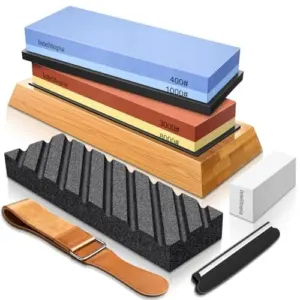
Most kits give you stones and leave you guessing. This one hands you a complete sharpening station for your bench.
You get 400/1000 and 3000/8000 dual-sided aluminum oxide whetstones, so you can set a bevel, smooth it, and polish it without buying anything else. A flattening stone, leather strop, bamboo base, and angle guide round out the set. It weighs 5 pounds and measures 9" x 8" x 3".
Soak with water only, no oil. Use the angle guide consistently, and condition the strop periodically.
| Best For | Home cooks and hobbyists who want a complete, all-in-one sharpening station for kitchen knives, pocket knives, scissors, and razors without buying extra gear. |
|---|---|
| Grit | 400/1000 & 3000/8000 |
| Material | Aluminum oxide corundum |
| Weight | 5 lb |
| Dimensions | 9″ x 8″ x 3″ |
| Lubrication | Water |
| Stability Base | Bamboo base |
| Additional Features |
|
- Dual-sided 400/1000 and 3000/8000 grit stones let you set, smooth, and polish a bevel with one kit.
- Includes a flattening stone, leather strop, bamboo base, and angle guide, so nothing else is needed to get started.
- Works with water only, so there’s no honing oil to buy or clean up.
- The stones need water lubrication the whole time you sharpen.
- The angle guide has to be used consistently to keep the bevel even.
- The leather strop needs conditioning from time to time to keep working well.
Honing Stone Materials and Blade Compatibility
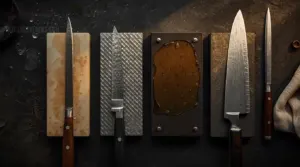
Your steel decides which abrasive material works. Knives at HRC 60 to 64, like most Japanese blades, need a surface that won’t chip a thin 15° edge. Ceramic rods suit them because they’re harder than the steel, with a rod at least 5 HRC points above the blade. A steel rod will gouge anything over HRC 60.
Softer Western knives in the HRC 54 to 58 range, such as Wüsthof or Victorinox, pair well with oil stones. Use honing oil so swarf doesn’t clog the surface.
Water stones give the finest edges and the best feedback. Soak them 5 to 15 minutes and flatten them regularly.
For steels above 65 HRC, choose bonded diamond plates. They need no lubricant, but heavy daily use wears them faster. Because their rigid construction means diamond plates resist dishing during normal use, they avoid the periodic flattening that water stones require.
Grit Selection for Restoring and Refining Edges
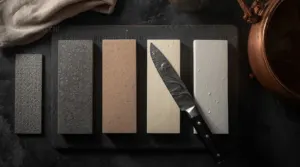
Once you’ve matched the abrasive to your steel, match the grit to the job. Damage sets the starting point, not habit.
Choose your grit by how badly the edge is damaged, because the wear on the blade should dictate where you begin, not routine
For chips, rolled edges, or a changed bevel angle, start at 200 to 300 grit. A diamond plate at 220 removes metal fast and gets a chipped edge back to a clean line. Don’t stay coarse longer than the damage requires.
For routine sharpening, 800 to 1200 grit does the work. A 1000 stone is the standard starting point for a dull but undamaged knife.
Improve next at 2000 to 3000, then finish at 4000 to 6000. That range suits most kitchen knives. For meat, stop there, since going finer can roll the edge on sinew. Save 8000+ for slicing and show.
Honing Stone Size, Stability, and Kitchen Storage
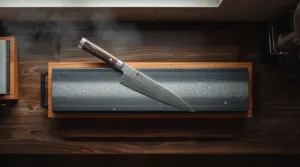
Grit gets the edge right, but the stone’s size decides how consistently you can apply it. Match length to your longest blade. An 8-inch stone covers most kitchen knives, while a 10 to 12 inch stone cuts the strokes needed on a long chef’s knife and keeps your angle steadier.
Look for 2-inch width and about 1 inch of thickness. Thicker stones resist dishing and last for years.
Stability matters as much as stone dimensions. A non-slip base or bamboo base keeps the stone from creeping mid-stroke, so use one. A stone that shifts will wreck your angle and risk your fingers.
For compact storage, 6-inch stones fit a drawer. Larger 10 to 12 inch stones need a shelf or wall mount.
Using, Cleaning, and Flattening Chef Honing Stones
A stable stone is only half the job. How you use it and look after it decides whether it stays accurate.
Soak waterstones for no more than 10 minutes, then lock the stone in place and keep the angle steady at 15 to 20 degrees. Let slurry formation on stones do some of the cutting. Don’t rinse it away mid-session.
Care comes down to three steps:
- Rinse waterstones with clean water after each session. Scrub diamond and ceramic stones with mild detergent and a nylon brush.
- Flatten waterstones every 2 to 3 sessions with a diamond plate, keeping both wet.
- Air dry on a rack. Never use a towel or enclosed container.
Skip WD-40 and hot water. Both will damage the stone.
Frequently Asked Questions (FAQs)
How often should chefs hone their knives?
Run your thumb along a chef’s edge after a Saturday dinner rush and it feels dull, though the steel is only bent. Hone at the start of every shift, and again mid-service if you’re breaking down bone-in proteins.
What is the difference between honing and sharpening?
Honing realigns a bent edge and removes almost no metal. Sharpening grinds steel away to build a new edge. If your blade is chipped or rounded, honing won’t fix it. Sharpen it.
How can you test if a knife is sharp?
A blade is a promise you make to the food. Test it on newsprint: hold the paper still and slice. A sharp edge cuts cleanly. A dull one tears or creases. Then pierce a firm tomato.
Can honing stones sharpen serrated knives?
Say your bread knife has gone dull and you reach for a flat whetstone. Don’t. It grinds away the teeth. Stick to a tapered diamond or ceramic rod, and work each gullet separately.
Conclusion
Match the steel, match the damage, match the stone. That’s the whole system. Hard, thin Japanese blades want fine, firm abrasives, while chipped edges demand coarse grits before any real polish.
Pick honing stones for chefs by hardness, grit, and base stability, then flatten them often and rinse them clean. Do that, and your knives stay sharp, your cuts stay clean, and the people you cook for never notice the patient work behind every plate.