This site is supported by our readers. We may earn a commission, at no cost to you, if you purchase through links. This content is for general informational and educational purposes only and is not a substitute for professional medical, dermatological, or nutritional advice.

A dull pocket knife slips off a tomato skin, skids across a cord, and turns a simple cut into a risky one. A sharp blade does the opposite. It bites cleanly, follows your hand, and gives you control.
The fix fits in your pocket. The right honing stones for pocket knives restore a working edge in minutes, on the trail, at camp, or at your kitchen table. Grit, material, and size decide how fast you cut and how long the stone lasts.
Here are four top picks, plus the know-how to choose, use, and care for them.
Table Of Contents
Key Takeaways
- Match your stone to how you’ll use it: the Angerstone suits trail carry, the Smiths Tri-Hone gives you a full three-stage setup, and the Intelitopia and KEENBEST sets work best at home with water.
- Pick your grit by what your edge needs, using coarse (200-400) for chips, medium (800-1500) for refining, and fine (3000-8000) for polish, and moving up one step at a time.
- Hold a steady 17 to 22 degree angle with light pressure and 5 to 10 smooth strokes per side, then move to a finer grit once a burr runs the full length of the edge.
- Rinse your stone after every use, flatten it when it cuts unevenly, and let it air dry fully so it keeps working well for years.
4 Best Honing Stones for Pocket Knives
A good pocket stone keeps your knife sharp wherever you are. The four picks below cover different budgets, grits, and carry styles, so you can match one to the way you work. Here’s what each one offers and who it suits best.
New to sharpening, our beginner’s guide to honing stones shows how to keep a steady angle so it feels natural within a few sessions.
1. Smiths Tri-Hone Sharpening System
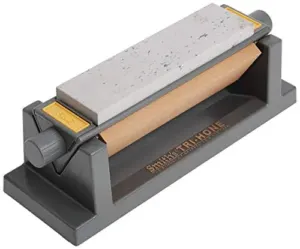
A three-stone setup gives you control over every stage of sharpening. You get a 300-grit coarse synthetic stone for reshaping dull edges, an 800-grit medium synthetic stone, and a 1,000-grit fine Arkansas stone for finishing. Each stone is 6 inches long, so strokes feel smooth and full.
The stones sit on a molded plastic triangle with grips, so you can rotate between grits quickly. Nonskid rubber feet keep it steady, and the V-trough catches oil drips. An angle guide and a 1 oz bottle of honing solution are included.
Some users report stones coming loose after repeated use, so check yours now and then.
| Best For | Hunters, anglers, and everyday carry knife owners who want a simple three-stage sharpening setup for pocket, hunting, and fishing knives, plus other tools. |
|---|---|
| Grit Options | 300, 800, 1000 |
| Stone Material | Arkansas and synthetic |
| Lubricant | Honing solution |
| Dimensions | 1.63″ x 1″ x 6″ |
| Weight | N/A |
| Knife Types | Pocket, hunting, fishing, kitchen |
| Additional Features |
|
- Three grits (300 coarse, 800 medium, 1,000 fine Arkansas) let you reshape a dull edge and then finish it.
- The molded triangle with handles rotates between stones, and the nonskid rubber feet keep it steady while you work.
- The V-trough catches oil drips, and the included angle guide and 1 oz bottle of honing solution mean you can start right away.
- Some users report the stones coming loose after repeated use.
- Not everyone finds it suitable for typical kitchen knives.
- Reports on long-term durability are mixed.
2. Intelitopia Dual Grit Knife Sharpening Set
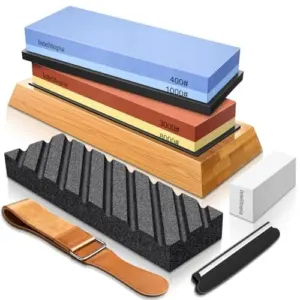
If you’d rather sharpen with water, this set keeps things simple. You get two dual-sided whetstones in 400/1000 and 3000/8000 grits, so you can reshape a dull edge and then polish it. They’re made of aluminum oxide corundum, and no honing oil is needed.
If you’re buying for a professional kitchen, this honing stones for chefs guide shows how the right grit pairing keeps a knife edge consistent.
A leather strop, flattening stone, bamboo base, and angle guide come in the box. It sharpens pocket knives, kitchen knives, scissors, and razors. Use the guide every time for a consistent bevel, and condition the strop now and then.
| Best For | Home cooks and hobbyists who want a complete, water-based sharpening kit to reshape and polish kitchen knives, pocket knives, scissors, and razors. |
|---|---|
| Grit Options | 400/1000, 3000/8000 |
| Stone Material | Aluminum oxide corundum |
| Lubricant | Water |
| Dimensions | 9″ x 8″ x 3″ |
| Weight | 5 pounds |
| Knife Types | Kitchen, pocket, scissors, razors |
| Additional Features |
|
- Two dual-sided whetstones (400/1000 and 3000/8000 grit) cover both reshaping a dull edge and polishing it.
- Comes with a leather strop, flattening stone, bamboo base, and angle guide, so everything needed is in the box.
- Uses water only, so no honing oil is required.
- The angle guide must be used every time to keep a consistent bevel.
- The stones need water lubrication during use.
- The leather strop needs to be conditioned now and then to keep working well.
3. Angerstone Pocket Sharpening Stone 400/1000
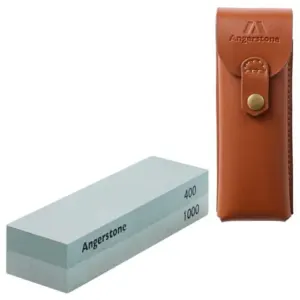
If you want a simpler setup that’s easier to carry, this one’s for you. It’s a dual-grit corundum stone with 400 and 1000 grit sides, so you can reshape a dull edge and then smooth it.
At 5.12 inches long and 8.64 ounces, it still fits a backpack, and the cowhide leather case protects it on the trail. Add water or honing oil every time you sharpen.
It grips hunting, camping, and survival knives, plus axes and chisels. Skip ceramic or extremely hard blades.
| Best For | Hikers, campers, and hunters who want a pocket-sized, dual-grit sharpening stone they can carry on the trail and use on knives, axes, and chisels. |
|---|---|
| Grit Options | 400/1000 |
| Stone Material | Corundum |
| Lubricant | Water or oil |
| Dimensions | 5.12″ x 1.65″ x 1.89″ |
| Weight | 8.64 ounces |
| Knife Types | Hunting, pocket, camping, survival |
| Additional Features |
|
- Dual-grit design with 400 and 1000 grit sides lets you reshape a dull edge and then smooth it
- Compact and portable at 5.12 inches long, with a cowhide leather case that protects it in a backpack or pocket
- Works on hunting, camping, and survival knives, as well as scissors, axes, hatchets, hooks, and chisels
- Needs water or honing oil every time you sharpen
- The coarse 400 grit side can remove more material than finer stones
- Not suitable for ceramic or extremely hard blade materials
4. KEENBEST Dual Grit Whetstone Sharpener
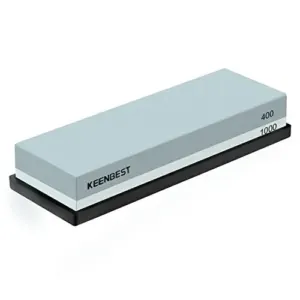
If portability matters less than power, this one’s worth a look. It’s a dual-sided stone with 400 grit for repairing nicked or heavily dulled edges and 1000 grit for a smooth finish.
Since 400 grit does the heavy lifting before 1000 grit refines the bevel, this step-by-step guide to sharpening razor blades with a stone shows how to match each side to your blade’s condition.
At 7 inches long and 16 ounces, it’s bigger than the Angerstone, but the non-slip rubber base keeps it steady while you work. Soak it in water for 10 to 15 minutes first. No oil needed.
It works on kitchen knives, scissors, chisels, hatchets, and garden tools, so one stone covers plenty of jobs.
| Best For | Home cooks and hobbyists who want one stone that can repair badly dulled or nicked blades and then polish them, and who don’t mind a bigger, heavier tool. |
|---|---|
| Grit Options | 400/1000 |
| Stone Material | White corundum, silicon carbide |
| Lubricant | Water |
| Dimensions | 7″ x 2.2″ x 1.1″ |
| Weight | 16 ounces |
| Knife Types | Kitchen, scissors, chisels, hatchets |
| Additional Features |
|
- Two grits in one stone: 400 grit repairs nicks and heavily dulled edges, and 1000 grit leaves a smooth finish
- Non-slip rubber base keeps the stone steady while you sharpen
- Works on kitchen knives, scissors, chisels, hatchets, axes, and garden tools, and needs no oil
- At 7 inches long and 16 ounces, it’s bulkier and less portable than smaller stones
- Needs a 10 to 15 minute water soak before each use for best results
- Results vary with steel type, pressure, and upkeep, so the outcome isn’t the same for every blade
Choose Honing Stone Materials and Grit
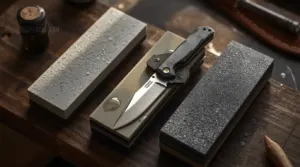
Material shapes how your honing stone feels and performs. Oil stones like novaculite give a polished edge but need honing oil. Water stones cut fast because soft binders release fresh abrasive, though they wear quickly. A diamond sharpening surface stays flat and works dry, so it’s easy to maintain. Diamond-coated stones use synthetic diamond particles bonded to a thin metal sheet with a protective nickel layer, which is why they cut quickly and can last many years.
Smart grit selection keeps your pocket knife sharp without wasted effort:
- Coarse (200-400): repairs chips and sets the bevel.
- Medium (800-1500): refines the edge and removes deep scratches.
- Fine (3000-8000): polishes to a razor finish.
Start where your knife needs it, then move up one step at a time. Most pocket knives need medium and fine, so add coarse for chips. An angle guide helps you keep control while you learn.
Compare Pocket Stone Sizes, Accessories, and Value
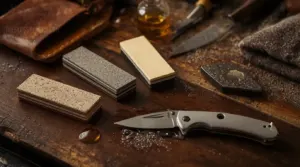
How long should your pocket stone be? Start with your blade. Most pocket knives have blades of 3.5 inches or less, so a stone of 4 to 5 inches gives you full strokes without taking up much room. Under 3 inches fits a small pouch easily, but you’ll sacrifice stroke length. Go thicker than ⅛ inch, because thin stones flex and break.
Accessories add real freedom. A pouch protects your stone in a pocket or bag. An angle guide helps you hold a steady edge while you build control, and some kits include a flattening plate or lubricant.
For value, look at the dual-sided stones. Two grits in one unit cost about 40% less per working surface than two separate stones. Bigger stones also wear slower, so they pay you back over time.
How to Use Pocket Knife Honing Stones
Picture a pocket knife that tears through a tomato skin instead of sliding off it. That’s what a few focused minutes on a honing stone can do for you.
Start by soaking a water stone for 10 to 15 minutes. Diamond stones just need a light water spray. Then set your angle, 17 to 22 degrees per side, and mark the bevel with a marker so you can see where the stone is cutting.
Keep these habits in mind:
- Push the blade from heel to tip in one smooth motion.
- Take 5 to 10 strokes per side, then switch.
- Use light pressure, about 2 to 3 pounds.
- Check for a burr with your thumb across the edge.
Once a burr runs the full length, move to a finer grit. Finish on a leather strop, then test the edge on paper. You’re in control of every stroke.
Clean, Flatten, and Store Your Honing Stones
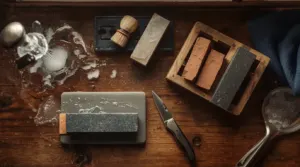
Rinse them, rub them flat, and dry them well. That’s the whole routine, and it keeps your honing stones cutting like new.
Clean your stone after every use. Water stones need a quick rinse to wash away swarf. Oil stones need a wipe with honing oil and a cloth. For diamond or ceramic hones, a soft brush and dish soap dissolve grime fast.
Flatten only when you see visible unevenness or notice slower cutting. Rub the stone on a flattening plate with water or oil. You can also lap a water stone on glass with wet sandpaper.
For storage, let each stone air dry completely to prevent mold. Keep them in a dry spot, away from bumps that cause chips. Use dividers so different grits never scratch each other.
Frequently Asked Questions (FAQs)
How often should pocket knives be honed?
Hone your pocket knives weekly, or every other week if you use them often. Touch up the edge whenever it starts to drag. Cutting cardboard or rope? Hone more often, and sharpen every one to two months.
Why does my knife feel dull after honing?
Ten passes, and your knife still tears paper. Usually the edge is rounded, and honing can’t remove metal to fix that. A burr or wobbly edge angle consistency can fool you. Sharpen on 1000 grit.
Can honing stones sharpen serrated pocket knife blades?
Not with a flat stone. It only touches the tooth tips and flattens them, which dulls the cut. For serrated blades, use a tapered or rod-style hone and work each gullet’s beveled side.
How do I know when my blade is sharp?
Trust your hands and a sheet of paper. A sharp edge slices printer paper cleanly without tearing or sawing. Lightly drag it across your fingernail too. If it grabs and resists, you’re good.
Conclusion
Why settle for a blade that fights you?
The right honing stones for pocket knives put control back in your hand. Pick a grit that fits your edge, match the stone to your pack, and keep it clean and flat.
Every single pass builds your skill. A few calm minutes with a good stone give you cleaner cuts, safer work, and freedom to trust your knife anywhere. Sharpen it, carry it, and cut with confidence.