This site is supported by our readers. We may earn a commission, at no cost to you, if you purchase through links. This content is for general informational and educational purposes only and is not a substitute for professional medical, dermatological, or nutritional advice.
Most jars in your bathroom cabinet list twenty-something ingredients, and maybe three of them do any real work. The rest are texture agents, preservatives, and marketing filler dressed up in Latin names.
That’s the problem with shopping by promise instead of by chemistry. A cream can claim "firming" or "brightening" all it wants, but the label only matters if the anti aging facial cream ingredients inside are active at a concentration your skin can actually use.
Once you know what retinoids do to collagen receptors, or why niacinamide shows up in nearly every formula worth buying, you stop guessing. You start reading ingredient lists like a chemist reads a recipe, and your routine gets a lot more effective.
Table Of Contents
- Key Takeaways
- How Anti-Aging Facial Cream Ingredients Work
- Best Ingredients for Wrinkles and Firmness
- Best Ingredients for Dark Spots
- Best Ingredients for Hydration and Barrier Repair
- How to Use Anti-Aging Ingredients Safely
- Frequently Asked Questions (FAQs)
- What is the most powerful anti-aging ingredient?
- What is the most powerful anti-aging cream?
- What are anti-aging ingredients in skincare?
- What is the main active ingredient in skin tightening?
- What is the main ingredient in anti-aging cream?
- What is the best anti-aging ingredient for face?
- Which ingredients should never be mixed together?
- How long before switching ineffective anti-aging products?
- Are expensive anti-aging creams more effective?
- Can I use anti-aging cream around my eyes?
- Conclusion
Key Takeaways
- Retinoids are your foreman ingredient—they drive collagen production and cell renewal faster than any peptide or antioxidant, though retinol takes 12+ weeks to work while prescription tretinoin acts in 4-6.
- No single jar fixes everything, so look for creams that pair retinoids with peptides, stabilized vitamin C, hyaluronic acid, and ceramides to cover firming, brightening, hydration, and barrier repair at once.
- Some combos backfire—layering retinoids with AHAs or vitamin C spikes irritation and cancels benefits, so introduce one active at a time and patch-test for 7-10 days first.
- Sunscreen isn’t optional backup, it’s the step that protects every other ingredient’s work, so daily broad-spectrum SPF 30 (or 50 with retinoids or vitamin C) is non-negotiable.
How Anti-Aging Facial Cream Ingredients Work
Anti-aging creams work like a construction crew, each ingredient assigned a specific job on your skin. Some rebuild structure, others speed up renewal, and a few just stand guard against damage. Here’s what’s actually happening beneath the surface with every application.
Retinol leads this crew as the foreman, and pairing it with the right supporting cast is exactly what this guide to effective anti-aging skin ingredients breaks down.
Collagen and Elastin Support
Think of collagen as scaffolding and elastin as the rubber bands holding your skin’s structure together.
Collagen boosters in creams stimulate fibroblasts to rebuild this connective tissue, restoring firmness. Elastin support keeps skin springing back after stretching, since elastin recoils far more than collagen. Peptides signal your skin to produce both structural proteins, gradually improving skin firmness over consistent use.
Healthy skin depends on collagen and elastin working together, as collagen resists tearing under tension while elastin prevents permanent deformation.
Faster Skin Cell Renewal
Scaffolding needs fresh material, and that’s where cellular renewal comes in. Skin cells cycle every 28 days in youth, slowing with age.
Retinoids accelerate turnover by signaling faster cell production. Niacinamide and AHAs like glycolic acid support exfoliation, clearing buildup so renewal shows. Together, these ingredients keep skin surfacing fresh cells rather than dull, aging ones.
Antioxidant Free Radical Defense
Fresh cells still need protection from daily wear. Free radicals, unpaired electrons from UV rays and pollution, trigger lipid peroxidation, damaging cell membranes.
Vitamin C, ferulic acid, and vitamin E work as free radical scavengers, neutralizing reactive species before they cause harm. Ferulic acid doubles vitamin C and E’s antioxidant capacity, supporting oxidative stress balance and reinforcing your skin’s natural antioxidant enzyme defenses daily.
Melanin Production Control
Dark spots start deep inside melanocytes, where tyrosinase activity drives melanin biosynthesis. MITF regulation and MC1R signaling control how much pigment your cells churn out.
Ingredients like vitamin C, kojic acid, and hydroquinone work through tyrosinase inhibition, blocking pigment before melanosome transfer delivers it to keratinocytes above, evening out tone at its source.
Barrier Repair and Hydration
Picture bricks and mortar: ceramides are the mortar holding skin cells together. Ceramide lipid repair cuts water loss dramatically, while hyaluronic acid hydration plumps from within and squalane forms a moisture seal on top.
- A cracked, tight-feeling cheek after a windy walk
- Skin that drinks in moisturizer instead of resisting it
- A dewy, cushioned look by midday
- Redness calming under a barrier-focused cream
- Fine lines softening as hydration builds
Niacinamide barrier support and fatty acid replenishment round out true barrier repair.
Best Ingredients for Wrinkles and Firmness
Wrinkles form when collagen production slows and the skin’s support structure weakens, so fixing them means targeting that process directly.
Not every ingredient works the same way or at the same speed, and knowing the difference saves you money and irritation.
Here’s what actually rebuilds firmness, ranked by how they get the job done.
Retinoids and Retinol
Retinol won’t work until your skin converts it to retinoic acid, the form that activates receptors driving collagen synthesis and cellular renewal. That extra step is why retinol acts slower than tretinoin, but with less irritation. Manage sensitivity by starting low, twice weekly, wrapped in moisturizer.
| Form | Strength | Onset |
|---|---|---|
| Retinol | OTC | 12+ wks |
| Tretinoin | Rx | 4-6 wks |
| Retinyl esters | Weak | Minimal |
Retinaldehyde and Prescription Retinoids
Sitting just one enzymatic step from retinoic acid, retinaldehyde converts faster than retinol, meaning quicker cellular renewal and collagen synthesis with less irritation.
Tretinoin still wins on raw potency through direct receptor activation.
Manage sensitivity by starting 2-3 times weekly.
Retinaldehyde degrades quickly, so look for airless, opaque packaging or encapsulated delivery systems that protect it from air, light, and water.
Collagen-supporting Peptides
Think of peptides as tiny messengers tapping fibroblasts on the shoulder, telling them to get back to work. Palmitoyl hexapeptide-12 (Val-Gly-Val-Ala-Pro-Gly) and palmitoyl tripeptide-5 (Lys-Val-Lys) trigger collagen and elastin synthesis, rebuilding the extracellular matrix from within.
Most formulas use 3-10% concentrations, and you’ll need 8-12 consistent weeks before firmness improves. Patience pays off here.
Alpha Hydroxy Acids
Sandpaper for your skin: that’s basically what alpha hydroxy acids do, dissolving the "glue" between dead cells for smoother, brighter texture.
Glycolic acid (from sugar cane) and lactic acid (from milk) are the workhorses here, boosting exfoliation and collagen production.
- Keep concentrations near 4%, pH above 3.8
- Expect sun sensitivity, so sunscreen is non-negotiable
- Watch for irritation on darker skin tones
- Use serums or creams consistently
Bakuchiol as a Retinol Alternative
Meet the plant-derived retinol alternative dermatologists actually respect: bakuchiol, from babchi seeds, activates collagen-producing receptors like retinoids do.
| Factor | Result |
|---|---|
| Efficacy | Equal to retinol on wrinkles |
| Tolerability | Less scaling, stinging |
| Origin | Not vitamin A-derived |
Better for sensitive skin, with added antioxidant perks and easier formulation stability.
Best Ingredients for Dark Spots
Dark spots don’t fade because you scrub harder—they fade when you interrupt the enzyme that makes them in the first place. That enzyme, tyrosinase, has several well-studied blockers, and not all of them work the same way or carry the same risks. Here’s what actually shuts down excess pigment production, starting with the most researched option on the market.
L-ascorbic Acid
Because it’s the standard, L-ascorbic acid earns its spot through pure chemistry: it inhibits tyrosinase, curbing melanin at the source, while delivering serious antioxidant potency against free radicals.
Effective ranges run 10-20%, offering:
- Brighter, more even tone
- Genuine collagen synthesis support
- Firmer texture over weeks
- Real free radical neutralization
It’s unstable, though, so formulation matters.
Stabilized Vitamin C Derivatives
If pure L-ascorbic acid feels too finicky, stabilized derivatives solve that. Magnesium ascorbyl phosphate resists oxidation in water-based formulas, extending shelf life to 12-24 months.
| Derivative | Solubility | Best For |
|---|---|---|
| Magnesium Ascorbyl Phosphate | Water | Antioxidant protection |
| Ethyl Ascorbic Acid | Oil | Brightening |
| Ascorbyl Glucoside | Water | Gradual release |
These trade some potency for tolerability, still delivering real skin brightening with less irritation.
Niacinamide for Uneven Tone
Niacinamide takes a different route to dark spots than vitamin C. Instead of blocking pigment production, it works on niacinamide pigment control, limiting how melanin transfers to surface cells. At 2-5%, it delivers real skin brightening, plus barrier support and calming benefits.
- Improves tone within 4-12 weeks
- Pairs well in serums
- Reduces redness
- Non-irritating
- Strengthens barrier
Kojic and Azelaic Acids
Two more tyrosinase blockers worth knowing: kojic acid, often 1-4%, binds the copper this enzyme needs, curbing melanin production.
Azelaic acid works differently, tackling hyperpigmentation while calming inflammation.
Expect kojic results in 4-8 weeks, azelaic in 8-12.
Both can sting initially; kojic occasionally triggers contact allergy with prolonged use.
Hydroquinone Benefits and Cautions
Call it the top choice for melanin inhibition: hydroquinone blocks tyrosinase directly, fading dark spots faster than kojic or azelaic acid.
It’s FDA-approved for melasma but prescription-only, not OTC.
Apply thin layers twice daily for 3 months, avoiding eyes and mouth.
Expect dryness, irritation. Patch test first.
Banned in the EU, Japan, and Australia over toxicity concerns, use cautiously and short-term.
Best Ingredients for Hydration and Barrier Repair
Wrinkles and dark spots get most of the attention, but a weak barrier undermines every other ingredient in your routine. Think of your skin barrier as the mortar holding the bricks together—without it, nothing stays where it should. Here are the five ingredients that rebuild that mortar and keep water locked in where it belongs.
Hyaluronic Acid and Sodium Hyaluronate
Think of hyaluronic acid as a sponge: it holds 1,000 times its weight in water, plumping skin fast.
Sodium hyaluronate penetrates deeper thanks to its smaller size.
Molecular weight variants matter: high weight sits on the surface, low weight sinks deeper.
Together, they boost hydration, strengthen your moisture barrier, and keep skin plump between applications.
Ceramides NP, AP, and EOP
Bricks need mortar, and your skin barrier needs ceramides holding everything together.
- Ceramide NP: most abundant, builds the main lipid matrix
- Ceramide AP: tightens lipid packing via hydrogen bonding
- Ceramide EOP: forms corneocyte envelopes for lasting strength
- Together: broader barrier repair balance than single types
- Paired with cholesterol and fatty acids for full restoration
This skin barrier strengthening trio locks in moisture retention lipids, reducing water loss noticeably.
Niacinamide for Barrier Support
Ceramides are the mortar, but niacinamide is the crew rebuilding your supply chain. It triggers barrier lipid upregulation, boosting ceramide, cholesterol, and fatty acid production from within.
| Effect | Humidity | Result |
|---|---|---|
| Water uptake | 95% RH | Increased hydration |
| Keratin swelling | 60% RH | Stratum corneum plasticity |
This niacinamide ceramide teamwork drives real TEWL reduction, at 2-5%, twice daily.
Glycerin and Other Humectants
Water follows glycerin like iron filings to a magnet. This humectant pulls moisture from the air straight into your stratum corneum, working reliably across a wide pH range.
Most formulas use it at 3-10% concentration, often paired with hyaluronic acid for layered hydration. Pair it with an occlusive, though, or that moisture escapes right back into dry air.
Squalane and Nourishing Oils
Oil doesn’t have to mean greasy. Squalane, hydrogenated from squalene, resists oxidation, blends seamlessly with actives, and mimics your skin’s own lipids for fast, non-greasy absorption.
Nourishing oils like jojoba and rosehip layer fatty acids to soften texture and support moisture barrier function. Together, they support skin elasticity and firmness, apply squalane after serums, before creams.
How to Use Anti-Aging Ingredients Safely
Great ingredients can still cause problems if you use them the wrong way. Timing, layering, and combining actives all matter just as much as the actives themselves. Here’s what you need to know before adding anything new to your routine.
Morning Versus Nighttime Application
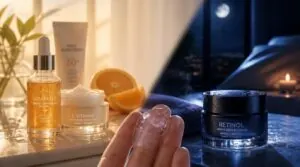
Timing matters as much as the ingredient itself. Mornings call for a gentle morning cleansing routine, Vitamin C, and SPF, layering antioxidants beneath sunscreen for daytime defense. Nights shift to repair: cleanse again, then apply retinoids, since retinoid night use only avoids photosensitivity. Hyaluronic Acid and peptides work either time, hydrating and rebuilding while you sleep or shielding you by day.
Compatible Ingredient Combinations
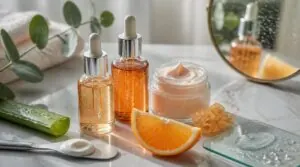
Pairing actives right multiplies results. Niacinamide and vitamin C stay stable near pH 5-6. Peptides plus hyaluronic acid plump skin safely, while retinoids paired with ceramides soothe as they renew.
| Combo | Benefit |
|---|---|
| Vitamin C + Peptides | Antioxidant + firming boost |
| Niacinamide + Hyaluronic Acid | Barrier layering, hydration |
| Retinol + Ceramides | Renewal with less irritation |
| Antioxidants + Moisturizer | Stabilized daytime protection |
Combinations Requiring Extra Caution
Not every pairing plays nice. Retinoids and AHAs clash on pH, retinol needs higher levels while glycolic acid wants 3.5-4.0, so layering both cancels efficacy and strips skin raw. BHAs compound that irritation.
Vitamin C oxidizes fast, going brown and useless.
Scrubs damage barriers already thinned by retinoids.
Stacking multiple actives overwhelms tolerance fast.
Patch Testing and Gradual Introduction
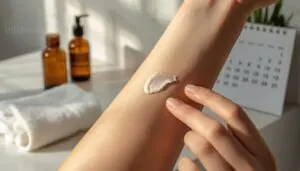
Given how easily actives clash, test first. Apply a pea-sized amount to your inner elbow, twice daily for 7-10 days, avoiding heat and rubbing. True reactions surface by day 5, not immediately. See redness or stinging? Stop. Otherwise, reintroduce gradually, one active at a time, letting sensitive skin adjust before layering. Gentle exfoliation waits until your barrier’s proven tolerant.
Daily Broad-spectrum Sunscreen Use
None of your actives matter without this step. Daily broad-spectrum SPF 30 (SPF 50 if you’re using retinoids or vitamin C) blocks UVA/UVB damage that undoes every ingredient above.
- Apply 15 minutes pre-exposure
- Use one ounce, full body
- Choose water-resistant formulas
- Reapply every 2 hours
- Layer over actives, under makeup
Skip sunscreen, and you’re renovating a house with the windows open.
Skipping sunscreen is like renovating a house with all the windows thrown wide open
Frequently Asked Questions (FAQs)
What is the most powerful anti-aging ingredient?
Think of skin as a construction site. Retinoids are the foreman, directing collagen rebuilding fastest. Retinol works well, but prescription-strength tretinoin activates receptors directly, refining texture and softening wrinkle depth more powerfully than any single peptide or antioxidant alone.
What is the most powerful anti-aging cream?
No single jar wins. The strongest formulas pair retinol with peptide complexes, stabilized vitamin C, hyaluronic acid, and ceramides, combining collagen support, brightening, deep hydration, and barrier reinforcement into one layered routine.
What are anti-aging ingredients in skincare?
Think of them as tiny renovation crews for your face. Retinoids rebuild collagen, Vitamin C brightens and defends, Peptides send rebuilding signals, Hyaluronic Acid floods in moisture, and Ceramides patch your barrier, each targeting a specific aging mechanism.
What is the main active ingredient in skin tightening?
No single ingredient does it all. Most firming active ingredients rely on a peptide complex tightening approach paired with retinoids firming peptides, collagen boosting actives, and elastin synthesis support to rebuild structure from within.
What is the main ingredient in anti-aging cream?
Retinoids, especially Retinol, are the main ingredient for firmer skin because they speed cell renewal and boost collagen. Vitamin C, Peptides, Hyaluronic Acid, and Ceramides help with brightness, hydration, and strength, but retinoids drive change.
For a luminous finish without compromising skincare, explore MAC Strobe Cream alternatives for radiant hydration.
What is the best anti-aging ingredient for face?
While some praise peptides or Vitamin C, Retinol stays best overall, with Retinaldehyde faster but gentler; Vitamin C works well with, Peptides-for-firmness, Hyaluronic-Acid hydration, and Ceramide barrier repair make results stronger, safer, and more complete for skin.
Which ingredients should never be mixed together?
Skip pairing retinoids with AHAs, benzoyl peroxide, or vitamin C. These ingredient conflicts spike irritation and cancel out benefits. Also avoid vitamin C with niacinamide in high strength, plus copper peptides with acids, which destabilizes results fast.
How long before switching ineffective anti-aging products?
Rome wasn’t built in a day, and neither is renewed skin. Give products a full twelve weeks of consistent use; if cellular turnover shows no visible change by then, it’s time to switch.
Are expensive anti-aging creams more effective?
A hefty price tag doesn’t guarantee results. What matters is active concentration, not cost. Budget formulas with Retinol, Vitamin C, Peptides, Hyaluronic Acid, or Ceramides can rival luxury creams when dosed and formulated correctly.
Can I use anti-aging cream around my eyes?
Think of your eye area as thinner glass, more fragile, quicker to crack. Use lower-concentration retinol, patch-test first, and favor gentle actives like hyaluronic acid, peptides, and ceramides over strong vitamin C formulas made for thicker skin.
Conclusion
Think of your skin like a house under renovation. Retinoids frame new structure, antioxidants guard the windows, and ceramides seal the roof against weather. No single fix does all three jobs, so anti aging facial cream ingredients work best as a coordinated crew, not a lone contractor.
Match actives to your actual concerns, introduce them slowly, and protect the work daily with sunscreen. That’s not a trend. That’s just how skin biology holds up over time.