This site is supported by our readers. We may earn a commission, at no cost to you, if you purchase through links. This content is for general informational and educational purposes only and is not a substitute for professional medical, dermatological, or nutritional advice.
Your skin feels smoother the moment you put the brush down. That part’s real. What isn’t real: any claim that dry brushing dissolves cellulite, because no study has ever shown bristles changing the fibrous bands under your skin.
Cellulite forms from connective tissue pulling down while fat pushes up, a structural issue no amount of surface scrubbing can fix. Dry brushing does boost blood flow and temporarily plump skin, which is why thighs look tighter right after a session.
Dry brushing for cellulite works as a texture booster, not a cure. Here’s how to use it the right way, and what to try when you want results that last longer than an hour.
Table Of Contents
- Key Takeaways
- Does Dry Brushing Reduce Cellulite?
- How Dry Brushing Affects Cellulite
- Top 3 Dry Brushes for Cellulite
- How to Prepare for Dry Brushing
- How to Dry Brush Cellulite
- Dry Brushing Legs and Thighs
- Dry Brushing Stomach and Buttocks
- How Often to Dry Brush
- Dry Brushing Safety and Aftercare
- More Effective Cellulite Treatment Options
- Frequently Asked Questions (FAQs)
- Does a dry brush really help with cellulite?
- How to tighten cellulite on legs?
- How long should you dry a brush to get rid of cellulite?
- How to dry brush cellulite on legs?
- Does dry brushing help cellulite?
- Can a body scrub cure cellulite?
- What is dry brushing your skin?
- Is there a miracle cure for cellulite?
- Can dry body brushing reduce your appearance?
- How do you clean a dry body brush?
- Conclusion
Key Takeaways
- Dry brushing can’t reduce cellulite because it only works on the skin’s surface, while cellulite forms from connective bands and fat deeper below.
- The smoother, tighter look you see right after brushing comes from increased blood flow and mild skin plumping, effects that fade within a few hours.
- For best results, brush dry skin in upward strokes toward your heart for 3-5 minutes, 2-3 times a week, using a natural-bristle brush.
- If you want lasting changes to cellulite’s structure, treatments like radiofrequency, laser therapy, subcision, or topical retinol have real evidence behind them.
Does Dry Brushing Reduce Cellulite?
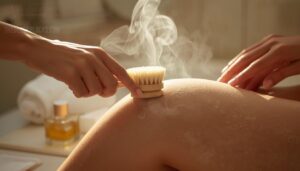
No, dry brushing won’t get rid of cellulite. It can smooth skin temporarily, but the dimpling itself stays put. Here’s what’s actually happening under your skin, and what you can realistically expect.
For a useful comparison, beard growth supplements for men explains why whole-body support and targeted topicals work differently.
Cellulite forms from fat pushing against connective bands beneath the skin, which is a completely different process from the moisture barrier issues behind common triggers for dry facial skin.
What Causes Cellulite Dimpling
Before you pick up a brush, understand what you’re up against: taut bands of connective tissue called septae anchor skin to muscle, pulling down while fat pushes up. Women have vertical bands, letting fat cell accumulation bulge through as dimples. Hormones, aging skin, and fat herniation through long septae all worsen this architectural imbalance.
While topical treatments like creams and dry brushing are commonly used, their effectiveness for lasting cellulite reduction lacks strong scientific evidence, as noted in discussions of home remedies for cellulite.
Temporary Skin-smoothing Effects
So why does skin look smoother right after a session? A few things happen at once.
Mechanical exfoliation sweeps away dull cells so skin feels softer immediately, while increased blood flow creates a temporary vascular glow. Add in better product absorption afterward, and you get real, visible smoothing, just not the structural fix your cellulite actually needs.
Scientific Evidence and Limitations
Here’s the honest gap: no randomized controlled trials have tested dry brushing for cellulite reduction. Zero peer-reviewed studies track long-term change.
Dermatologists rate this evidence "anecdotal", far below proven options.
The FDA doesn’t regulate it as medical treatment, and vibrational massage (not brushing) shows measurable results.
Realistic Dry Brushing Results
So what should you actually expect? Think cosmetic benefits only: temporary skin smoothing, a mild plumping effect, and a short-lived glow after each session.
Dry brushing can exfoliate your skin and stimulate circulation, even nudging lymphatic drainage. It won’t touch cellulite’s structure.
- Softer, brighter surface
- Brief plumped look
- No shape change
With consistent use, expect maintenance, not transformation.
How Dry Brushing Affects Cellulite
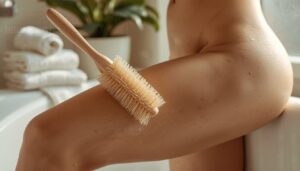
Dry brushing does something real to your skin, just not what most people think. Your body reacts to the bristles in a few specific ways, from blood flow to cell turnover. Here’s what actually happens beneath the surface when you brush.
Increased Surface Blood Flow
Friction from the bristles dilates surface capillaries fast, boosting visible blood flow within 1-2 minutes. That’s what creates the pink flush and a 1-2°C temperature rise in brushed areas.
Strokes toward the heart mirror lymphatic drainage, supporting venous return. Firmer bristles stimulate circulation more than soft ones, though a 3-5 minute session is enough to see this microcirculation boost.
Temporary Skin Plumping
That flush isn’t just color. It’s a vascular response: extra blood volume swells surface layers, thickening skin by 10-15% within minutes. Peak plumping hits at 5-10 minutes, lasting 2-4 hours.
This transient skin plumping smooths dimples temporarily and boosts moisturizer absorption by up to 30%. It doesn’t touch connective tissue bands, so cellulite’s structure stays unchanged underneath.
Dead Skin Cell Removal
While blood flow plumps skin temporarily, the bristles are doing real work underneath: mechanical exfoliation of the stratum corneum. Dead skin cells lift away, unclogging pores and revealing smoother texture instantly.
This process helps skin renewal in three ways:
- Clears buildup blocking epidermal turnover
- Boosts moisturizer absorption post-brushing
- Leaves skin brighter, softer to the touch
Real exfoliation benefits, but still no fix for cellulite’s structure.
Lymphatic Drainage Claims
Detox" is the word wellness marketing loves, but your lymphatic system isn’t a flush valve. It’s an immune and fluid balance network.
Brushing upward may offer mild lymph flow support, encouraging drainage toward nearby nodes. That’s genuinely helpful for puffiness.
It’s not a toxin eraser, and it won’t touch cellulite’s structure.
Why Results Are Temporary
Here’s the honest timeline: your skin resets fast. Blood flow stimulation peaks around 5 minutes, then fades within 30.
- Temporary plumping effect ends as circulation normalizes
- Dead skin renewal rebuilds surface cells within 24 hours
- Surface-level exfoliation lasts only 2 to 3 days
- Lymphatic drainage support doesn’t touch cellulite’s structure
That’s why maintenance repetition is needed, not optional, for any visible change.
Top 3 Dry Brushes for Cellulite
Your brush matters more than you’d think, since bristle type and stiffness change how your skin responds. Natural materials like sisal, boar, and cactus each offer a slightly different feel and firmness level. Here are three solid options worth considering for your routine.
1. Natural Sisal Dry Skin Brush for Exfoliation
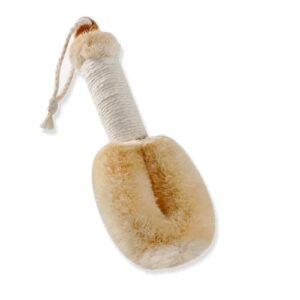
Sisal comes from the agave plant, and it’s about as no-nonsense as exfoliation gets. The densely packed fibers stay stiff yet flexible, sweeping away dead skin without causing micro-tears when used correctly.
At 9.45 x 3.82 x 2.13 inches and just 3.35 ounces, it’s easy to handle. Built from biodegradable sisal, jute, and wood, it’s a sustainable pick that also holds up well over months of regular use.
| Best For | Anyone wanting to smooth rough, dull skin or reduce the look of keratosis pilaris with a simple, natural dry-brushing routine. |
|---|---|
| Bristle Material | Sisal fiber |
| Handle Material | Sisal/jute/wood |
| Circulation Support | Yes |
| Exfoliation | Yes |
| Cellulite Benefit | Yes |
| Eco-Friendly | Biodegradable |
| Additional Features |
|
- Densely packed sisal bristles exfoliate effectively while staying flexible enough for comfortable use
- Supports circulation and lymphatic flow, helping skin feel renewed and look more radiant
- Made from biodegradable sisal, jute, and wood for an eco-friendly choice that holds up over time
- Bristles can shed with frequent use or if not dried properly
- Needs to air out fully between uses to avoid mold or mildew
- May feel too rough for sensitive or delicate skin if pressed too firmly
2. Belula Boar Bristle Dry Brush Set
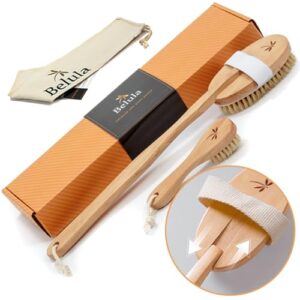
If sisal feels too aggressive for daily use, the Belula set gives you options. It bundles a boar bristle body brush, a separate face brush, exfoliating gloves, and a travel bag, all in one kit.
The wooden handle detaches with a hand strap, so you can use it dry or in the shower. Just know the stem connection can loosen over time, and the handle gets slippery once soap enters the picture.
| Best For | Anyone who wants a gentler, more versatile alternative to sisal brushes and prefers a full dry-brushing kit with options for face, body, and shower use. |
|---|---|
| Bristle Material | Boar bristle |
| Handle Material | Wood |
| Circulation Support | Yes |
| Exfoliation | Yes |
| Cellulite Benefit | Yes |
| Eco-Friendly | Not specified |
| Additional Features |
|
- Comes as a complete set with a body brush, face brush, exfoliating gloves, and travel bag
- Detachable handle with hand strap works for both dry brushing and shower use
- Natural boar bristles help exfoliate skin and support circulation
- Wooden handle can get slippery when wet with soap or conditioner
- Bristles may feel too stiff at first, especially on the face
- Removable stem connection may loosen with regular use over time
3. Hydrea London Cactus Bristle Dry Body Brush
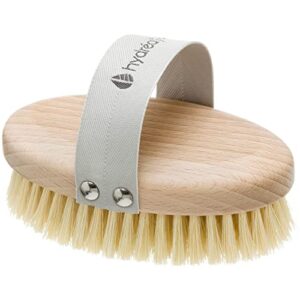
For a firmer touch, Hydrea London’s cactus brush steps things up. The bristles hit level 5 on the brand’s exfoliating scale, its firmest rating, so expect a stronger sensation than boar or sisal offers.
Each bristle runs about 1.5 inches and curves to follow your body’s shape. The FSC-certified beechwood handle adds an ergonomic curve for gliding over thighs and hips. Keep it dry between uses, since moisture warps both bristles and wood. With proper care, it lasts up to a year.
| Best For | People with normal-to-tough skin who want a firm, invigorating dry brush to boost circulation and smooth rough patches before showering. |
|---|---|
| Bristle Material | Cactus fiber |
| Handle Material | Beechwood |
| Circulation Support | Yes |
| Exfoliation | Yes |
| Cellulite Benefit | Yes |
| Eco-Friendly | FSC certified |
| Additional Features |
|
- Stiff cactus bristles deliver a strong exfoliating effect for smoother-feeling skin
- FSC-certified beechwood handle offers an ergonomic, sustainable, and vegan-friendly design
- Regular use may help reduce the look of cellulite and prevent ingrown hairs
- Firm bristles can feel too harsh on sensitive or delicate areas
- Not designed for use on the face or on broken/irritated skin
- Must be used dry only, so it can’t be worked into a shower routine
How to Prepare for Dry Brushing

Good results start before the brush ever touches your skin. A few simple steps set you up for a safe, effective session every time. Here’s exactly what to check off first.
Choose Natural Bristles
Before you touch your skin, look at your brush. Natural bristles like sisal, boar, or cactus outperform synthetic ones for dry brushing and cellulite work. Natural vs synthetic comes down to flex and porosity, reducing micro-tears. Want vegan brush options? Cactus fibers work great. Check the bristle firmness guide too, since sensitive skin care depends on choosing wisely.
Start With Completely Dry Skin
Once you’ve got the right brush, check your skin. Water-free brushing only works if skin passes the dry skin test: matte, not slippery, no sheen. Wait 5-10 minutes after showering.
Moisture barrier check matters because damp skin blocks exfoliation and softens the stratum corneum. Skin readiness means no lotion residue either, so pre-brush dryness sets up real blood flow stimulation for cellulite work.
Check Skin for Irritation
One quick check before you brush: does your skin already show any signs of skin redness, rashes, or open spots? Skip those areas.
Watch for a burning sensation warning or stinging once you start. Do a swelling and hives check, and stay alert to an itching and dryness alert. New brush? Patch test new brushes first, on your inner arm.
Brush Before Showering
Timing is everything with this routine. Dry skin grip matters because bristles catch and lift dead cells that wet skin lets slip. Brush right before you shower, whether morning or night: morning brushing energizes, evening brushing unwinds.
- Skip lotion or oil beforehand
- Brush the full body, three to five minutes
- Step into a warm shower opens pores next
- Finish with cool water boosts circulation
- Rinse off exfoliation debris completely
Keep Your Brush Clean
Your brush touches dead skin every session, so cleaning it matters as much as the technique itself.
Wash weekly with warm water and mild soap, swirling bristles for 30 seconds, then rinse clear. Increase to every 3-4 days with daily use. Dry flat, bristles up, in a ventilated spot. Never share it, and replace it every 6-12 months.
How to Dry Brush Cellulite
Technique matters just as much as the brush you choose. Getting the strokes right is what actually stimulates circulation and sweeps away dead skin. Here’s exactly how to move the brush, step by step.
Begin at Your Feet
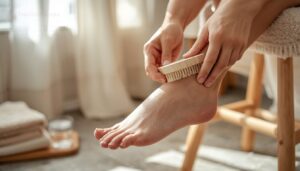
Your feet set the tone for the whole session. Sit down, keep ankles relaxed, and brush both the top and sole with light pressure. Circle each ankle bone 3-5 times to wake up lymphatic nodes there, then let strokes drift toward the hip.
Two to three minutes per foot is plenty before moving upward.
Brush Upward Toward Your Heart
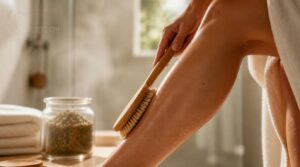
Direction matters more than most people realize. Your lymphatic system only flows one way, upward toward the neck, so every stroke needs to follow that path from ankles to hips to chest.
Use light pressure on thin skin, firmer pressure on thighs, adjusting gradually. Keep sessions to three to five minutes, two to three times weekly, always with a natural bristle brush for real lymphatic drainage benefits.
Use Long Overlapping Strokes
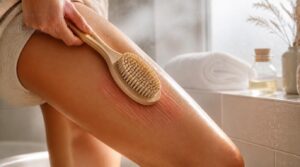
One pass over your skin barely counts as brushing. Real exfoliation comes from 5 to 10 overlapping strokes per section, brush staying in continuous contact the whole time, no lifting between swipes.
Cover roughly 5 to 7 centimeters per stroke, working thighs in slightly longer 10 to 15 centimeter sweeps. You’ll know it’s working when skin shows a light pink flush, not redness.
Apply Gentle, Steady Pressure

More strokes mean nothing if your hand is heavy. Firm but not scraping is the goal, never enough to redden skin.
Start light on thin areas like feet and shins. Sensitive zones, abdomen, breasts, neck, need consistently gentle pressure. This helps microcirculation and lymphatic drainage without irritating skin. Stop if you feel tingling, warmth, or discomfort, that’s your signal pressure’s too high.
Brush Each Section Briefly
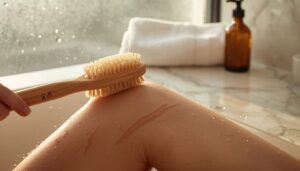
Pressure matters, but so does timing. Give each section three to five strokes, roughly 20-30 seconds, before moving on. A whole-body session should stay under five minutes total.
Watch your skin, not the clock. A light pink flush means you’re done with that area. Rushing skips exfoliation benefits; lingering irritates skin and disrupts lymphatic drainage instead of supporting it.
Dry Brushing Legs and Thighs
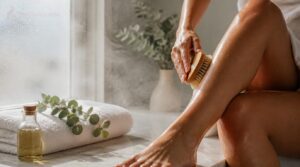
Your legs and thighs deserve their own routine, since this is where most cellulite usually shows up. A clear, step-by-step path makes the process easy to follow and hard to mess up. Here’s exactly how to work your way from ankles to hips.
Start Around The Ankles
Ankles are where every good leg session begins, and skin here is thinner than most people expect.
- Ankle brush selection: medium-soft natural bristles
- Stroke direction: upward, toward the heart
- Overlapping motions covering the whole joint
- 8-10 strokes before moving up
Use light pressure technique and keep the session timing to 10-15 seconds per ankle to protect this sensitive area.
Brush Calves With Upward Strokes
From ankles, move straight into the calves using the same upward strokes, now covering the gastrocnemius and soleus muscles beneath.
Each stroke should run the full calf length, ankle to knee, in 5 to 8 overlapping passes per leg. This follows lymphatic flow toward the popliteal nodes behind your knee, supporting drainage through the entire lower limb before you reach the thighs.
Circle Knees Gently
Slow down once you reach the knee joint. This spot needs a different touch than the calves.
Switch to gentle circular motion, barely grazing the skin to activate the popliteal lymph nodes tucked behind your kneecap.
- Soft, feather-light circles
- Warm, faintly pink skin
- Calm, unhurried rhythm
Use a light pressure technique here, since knee skin bruises easily. A few passes support circulation and drainage upward.
Sweep Thighs Toward Hips
From knee to hip, the stroke changes again. This is where the hip sweep technique takes over, guiding lymphatic flow upward.
| Stroke Part | What To Do |
|---|---|
| Direction | Outer thigh toward hip |
| Angle | Flat, even bristle contact |
| Pressure | Light, dialed down on inner thigh |
| End Point | Light finishing pass at hip crease |
Target Dimpled Areas Lightly
Where dimples show up most, ease off the pressure even further. Use light pressure zones and a gentle stroke technique with short, overlapping passes.
- Two to three strokes per dimpled patch
- Alternate motion patterns, vertical then circular
- Brief contact method, no lingering
- Sensitive area care on inner thighs
This helps natural bristles do their job: skin exfoliation and lymphatic system stimulation, without irritation.
Dry Brushing Stomach and Buttocks
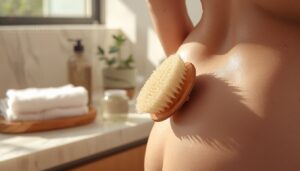
Your stomach and buttocks need a gentler approach than your legs and thighs. These areas sit closer to sensitive nerve endings and internal organs, so your technique has to adjust. Here’s how to brush this zone safely and effectively.
Use Light Abdominal Pressure
Your stomach deserves the gentlest touch on your whole body. Abdominal skin runs just 1-2 millimeters thick, roughly half the depth of your thighs, so light pressure is non-negotiable here.
Use gentle strokes, almost like a light Swedish-style massage, to support blood flow and encourage lymphatic flow without irritating this sensitive area or causing unnecessary discomfort.
Follow Clockwise Stomach Circles
Direction matters here. Move your brush in seven clockwise circles around your navel, following your abdominal lymphatic flow toward the thoracic duct.
This clockwise circle technique mirrors your digestive tract’s natural path, supporting blood flow rather than fighting it. Stick with dry skin application each morning, and you’ll build a routine that genuinely respects your body’s own drainage system.
Brush Buttocks Toward Hips
Save this section for last in your lower-body routine, since it completes the circuit you started at your ankles.
Sweep from your posterior thigh up toward your hip joint, directing lymph fluid toward your groin nodes. Use 3 to 5 overlapping strokes per side, about 30 seconds each.
- Follow your natural drainage pathway
- Support inguinal lymph node function
- Boost blood circulation stimulation
- Keep strokes long, not circular
- Maintain gentle, steady pressure
Avoid Aggressive Repeated Strokes
More pressure won’t erase dimples faster. It just damages skin.
Scrubbing hard with your bristle brush causes microtears in the epidermis, taking 24 to 48 hours to heal. It also risks broken capillaries, those permanent red lines under thin skin.
Stick with light pressure strokes. Gentle, repeated passes give you exfoliation and mechanical stimulation without harming your skin barrier.
Protect Sensitive Skin Areas
Some spots just need a lighter touch. Skip broken skin, moles, and areas with visible inflammation entirely.
Use gentle abdominal pressure near your navel and ribs. Patch test any new brush on your forearm first, checking for reactions before full use.
Afterward, shower with lukewarm water, then apply a fragrance-free moisturizer while skin’s still damp. This locks in hydration after exfoliation.
How Often to Dry Brush
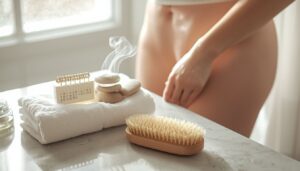
How often you brush matters just as much as how you brush. Too much, too soon can irritate your skin instead of helping it. Here’s how to build a routine that works with your skin, not against it.
Begin Once or Twice Weekly
Rarely does more mean better here, so start slow weekly. Twice a week is plenty for a proper skin adaptation period, letting your barrier recover in the 48 hours between sessions.
Pick a soft natural bristle brush for these first two sessions, keep each one short, and monitor skin response for pink flush or tingling that fades within thirty minutes.
Increase Frequency Gradually
Once your skin tolerates two weekly sessions without redness, add a third. That’s tolerance building, and it’s individual: sensitive skin progresses slower than tolerant skin.
Keep a skin sensitivity check after every session. No irritation, no tightness? Move toward four sessions weekly, the range tied to smoother-looking, better-circulated skin over time, without triggering fluid retention or overexfoliation.
Limit Sessions to Five Minutes
More isn’t better here. The best session duration for dry brushing caps at five minutes, full stop.
That window covers every region with consistent pressure application, from ankles to shoulders, without overloading lymphatic stimulation. Sessions can stretch to twenty minutes, but results plateau well before then.
Five minutes keeps this a time-efficient routine you’ll actually stick with daily.
Monitor Your Skin Response
Your skin tells you everything you need to know. A light flush means good circulation, and it should fade within minutes.
Watch for redness beyond the brushed area, persistent itching, or dark patches. These signal barrier stress, not glow. Moisturize right after, and log changes weekly to keep cellulite results safe and your skin texture improving steadily.
Expect Only Temporary Changes
Set your expectations honestly: dry brushing won’t erase cellulite, no matter how consistent your routine is. The temporary glow and smoother skin texture fade within hours as circulation returns to normal.
That’s the deal. You’re managing appearance, not structure, so keep sessions short, moisturize after, and enjoy the boost without expecting permanent change.
Dry brushing manages appearance, not structure, so enjoy the temporary glow without expecting lasting change
Dry Brushing Safety and Aftercare

Dry brushing is safe for most people, but a few precautions keep it that way. Your skin can react to the friction, so knowing what to watch for matters just as much as technique. Here’s what to keep in mind before and after every session.
If you have sensitive skin, choosing the right product matters too — gentle tanning lotions formulated for sensitive skin can make your post-brushing routine far more comfortable.
Avoid Broken or Inflamed Skin
Your skin has to be intact before a brush ever touches it. Run a quick skin sensitivity check: look for cuts, scabs, rashes, or warm, swollen patches. Brushing over broken skin or inflamed skin raises injury and irritation risk.
- Fresh cuts or scrapes
- Active rashes
- Red, swollen patches
- Sunburned areas
Skip those zones. Use gentle brushing technique and light pressure control everywhere else, especially on sensitive skin.
Stop if Irritation Develops
Your skin will tell you when to quit, so listen. Redness within five minutes, itching that builds, or a burning feeling all mean stop immediately. Hives or swelling lasting past 10 minutes call for prompt rinsing with cool water.
Pat dry, skip further exfoliation for 24 hours, and moisturize sensitive skin right after. Cellulite improvement isn’t worth new skin irritation.
Shower With Lukewarm Water
Hot water undoes the work your brush just did. Keep the dial at 98-104°F, which protects your skin’s acid mantle and limits water loss.
Aim for:
- Under 105°F, always
- 5-10 minutes max
- Lukewarm, not hot, start to finish
This keeps pH stable and your barrier intact after all that brushing over dead skin cells.
Apply Moisturizer After Showering
Once you step out, pat dry gently and leave skin slightly damp. That dampness is your friend: moisturizer absorbs best within a few minutes, locking in hydration before it evaporates.
Choose a cream or ointment over a thin lotion, since brushing removed dead skin cells and skin can drink in more product now. This step helps circulation and lasting skin texture improvement.
Avoid Brushing Your Face
Your face isn’t part of this routine, no matter how tempting it seems for skin rejuvenation.
Facial skin is 2-3 thinner than body skin, with denser nerves and glands, so mechanical stimulation meant for thighs can trigger irritation, broken skin, or infection risk fast.
Save the bristles for cellulite and exfoliate your face with gentler, purpose-made tools instead.
More Effective Cellulite Treatment Options
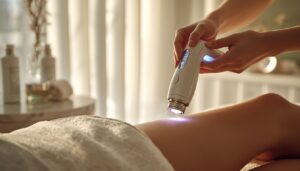
Dry brushing has its place, but it won’t touch the deeper structure causing your dimples. If you want real change, you need treatments that work below the surface. Here are five options worth discussing with a professional.
Radiofrequency and Laser Therapies
Beyond dry brushing, radiofrequency (RF) treatments heat skin and deeper tissue to trigger real collagen production, unlike brushing’s surface-only effect. RF stimulates fibroblasts up to 42°C, tightening skin over 6-12 months.
Laser therapy, like Cellulaze, breaks fibrous bands causing dimples while releasing trapped fat. Combined RF and laser protocols show cellulite scores improving from 9.3 to 6.0, with results lasting one to two years.
Subcision and Tissue Release
If RF and laser work below the surface, subcision goes deeper still. This procedure physically cuts the fibrous septa causing dimples, at 6-10mm depths, using local anesthesia infiltration. Unlike brushing’s mechanical skin stimulation, subcision creates lasting change. Bruising resolves in 7-10 days, and collagen stimulation continues for months, offering results dry brushing simply can’t match.
Acoustic Wave Therapy
Why does acoustic wave therapy outperform dry brushing? It uses ultrasonic waves penetrating 25mm deep, triggering cavitation and collagen stimulation.
| Feature | Detail |
|---|---|
| Sessions | 4-6 |
| Duration | 30-45 min |
| Depth | 25mm |
| Collagen boost | 15% |
| Satisfaction | 70% |
A 2013 trial showed real improvement, with minimal recovery time, unlike brushing’s temporary skin tightening.
Topical Retinol Creams
Your nightly skincare routine might do more than dry brushing ever could. Retinol boosts collagen by up to 180%, thickens skin from 1.44mm to 1.60mm, and shrank cellulite’s hypoechogenic areas from 53% to 18% in ultrasound studies. Pair it with caffeine for stronger results.
New liposomal formulas improve stability sevenfold, making today’s anticellulite creams far more reliable than surface exfoliation alone.
Professional Treatment Consultation
When retinol and dry brushing aren’t cutting it, book a professional treatment consultation with a dermatologist. Expect cellulite severity grading, an ultrasound scan, and a suited treatment plan.
- Candidate eligibility screening rules out infections or bleeding disorders
- Cost and insurance details, since most plans skip cosmetic care
- A follow-up aftercare protocol scheduled 4 to 6 weeks later
A real dermatological consultation beats guesswork every time.
Frequently Asked Questions (FAQs)
Does a dry brush really help with cellulite?
No, not structurally. It only offers temporary smoothing through blood flow and exfoliation, not real collagen production or dermal elasticity improvement. Think glow, not cellulite reduction. Skin texture improves briefly; the dimpling underneath stays exactly the same.
How to tighten cellulite on legs?
True tightening comes from leg firming exercises, targeted massage, and compression garments, not brushing alone. Pair these with hydration, a protein-rich diet, and steady circulation to support collagen production and dermal elasticity improvement over time.
How long should you dry a brush to get rid of cellulite?
Keep sessions to 3-5 minutes, done 2-3 times weekly, never exceeding 10 minutes. Morning brushing boosts circulation before showering. Visible plumping fades within hours since it only affects epidermal renewal, not deeper dermis remodeling that causes dimpling.
How to dry brush cellulite on legs?
Start at your ankles with a botanics natural bristle body brush, sweeping upward in overlapping strokes toward your knees, thighs, and hips. Use firm, gentle pressure to guide lymph flow and support drainage along the way.
Does dry brushing help cellulite?
No, it doesn’t. Dry brushing offers temporary smoothing through blood flow, not real fat deposit breakdown. Exfoliation feels great, but cellulite myth busting matters: no lymphatic drainage magic, no noninvasive cellulite reduction, just short-lived surface effects.
Can a body scrub cure cellulite?
No, a body scrub can’t cure cellulite, it’s putting a bandage on a wound that needs surgery. Scrubs exfoliate just 02 mm of skin, while cellulite forms 20 to 80 mm deeper, far beyond mechanical reach.
What is dry brushing your skin?
It’s a mechanical exfoliation method using a firm, natural-bristle brush on dry skin before showering. Short upward strokes lift dead cells, boost circulation, support lymphatic drainage, and leave skin with a temporary glow.
Is there a miracle cure for cellulite?
No magic wand exists here. Genetic and hormonal factors run too deep for creams or brushes to fix. No permanent cure is backed by clinical evidence, whether it’s topical solutions, subcision, or radiofrequency treatments requiring FDA-reviewed trials.
Can dry body brushing reduce your appearance?
Yes, but only for a bit. This gentle stroke technique boosts surface circulation, giving a temporary plumping effect and smoother skin texture, not a lasting fix for cellulite’s deeper structure.
How do you clean a dry body brush?
Soak your natural stiff-bristled brush in warm water with three drops of tea tree oil for ten minutes, rinse bristles down, then air dry away from sunlight, bristles facing downward, before storing somewhere dry.
Conclusion
Think of your skin like a lake’s surface. A stone skims it, ripples show, then the water goes still.
Dry brushing for cellulite works the same way: real texture, temporary tightening, no structural fix. You’ll see smoother skin for an hour, not smoother tissue forever. Use it as a finishing touch, not a treatment plan.
Pair it with proven options like radiofrequency, retinol, or acoustic waves, and let your brush do what it does best.