This site is supported by our readers. We may earn a commission, at no cost to you, if you purchase through links. This content is for general informational and educational purposes only and is not a substitute for professional medical, dermatological, or nutritional advice.

Drop indoor humidity from 50% to 30%, and your skin loses 30% more water through its surface. That’s not a guess, it’s basic skin physiology, and it’s exactly what your heating system does every winter. Add cold wind and hot showers to the mix, and your skin barrier takes a beating from every direction at once.
Most people respond by slathering on more moisturizer and calling it a day. That approach misses the real problem: winter dryness comes from multiple mechanisms working together, so it needs a layered defense, not a single product.
Building the right dry skin care routine for winter means matching each step to the damage it’s meant to undo, morning through night.
Table Of Contents
- Key Takeaways
- Why Winter Makes Dry Skin Worse
- Morning Winter Routine for Dry Skin
- Night Winter Routine for Dry Skin
- Best Winter Ingredients for Barrier Repair
- Daily Habits That Prevent Winter Dryness
- Frequently Asked Questions (FAQs)
- How to take care of very dry skin in winter?
- What is the 4 2 4 rule in skincare?
- What should I use for dry skin in winter?
- What is the best skin care routine in winter?
- How do you fix dry skin in the winter?
- What is a good skin routine for dry skin?
- What is the 7 skin method for dry skin?
- How can I get rid of dry skin in the winter?
- What can be done to relieve dry and itchy skin?
- How to use a winter skincare routine?
- Conclusion
Key Takeaways
- Winter dryness comes from several things attacking your skin at once—low humidity, wind, indoor heat, and hot showers—so you need a layered routine, not just more moisturizer.
- Applying products to damp skin matters a lot: serums and moisturizers absorb much better within a couple minutes of washing, so don’t let your skin dry out in between steps.
- Ceramides, hyaluronic acid, glycerin, niacinamide, and squalane each play a different role in rebuilding your skin’s barrier, and combining them works better than relying on just one.
- Small daily habits—shorter, cooler showers, a humidifier at night, wind protection outdoors, and omega-3-rich foods—do as much to prevent dry skin as any product you put on your face.
Why Winter Makes Dry Skin Worse

Winter doesn’t just feel harsh on your skin, it actively works against it. Several forces team up to pull moisture away faster than your skin can replace it. Here’s what’s really going on beneath the surface.
Cold air, indoor heating, and low humidity all chip away at your skin’s barrier, which is why choosing the right facial moisturizer for cold weather climates matters so much this season.
Low Humidity Increases Water Loss
Under the air’s dryness, your skin loses water fast. At 30% humidity, water loss jumps 30% versus 50% humidity, and dips below 30% double it.
Winter heating often drops indoor air to 20%, adding roughly 40% more water loss than summer.
Monitoring humidity and running a humidifier restores 40-45% levels, cutting transepidermal water loss by about 30%.
Cold Wind Weakens Skin Barrier
Dry air isn’t winter’s only weapon—wind adds physical injury on top of it. Gusts cause mechanical skin abrasion, stripping lipids and roughening the stratum corneum.
Three things happen fast:
- Wind-Induced Lipid Loss raises transepidermal water loss
- Vasoconstriction Impact slows repair
- Oxidative Stress Effects degrade collagen
Barrier repair requires windburn prevention and real skin barrier protection.
Ceramide-rich moisturizers help restore the skin barrier and reduce transepidermal water loss ceramide-containing formulations.
Indoor Heat Dries Skin Faster
Wind isn’t the only invisible threat—your furnace works against you too. Heated indoor air pushes humidity below 30%, well under the 40–60% your skin needs. This accelerates transepidermal water loss and breaks down barrier lipids.
Vents and radiators create dry-air pockets, worsening things further. Placing a humidifier nearby restores moisture retention and helps genuine barrier repair.
Hot Water Strips Natural Oils
That steamy shower feels great, but heat above 130°F strips 35% of surface sebum in three minutes. Lipid removal doubles for every 10°F increase.
Skip the hot water: a 95°F wash keeps oil loss under 5%. Apply moisturizer within two minutes—waiting five drops absorption by 25%, leaving your barrier vulnerable for hours.
Common Dry Skin Warning Signs
Your skin sends signals before real damage sets in. Watch for a tight skin sensation on cheeks and forearms, plus flaky skin on elbows and knees, skin redness across the cheeks, itchy skin on lower legs, and small cracks on fingertips.
Each points to transepidermal water loss outpacing skin barrier repair—catch them early, and winter dryness stays manageable.
Morning Winter Routine for Dry Skin
Your skin loses moisture all night long, so how you treat it in the morning sets the tone for the rest of the day. A good routine doesn’t need to be complicated, but the order you apply products in actually matters. Here are the five steps worth building into your morning habits.
Cleanse Gently With Lukewarm Water

That first splash sets the tone for your whole day. Use water between 98.6°F and 104°F — hot enough to feel comforting, cool enough to protect your skin barrier.
Follow that gentle splash with a rich, glycerin-packed formula — this guide to moisturizers for dry, sensitive skin can help you lock in hydration without clogging pores.
A gentle, nonfoaming cleanser (pH 5.5–6.5) matters just as much:
- Preserves natural lipids
- Prevents tightness
- Helps barrier repair
Cleanse for 30–60 seconds. Longer strips moisture; shorter skips buildup.
Apply Hydrating Toner or Essence

Right after rinsing, press a hydrating toner or essence into damp skin—hands only, no cotton pads.
Tap gently in upward motions; damp skin absorbs humectants faster. Hyaluronic acid and glycerin pull water into the surface within seconds.
Choose fragrance-free, low-alcohol formulas. This step preps skin so your next layer actually sinks in.
Layer Serum on Damp Skin

Don’t let that toner dry before your serum goes on—this is where hydration layering really pays off.
Dispense a couple drops of hyaluronic acid serum and pat it into still-damp skin. Damp skin application means faster absorption and less product wasted; you’ll need noticeably less than you think.
Spread gently outward, never rubbing. Ceramides in your next step will lock this moisture against your skin barrier.
Seal Hydration With Rich Moisturizer

Think of rich moisturizer as the lid on a jar—without it, all that serum evaporates by lunch.
Rich moisturizer is the lid on the jar—skip it, and your hard-earned hydration evaporates by lunch
Massage it in using upward strokes, focusing on cheeks and jawline. Look for ceramides and occlusive agents like squalane; they lock hyaluronic acid against damp skin, reducing water loss for hours.
- Cheeks
- Jawline
- Neck
- Backs of hands
Finish With Broad-Spectrum SPF 30

Skipping sunscreen in winter is a mistake—snow can reflect up to 80% more UV rays.
Use broad spectrum sunscreen SPF 30, applying a nickel-sized amount for full coverage. Sensitive skin? Choose mineral over chemical formulas. Reapply every two hours outdoors, since year-round sunscreen use protects against collagen breakdown that worsens winter dryness and fine lines.
Night Winter Routine for Dry Skin

Your skin does its real repair work while you sleep, so nighttime is when your routine matters most. Cold, dry air doesn’t stop working against your barrier just because the sun’s down. Here’s how to build a night routine that helps your skin recover by morning.
Remove Makeup With Gentle Cleanser
Since your skin barrier is already stressed by winter air, washing your face wrong at night makes things worse.
- Swipe micellar water first to lift makeup
- Follow with an oil-free gentle cleanser
- Massage in circles for 30 seconds
- Rinse with lukewarm water
- Pat dry, then apply hydrating toner
This routine protects your skin barrier while fully removing dry skin in winter’s stubborn residue.
Apply Nourishing Serum or Oil
Once your toner sets, apply serum within two minutes—damp skin absorbs up to 25% more hyaluronic acid. Use a pea-sized amount, pressing gently for 30 seconds in upward circles to boost penetration.
Layering a facial oil like squalane afterward locks in humectants and seals hydration, mimicking your skin’s natural sebum for lasting barrier repair overnight.
Use Rich Barrier-Repair Night Cream
Now for the real barrier repair work. Massage a pea-sized dose of ceramide-based night cream onto damp skin—0.8 grams absorbs per minute, leaving no sticky residue.
Three things happen fast:
- Ceramides rebuild lipids within 30 minutes
- Niacinamide boosts ceramide synthesis 15%
- Hyaluronic acid binds 24x its weight in water
Skin hydration and barrier repair continue for 8 hours.
Seal Dry Patches With Petrolatum
Cracked heels or elbows need more than cream. Pat on petrolatum with clean fingertips—rice-sized for eyelids, dime-sized for heels—and press for 10 seconds.
| Area | Amount | Reapply |
|---|---|---|
| Face | Pea-sized | 4–6 hrs |
| Heels/Elbows | Dime-sized | 4–6 hrs |
| Eyelids | Rice-sized | As needed |
This occlusive barrier cuts TEWL over 98%, locking moisture in overnight.
Run a Humidifier Overnight
Your heater dries the air while you sleep, so a cool mist humidifier does the repair work your skin can’t.
Set it to 45% humidity, 2 meters from the headboard—close enough to help, far enough to avoid soaking bedding.
Clean the tank every 24 hours with diluted vinegar.
Cost? About $0.03 nightly, cheap insurance for your lipid barrier.
Best Winter Ingredients for Barrier Repair
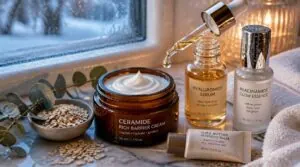
Not every moisturizer earns a spot on your shelf this season. Your skin barrier needs specific ingredients that work together to hold water in and keep irritants out. Here are five that actually make a difference.
Ceramides Replace Missing Barrier Lipids
Your skin loses ceramides fast in winter, nearly half its barrier lipids depend on them. Ceramide moisturizers replace what’s missing, restoring the 1:1:1 lipid ratio your skin needs.
- Ceramide NP makes up 20% of skin ceramides
- Combining NP and EOP types rebuilds structure in 24 hours
- Consistent use cuts water loss by up to 30%
That’s long-term barrier repair, not a quick fix.
Hyaluronic Acid Draws in Water
Think of hyaluronic acid as a sponge for your skin. Molecular weight determines its job: low weight (5–20 kDa) penetrates deep, high weight (800–1,200 kDa) hydrates the surface. One gram holds 1,000 grams of water.
Formulas near pH 5.5–7.0, paired with aloe or panthenol, boost retention—making your hydrating serum work harder against winter’s barrier damage.
Glycerin Improves Moisture Retention
Old but gold: glycerin still outperforms trendier humectants for one simple reason, it binds water like nothing else.
- Holds seven times its own weight in water
- Cuts TEWL by 25% within 30 minutes
- Works in humidity as low as 30%
- Fills gaps in your skin’s lipid matrix
- Pairs well with occlusive, barrier repair creams
Barrier healing starts here, long before fancier ingredients enter your routine.
Niacinamide Supports Ceramide Production
What if your moisturizer could tell your skin to make its own repair materials? Niacinamide does exactly that. It triggers SPT enzyme activation, boosting ceramide synthesis up to 5.5-fold.
| Compound | Fold Increase | Barrier Role |
|---|---|---|
| Ceramides | 5.5x | Repairs lipids |
| Glucosylceramide | 7.4x | Strengthens barrier |
| Sphingomyelin | 3.1x | helps maintain structure |
Choose ceramide-based products with niacinamide for real skin barrier repair this winter.
Squalane Softens Without Heavy Greasiness
Oil that clogs pores is the last thing dry, winter-worn skin needs. Squalane fixes that. It mimics sebum almost exactly, absorbs in about 30 seconds, and boosts moisture 12% within 10 minutes.
With a comedogenic rating of 0–1, it works as a noncomedogenic moisturizer layered under humectant ingredients like hyaluronic acid, giving you softness without any greasy residue.
Daily Habits That Prevent Winter Dryness

Your skincare products matter, but daily habits shape how your skin holds up all season long. Small choices, made consistently, protect your barrier far more than any single product can. Here are the habits worth building into your routine.
Limit Cleansing and Hot Showers
By evening, that steamy shower can feel like the only comfort winter offers, but it’s quietly working against your skin barrier.
- Keep water at 98–100°F
- Cap showers at 5 minutes
- Cleanse just twice daily
- Moisturize within 3 minutes after
Hot water above 104°F raises water loss up to 30%. Gentle habits protect dry winter skin far better than scalding rinses ever will.
Avoid Harsh Actives and Fragrance
Gentle water isn’t enough if your products fight back. Skip retinoids, high-percentage AHAs, and benzoyl peroxide when humidity drops—harsh actives spike irritation on compromised skin.
Choose fragrance-free skincare; scent penetrates easier through weakened barriers. Favor gentle exfoliation (lactic or polyhydroxy acids) over walnut scrubs.
Check preservatives too. Always patch test new products on your forearm first—your sensitive skin will thank you.
Protect Skin From Wind
Windburn isn’t just wind—it’s cold air attacking your skin barrier directly. Layer protective clothing (scarves, gloves, hats) and apply moisturizer before outdoors.
- Windproof jackets block direct airflow
- Lip balm SPF 30+ prevents chapping
- Reapply sunscreen every two hours
Windy days still carry UV rays—don’t skip protection just because it’s cold.
Support Hydration With Omega-3 Foods
Skincare isn’t only topical. Omega-3 fatty acids rebuild your skin barrier from within, cutting inflammation-driven water loss by up to 15%.
Wild salmon and mackerel deliver EPA and DHA directly; walnuts and flaxseed offer ALA your body converts. Aim for 250–500 mg daily. Pair with olive oil or avocado to boost absorption up to 30%.
Treat Lips, Hands, and Body
Because lips, hands, and feet have thinner skin, they crack first and heal last.
- Dab lip balm with beeswax and shea butter before bed
- Massage hand cream in for a full minute after washing
- Seal damp skin with body oil at night
- Wear protective gloves outdoors, lined and waterproof
Run your humidifier overnight—dry indoor air undoes everything you just applied.
Frequently Asked Questions (FAQs)
How to take care of very dry skin in winter?
Cleanse gently, layer a hydrating serum on damp skin, then seal with a ceramide-rich moisturizer. Add an overnight humidifier and occlusive balm on cracked spots to curb transepidermal water loss and rebuild your skin’s barrier function fast.
What is the 4 2 4 rule in skincare?
Picture rain soaking into dry soil instead of running off: that’s your skin under the 4-2-4 rule—four minutes cleansing, two minutes serum absorption, four minutes moisturizer sealing, timed layering that helps winter skin actually drink in hydration.
What should I use for dry skin in winter?
Reach for humectant moisturizers with hyaluronic acid or glycerin, layered under ceramide-based products for barrier repair. Add occlusive sealing agents like petrolatum on rough patches, a gentle cleanser, humidifier use, and omega-3-rich foods for lasting hydration.
What is the best skin care routine in winter?
Your face feels tight, flaky patches catch on your sleeve, and moisturizer barely lasts an hour. The best approach pairs a morning hydration routine with ceramide-based night repair, plus a humidifier to fight indoor TEWL and low humidity.
How do you fix dry skin in the winter?
Fixing winter dryness means switching to gentle cleansing, layering hydrating serums on damp skin, sealing with ceramide-based moisturizers, running a humidifier, and limiting hot showers, since each step rebuilds your lipid barrier and slows transepidermal water loss.
What is a good skin routine for dry skin?
A good routine pairs morning hydration layering with nighttime barrier repair: cleanse gently, apply ceramide-based products and rich moisturizers to curb TEWL, exfoliate weekly, and support skin with omega-3 foods, water, and daily lip and hand care.
What is the 7 skin method for dry skin?
This Korean layering technique patting seven rounds of hydrating toner onto damp skin builds serious moisture retention, boosting hydration roughly 30% within a week while supporting barrier repair through humectants like hyaluronic acid.
How can I get rid of dry skin in the winter?
Cleanse gently with lukewarm water, then seal in moisture with ceramide-based products right away. Run a humidifier, wear protective clothing outdoors, eat omega-3 rich foods, and apply body creams daily to rebuild your skin’s barrier.
What can be done to relieve dry and itchy skin?
Relief starts with moisturizing after showering, gentle cleansing, and rich body creams to rebuild the barrier.
Skip hot showers, run a humidifier daily, wear protective clothing outdoors, and apply barrier creams often—these calm itching while counteracting indoor heating’s drying effects.
How to use a winter skincare routine?
Follow it in order: gentle cleansing technique, serum application on damp skin, moisturizer layering to lock in ceramide-based products, then night cream sealing. Run a humidifier nightly—consistency curbs transepidermal water loss and rebuilds your lipid barrier through winter.
Conclusion
Winter can turn even the toughest skin into a cracked desert overnight, and that’s barely an exaggeration. Your barrier doesn’t fail from one bad habit; it fails from neglect, layer by layer.
A real dry skin care routine for winter works the same way healing does: gradually, consistently, without shortcuts. Cleanse gently, layer hydration, seal it in, and protect what you’ve built. Do that daily, and dryness stops being winter’s inevitable toll. Your skin holds the line instead.