
This site is supported by our readers. We may earn a commission, at no cost to you, if you purchase through links. This content is for general informational and educational purposes only and is not a substitute for professional medical, dermatological, or nutritional advice.

Most people give a hair loss treatment about four weeks before declaring it a failure, which is precisely when minoxidil users usually hit the shedding phase that scares them into quitting. That timing matters, because visible density usually arrives around month six, and only with consistent, lifelong use.
Between serums, foams, and prescription-strength claims, it’s easy to spend hundreds of dollars on products that your scalp will never respond to. These hair loss treatment reviews cut through that noise, weighing active ingredients, clinical evidence, monthly cost, and side effects so you can choose with confidence and protect your results.
Table Of Contents
- Key Takeaways
- Hair Loss Treatments Compared: Active Ingredients, Evidence, and Cost
- Top 7 Hair Loss Treatments Reviewed
- 1. NutraM Hair Serum DHT Blocker
- 2. Keranique Hair Regrowth Treatment For Women
- 3. Hers Minoxidil Hair Regrowth Treatment Solution
- 4. BosleyMD Minoxidil Hair Regrowth Treatment Men
- 5. Hers Minoxidil Foam Hair Regrowth Treatment
- 6. Keeps Minoxidil Hair Regrowth Treatment Men
- 7. Rogaine Mens Hair Regrowth Foam
- How to Choose a Treatment for Your Hair Loss Cause
- Hair Loss Treatment Results: Regrowth Timelines and Long-Term Maintenance
- Hair Loss Treatment Safety: Side Effects and When to See a Dermatologist
- Frequently Asked Questions (FAQs)
- Which hair loss treatment works best?
- Which is the best treatment for hair fall?
- What is the best permanent treatment for hair loss?
- Can pregnant women use hair regrowth treatments?
- What causes hair loss after COVID recovery?
- Are natural oils effective for hair growth?
- How much hair shedding is considered normal?
- Do hair growth supplements actually work effectively?
- How much do hair loss treatments typically cost?
- Can hair loss treatments work for receding hairlines?
- Conclusion
Key Takeaways
- Hair loss treatments only work while you’re using them, so you’ll need to commit to consistent daily use for at least six months, expect an early shedding phase, and accept that stopping reverses your gains within months.
- Minoxidil is the only FDA-approved over-the-counter option, and pairing it with prescription finasteride usually beats either one alone for pattern hair loss, while supplements, natural oils, and botanical serums have weaker or mixed evidence.
- Your cause determines the right treatment, so confirm whether you’re dealing with pattern loss, autoimmune alopecia, temporary shedding, or scarring alopecia before you buy anything, since minoxidil won’t fix every type and scarring alopecia needs early dermatologist care.
- You should see a dermatologist before starting if your loss is sudden, patchy, or postpartum, or if you’re pregnant or have heart disease, and stop treatment and call a doctor if you notice chest pain, swelling, severe allergic reactions, sexual or mood changes, or suicidal thoughts.
Hair Loss Treatments Compared: Active Ingredients, Evidence, and Cost
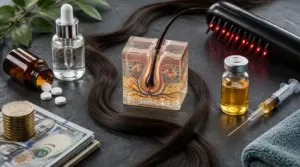
Most hair loss treatments fall into three camps, and knowing which camp a product belongs to protects both your scalp and your wallet. Among the active ingredients that matter, minoxidil is the only FDA-approved over-the-counter option, at 5% for men and 2% or 5% for women. Finasteride and dutasteride work differently, blocking DHT conversion, but they require a prescription.
Since results take months to show, it helps to compare hair loss restoration products side by side and stick with one proven option rather than switching.
The evidence is strongest for minoxidil, finasteride, low-level laser therapy and PRP. Saw palmetto, biotin and marine collagen? The data there’s weaker and often mixed. A 2024 randomized controlled trial found that low-level laser therapy produced hair density improvements statistically comparable to 5% topical minoxidil in men with androgenetic alopecia over six months.
Cost varies widely. Minoxidil runs roughly $5 to $50 monthly, finasteride $10 to $30, and PRP $1,500 to $3,500 per session. Remember, minoxidil needs lifelong use, and finasteride isn’t for everyone.
Top 7 Hair Loss Treatments Reviewed
The seven products below are the ones we reviewed, and each is judged on its active ingredient, its likely cost, and how safe it is to use. Because results vary from person to person, you’ll want to read each entry with your own hair loss pattern in mind. Keep in mind, too, that you shouldn’t start any of them without confirming the cause of your thinning first.
1. NutraM Hair Serum DHT Blocker
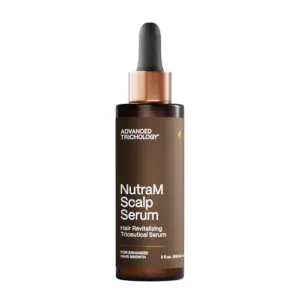
The NutraM Hair Serum DHT Blocker takes a different route than prescription options, and you should understand that before buying. Developed by a trichologist with 20 years of in-clinic hair loss experience, it’s a non-greasy topical that combines melatonin with botanicals, aimed at limiting DHT’s local effect on your scalp.
Apply 1 to 2 ml (one dropper) to thinning areas nightly, shake the bottle first, and give it 3 to 6 months before judging density. No results are guaranteed, and it’s not a substitute for finasteride or minoxidil.
Some users report stinging and redness, and opinions on scent and value vary. If your scalp is sensitive, patch test it first.
| Best For | People with mild to moderate thinning who want a non-greasy, daily scalp serum to use alongside, or as a gentler alternative to, prescription treatments, and who are patient enough to wait 3 to 6 months for results. |
|---|---|
| Active Ingredient | Melatonin and botanicals |
| Form | Serum |
| Application Frequency | Nightly |
| Time to Results | 3 to 6 months |
| Target User | Mild to moderate thinning |
| Reported Side Effects | Stinging and redness |
| Additional Features |
|
- Developed by a trichologist with 20 years of in-clinic hair loss treatment experience
- Non-greasy formula with natural ingredients, including melatonin, that is suitable for daily use
- Supports hair growth and increased thickness when applied to the scalp
- Some users report stinging sensations and redness, so a patch test is wise for sensitive scalps
- Customer feedback on the scent is mixed
- Opinions on value for the cost vary, and results are not guaranteed
2. Keranique Hair Regrowth Treatment For Women
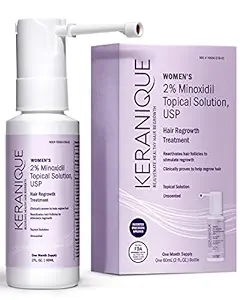
Where NutraM leans on botanicals, Keranique is a hair regrowth treatment built around 2% minoxidil, the FDA-approved topical solution for female pattern hair loss. That distinction matters if you want evidence behind your choice.
Apply 1 mL, about six sprays, to thinning areas along your part line twice daily, on dry or towel-dried hair, and let it air dry completely before styling. In clinical studies, 19% of women reached moderate regrowth after eight months, versus 7% on placebo, so results aren’t guaranteed.
Expect shedding for two to six weeks and visible change near month four. Like most hair growth products, it’s flammable, so keep it well away from flame.
If you’re shopping for a younger family member, this guide to hair growth serums for teenagers compares gentle, drug-free formulas like this one.
| Active Ingredient | 2% minoxidil |
|---|---|
| Form | Liquid solution |
| Application Frequency | Twice daily |
| Time to Results | 3 to 6 months |
| Target User | Women with hereditary thinning |
| Reported Side Effects | Greasiness and drying time |
| Additional Features |
|
3. Hers Minoxidil Hair Regrowth Treatment Solution
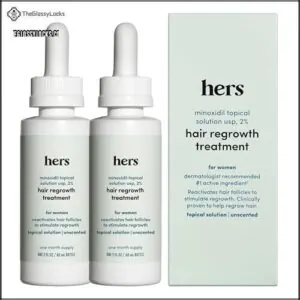
Hers delivers the same 2% minoxidil as Keranique, but in a liquid solution rather than a spray, so you’ll measure your dose instead of counting pumps.
If you’re hoping to use minoxidil beyond your scalp, these solutions for patchy beard growth explain how it can help fill in sparse facial hair.
Apply 1 mL to your scalp twice daily, parting your hair so the liquid reaches skin, and let it dry completely before styling or going to bed. It’s meant for women with hereditary thinning, not sudden or patchy loss, and pregnant or breastfeeding women shouldn’t use it.
Expect three to six months of consistent use before judging results, and note that customer feedback is mixed. Some report no change, and others find drying time unpredictable.
| Best For | Women with hereditary thinning who are willing to commit to several months of consistent daily use and want a 2% minoxidil treatment. |
|---|---|
| Active Ingredient | 5% minoxidil |
| Form | Spray |
| Application Frequency | Twice daily |
| Time to Results | Around 16 weeks |
| Target User | Men with vertex thinning |
| Reported Side Effects | N/A |
| Additional Features |
|
- Contains 2% minoxidil, which stimulates hair follicles and extends the natural hair growth cycle.
- Clinically tested to support regrowth within 3 to 6 months of consistent use.
- Can give hair a thicker, fuller appearance.
- Customer feedback on effectiveness is mixed, and some users report seeing no results.
- Results take three to six months, and users report varying greasiness and drying time after application.
- Not suited to sudden or patchy hair loss, and pregnant or breastfeeding women shouldn’t use it.
4. BosleyMD Minoxidil Hair Regrowth Treatment Men
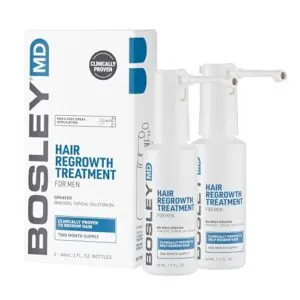
The 5% strength in BosleyMD’s formula is aimed at men with vertex thinning, and it isn’t meant for a receding hairline. Apply 1 mL to a dry scalp every morning and night, and make sure the liquid actually touches skin, because product sitting only on hair does nothing.
In a large post-marketing study, 63.7% of men rated 5% minoxidil effective or very effective, though roughly half of users lack enough SULT1A1 enzyme activity to convert it properly. Expect visible results around 16 weeks, and note that a 2-pack covers two months. Stopping usually reverses your gains within months, so commit first.
| Best For | Men with thinning at the crown (vertex) who are willing to apply the solution twice a day and stick with it for the long haul. |
|---|---|
| Active Ingredient | 5% minoxidil |
| Form | Foam |
| Application Frequency | Once daily |
| Time to Results | 3 to 6 months |
| Target User | Scalp hair regrowth seekers |
| Reported Side Effects | Scalp irritation, greasiness |
| Additional Features |
|
- The 5% strength was rated effective or very effective by 63.7% of men in a large post-marketing study.
- The no-mess sprayer makes it easier to target thinning areas of the scalp.
- The 2-pack provides a two-month supply, so you can start treatment without reordering right away.
- It isn’t meant for a receding hairline, so it won’t suit everyone with hair loss.
- Roughly half of users lack enough SULT1A1 enzyme activity to convert minoxidil properly, so results can vary.
- Visible results take around 16 weeks, and stopping treatment usually reverses your gains within months.
5. Hers Minoxidil Foam Hair Regrowth Treatment
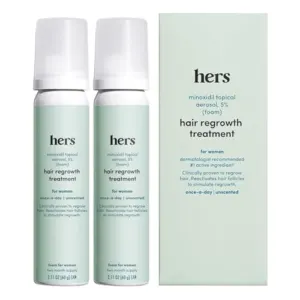
A foam can be easier to handle than a liquid, and Hers Minoxidil Foam delivers 5% minoxidil in a once-daily application to your scalp. It stimulates your follicles and extends their natural growth cycle, so you may notice fuller hair in three to six months with consistent daily use.
Still, you should weigh the drawbacks before buying. Some users report the foam dispenses as a liquid, and others mention scalp irritation or a greasy feeling. Durability is another concern, since the can reportedly breaks after about five uses.
Ranked 36th in its category, it’s a workable option rather than a standout, so ask whether you’ll tolerate these quirks before committing fully.
| Best For | People who want to try a once-daily 5% minoxidil foam for scalp hair regrowth and can tolerate some quirks like a runny texture or occasional scalp irritation. |
|---|---|
| Active Ingredient | 5% minoxidil |
| Form | Foam |
| Application Frequency | Twice daily |
| Time to Results | 4 to 6 months |
| Target User | Men with crown thinning |
| Reported Side Effects | Itching and breakouts |
| Additional Features |
|
- Contains 5% minoxidil, applied once daily to the scalp
- Stimulates hair follicles and extends the natural growth cycle
- May promote fuller-looking hair in three to six months with consistent use
- Some users report the foam dispenses as a liquid
- May cause scalp irritation or a greasy feeling in the hair
- The can reportedly breaks after about five uses
6. Keeps Minoxidil Hair Regrowth Treatment Men
Picture a man in his late thirties who notices his crown thinning in a bathroom mirror and signs up for a subscription on a Tuesday night, expecting a fix by Christmas. That’s the mindset Keeps quietly asks you to drop.
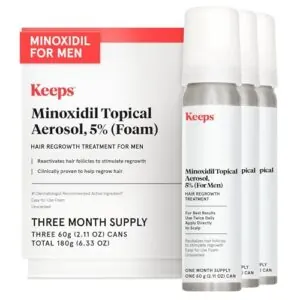
The 5% minoxidil foam runs about $10 to $15 monthly, and you apply half a capful to your crown twice daily. Visible results may take 4 to 6 months of consistent use, and effectiveness usually peaks near 12 months in clinical trials.
Be cautious, though. Scalp itching and breakouts are more common at 5% strength, and value reviews are mixed. Stop using it, and you’ll lose the regrowth within months.
| Best For | Men with male pattern hair loss at the crown who want a simple foam treatment and are willing to use it consistently for several months before expecting visible results. |
|---|---|
| Active Ingredient | N/A |
| Form | N/A |
| Application Frequency | N/A |
| Time to Results | N/A |
| Target User | N/A |
| Reported Side Effects | N/A |
| Additional Features |
|
- Contains 5% minoxidil, designed for crown and vertex application
- Helps control hair loss and supports thicker-looking hair
- Visible results may appear in 4 to 6 months with consistent use
- May cause skin breakouts or scalp irritation
- Reviews are mixed on how well it works and whether it’s worth the price
- Customers report that the advertised one-month supply doesn’t last that long
7. Rogaine Mens Hair Regrowth Foam
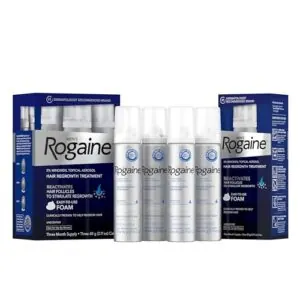
Clinical testing shows Rogaine Men’s Foam improved hair regrowth up to 4x versus control in 16 weeks, which is why it remains the standard many trichologists measure other products against.
The 5% minoxidil formula comes as a four-month supply of four 2.11 oz cans, and Tricho-Prime technology conditions your scalp to help prevent irritation. You’ll apply half a capful twice daily to thinning areas on top. Still, some users get itching or scabs, and the foam can dispense inconsistently or feel watery.
Some users find it expensive relative to results. Expect about four months before visible change, and know that stopping reverses your regrowth.
| Best For | Men with hereditary thinning on top of the scalp who are willing to commit to twice-daily use for at least four months. |
|---|
- Clinically shown to improve hair regrowth up to 4x versus control in 16 weeks
- Contains 5% minoxidil, which reactivates the natural hair growth cycle to slow hereditary hair loss
- Tricho-Prime technology conditions the scalp to help prevent irritation
- Some users get skin irritation, itching, or scabs
- The foam can dispense inconsistently or feel watery
- Some users find it expensive relative to results, and stopping use reverses regrowth
How to Choose a Treatment for Your Hair Loss Cause

Not every kind of hair loss reacts to the same treatment, and picking the wrong one can cost you months of progress.
The five points below match each common cause with the approach that works best, so you’ll know where to focus.
Start with identifying your cause, since everything else depends on getting that part right.
Identify Your Hair-Loss Cause
Before you buy anything, figure out what’s actually driving your hair loss, because the wrong product wastes months. Patterned thinning suggests androgenetic alopecia, sudden bald patches point toward alopecia areata, and diffuse shedding often follows stress or illness.
- Note where thinning appears.
- Track when shedding began.
- Request ferritin and thyroid tests.
Minoxidil and Finasteride won’t fix every cause.
Treat Pattern Hair Loss
Pattern hair loss rewards early action.
For male pattern baldness, combining topical minoxidil with oral finasteride usually outperforms either alone, though finasteride requires a prescription.
For female pattern baldness, minoxidil is your best-supported option, and 2% solution or 5% foam both work well.
Expect hair regrowth after roughly four months, and keep applying it, because gains fade once you stop.
Manage Autoimmune Hair Loss
Pattern loss is hormonal, but alopecia areata is different: an autoimmune disorder in which an immune system attack targets your hair follicles. Minoxidil won’t fix that. Here’s what to do:
- See a dermatologist for diagnosis.
- Ask about JAK inhibitors, approved for adults.
- Discuss boxed-warning risks first.
- Manage stress and protect your confidence.
Address Temporary Shedding Triggers
Not all shedding is permanent, and that’s reassuring.
If you’re losing hair diffusely, suspect telogen effluvium, often stress-induced hair loss that appears two to three months after surgery, illness, childbirth, or crash dieting.
Check medications, thyroid levels, and ferritin, since a nutritional deficiency or hormonal imbalance can drive it.
Fix the trigger, and shedding reduction usually follows within months.
Treat Scarring Alopecia Early
Not every bald patch is reversible, and that’s the part you shouldn’t wait on. If your scalp burns, itches, or looks shiny and smooth, Treat Scarring Alopecia Early, because Early Intervention protects follicles that can’t regrow.
- Book a dermatologist and request a biopsy.
- Photograph patches monthly.
- Ask about steroids or hydroxychloroquine.
- Skip unproven serums.
- Compare Costs & Safety.
Hair Loss Treatment Results: Regrowth Timelines and Long-Term Maintenance
Once you’ve matched a treatment to your cause, the next question is how long it’ll take to show up. Most people notice initial shedding in weeks 2 to 8, followed by fine vellus hair by month 2 or 3. Real hair regrowth usually appears between months 3 and 4, and visible density usually arrives around month 6 for consistent users. While you wait for results, a scalp massager for hair growth can make daily massage easier, and small studies link massage to thicker hair.
Clinical trial evidence suggests maximum results develop by 12 months, with 35% of users achieving significant regrowth, 47% moderate improvement, and 26% holding steady. Results are stronger at the crown than the frontal hairline.
Here’s the catch: stopping hair loss medications reverses your gains within 3 to 6 months. Long-term maintenance isn’t optional, because untreated hair thinning progresses at roughly 5% a year.
Hair loss treatments only work while you use them: stop, and your gains vanish within months while thinning quietly continues
Hair Loss Treatment Safety: Side Effects and When to See a Dermatologist

A treatment that’s safe for your neighbor isn’t automatically safe for you, so weigh safety and side effects before you commit. Clinical trial evidence shows most minoxidil users face only scalp itching and dryness, yet finasteride, especially compounded topical versions, can bring sexual and mood changes.
Stop and call a doctor if you notice:
- Chest pain, fainting, or lightheadedness
- Sudden swelling or unexplained weight gain
- Hives, facial swelling, or trouble breathing
- Persistent low libido or erectile problems
- Anxiety, panic, or suicidal thoughts
Book a dermatologist consultation before starting if your hair loss is sudden, patchy, or postpartum, or if you’re pregnant or have heart disease. Treatment adherence matters, but never push through worsening symptoms; stopping is safer than enduring them.
Frequently Asked Questions (FAQs)
Which hair loss treatment works best?
Picture a 34-year-old man, thinning at the crown, who starts minoxidil 5% and finasteride together. You’ll likely see less shedding by month three, visible regrowth by month six, and the best results around month twelve.
Which is the best treatment for hair fall?
In one year-long study, 1% of men improved on combined therapy. That’s why, for pattern hair loss, pairing finasteride with minoxidil usually works best. For shedding, though, correct nutritional deficiencies first.
What is the best permanent treatment for hair loss?
Picture a gardener moving seedlings from a sheltered bed to bare patches of lawn, where they keep growing for decades.
That’s hair transplant surgery: follicular unit extraction relocates DHT-resistant follicles, delivering permanent hair restoration, though you’ll still need medication for native hair.
Can pregnant women use hair regrowth treatments?
You might think a drugstore foam or "natural" serum is gentle enough, but it isn’t a safe bet. Skip minoxidil and oral treatments during pregnancy; finasteride harms male fetuses. Postpartum shedding usually fades on its own.
What causes hair loss after COVID recovery?
Microclots starving your follicles is only partly true; telogen effluvium drives COVID-related hair loss.
Fever and inflammation trigger stress-induced hair loss, while nutritional deficiencies or hormonal imbalance can prolong it. Shedding usually resolves within months.
Are natural oils effective for hair growth?
Can natural oils really boost hair growth? Not reliably. One small rosemary trial matched minoxidil but lacked a placebo group.
Topical application may help scalp health, yet no oil is a proven hair loss treatment.
How much hair shedding is considered normal?
Shedding 50 to 100 hairs a day is normal, though your count shifts with washing habits and hair length. Postpartum or stress-related telogen effluvium can raise it temporarily. A widening part, persisting beyond several months, deserves a dermatologist’s assessment.
Do hair growth supplements actually work effectively?
Ironically, the biotin gummy you’re swallowing probably targets a deficiency you don’t have. Hair growth supplements can help when nutritional deficiencies, like low iron, vitamin D, or ferritin, drive your shedding, but otherwise results stay modest.
How much do hair loss treatments typically cost?
Think of your scalp as a slow-growing investment: minoxidil costs $10–45 monthly, while generic finasteride runs roughly $5–
Combination therapy lands near $20–30 monthly, yet hair transplant surgery costs $7,400–25,000 upfront, so budget with care.
Can hair loss treatments work for receding hairlines?
Ironically, treatment works best before your receding hairline shows. Can hair loss treatments work for receding hairlines? Yes, mainly against hair follicle miniaturization.
Hair Loss Treatment Reviews: What Works, Costs & is Safe in 2026
Conclusion
Picture a woman who quits her foam at week five because her shedding spiked, never learning that the spike often signals follicles resetting. She’s not alone, yet she’d likely see results by month six.
Use these hair loss treatment reviews to match an ingredient to your cause, then commit to consistent daily use for at least six months. Your scalp rewards patience, not product-hopping, so track photos and call a dermatologist if anything feels wrong.