This site is supported by our readers. We may earn a commission, at no cost to you, if you purchase through links. This content is for general informational and educational purposes only and is not a substitute for professional medical, dermatological, or nutritional advice.

Store-bought scrubs often list a dozen ingredients you can’t pronounce, cost twice what they’re worth, and still leave your skin feeling stripped. A handful of pantry staples can do a better job, because you control exactly what touches your skin.
Homemade body scrub recipes let you match every ingredient to your skin type, skip the irritants, and adjust the texture to your needs. Dry skin gets a richer oil base. Sensitive skin gets the finest granules. You set the rules.
This guide walks you through five recipes, the right way to apply them, and how to store them safely.
Table Of Contents
- Key Takeaways
- Choose Body Scrub Ingredients for Your Skin Type
- Step-by-Step Homemade Body Scrub Recipes
- How to Apply Homemade Body Scrubs
- How Often to Exfoliate Safely
- How to Store Homemade Body Scrubs
- Frequently Asked Questions (FAQs)
- What is the best homemade scrub for the body?
- What are the best ingredients for a body scrub?
- What is the best homemade exfoliator for mature skin?
- What is the best body scrub for removing dead skin?
- Can homemade body scrubs be used on the face?
- Are DIY body scrubs safe to use during pregnancy?
- Can body scrubs help reduce the appearance of cellulite?
- How do homemade scrubs compare to store-bought versions?
- Are homemade body scrubs safe for childrens skin?
- Conclusion
Key Takeaways
- Matching your scrub’s base oil and granule size to your skin type — fine sugar for dry or sensitive skin, coarser salt or coffee for oily or normal skin — prevents irritation and delivers better results than any one-size-fits-all formula.
- Exfoliating too often disrupts your skin’s natural 28-day renewal cycle, so stick to once weekly for sensitive skin, twice or three times for oily or normal skin, and cut back immediately if you notice redness or tightness.
- Homemade scrubs are fragile: sugar-based blends last up to four weeks, while salt-and-oil mixes go off within two, so always store them in airtight glass jars, away from moisture and sunlight, and use a dry scoop every time.
- Applying your scrub to warm, damp skin in slow circular motions — then following up with moisturizer while skin is still slightly damp — maximizes dead-skin removal and locks in hydration more effectively than scrubbing dry skin.
Choose Body Scrub Ingredients for Your Skin Type
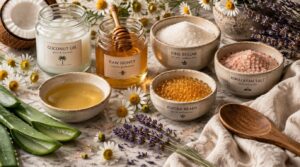
Everything in a homemade scrub has a specific job, and matching each ingredient to your skin type is how you get real results without irritation.
Knowing which actives suit your complexion makes all the difference, as this tree hut mango sugar scrub skin review shows with measurable, first-use results.
Dry skin does best with a richer carrier oil base, like coconut or jojoba, to prevent that tight feeling after rinsing. Fine sugar granules suit dry skin much better than coarse salt, which can scratch already-fragile skin.
Sensitive or eczema-prone skin needs the finest particles available. Skip essential oils and any added fragrance entirely, since both raise irritation risk on reactive skin.
Oily and normal skin can tolerate a wider range of textures and ingredients. You can use coarser particles and lighter oils comfortably.
Always do a patch test first, regardless of your skin type.
Step-by-Step Homemade Body Scrub Recipes
Each recipe below uses simple, pantry-friendly ingredients and takes just a few minutes to put together.
You’ll find options for every skin type and preference, from gentle brown sugar blends to invigorating coffee scrubs. Pick the one that fits your skin’s needs and follow the steps closely.
Brown Sugar Body Scrub
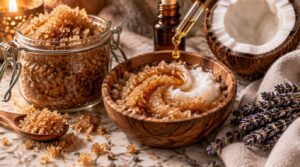
Combine brown sugar and coconut oil in a mixing bowl, then stir in a few drops of essential oils. The coarse sugar crystals scrub away dead skin while oil reduces friction.
- 1/2 cup brown sugar
- 2 tablespoons coconut oil
- 10 drops essential oils
- Stir until fully blended
- Store in a sealed container
Apply to damp skin in slow, gentle circles.
This technique is a key part of shaving prep for healthy, bump-free skin, helping lift hair follicles and soften the skin before your razor touches it.
Coffee and Coconut Oil Scrub

If you enjoyed the brown sugar scrub, this body scrub gives you a stronger exfoliant. Coffee grounds are coarser and exfoliate skin more firmly. For best results, look for a coarse-ground coffee scrub with a gritty texture that really buffs away dead skin.
- 1/2 cup coffee grounds
- 3 tablespoons coconut oil
- Stir until fully blended
- Store in a sealed jar
Apply gently. Coconut oil makes this a moisturizing scrub, but avoid it if you’re acne-prone. Coffee grounds stain tubs.
Fine Sea Salt Body Scrub
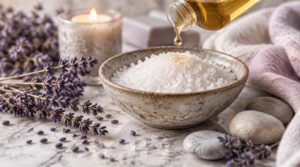
Fine sea salt is milder than coffee grounds, making it a better pick for normal to oily skin.
- Add 1 cup fine sea salt and ½ cup carrier oil to a clean mixing bowl.
- Stir in 10-15 drops of essential oils like lavender.
- Do a patch test before applying widely.
Salt is naturally drying, so don’t skip the carrier oil.
Green Tea and Sugar Scrub
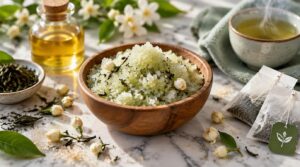
For a gentler approach, this green tea and sugar scrub pairs antioxidant-rich tea with granulated sugar to exfoliate dull skin.
Brew a strong cup, cool it fully, then mix two tablespoons into half a cup of sugar and your carrier oil. The tea adds polyphenols; the sugar does the scrubbing.
Refrigerate this body scrub and use it within a week.
Honey and Brown Sugar Scrub

Mix honey and brown sugar in equal parts for a paste that gives you precise skin exfoliation control.
- Measure 2 tablespoons brown sugar into a bowl
- Add 1 tablespoon room-temperature honey
- Stir until grains are coated
- Mix in a few drops of carrier oil
- Patch test on your inner arm first
Your homemade body scrub’s ready. Store it tightly sealed.
How to Apply Homemade Body Scrubs

Think of your skin like a canvas: you need to prep the surface before anything sticks.
- Rinse your body with warm water first to soften the skin and open up the surface.
- Spoon the mixture directly onto your palm or a washcloth.
- Apply using circular motion, keeping pressure light and steady.
- Rinse completely, then pat dry with a towel instead of rubbing.
Get the consistency right before you start. Too thick? Add a few drops of water.
Once applied, focus circular motion on rough patches like elbows and heels. Avoid broken or irritated skin entirely.
After rinsing, topical absorption improves, so follow with a moisturizer while your skin’s still slightly damp. This locks in comfort and keeps the barrier calm.
How Often to Exfoliate Safely
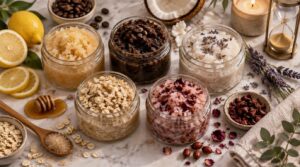
Your skin’s cell turnover cycle runs about 28 days. Exfoliation helps when it works with that natural rhythm, not rushes it.
Exfoliation works best when it follows your skin’s natural 28-day rhythm, not fights it
- Oily or normal skin: exfoliate 2-3 times weekly
- Dry or flaky skin: limit exfoliation to 1-2 times weekly
- Sensitive skin: stick to once weekly
- Rough zones (elbows, knees, feet): tolerate more frequent exfoliation
- Keratosis pilaris areas (arms, thighs): benefit from consistent 2-3 times weekly
Start once weekly and increase only if your skin’s handling it well. Reduce frequency immediately if you notice redness, tightness, or stinging. Those are early signs of overexfoliation and skin irritation. Understanding skin type and exfoliation frequency can help you fine-tune your routine based on whether your skin is oily, dry, or sensitive.
Warmer months allow more sessions. In cold or dry weather, dial it back. If you’re uncertain about your skin’s needs, a dermatologist consultation can help.
How to Store Homemade Body Scrubs

Bad storage ruins a good scrub faster than you’d expect. Follow these five rules to protect your batches:
- Transfer scrubs to an airtight jar right after mixing to block moisture and oxygen.
- Keep jars away from direct sunlight to slow oil oxidation.
- Always use a dry spoon or scoop to avoid introducing water.
- Store in a cool, dark spot outside the shower to extend shelf life.
- Discard any scrub that smells sour, a warning sign of rancid oils.
Scrubs you whip up in a mixing bowl are fresh but fragile. Sugar-based formulas generally last up to four weeks. Salt-and-oil blends separate faster, so use those within two weeks. If you have skin sensitivity, always work from a smaller, fresher batch. Transferring your batch immediately into an airtight glass storage jar helps those shorter-lived salt-and-oil blends stay fresh through every use.
Frequently Asked Questions (FAQs)
What is the best homemade scrub for the body?
No homemade body scrub works best for every skin type. Your skin type always decides. A sugar scrub recipe suits sensitive skin, while a coffee scrub with coconut oil works for rougher areas needing more exfoliation.
What are the best ingredients for a body scrub?
The best ingredients work like teammates: one scrubs, one soothes. Brown sugar, coffee grounds, or fine sea salt exfoliate dead skin cells. Coconut oil makes it glide. A drop of essential oils finishes your mix.
What is the best homemade exfoliator for mature skin?
Does your skin need something truly gentle? For mature skin, combine brown sugar with a carrier oil like coconut oil. The sugar slowly dissolves as you scrub, lifts dead skin cells, and keeps exfoliation smooth.
What is the best body scrub for removing dead skin?
To exfoliate dead skin cells, the type and size of granules in your scrub matter most. A coarse sugar exfoliant or finely ground coffee uses physical abrasion to smooth skin texture and encourage skin renewal.
Can homemade body scrubs be used on the face?
Most body scrub recipes aren’t suitable for facial skin, especially if you have sensitive skin. The particles are too coarse, and rough salt or sugar can easily cause irritation, visible redness, or skin barrier damage.
Are DIY body scrubs safe to use during pregnancy?
Wondering if your daily routine needs adjusting? Pregnancy can make sensitive skin more reactive.
Keep a homemade body scrub gentle: use fine-grit, a safe carrier oil, and always check essential oil safety. Patch test first.
Can body scrubs help reduce the appearance of cellulite?
Scrubs like coffee grounds or brown sugar can temporarily smooth skin texture, making cellulite look less visible. The skin massage during application also boosts local circulation briefly. But any cellulite reduction is surface-level, not structural.
How do homemade scrubs compare to store-bought versions?
Nothing in natural skincare gives you more control than making a homemade body scrub, but store-bought versions win on preservatives and batch consistency. Your DIY beauty results will vary from one batch to the next.
Are homemade body scrubs safe for childrens skin?
Yes, but with care. Children’s sensitive skin absorbs substances more readily than adult skin, so avoid essential oils. Stick to fine sugar or oatmeal. Always patch test first, and exfoliate no more than once weekly.
Conclusion
Think of your bathroom shelf as a small kitchen: a jar of sugar, a spoonful of oil, a pinch of something fragrant, and you’ve got everything you need. These homemade body scrub recipes prove that cleaner ingredients and real results don’t have to compete.
Pick one recipe this week. Adjust the texture, swap the oil, make it yours. Your skin will tell you what works, and that feedback is the whole point.