This site is supported by our readers. We may earn a commission, at no cost to you, if you purchase through links. This content is for general informational and educational purposes only and is not a substitute for professional medical, dermatological, or nutritional advice.

Most guys don’t think about their trimmer’s shelf life until it starts tugging instead of cutting. You’re halfway through shaping your beard, and suddenly the blades are catching, pulling, making you wince—that’s when you realize this tool won’t last forever.
A decent electric beard trimmer should give you 5 to 10 solid years, but here’s the thing: that range is huge, and where yours lands depends entirely on how you treat it. Premium models with metal housings can push past the decade mark, while budget picks might tap out around year two or three.
The difference isn’t just about spending more upfront—it’s about understanding what kills these tools early and what keeps them running smooth for years.
Table Of Contents
- Key Takeaways
- Average Lifespan of Electric Beard Trimmers
- Factors Affecting Trimmer Longevity
- Maintenance Tips to Extend Trimmer Life
- Top Products for Trimmer Performance and Care
- Frequently Asked Questions (FAQs)
- What is the lifespan of a beard trimmer?
- How long do electric trimmers last?
- Why do electric shavers stop working?
- What is the best way to clean a beard trimmer?
- How often should I replace the blades of my beard trimmer?
- Are there any additional accessories I should buy for my beard trimmer?
- How do I know when it is time to upgrade to a new beard trimmer?
- Can I replace the battery in my cordless trimmer?
- How do I know when blades need sharpening?
- Are waterproof trimmers more durable than standard models?
- Conclusion
Key Takeaways
- Quality electric beard trimmers last 5 to 10 years with proper maintenance, but budget models typically die around year two or three—premium metal-housed units can push past a decade while cordless models are limited by battery degradation after 2 to 5 years.
- Most trimmers die early from neglect, not wear—hair buildup clogs blades, moisture corrodes internals, and skipping oil creates friction that kills motors, but consistent cleaning, drying, and lubricating after each use can double your trimmer’s lifespan.
- You’ll know your trimmer’s done when blades start pulling hair instead of cutting cleanly, the motor makes weird noises, battery life tanks, or it overheats during short sessions—at that point, even blade replacements won’t save it.
- Corded trimmers outlast cordless models because they skip battery degradation entirely, delivering consistent power indefinitely with just blade changes, while cordless freedom costs you 2 to 5 years max before the battery becomes the weak link.
Average Lifespan of Electric Beard Trimmers
You’re probably wondering how long your trimmer’s actually going to last before it kicks the bucket. The truth is, it depends on a few things—quality, how you use it, and whether you’re keeping up with basic care.
Most trimmers will give you anywhere from 3 to 5 years of solid performance, especially if you’re using the right techniques for different beard trimmer styles and cleaning the blades regularly.
Let’s break down what you can realistically expect from your gear.
Typical Years of Use for Quality Trimmers
Quality trimmers don’t quit on you overnight. With proper maintenance, you’re looking at a solid 5 to 10 years of reliable performance. Here’s what influences trimmer durability:
- Premium builds with metal housings push 7 to 10 years
- Budget models show wear around 2 to 4 years
- Heavy use dulls blades faster, shortening lifespan
- Light to moderate trimming can stretch longevity past 8 years
- Blade and attachment replacements add 1 to 3 extra years
Motor longevity and blade sharpness depend on your user habits and trimmer maintenance routine. It’s vital to consider the impact of on your trimmer’s lifespan.
Differences Between Corded and Cordless Models
Corded and cordless models follow different paths to longevity. Corded trimmers skip the battery hassle, delivering consistent power and often lasting indefinitely with blade changes. Cordless freedom comes at a cost—batteries degrade after 2 to 5 years, even with light use.
Here’s the breakdown:
| Feature | Corded Benefits | Cordless Freedom |
|---|---|---|
| Power Comparison | Constant voltage, peak performance | Battery drains, throttles speed |
| Handling Ergonomics | Lighter, less fatigue | Heavier, battery adds weight |
| Battery Life | None needed | 40–120 min runtime |
| Lifespan | Indefinite with maintenance | Limited by battery health |
| Maintenance | Simpler, fewer parts | Requires battery care |
Signs Your Trimmer is Reaching End of Life
Battery life tells you when the end is near—but blade wear gives you the first warning. Your trimmer’s hitting retirement when performance drops turn every trim into a chore. Watch for these red flags:
- Blades pull hair instead of cutting cleanly, needing multiple passes
- Motor noise shifts louder or irregular during use
- Battery drain accelerates, runtime shrinks noticeably
- Overheating kicks in after short sessions
- Trimmer stalls on thick beard areas
Maintenance only delays the inevitable—motor failure and worn internals eventually win.
Proper storage habits like those in this guide to extending razor blade sharpness can slow degradation, but even ideal conditions only buy time before replacement becomes necessary.
Factors Affecting Trimmer Longevity

Not all trimmers are built the same, and you’ve probably noticed some hold up way better than others. The real question isn’t just about the brand name on the box—it’s about how you’re using it, what you’re cutting, and where you’re keeping it.
Let’s break down the key factors that’ll either add years to your trimmer’s life or send it to an early grave.
Impact of Build Quality and Brand Reputation
You can’t outsmart the basics—build quality separates trimmers that last from those that quit. High-end models use CNC-machined aluminum housings for heat dissipation and rigidity, while tight tolerances prevent blade wobble that kills cutting accuracy.
Brand trust matters too; reputable names deliver real warranty support, easier parts access, and consistent manufacturing processes. That reliability translates directly to product longevity and electronics durability you can count on. Strict quality control measures in manufacturing are also essential for ensuring the long-term durability of electric beard trimmers.
Frequency and Intensity of Use
How often you fire up your beard trimmer directly impacts its longevity. Daily users trimming 6 to 8 minutes generally replace blades every 6 to 12 months due to blade wear, while moderate trimming frequency extends that window to 9 to 14 months.
Session intensity matters too—deep, rapid passes create motor strain and heat buildup faster than light, controlled strokes, shortening overall lifespan without proper maintenance.
Effects of Hair Type and Trimming Habits
Your hair texture and grooming habits shape how long your beard trimmer survives. Coarse beards force blades to work harder, dulling edges faster than fine hair—expect blade changes every 6 to 9 months with dense growth.
Trimming frequency compounds the strain; daily sessions accelerate motor wear and heat buildup.
Cutting techniques matter too—aggressive passes and wet trimming create extra friction, shortening your trimmer’s lifespan without consistent maintenance.
Influence of Storage Conditions and Moisture
Where you stash your trimmer matters more than most guys realize. Humidity above 60 percent corrodes metal blades and degrades battery contacts—moisture damage shortens lifespan fast. Temperature swings between storage sessions cause condensation inside, risking shorts and rust.
Dry storage essentials for maximum upkeep:
- Store in a cool, dry cabinet away from bathroom steam
- Use silica gel packets inside your case
- Dry thoroughly after cleaning before putting away
- Raise off damp floors
- Check seals on water-resistant models regularly
Proper storage and maintenance beats expensive replacements.
Maintenance Tips to Extend Trimmer Life
Your trimmer won’t last if you treat it like a tank—even the best ones need regular attention to keep performing. Most guys skip the basics, then wonder why their blades start pulling instead of cutting clean.
Even the best trimmers die early when you skip basic maintenance—most guys wonder why their blades pull instead of cut clean
Here’s what you actually need to do, not just what the manual says.
Proper Cleaning After Each Use
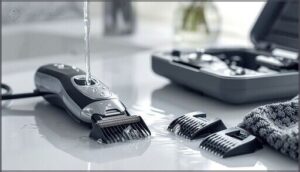
Think of cleaning as non-negotiable Hygiene Practices that double your Beard Trimmer Lifespan. After each use, wipe heads with a damp cloth, rinse detachable blades for 5-10 seconds, then brush between teeth. Dry everything thoroughly before Trimmer Storage in a ventilated case. Daily Sanitizing with Cleaning Solutions prevents buildup that kills motors and dulls blades—simple Trimmer Care that pays off.
| Cleaning Step | Why It Matters |
|---|---|
| Wipe & rinse blades | Removes hair/residue buildup |
| Brush internal teeth | Prevents clogging, maintains sharpness |
| Dry all components | Stops rust and corrosion |
| Store in dry case | Minimizes moisture damage |
Oiling and Lubricating Blades
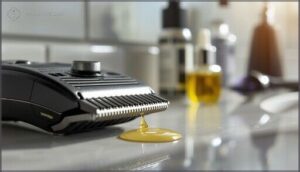
Blade Oil is your trimmer’s lifeline. Apply two to three drops along the teeth while your Beard Trimmer runs on low speed—this Oil Application spreads lubricant evenly, cutting Friction Reduction into overdrive. Run it for 5–10 seconds, wipe off the excess, and you’ve just extended Blade Longevity by months.
Use only clipper-specific Blade Oil Types; household oils gum up fast. Before and after every session, Lubrication Techniques like this keep Blades sharp and your Maintenance game tight.
Replacing Blades and Heads
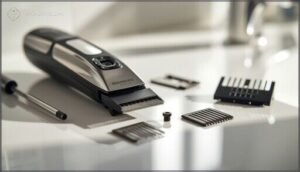
Even with perfect Maintenance, your Beard Trimmer Blades won’t stay sharp forever. Swap the head every 12 to 18 months—sooner if cutting performance drops over 20 percent.
Pull the plug, align the new head’s tabs with the trimmer body, snug the screw clockwise, then test at low speed. Proper Head Maintenance and timely Blade Replacement keep Trimmer Upkeep simple and Durability Tests passing. Replacement parts matter.
Importance of Sterilizing and Removing Hair Buildup
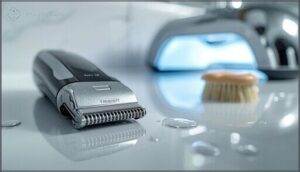
Sanitizing Methods protect more than your skin—they stop bacteria and fungi from corroding blades.
After each session, brush out trapped fibers to prevent clogging, then hit cutting surfaces with alcohol wipes or UV sterilizers for quick Beard Trimmer Maintenance.
Hair Removal plus Sterilization Techniques keep performance sharp, Trimmer Hygiene solid, and Blade Maintenance on point.
Top Products for Trimmer Performance and Care
You can maintain your trimmer all day long, but if you’re not using the right products, you’re just spinning your wheels.
Over the years, I’ve tested dozens of sprays, cleaners, and trimmer models—some are game-changers, others are pure snake oil. Here are the products that actually deliver in terms of keeping your gear sharp and running smooth.
1. Andis Clipper Care Spray
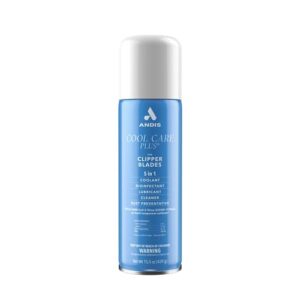
You’ll want a spray that does the heavy lifting, and Andis Cool Care hits all five marks—coolant, disinfectant, lubricant, cleaner, rust preventative. The high-pressure nozzle blasts hair out of blade teeth without removing anything from your clipper, just spray while it’s running.
It knocks down bacteria, fungus, even tuberculocidal stuff between clients. The 15.5 oz can has a sculpted grip so your hand won’t cramp. Downside? Strong chemical smell, no fragrance-free option available.
| Best For | Professional barbers and groomers who need a multi-purpose spray that disinfects, cools, and maintains clipper blades between clients. |
|---|---|
| Blade Maintenance | Lubricates and disinfects blades |
| Primary Use | Clipper/trimmer care |
| Vacuum System | No |
| Power Source | Not applicable |
| Cleaning Method | Spray application |
| Target Users | Barbers/grooming |
| Additional Features |
|
- 5-in-1 formula handles cooling, disinfecting, lubricating, cleaning, and rust prevention in one spray
- High-pressure nozzle removes hair from blade teeth while the clipper runs—no disassembly needed
- Kills bacteria, fungus, and tuberculocidal pathogens for serious hygiene between cuts
- Strong chemical smell can be overwhelming in small spaces or for sensitive users
- No fragrance-free version if you’re bothered by the scent
- Requires regular use to keep blades sharp and protected long-term
2. Clippercide Clipper Disinfectant Spray
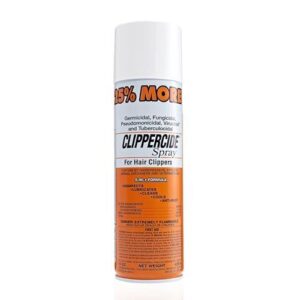
Barbicide’s Clippercide is an EPA-registered solution that kills HIV-1, TB, bacteria, and fungus in just ten minutes. It’s a 5-in-1 product that disinfects, lubricates, cleans, cools blades on contact, and prevents rust by leaving a thin protective film.
To use, spray it after each cut, let it sit, and then wipe off the excess. The aerosol blast effectively clears hair and debris from between teeth without needing to disassemble your clipper. It’s unscented and works on all metal blades.
While some professionals question its full sterilization claims if hair isn’t brushed out first, Clippercide is OSHA-compliant for barbershops.
| Best For | Barbers, stylists, and pet groomers who want an EPA-registered spray that disinfects, lubricates, and maintains clipper blades between cuts. |
|---|---|
| Blade Maintenance | Lubricates and disinfects blades |
| Primary Use | Clipper/trimmer care |
| Vacuum System | No |
| Power Source | Not applicable |
| Cleaning Method | Spray application |
| Target Users | Barbers/grooming |
| Additional Features |
|
- Kills HIV-1, TB, bacteria, and fungus while meeting OSHA compliance standards for barbershops
- 5-in-1 formula handles disinfection, lubrication, cleaning, cooling, and rust prevention in one product
- Aerosol spray clears hair and debris from blade teeth without requiring clipper disassembly
- Requires 5-10 minutes of wait time after application before wiping off excess
- Some users question whether it fully sterilizes clippers if residual hair isn’t removed first
- Effectiveness depends on proper application technique and pre-cleaning steps
3. Remington Vacuum Beard Trimmer
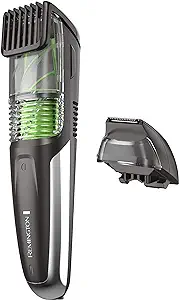
If you’re serious about keeping your workspace clean during grooming, the Remington MB6850A-AT captures up to 95% of trimmed hair in its built-in vacuum chamber. The vacuum chamber detaches for quick emptying, and the whole unit is washable.
You get 13 length settings from 2-18mm, titanium-coated blades that stay sharp, and about 60 minutes of cordless runtime. Just know the minimum length is 2mm, not the ultra-fine 0.5mm some guys want, and you’ll need to empty that chamber more often with thick beards.
| Best For | Guys who want minimal cleanup after trimming and don’t mind a 2mm minimum length setting. |
|---|---|
| Blade Maintenance | Removable steel blades |
| Primary Use | Beard trimming |
| Vacuum System | Captures up to 95% hair |
| Power Source | Rechargeable battery |
| Cleaning Method | Washable/removable blades |
| Target Users | Home use/travel |
| Additional Features |
|
- Vacuum system grabs 95% of hairs so you’re not cleaning the sink for 10 minutes
- 13 length settings give you plenty of style options from stubble to longer beards
- Washable design and removable blades make maintenance super easy
- Won’t get you that super-close 0.5mm stubble look some guys prefer
- You’ll be emptying the vacuum chamber pretty often if you have a thick beard
- The blade guard can feel flimsy and might give you uneven results
4. Philips Norelco Vacuum Beard Trimmer
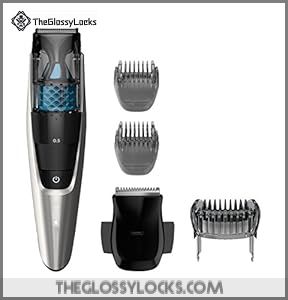
The Philips Norelco vacuum trimmer pulls in 90% of cut hair, keeping your sink cleaner than most setups. You’re looking at 20 length settings between 0.5mm and 10mm, self-sharpening blades that actually stay sharp, and 80 minutes of cordless runtime. The contour-following comb conforms to your jawline curves for even results.
Weak point? Those plastic tabs on the blade assembly break if you’re not gentle during cleaning. The vacuum chamber also traps hair in corners, so you’ll spend extra time keeping it maintained.
| Best For | Men who trim their beards regularly at home and want to cut down on cleanup time without sacrificing precision. |
|---|---|
| Blade Maintenance | Self-sharpening steel blades |
| Primary Use | Beard trimming |
| Vacuum System | Catches up to 90% hair |
| Power Source | Battery powered |
| Cleaning Method | Vacuum chamber/blade clean |
| Target Users | Home/professional use |
| Additional Features |
|
- Vacuum system captures 90% of trimmed hair, making cleanup significantly easier than standard trimmers
- 20 built-in length settings and self-sharpening blades provide consistent, even results across different beard styles
- 80-minute battery life means you won’t need to charge frequently, even with regular use
- Plastic tabs on the blade assembly are fragile and can break easily during cleaning or maintenance
- Vacuum chamber design traps hair in hard-to-reach corners, requiring extra cleaning effort
- Bulkier size makes precision work around sensitive areas like the nose and ears more difficult
5. Remington Vacuum Haircut Kit
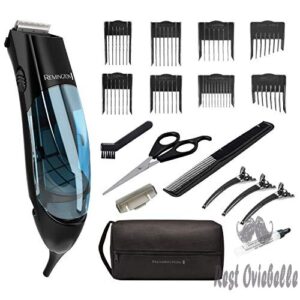
The Remington kit shifts from beard detail work to full haircuts, packaging 18 pieces including six guard combs, taper attachments, scissors, and that XL vacuum chamber. Dual motors drive both blade speed and suction simultaneously, pulling in most clippings before they hit your floor.
You’re tethered to an outlet with the corded setup, but that guarantees consistent power through longer cutting sessions without battery fade. The removable chamber empties fast, precision-ground blades hold their edge through repeat use, and the whole kit stores in one pouch.
| Best For | Home users who want mess-free haircuts without constant cleanup and don’t mind staying near an outlet. |
|---|---|
| Blade Maintenance | Precision-ground blades |
| Primary Use | Beard/trimmer cutting |
| Vacuum System | Captures up to 90% hair |
| Power Source | Corded |
| Cleaning Method | Removable chamber |
| Target Users | Home/barber use |
| Additional Features |
|
- Vacuum system captures about 90% of hair clippings so you’re not sweeping for an hour afterward
- Dual motors keep both cutting power and suction steady throughout longer sessions
- Complete 18-piece kit gives you guards, scissors, and attachments in one storage pouch
- Corded design limits your movement and means you need to stay near a power outlet
- Bulkier and heavier than standard clippers because of the vacuum feature
- Takes a few tries to get comfortable with the added weight and feel during use
Frequently Asked Questions (FAQs)
What is the lifespan of a beard trimmer?
Like a reliable workhorse, a quality electric beard trimmer usually runs strong for seven to ten years with proper care, though battery health usually dictates when cordless models start losing steam.
How long do electric trimmers last?
Most electric trimmers run strong for about 3 to 6 years with regular upkeep, though corded models often outlast battery-powered units that usually fade after 2 to 4 years.
Why do electric shavers stop working?
Your trimmer quits when the motor burns out from overwork, the battery dies after too many charge cycles, or hair jams the blades—turning your once-reliable tool into dead weight.
What is the best way to clean a beard trimmer?
You’ll want to brush out hair after every trim, then wipe the blades with rubbing alcohol. Oil them lightly, and deep clean with soapy water weekly—keeps everything sharp.
How often should I replace the blades of my beard trimmer?
Most blades need swapping every 12 to 18 months with regular use, but you’ll know it’s time when your trimmer starts tugging hair or delivering uneven cuts despite proper cleaning and oiling.
Are there any additional accessories I should buy for my beard trimmer?
You’ll want guard combs for flexible length control, cleaning brushes to maintain performance, and blade oil to reduce friction.
Detail attachments help with precision work, while a travel case protects your investment.
How do I know when it is time to upgrade to a new beard trimmer?
Your trimmer’s motor starts groaning like an old engine, blades pull instead of cut, or your charge dies in under 20 minutes—those are clear signs it’s time to upgrade.
Can I replace the battery in my cordless trimmer?
Yes, you can replace the battery in many cordless trimmers, especially models with accessible housings. Check if your trimmer uses removable battery packs—popular brands often support straightforward swaps without professional help.
How do I know when blades need sharpening?
Ironically, your trimmer will tell you exactly when it’s dull—it’ll start pulling hair instead of cutting cleanly, require multiple passes, and leave uneven stubble lines that scream for a blade replacement.
Are waterproof trimmers more durable than standard models?
Waterproof trimmers resist moisture and corrosion better than standard models, but durability depends more on build quality and maintenance habits.
Sealed housings protect motors, though drying after wet use still extends lifespan notably.
Conclusion
Here’s the irony: most guys replace their trimmer right when a simple blade swap or deep clean would’ve brought it back to life. You now know how long electric beard trimmers last—and more importantly, you know what actually shortens that timeline.
Keep those blades oiled, clear the buildup after every session, and don’t let moisture sit overnight. Do that, and your trimmer won’t just survive—it’ll outlast the cheap replacements your buddies keep buying every other year.