This site is supported by our readers. We may earn a commission, at no cost to you, if you purchase through links. This content is for general informational and educational purposes only and is not a substitute for professional medical, dermatological, or nutritional advice.

Your hands tell on you before your face ever does. You can Botox your forehead and filter your selfies, but those flat brown patches across your knuckles? They’re the receipts for every summer since 1995, the ones sunscreen never quite reached.
Dermatologists call them solar lentigines. Everyone else calls them age spots, or the reason you’ve started hiding your hands in photos.
Here’s the good news: knowing how to get rid of age spots on your hands isn’t guesswork anymore. Between the right creams, in-office procedures, and a habit shift or two, you’ve got real options, and we’ll walk through exactly what works.
Table Of Contents
- Key Takeaways
- What Causes Age Spots on Hands?
- How to Get Rid of Age Spots on Your Hands
- Best Topical Treatments for Hand Age Spots
- Dermatologist Treatments for Faster Removal
- How to Prevent Age Spots From Returning
- Frequently Asked Questions (FAQs)
- How do I get rid of age spots?
- How to remove age spots on hands?
- How did you get age spots?
- Are age spots on hands dangerous?
- Can chemical peeling treat age spots on hands?
- Does a hand cream reduce age spots?
- How do you get rid of age spots on your hands naturally?
- Does hydrogen peroxide get rid of age spots?
- What fades age spots on hands?
- Can you reverse age spots on hands?
- Conclusion
Key Takeaways
- Age spots come from decades of cumulative sun exposure, not one bad summer, so daily broad-spectrum SPF 30+ sunscreen (reapplied after washing hands) is the real foundation of any treatment plan.
- Fading existing spots takes layered patience: topical options like hydroquinone, retinol, vitamin C, or kojic acid need 8-12 weeks to show results, while in-office procedures like lasers, IPL, or chemical peels work faster but usually need multiple sessions.
- Not every spot is harmless, so watch for asymmetry, ragged borders, uneven color, or a diameter past 6mm (the ABCDE checklist) and get anything suspicious checked by a dermatologist rather than treating it yourself.
- Even after treatment, spots can return if you slack on prevention, so daily sunscreen, UV-protective gloves for driving, and a consistent retinoid/antioxidant routine are what actually keep your hands clear long-term.
What Causes Age Spots on Hands?

Look down at your hands and you’re reading a bit of your own history. Those brown patches didn’t show up overnight, and they’re not random—there’s real biology behind every one. Here’s what’s actually driving them.
Your hands carry a history of sun exposure, each brown patch a record of real biology, not random chance
Cumulative UV Exposure
Think of every unprotected hour outdoors as a deposit in a UV damage account. UV radiation from the sun (and sunbeds) accumulates over decades, even without sunburn. Reflective surfaces, altitude, thin cloud cover, and skipping shade all raise your dose.
If chemo has left your scalp bare, a few practical scalp care tips after hair loss from chemo can help you build sun habits that protect it while it recovers.
In fact, checking the UV Index and measurement scale can help you gauge daily risk before heading out. Check the UV Index, seek shade, and wear sunscreen daily. Photodamage prevention starts now, not later.
Genetics and Skin Tone
Not everyone’s UV account drains the same way. MC1R variants control your eumelanin-to-pheomelanin balance, the ratio determining genetic skin tone and how well you resist damage.
| Skin Type | Age Spot Risk |
|---|---|
| Fair, MC1R variant | Higher, earlier |
| Olive/Medium | Moderate |
| Deep pigmentation | Lower |
Fair-skinned patients need sunscreen sooner. Ask your dermatologist about genetic risk factors.
Hormonal Pigment Changes
Genetics loads the gun, but hormones can pull the trigger. Estrogen pigment effects ramp up during pregnancy or menopause, while progesterone skin changes compound it. This hormone melanin signaling works through melanocyte-stimulating hormone, driving hyperpigmentation beyond typical UV damage. That’s endocrine pigment regulation at work, not just sun exposure. Ask your dermatologist if hormonal pigment changes factor into your treatment plan.
Typical Age Spot Appearance
So what do these hormone-driven spots actually look like on your hands? Flat brown patchesFlat brown patches with clearly defined edges**, ranging from a freckle-sized dot to a couple centimeters. Color runs tan to dark brown, sometimes gray. Size varies spot to spot, even on the same hand.
Solar lentigines cluster on sun-exposed skin, classic hyperpigmentation, not raised, just stubborn discoloration.
Age Spots Versus Melanoma
Here’s the question that matters: how do you tell a harmless spot from something dangerous? Use the ABCDE checklist.
- Asymmetry and ragged border differences
- Color variation, multiple shades in one lesion
- Diameter past the 6mm pencil-eraser threshold, or evolution over time
Age spots stay put. Melanoma changes. Family history raises melanoma risk. When unsure, get it checked before reaching for hydroquinone, laser treatments, or sunscreen alone.
How to Get Rid of Age Spots on Your Hands
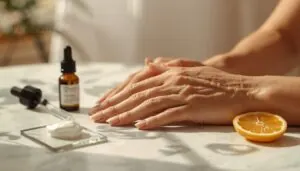
So you’ve got age spots on your hands and you want them gone. Good news: you’ve got real options, from drugstore creams to in-office procedures. Here’s how to think through the choices, step by step.
Many of these treatments—especially lasers—target melanin in the skin, the same principle behind how laser hair removal disrupts follicle regrowth, so it’s worth understanding before you commit.
Begin With Sun Protection
Here’s the truth: no cream outworks fresh sun damage. Start with broad spectrum SPF 30+ sunscreen daily, reapplied after washing hands.
Add UPF-rated driving gloves (they block 98% of UV) and dodge peak sun hours, 10 a.m. to 2 p.m.
Skip this step, and you’re just repainting a fence during a storm.
Apply Targeted Fade Creams
Once sunscreen’s locked in, fade creams do the heavy lifting. Cleanse and dry hands first, then apply with fingertips directly onto spots.
Look for hydroquinone, glycolic acid, or niacinamide. Expect 8-12 weeks minimum.
- Cleanse and dry skin
- Patch test 24 hours prior
- Apply twice daily
- Wait 15 minutes before moisturizer
- Track fading at 4, 8, 12 weeks
Consider Prescription Treatments
Stubborn spots need bigger guns. Prescription hydroquinone 4% works twice as fast as OTC versions, often paired nightly with tretinoin.
| Option | Best For |
|---|---|
| Hydroquinone 4% | Deep spots |
| TriLuma | Combo therapy |
| Lytera 2.0 | Maintenance |
| ProfessionalC 10 | Antioxidant boost |
Apply every other night first, watch irritation, then advance. Telehealth makes prescriptions easy to access.
Explore In-Office Procedures
When creams stall, in-office procedures step in.
Laser Spot Removal (Q-switched or PicoWay) targets melanin directly, often clearing spots in 2-3 sessions.
IPL Skin Rejuvenation darkens spots before they flake off within a week.
Cryotherapy Spot Treatment freezes individual spots in seconds.
Chemical Peel Sessions or a BBL Laser Combo work well for widespread pigmentation, sometimes finishing the job in a single afternoon.
Expect Gradual Results
Nobody’s hands turn spotless overnight. Whether you choose topical treatments or skin resurfacing, expect gradual results over weeks, not days.
- Week 2-4: mild lightening begins
- Week 8: spots 20-30% lighter
- Week 12: 50%+ fading typical
- Month 6: most improvement plateaus
- Ongoing: long-term maintenance therapy keeps spots away
Patience and consistency beat impatience every time.
Best Topical Treatments for Hand Age Spots

Your skincare cabinet is the first line of defense, and not every ingredient earns its spot there. Some active compounds have decades of research behind them, others are more hype than help. Here’s what actually works on those stubborn hand spots, starting with the tried-and-true approach.
Hydroquinone Fade Creams
Think of hydroquinone as the go-to for fading age spots, a dermatologist-recommended topical agent used for decades. At 2% (OTC) or 4% (prescription), it blocks pigment production, with results in 4-8 weeks.
Apply thinly, wash hands after. Watch for dryness or irritation. Skip OTC skin lightening products with hydroquinone; the FDA warns these are illegal and potentially harmful.
Retinol and Prescription Retinoids
Retinol works slower than hydroquinone but earns its keep. Enzymes convert it to retinoic acid, which speeds cell turnover and blocks tyrosinase, fading spots in 8-12 weeks while boosting collagen.
Prescription tretinoin (0.025%-0.1%) skips that conversion step, showing results by week four but causing more irritation. Start every other night, applying to dry skin, and pair with daily sun protection.
Vitamin C and Niacinamide
Not everyone tolerates retinoids well, and that’s where vitamin C and niacinamide step in. Vitamin C (10-20% L-ascorbic acid) brightens and fights oxidative damage; niacinamide calms the skin barrier and rarely stings.
Why pair them:
- Antioxidant teamwork
- Skin tone support
- Gentler than retinoids
- Layer vitamin C first
- Follow with niacinamide
Together, they support tone without irritation.
Azelaic and Kojic Acids
Can’t tolerate vitamin C? Try azelaic acid, which fights inflammation while blocking pigment, or kojic acid, which directly interrupts melanin production.
| Ingredient | Typical Strength | Best For |
|---|---|---|
| Azelaic Acid | 10-20% | Sensitive, inflamed skin |
| Kojic Acid | 1-4% | Direct pigment fading |
| Combined | Varies | Stubborn, resistant spots |
Pairing both often outperforms either alone, though results still take weeks.
Ingredients to Avoid
Not every "brightening" product deserves shelf space. Watch for formaldehyde-releasing preservatives (DMDM hydantoin, quaternium-15), PFAS, parabens, and phthalates hiding in fine print. Lead contamination is rarer but worth sourcing carefully.
Stick with proven actors: hydroquinone, kojic acid, prescription creams, or gentler DIY options like lemon juice and honey, applied consistently, without the questionable extras.
Dermatologist Treatments for Faster Removal
Creams take patience, but your dermatologist has faster tools in the office. These treatments target pigment directly, often clearing spots in a fraction of the time. Here’s what actually happens on the table.
Intense Pulsed Light Therapy

Think of IPL as a targeted flash of light that convinces pigment to give up and fade. Sessions run about 20 minutes, using adjustable wavelength filters and fluence settings matched to your skin.
- Protective eyewear is mandatory
- Spots darken, then flake off within days
- Usually 4 to 6 sessions needed
- Minimal downtime, mild pinching sensation
Results build gradually, session by session, toward visible hyperpigmentation reduction.
Pigment-Correcting Laser Treatments
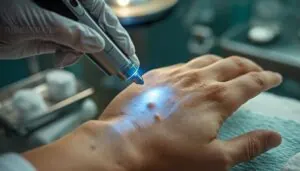
Lasers like PicoWay work differently than IPL, delivering picosecond pulses matched to your pigment’s wavelength. Shorter wavelengths hit superficial spots; deeper pigment needs longer ones.
Dermatologists dial in fluence (often 8-10 J/cm²), pulse duration, and slight spot overlap for even hyperpigmentation reduction. Most plans involve multiple sessions, since this skin resurfacing approach builds results gradually rather than erasing spots overnight.
Cryotherapy for Individual Spots
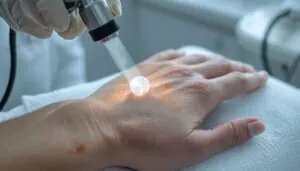
Cold works fast. Cryotherapy freezes individual age spots with liquid nitrogen, using a cryospray or cotton-tipped applicator to form an ice ball 1-2mm beyond the spot’s edge. One freeze-thaw cycle near −5°C often suffices.
You’ll see whitening, then blistering over days. Side effects include temporary hypopigmentation, redness, or rare scarring, your dermatologist weighs these against desired skin rejuvenation.
Professional Chemical Peels
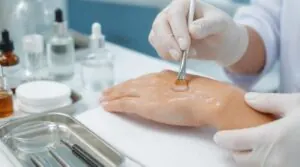
Chemical peels work like controlled sunburn, your dermatologist picks an acid (glycolic, TCA, salicylic) matched to your peel depth needs.
Skin preparation matters first. Then peeling, recovery (flaking, redness), and maintenance follow. Light-to-medium peels treat hyperpigmentation and skin discoloration on hands, often needing 3-6 in-office sessions spaced weeks apart for real, lasting improvement.
Comparing Results and Risks
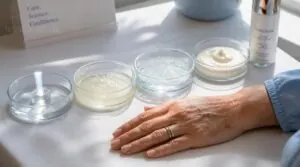
So which treatment actually wins? It depends on your priorities: speed, budget, or risk tolerance.
- Laser treatments: fastest, priciest, higher risk for darker skin
- Chemical peels: moderate cost, 50% fading in nearly half of patients
- Cryotherapy: longer-lasting but slower healing, scarring risk
- Hydroquinone: cheapest, slowest, lowest complication rate
Consistent sunscreen use afterward extends every outcome, regardless of method.
How to Prevent Age Spots From Returning

Here’s the truth no one likes: treatment fades spots, but only prevention keeps them gone. Skip this step, and you’re just buying yourself a repeat performance in a year or two. So let’s cover the five habits that actually make a difference.
The same logic applies to your hair—if you’re impatient with recovery, check out how long to wait between bleaching sessions before booking your next appointment.
Apply SPF 30 Daily
Every fade cream you use works twice as hard if you skip this step: daily SPF 30, broad-spectrum, non-negotiable.
Hands get hit constantly, driving, dishes, daily errands. Make sunscreen your final morning step, covering hands like any exposed skin.
Consistency matters more than any single "best" product. Skip a day, and you’re inviting new spots right back in.
Reapply Sunscreen After Washing
Here’s the gap nobody mentions: you apply sunscreen at 8am, wash your hands by 9, and now you’re bare-skinned outside.
Handwashing creates a real protection gap. Towel drying and water-resistant formulas both lift product off skin. Sweat does the same.
Reapply after washing, then stick to Cleveland Clinic’s rule, every two hours outdoors, fresh layer, not a touch-up.
Wear UV-Protective Driving Gloves
Reapplying only covers you outdoors, but your commute is a UV trap too. Windshields block UVB, not UVA, so driving hands take a beating.
Grab UPF-rated sun gloves, 50+ blocks 98% of rays. Look for wrist coverage, non-slip grip, breathable fabric, and a snug fit that won’t hamper steering control.
Maintain Retinoid and Antioxidant Care
Gloves protect your commute; your nightstand takes care of the rest. Pair a nighttime retinoid (start 2x/week) with a moisturizer to buffer irritation, then layer morning antioxidants like vitamin C.
Quick routine:
- Cleanse gently
- Retinoid thin layer, PM
- Vitamin C serum, AM
- Moisturizer, both times
Consistency, not intensity, keeps spots from creeping back.
Monitor New or Changing Spots
Rarely does treating age spots mean you’re done watching them. Once a month, check for spot size changes, border irregularity, or new color variation. Run the ABCDE checklist.
A dermatologist at Mount Sinai West can perform dermatoscopy, using a dermatoscope to distinguish benign lesions from malignant ones, catching trouble long before your eyes could.
Frequently Asked Questions (FAQs)
How do I get rid of age spots?
Like sun damage stuck on repeat, age spots don’t erase easily. You can’t fully remove them, but fade creams, laser treatments, chemical peels, and daily sunscreen dramatically lighten hand pigmentation, often combined for faster, longer-lasting results.
How to remove age spots on hands?
Removal works best with layered strategy: prescription hydroquinone, laser treatments, or chemical peels for stubborn pigment, paired with daily SPF 30+ sunscreen.
Gentle exfoliation and vitamin C serums support at-home spot lightening between office visits, speeding gradual fading safely.
How did you get age spots?
The sun never forgets, and neither does your skin. Decades of UV exposure triggered melanin overproduction, while genetics and hormones shaped how those solar lentigines settled onto your hands’ sun-exposed skin.
Are age spots on hands dangerous?
Good news: they’re harmless pigmentation, not a health threat. But some skin cancers mimic age spots, so any spot that’s new, changing, or asymmetrical deserves a dermatologist’s look, not a guess.
Can chemical peeling treat age spots on hands?
Yes. Chemical peels create controlled damage to your outer skin, prompting fresh, evenly pigmented skin to grow back.
Superficial and medium-depth peels work best for hyperpigmentation, usually requiring several sessions spaced weeks apart for noticeable skin lightening.
Does a hand cream reduce age spots?
By 50, nine in ten hands show spots, but a jar alone won’t erase them. Creams with hydroquinone, kojic acid, or vitamin C fade pigment gradually, working through steady exfoliation and consistent use, never overnight removal.
How do you get rid of age spots on your hands naturally?
Dab diluted lemon juice on spots 2–3 times weekly, or apply aloe vera twice daily for a month. Try honey exfoliation or apple cider vinegar rinses weekly. Follow with vitamin C serum and sunscreen for best fading results.
Does hydrogen peroxide get rid of age spots?
Hydrogen peroxide may slightly lighten age spots, but it’s not clinically proven and often causes irritation or patchy discoloration. Dermatologists recommend safer, evidence-backed options like hydroquinone, vitamin C, or kojic acid for consistent, reliable fading instead.
What fades age spots on hands?
Hydroquinone, vitamin C, and glycolic acid creams fade spots gradually over weeks. For faster change, laser therapy, chemical peels, or IPL break down pigment directly, often outpacing topical routines within just a few sessions.
Can you reverse age spots on hands?
Full reversal isn’t realistic, but substantial fading is. Laser therapy and chemical peels give the fastest results, while hydroquinone creams plus daily sunscreen gradually lighten existing spots and keep new ones from forming.
Conclusion
A year from now, you’ll glance down mid-conversation and forget your hands were ever a worry. That’s the real payoff of learning how to get rid of age spots on your hands: not one dramatic fix, but small, consistent choices that compound.
Sunscreen prevents tomorrow’s spots. Creams and lasers erase yesterday’s. Keep at it, and your hands will finally match the story you want to tell.
Some receipts, it turns out, you can void.