This site is supported by our readers. We may earn a commission, at no cost to you, if you purchase through links. This content is for general informational and educational purposes only and is not a substitute for professional medical, dermatological, or nutritional advice.
Most people try to strengthen hair by buying another bottle. Yet a 4-minute scalp massage done daily, paired with washing just two or three times a week, may do more for thickness than many products on the shelf. Research shows modest gains appear after about 24 weeks.
Hair breaks for ordinary reasons: a flat iron on damp strands, bleach layered over dye, meals low in protein or iron. Each habit adds up, for better or worse.
If you want to learn how to strengthen hair, start with what you control. Your plate, your tools, your products and your scalp each play a part.
Table Of Contents
- Key Takeaways
- How Can Daily Care Strengthen Your Hair?
- Eat Nutrient-Rich Foods for Stronger Hair
- Prevent Damage From Heat and Chemical Treatments
- Choose Strengthening Products That Match Your Damage
- Adapt Your Routine to Your Hair Type
- Address Scalp Problems and Persistent Hair Weakness
- Frequently Asked Questions (FAQs)
- Conclusion
Key Takeaways
- A 4-minute daily scalp massage and washing just two or three times a week may do more for thickness than many products, though research shows only modest gains after about 24 weeks.
- You’ll get the most from eating a protein source at every meal along with iron, zinc and healthy fats, and supplements make sense only when bloodwork shows a real gap, since extras like biotin or high-dose vitamins A, E and selenium can skew tests or worsen shedding.
- You can cut breakage by drying hair before heat styling, using the lowest effective temperature with a heat protectant, and spacing out bleaching, dyeing and other chemical treatments so they don’t pile up.
- If you’re still seeing sudden shedding, a widening part or a red, painful or flaking scalp after about 24 weeks of steady care, see a dermatologist, who can find the cause and offer treatments you can’t buy over the counter.
How Can Daily Care Strengthen Your Hair?

You don’t need an elaborate regimen to build stronger hair. Small habits, repeated daily, tend to do more than occasional big efforts. Start with your scalp, since that’s where each strand begins. A 4-minute scalp massage may improve blood flow to follicles, and one 24-week study found it modestly increased hair thickness. Firm pressing and pinching motions work through mechanotransduction of physical force, which signals dermal papilla cells to support the hair growth phase.
Next, go easy on washing. Two to three times a week usually preserves natural oils, and a quarter-sized amount of shampoo focused on your scalp is enough.
If you’ve recently dyed your hair, wash it every two to three days with cool water and color-safe products, and check this guide on how long to wait to wash hair after coloring to protect your color.
Protect your hair from heat and tight styles.
Eat Nutrient-Rich Foods for Stronger Hair

What you eat shapes the hair your follicles can produce. Below, you’ll see how to get the key hair nutrients from everyday foods, and when a supplement may be worth considering. Each part also covers what to watch for, so you can make choices that feel safe and manageable.
Meeting Nutrient Needs Through Food
Protein, iron, zinc, and healthy fats do most of the work behind stronger hair, and food is the best place to get them. Aim to include a protein source at each meal, such as eggs, fish, beans, or tofu, since hair is mostly keratin. Pair plant-based iron sources like lentils or spinach with vitamin C foods, like citrus or peppers, to improve absorption.
Oily fish, walnuts, and chia seeds supply omega-3 fats, while meat, shellfish, nuts, and whole grains provide zinc. Restrictive or low-fat diets may leave gaps, so variety matters more than any "hair" food.
Pairing these foods across the week is easier than it sounds, and this guide to what hair growth needs from your diet shows how the nutrients fit together.
When Supplements Help—and Their Risks
Food covers most needs, but a supplement can help when bloodwork shows a real gap. Low iron or vitamin D are the most common examples, and a healthcare provider can test for both.
Taking extras without a deficiency may not help and can cause problems:
- Biotin shows no clear hair benefit without a deficiency, and it can skew lab results.
- High doses of vitamin A, selenium, or vitamin E may worsen shedding.
- Iron can cause stomach upset and toxicity.
- Many hair products aren’t regulated like medications.
Choose third-party tested products, and give any supplement three to six months before judging results.
Prevent Damage From Heat and Chemical Treatments
Even with a great diet, your strands can only handle so much stress. Heat and chemicals are two of the biggest threats, so it helps to limit both.
For simple swaps that cut down on heat and chemical stress, these tips to prevent future hair damage are an easy place to start.
Even a nourishing diet can’t shield your hair from the toll that hot tools and harsh treatments take, so ease up on both
Dry your hair before using a flat iron or curling iron, since wet hair is more vulnerable. Use the lowest temperature that works, keep passes to a minimum, and apply a heat protectant first. It may reduce damage, but it won’t erase it.
Space out bleaching, relaxing, perming and dyeing. Overlapping chemical services can compound weakness.
Choose Strengthening Products That Match Your Damage
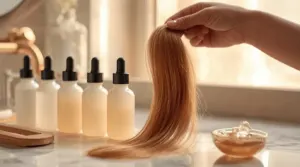
Match your protein to the damage you’re seeing. That mismatch is often why hair product efficacy falls short.
Here’s a guide:
- Bleached or colored hair: hydrolyzed keratin may help replace lost cystine.
- Heat-damaged hair: hydrolyzed wheat or soy may improve moisture retention and fiber strength.
- Sun or pollution stress: keratin films may smooth and protect the cuticle.
- Severe breakage: low-weight amino acids may reach deeper.
- Cuticle damage: high-weight collagen forms a surface film.
Layer small proteins first, then larger ones.
Adapt Your Routine to Your Hair Type

Match your wash schedule to how quickly your scalp gets oily. Straight, oily hair usually does best with daily washing, while wavy hair often needs it every three to four days. If your hair is dry, curly, or coily, washing once a week or less may help it hold onto natural oils.
Choose sulfate-free, moisturizing formulas for dry types, and keep conditioner on mid-lengths and ends for straight hair. Curls and coils may need regular deep conditioning and gentle detangling to limit breakage.
Reassess every few months, since hormones, age, and weather can change what your hair needs.
Address Scalp Problems and Persistent Hair Weakness

Sometimes a healthy routine still isn’t enough to keep your hair strong. A flaky, itchy, or irritated scalp may be getting in the way, and persistent weakness can have causes that daily care doesn’t reach.
The next two points cover how to manage common scalp issues at home and how to tell when it’s time to get professional help.
Managing Dandruff and Scalp Irritation
Flakes and itch can wear down your confidence, but they’re usually manageable at home.
Wash with warm water, since hot water may irritate your scalp and speed up skin cell turnover. Use a medicated shampoo with zinc pyrithione, ketoconazole, or selenium sulfide, and apply it to your scalp only. Let it sit for 5 to 10 minutes before rinsing.
Follow with conditioner on your lengths to prevent dryness, especially if your hair is curly or coily. Skip alcohol-based products and limit heat styling.
Stress and cold, dry weather may trigger flare-ups, so a humidifier can help in winter.
When to See a Dermatologist
Say you’ve used minoxidil faithfully for seven months, yet your part keeps widening and your brush collects more strands than it used to. At that point, more waiting rarely helps.
A dermatologist consultation makes sense if hair falls out suddenly, since thyroid problems, hormonal shifts, or autoimmune conditions may be behind it. Book one too if your scalp is red, itchy, flaking, painful, or scarred, as these signs can point to scarring alopecia or an infection.
A professional can test for nutritional deficiencies, pinpoint the cause, and prescribe options you can’t buy over the counter.
Frequently Asked Questions (FAQs)
How long does it take to strengthen weak hair?
It may feel like waiting is pointless, but results do come, just not overnight. Protein treatments often improve hair strength within 4 to 12 weeks, while supplements usually need 3 to 6 months of steady use.
Is hair breakage the same as hair loss?
No, they’re different. Hair breakage snaps strands along the shaft, leaving short, uneven pieces, while hair loss means whole hairs leave the follicle. They can happen together, so see a dermatologist if thinning persists.
Can stress cause hair to become weaker?
Stress usually doesn’t weaken the hair strand itself. It can push more follicles into a resting phase, so you may notice diffuse shedding a few months later. Breakage along the length more often points to heat or chemical damage.
Does hard water weaken hair over time?
Yes, it may. Research suggests hard water minerals can lower the tensile strength of hair by roughly 8%, and buildup blocks moisture. Over time, your hair may turn dry, brittle and more prone to breakage.
Can scalp massages help make hair stronger?
In one small trial, men who did four-minute scalp massages daily for 24 weeks saw their hair thickness rise by roughly 8 to 10%. Thicker strands may feel stronger, though the study was tiny.
Does cutting hair regularly make it grow faster?
Think of a tree: pruning the branches never changes how fast the roots work. Your hair grows from follicles under the skin, so trimming won’t speed it up. Regular trims may help you keep length by reducing breakage.
Real changes happen at the follicle, where a longer anagen phase keeps more follicles active, so explore how hair growth can be accelerated.
Conclusion
Eat for your strands, protect them from heat, and treat your scalp with care. Each choice is small, but together they shape what grows from your head. Knowing how to strengthen hair means matching your habits to your damage, not chasing every new product.
Give your routine about 24 weeks before judging it. If shedding continues or your scalp stays irritated, see a dermatologist. Patience and steady care pay off.
If your hair seems to be thinning, the cause may be breakage rather than follicle damage, and how hard water affects your hair explains why.