This site is supported by our readers. We may earn a commission, at no cost to you, if you purchase through links. This content is for general informational and educational purposes only and is not a substitute for professional medical, dermatological, or nutritional advice.

That dark spot from last year’s breakout hasn’t moved an inch, and the sunscreen you bought after your dermatologist’s lecture still sits half-used in your bathroom cabinet. Sound familiar? Hyperpigmentation doesn’t react to guesswork or wishful thinking, it reacts to identifying the actual trigger, sun damage, hormones, inflammation, and matching it with ingredients that address that specific mechanism.
Melasma needs different tactics than the mark left by a popped pimple, and treating them the same way wastes months you don’t have to spare.
Learning how to treat hyperpigmentation means understanding your skin’s particular story first, then building a routine, choosing ingredients like niacinamide or tranexamic acid, and knowing when professional treatments earn their place, around that diagnosis rather than against it.
Table Of Contents
- Key Takeaways
- Treat Hyperpigmentation With Targeted Daily Care
- Build Your Morning and Evening Routine
- Choose Effective Dark Spot Ingredients
- Explore Professional Hyperpigmentation Treatments
- Prevent New and Recurring Dark Spots
- Frequently Asked Questions (FAQs)
- What is the fastest way to fix hyperpigmentation?
- Does hyperpigmentation go away?
- What do Koreans use for hyperpigmentation?
- What is the main cause of hyperpigmentation?
- What is the best treatment for hyperpigmentation?
- How to diminish the appearance of hyperpigmentation?
- What are the side effects of treatment for hyperpigmentation?
- Can a dermatologist help with hyperpigmentation?
- What is the fastest way to heal hyperpigmentation?
- What is the fastest way to cure hyperpigmentation?
- Conclusion
Key Takeaways
- Figure out what’s actually causing your dark spots first, sun damage, hormones, or leftover acne inflammation, since each one needs a different fix and treating them all the same way just wastes time.
- Build a routine around gentle consistency rather than aggressive treatment, since niacinamide, retinol, and mandelic acid work by different mechanisms but all need weeks to show results and can backfire if you rush them.
- Never skip sunscreen, reapplying broad-spectrum SPF every two hours, because even the best brightening ingredients can’t outpace new sun damage undoing your progress.
- When at-home care stalls out, dermatologist-guided options like chemical peels, lasers, or prescription hydroquinone can speed things up, but they need to be matched carefully to your skin tone and pigmentation type to avoid making things worse.
Treat Hyperpigmentation With Targeted Daily Care

Not all dark spots are the same, and treating them like they are is where most routines go wrong. Your skin’s story, whether it’s a stubborn acne mark, a sun-triggered patch, or a hormonal shift, shapes exactly what it needs to heal. Here’s how to read the signs and build a routine that actually matches your skin.
Pairing that targeted treatment with a gentle, effective cleanse—like the options covered in this guide to choosing the best face wash for Black men’s skin—helps calm irritation before it deepens into lasting discoloration.
Identify The Pigmentation Cause
Why does that spot keep coming back? Hyperpigmentation has five main triggers: sun exposure, hormonal fluctuation, inflammatory trauma, medication use, and genetic predisposition. Melasma often traces to hormones, while post-inflammatory hyperpigmentation follows acne or injury.
Identifying your specific cause determines which tyrosinase inhibitor or treatment actually works, rather than guessing your way through products that address the wrong mechanism entirely.
Treat Post-inflammatory Dark Spots
That leftover mark from a healed pimple is post-inflammatory hyperpigmentation, and it fades over months, slower with cystic acne. Support it with niacinamide and gentle chemical exfoliation, plus daily sunscreen.
- Skip picking
- Use gentle cleansers
- Avoid friction
- Introduce retinol slowly
Stop any active that burns. Setbacks come from skipped sunscreen or over-exfoliating, not from patience.
In skin of color, postinflammatory hyperpigmentation from acne often requires targeted treatment due to increased melanin reactivity and prolonged resolution time managing postinflammatory hyperpigmentation
Manage Melasma and Hormonal Pigmentation
Melasma plays by different rules than acne marks. It’s hormone-triggered pigmentation, tied to pregnancy, birth control, and sun—including visible light. Expect recurrence; management (tyrosinase inhibitors, niacinamide, daily sunscreen) is lifelong, not curative.
Combination regimens (hydroquinone, tretinoin, steroid) need dermatologist supervision. Camouflage makeup, layered after treatment and SPF, helps cosmetically without replacing either.
Adjust Care for Body Skin
Whatever’s driving your pigmentation, body skin needs its own game plan.
Body skin tolerates stronger exfoliants than your face, so exfoliate two to three times weekly with a mandelic acid wash. Skip scrubs on active dark spots.
Layer a niacinamide moisturizer within three minutes of showering, spot-treat sparingly, apply SPF 50, and choose breathable, dye-free fabrics to prevent friction marks.
Start Gently and Stay Consistent
Rushing rarely pays off with hyperpigmentation. Patch test any new product, then introduce retinol or niacinamide gradually, every other night, so cell turnover speeds up without triggering irritation.
Pair evening treatment with barrier-friendly moisturizing and a steady morning sunscreen habit. Consistency, not intensity, fades dark spots over weeks. Give your skin time to adapt, and results follow.
Adding a targeted retinoid or vitamin C serum into your evening routine, as outlined in this acne treatment for dark spots guide, can speed up fading without irritating sensitive skin.
Consistency, not intensity, is what fades dark spots and gives skin time to truly heal
Build Your Morning and Evening Routine
Consistency beats intensity when you’re fading dark spots, which means your routine matters more than any single product. A well-built morning and evening sequence protects your skin while giving active ingredients room to work. Here’s how to structure both, step by step.
Morning Cleanse and Brightening Serum

Mornings set the tone for pigmentation control. Start with a gentle cleanser, then layer a vitamin C serum for antioxidant defense and a niacinamide boost to disperse melanin granules.
- Cleanser: removes debris without stripping barrier
- Vitamin C: pairs well with antioxidant serum
- Hyaluronic acid: adds hydration before SPF
Keep it simple, consistent, and your skin will thank you.
Apply Broad-spectrum SPF 30

Last step before daylight hits: broad-spectrum SPF 30, blocking 97% of UVB and filtering UVA to 400nm. Mineral (zinc oxide) works instantly; chemical (avobenzone plus octocrylene) needs 15 minutes to form its protective film.
Use the two-finger rule for exposed areas, pat—don’t rub—and reapply every two hours. Skip this, and you’re undoing every brightening ingredient you just applied.
Evening Cleanse and Targeted Treatment
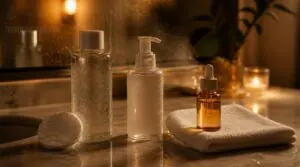
Evening skin needs a real reset. Start with a double cleanse: micellar water lifts sunscreen and oil, then a pH-balanced cleanser (5.0–5.5) finishes the job without stripping.
Wait two minutes, apply an exfoliating toner up to three nights weekly, then pause five minutes before your retinol or mandelic acid serum, your actual hyperpigmentation fighters, targeting discoloration directly.
Moisturize to Protect Skin Barrier

Here’s the trick: exfoliating acids treat pigment, but they also thin your barrier if you don’t back them up. A ceramide-rich moisturizer, ideally with a 1:1:1 ceramide-cholesterol-fatty acid ratio, restores what retinol strips away.
Look for pH-balanced formulas around 5.5 and true occlusives, which seal in hydration for hours and calm inflammation while you sleep.
Introduce Active Ingredients Gradually

Patience beats potency here. Patch test any new active first, then start low then slow: one or two nights weekly, one active at a time, whether that’s retinol, mandelic acid, kojic acid, or glycolic acid.
Build tolerance gradually before increasing frequency. Notice stinging or peeling? Pause when irritated, then resume slower. Consistency, not intensity, fades pigmentation safely.
Choose Effective Dark Spot Ingredients
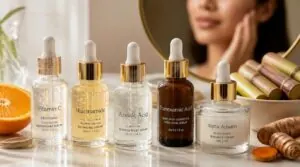
Once your routine is in place, the real work comes down to what you’re putting on your skin. Not every ingredient targets dark spots the same way, and knowing how each one works helps you build a routine that actually fits your skin. Here’s a rundown of the five worth knowing.
Retinoids Speed Cell Turnover
Retinol works by speeding up cell turnover, pushing pigmented cells out faster while stimulating collagen underneath. Within 4-6 weeks, turnover can double, shortening how long dark cells linger on your skin.
Melanin disperses more evenly as renewal accelerates. Most people notice fading within two months, though pairing retinol with lactic acid speeds things along—your skin renews and rebuilds simultaneously.
Mandelic and Lactic Acid Exfoliation
Mandelic acid exfoliates gently, thanks to its larger molecular weight (152.15 g/mol) versus lactic acid’s smaller size, meaning shallower penetration and less irritation.
Lactic acid, by contrast, binds water aggressively—boosting hydration by up to 35% when paired together. This duo balances exfoliation depth with barrier support, working best at pH 4, where combined use actually reduces irritation for uneven skin tone.
Kojic Acid Limits Excess Melanin
While mandelic and lactic acids resurface skin, kojic acid works underneath, binding copper ions inside tyrosinase to block melanin production at the source. Studies show roughly 80% enzyme inhibition at just 0.5%.
Pair it with a gentle retinoid, and turnover improves so kojic acid reaches melanocytes faster, cutting treatment time from twelve weeks to eight.
Niacinamide Disperses Melanin Granules
Where kojic acid shuts down tyrosinase, niacinamide takes a different route: it blocks melanosome transfer, stopping pigment granules from reaching keratinocytes at the surface. Cell studies show 35-68% inhibition.
At 2-5% concentrations, you’ll notice brightening within four weeks, and it plays well with acne-prone or sensitized skin, calming inflammation without triggering irritation or purging.
Licorice Root Calms and Brightens
Where kojic acid and niacinamide work through separate mechanisms, licorice root brings both to the table: it’s a tyrosinase inhibitor that also calms inflammation. Sourced from Glycyrrhiza glabra, it contains licochalcone A, which curbs melanin synthesis while soothing redness.
You’ll often find it paired with niacinamide or kojic acid in brightening serums, working toward a genuinely even skin tone.
Explore Professional Hyperpigmentation Treatments

Sometimes at-home care just can’t keep up, and stubborn discoloration calls for a dermatologist’s toolkit. Professional treatments work faster and go deeper than serums alone, but they also come with more complexity around your skin tone and pigmentation type. Here’s what your provider might reach for.
Chemical Peels for Stubborn Discoloration
Some dark spots just won’t quit—that’s when chemical peels earn their place. Peel depth selection matters most: superficial glycolic acid lifts mild spots in days, medium-depth needs more healing. Good candidates have realistic expectations and healthy skin.
Before treatment:
- Stop retinoids beforehand
- Prep with sunscreen
- Patch test first
- Follow post-peel care closely
Laser Selection by Skin Tone
Not all lasers suit all skin. Fitzpatrick skin classification guides wavelength choice, cooling, pulse duration, and spot size, since deeper tones absorb more energy and risk burns.
Ablative lasers resurface aggressively; nonablative lasers work gently, with less downtime. Your provider adjusts settings—shorter pulses, proper cooling, smaller spots—to target pigment safely without triggering new dark spots.
IPL for Suitable Pigmentation Types
Think of IPL as a broad-spectrum flashlight that gets filtered down to the exact color your pigmentation absorbs best.
Wavelength selection matters most for matching depth—epidermal spots respond differently than deeper melanin.
Pulse duration respects thermal relaxation timing, limiting heat spread.
Fluence gets adjusted per your skin’s reaction.
Darker Fitzpatrick types often need alternative treatments, since higher melanin raises burn risk.
Microdermabrasion Versus Dermabrasion
Depth makes the difference here. Microdermabrasion buffs away 20-30 microns, gentle enough for daily-life downtime, costing $75-150 per session over 6-10 visits.
Dermabrasion digs to 100-150 microns, needing anesthetic and 5-10 days recovery, running $200-500 but often resolving in just 1-3 sessions—better suited to lighter skin tones given pigmentation risk.
Prescription Treatments From Dermatologists
When over-the-counter options stall out, it’s time for a dermatologist consultation.
Prescription-strength hydroquinone (2-4%) remains the go-to choice, often paired with tretinoin in a "sandwich" method. Can’t tolerate hydroquinone? Azelaic acid offers a gentler tyrosinase-inhibiting alternative. For resistant melasma, dermatologists may add oral tranexamic acid or compound a custom formulated cream made for your skin.
Prevent New and Recurring Dark Spots
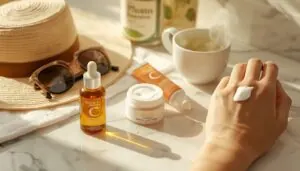
Treating existing dark spots only gets you halfway there, because new ones can form just as easily if your skin stays unprotected. Prevention comes down to a few consistent habits, not a complicated routine. Here’s what actually keeps hyperpigmentation from creeping back.
The same logic applies elsewhere on your body — understanding the difference between corns and plantar warts helps you catch and prevent recurring skin issues before they become harder to treat.
Reapply Sunscreen Throughout The Day
One application isn’t enough. Reapply every two hours, and sooner if you’re sweating, swimming, or towel-drying off. High UV index days speed up breakdown fast.
- Sweat/water: reapply after 40–80 minutes
- Makeup layered on: reapply anyway
- Hiking or sports: reapply hourly
- Cloudy days: still reapply on schedule
Skipping reapplication undoes your photoprotection efforts entirely.
Choose Mineral or Tinted Sunscreen
Reapplication only works if the formula itself holds up.
Mineral sunscreen with zinc oxide gives instant, stable broadspectrum protection that won’t break down in heat or water. Tinted versions add iron oxide for melasma-prone skin, matching most Fitzpatrick shades while staying fragrance-free and gentle post-peel. Choose your shade like you’d match foundation—there’s a range for that.
Wear UPF Hats and Clothing
Sunscreen has limits, so let physical barriers pick up the slack.
- Wide-brim hats (3+ inches) shade face, neck, and scalp
- UPF 50+ fabrics with tight weaves block more broadspectrum UV
- Darker colors and synthetic fibers deflect UV better
- Keep hats dry—wet fabric loses protection
- Replace worn or faded UPF gear regularly
Seek Shade During Peak Hours
Hats and clothing only go so far—your best move is timing. Peak UV hours fall between 10 a.m. and 4 p.m., with solar noon delivering maximum intensity.
If you’re not sure how to plan around those hours, this guide on how to prevent sunburn on the scalp breaks down smart timing strategies alongside your hat and sunscreen routine.
Shade seeking strategies (awnings, umbrellas, mature trees) cut UV exposure by up to 75%, even under clouds. When the UV index hits 8 or higher, plan errands earlier or later.
Avoid Picking and Over-exfoliation
Your fingers are the biggest threat to clear skin. Picking a pimple can push bacteria deeper, extending healing from 5 days to 14. Over-exfoliating strips your barrier, causing 15% moisture loss within 24 hours.
Watch for tightness or redness—classic over-exfoliation signs. Stick to gentle methods, twice-weekly max, and moisturize immediately to support skin barrier repair and prevent lasting hyperpigmentation.
Frequently Asked Questions (FAQs)
What is the fastest way to fix hyperpigmentation?
Professional procedures deliver the fastest results: chemical peels and laser treatments target pigment directly. But daily active ingredients with tyrosinase inhibition, plus a consistent routine, sustain skin brightening and prevent postinflammatory hyperpigmentation from returning.
Does hyperpigmentation go away?
Yes, often. Post-inflammatory dark spots fade as inflammation resolves, but melasma often recurs with sun and hormone triggers. Consistency and daily sun protection determine whether skin brightening sticks or fades away too soon.
What do Koreans use for hyperpigmentation?
Korean skincare leans on gentle, cumulative brightening: fermented rice water and centella asiatica calm and even tone, while niacinamide creams and vitamin C serum disperse melanin.
Licorice extract adds antioxidant support, and laser treatments handle stubborn spots.
What is the main cause of hyperpigmentation?
UV exposure triggers melanin overproduction, but skin inflammation, hormonal influence, genetic predisposition, and certain medications also spark excess pigment. Melasma, acne marks, and sun damage all trace back to melanocytes reacting to these overlapping triggers.
What is the best treatment for hyperpigmentation?
There’s no one-size-fits-all fix. The best results come from combining retinoids, lactic acid, and niacinamide with daily SPF, since layering targeted ingredients treats melasma and post-blemish marks faster than any single product alone.
How to diminish the appearance of hyperpigmentation?
Layer a brightening serum with gentle exfoliation and nighttime retinol, then reapply sunscreen daily. This gradual approach curbs melanin production, fading melasma and post-blemish marks without irritating skin discoloration or disrupting your barrier.
What are the side effects of treatment for hyperpigmentation?
Retinoids and chemical peels can cause redness, peeling, and photosensitivity. Laser therapy risks temporary pigment changes, while hydroquinone may trigger sensitivity or dermatitis. Oral medications carry their own systemic effects, so gradual introduction and sun protection matter most.
Can a dermatologist help with hyperpigmentation?
Yes. A dermatologist-recommended plan pinpoints your pigmentation type, customizes treatment strength, monitors progress with photos, and grips irritation early, calming melanocyte activity while protecting your skin barrier for safer, longer-lasting results than guesswork alone.
What is the fastest way to heal hyperpigmentation?
Rome wasn’t built in a day, and neither is clear skin. Match treatment to cause: layer tretinoin or kojic acid with salicylic acid and vitamin C, exfoliate gradually, and reapply sunscreen daily for real, lasting fade.
What is the fastest way to cure hyperpigmentation?
Quick results come from combined therapies: a Q-switched laser session plus tretinoin and kojic acid at home. Chemical peels speed things along too, but true "curing" hyperpigmentation rarely happens overnight, consistency still wins.
Conclusion
Skin remembers every insult like a diary written in melanin, but that story can still change its ending.
Learning how to treat hyperpigmentation comes down to patience paired with precision: identify the cause, match it to the right ingredient or procedure, and protect your progress daily with SPF.
Dark spots didn’t appear overnight, and they won’t vanish overnight either. Stay consistent, stay gentle, and give your skin the time it needs to rewrite itself.
- https://www.cerave.com/skincare/facial-serums/resurfacing-retinol-serum
- https://myaccount.nytimes.com/auth/login?response_type=cookie&client_id=vi&redirect_uri=https%3A%2F%2Fwww.nytimes.com%2F2025%2F11%2F14%2Ft-magazine%2Fhyperpigmentation-dark-spots-treatment.html&asset=opttrunc
- https://www.aocd.org/page/Hyperpigmentation